Manna was the food God provided for the Israelites during their wilderness journey after the exodus from Egypt. It sustained the nation for many years and became one of the Bible’s clearest pictures of daily dependence on God.
The main account of manna appears in Exodus 16, shortly after Israel left Egypt. The people had entered the wilderness and found themselves without enough food, so they complained to Moses and Aaron. God responded by providing bread from heaven in a regular, measurable way.
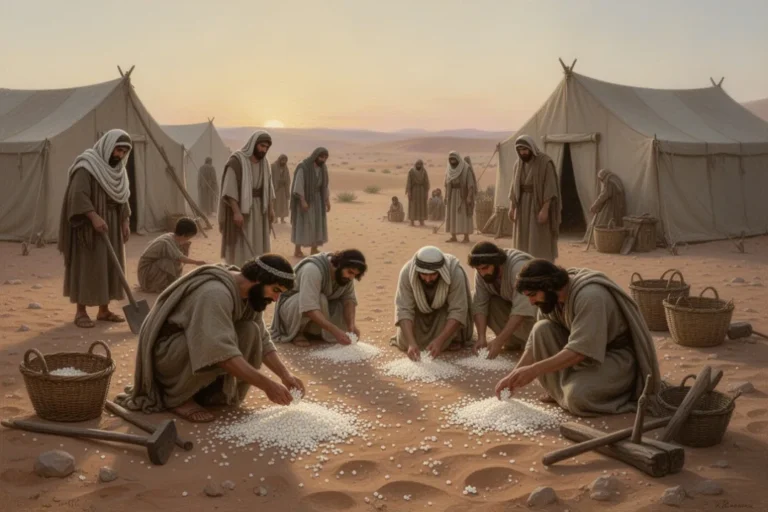
According to the biblical description, manna appeared on the ground each morning after the dew evaporated. It looked like a fine, flaky substance and resembled coriander seed. The Israelites gathered it, ground or crushed it, and prepared it as food with a taste compared to wafers made with honey.
The name manna is connected with the Israelites’ question about what they were seeing. Exodus 16 presents the word as related to their expression of uncertainty: “What is it?” Since Bible translations handle the wording differently, the name is best understood as reflecting their wonder and unfamiliarity.
Manna was not presented as an ordinary crop or a product of settled agriculture. It arrived in a way that made its source unmistakable to the Israelites. God supplied food in a barren place, where the people could not depend on farms, markets, or stored harvests.
Central idea: Manna was more than an emergency meal. Its daily arrival trained Israel to receive provision from God one day at a time and to trust his instructions about how to gather it.
The Bible also mentions manna in several later passages. Numbers 11 describes the people’s dissatisfaction with it and adds details about how they collected and prepared it. Deuteronomy 8 looks back on the experience as a period of testing and instruction, while Joshua 5 records that the manna stopped after Israel began eating the produce of the land of Canaan.
Exodus 16: God first provides manna and establishes instructions for gathering it.
Numbers 11: Israel complains about manna and longs for the foods of Egypt.
Deuteronomy 8: Moses explains what the wilderness provision was meant to teach.
Joshua 5: The provision ends when Israel eats food from the promised land.
Psalm 78: Manna is remembered as food from heaven in a retelling of Israel’s history.
How God instructed Israel to gather manna
Manna came with specific instructions, and those instructions turned provision into a daily lesson in trust and obedience. Each person was to gather an appropriate amount for the day rather than hoarding extra food for the next morning. When some people kept leftovers overnight, the stored manna spoiled and developed worms.
This pattern confronted the desire for complete control. The Israelites could not treat manna as a private supply to be stockpiled indefinitely. They had to return each morning and receive what God provided for that day.
The instructions also included an exception before the Sabbath. On the sixth day, the people were to gather twice as much because no manna would appear on the seventh day. The extra portion remained usable overnight, unlike the ordinary daily supply.
This arrangement connected God’s provision with Sabbath rest. Israel was not required to gather food every day without interruption. The people were expected to work when gathering was commanded and to rest when God designated a holy day.
Gather manna in the morning, before the day’s heat made it disappear.
Collect an amount appropriate for each person in the household.
Do not store ordinary manna overnight for the following day.
Gather a double portion on the sixth day.
Keep the sixth-day portion for the Sabbath instead of gathering that day.
Exodus 16 says that some Israelites ignored these directions. They tried to keep manna overnight or went out to search for it on the Sabbath. Their actions showed that the challenge was not simply obtaining food; it was believing that God’s word could be trusted.
The passage also says that the amount gathered was measured so that those who gathered much did not have too much and those who gathered little did not lack. This detail emphasizes shared sufficiency within the community. Manna was not meant to create competition or unequal accumulation among the Israelites.
Why the daily pattern mattered
Daily manna did not make Israel independent. It created a repeated relationship between need, prayerful trust, and obedient action. The people had to gather the food themselves, but the food was available only because God supplied it.
That balance matters when reading the story. Manna was not a promise that people would never have to work, plan, or respond responsibly. Instead, it showed that human effort operates within God’s sustaining care.
Deuteronomy 8 explains that God allowed Israel to experience hunger and then fed them with manna so they would learn that human life depends on more than physical food. The point was not that bread is unimportant. It was that material provision alone does not explain or sustain a faithful life.
What manna teaches about God’s care and human dependence
The manna story portrays God as attentive to a vulnerable people in an inhospitable environment. Israel had left slavery but had not yet reached the land promised to them. During that uncertain period, manna demonstrated that God’s care did not depend on comfortable circumstances.
The provision was practical, not merely symbolic. The Israelites needed food, and the biblical account says God gave them food. At the same time, the method of provision carried spiritual meaning: it taught them to trust God’s timing, respect his commands, and remember their dependence.
Manna also exposed the difference between present need and imagined security. The people were told to gather enough for the day, but some tried to preserve more than they were authorized to keep. Their hoarding reflected fear that tomorrow’s supply might not come.
That fear is one reason the story remains meaningful to many readers. The Bible does not present anxiety as a strange human reaction. Israel had genuine reasons to feel insecure. Yet the manna account challenges the assumption that anxiety can be solved simply by gathering more possessions.
At the same time, the passage should not be used to dismiss prudent preparation or the suffering of people who lack food. Manna is a specific act of divine provision in Israel’s history, not a command to ignore responsible planning or social justice. Its emphasis is on trusting God while obeying faithfully, not on romanticizing deprivation.
The story also gives the wilderness a teaching purpose. Deuteronomy 8 describes the years in the desert as a period in which Israel’s character and loyalty were revealed. Manna became a daily reminder that the nation was being formed for life with God, not merely transported from one location to another.
Reading the lesson carefully: Manna does not guarantee that every believer will receive a visible miracle whenever food or money is scarce. It reveals God’s faithfulness in Israel’s story and calls readers to dependence, gratitude, obedience, and care for others.
Psalm 78 remembers manna as “grain of heaven” in a poetic retelling of Israel’s history. The psalm celebrates God’s generosity while also criticizing the people’s unbelief and repeated rebellion. That combination is significant: the provision was abundant, but receiving gifts did not automatically produce gratitude.
Why Israel eventually stopped receiving manna
Manna continued throughout Israel’s wilderness period, but it did not continue forever. Joshua 5 states that the manna stopped after the Israelites crossed into Canaan and ate food grown in the land. The change marked a transition from wilderness dependence to settled life in the promised land.
The end of manna was not a sign that God had stopped caring for Israel. It showed that God’s provision can change form. In the wilderness, food arrived miraculously each morning. In Canaan, Israel was expected to cultivate land, harvest crops, and live within the ordinary patterns of a settled community.
This transition prevents a narrow understanding of divine provision. The Bible recognizes both extraordinary gifts and ordinary means. A harvest, a skill, a job, a household, or a community can all become ways through which needs are met, even when there is no visible miracle.
The timing also demonstrated that manna belonged to a particular stage of Israel’s history. It was designed for a people traveling through the desert, not as a permanent replacement for agriculture. When their circumstances changed, the form of provision changed with them.
Joshua 5 places the end of manna near Israel’s observance of Passover in the land. This connects two major memories: God’s rescue from Egypt and God’s sustenance in the wilderness. The people had moved from slavery, through dependence in the desert, toward life in the land they had been promised.
In Egypt: God delivered Israel from oppression.
In the wilderness: God supplied food and taught dependence.
At the edge of Canaan: Israel faced the responsibilities of settled life.
In the land: Provision came through crops and the work of cultivation.
The shift raises a useful question for readers: Can you recognize provision when it no longer looks miraculous? The manna story suggests that faith must continue after the dramatic season ends. God’s care is not limited to extraordinary events.
How Jesus uses manna in the Gospel of John
The most important New Testament discussion of manna appears in John 6. After Jesus feeds a large crowd, people refer to the manna given to their ancestors in the wilderness. They are thinking about Moses and the bread from heaven, but Jesus redirects the discussion toward God’s greater gift.
Jesus explains that Moses was not ultimately the source of the wilderness bread. He points to God as the giver and says that God provides the true bread from heaven. The conversation then centers on Jesus himself as the bread of life.
John 6 does not deny the reality or importance of the manna. Instead, it treats manna as a sign that points beyond itself. The Israelites ate manna and eventually died, while Jesus presents himself as the source of life that reaches beyond ordinary physical nourishment.
Jesus’ teaching uses a contrast between temporary and lasting provision. Manna met a bodily need during Israel’s journey, but it did not remove death or establish the fullness of eternal life. The bread Jesus offers represents believing in him and receiving life through relationship with him.
The language in John 6 can be difficult because Jesus moves between physical bread, spiritual life, belief, and eternal hope. Christian traditions interpret parts of the chapter differently, especially the later language about eating Jesus’ flesh and drinking his blood. All mainstream readings agree that the chapter presents Jesus as God’s decisive provision for human need.
The connection between manna and Jesus can be outlined this way:
Manna came from God: Jesus is presented as the true bread given by the Father.
Manna sustained physical life: Jesus offers life that is deeper and lasting.
Manna was received daily: Faith involves ongoing dependence rather than a single moment of self-sufficiency.
Manna belonged to the wilderness: Jesus meets people in their need and leads them toward God’s promised life.
John 6 therefore gives manna a Christ-centered meaning for Christian readers. The wilderness food becomes part of a larger biblical pattern in which God provides what human beings cannot create for themselves. The focus moves from bread that sustains the body for a time to Christ as the source of eternal life.
Revelation 2:17 refers to “hidden manna” in a message to the church at Pergamum. The verse uses symbolic language alongside the promise of a white stone and a new name known to the one who receives it.
The passage does not explain every detail of the image, so readers should avoid treating “hidden manna” as a clearly defined object with a universally agreed interpretation. In context, it represents God’s secret and sustaining reward for those who remain faithful to Christ.
The word “hidden” may evoke the idea of heavenly provision known fully to God and received by his people. It also fits the broader pattern of Revelation, where familiar biblical images are given an end-time or heavenly dimension.
This reference shows that manna remains part of the Bible’s symbolic vocabulary long after the wilderness generation. It can signify food from God, hidden grace, spiritual sustenance, and the promise that faithful believers will receive what God has prepared for them.
When read alongside Exodus 16 and John 6, Revelation 2:17 creates a broad arc. Manna begins as food for Israel in the desert, becomes a sign pointing to Jesus in John’s Gospel, and appears as a promise of divine provision in Revelation.
Readers can draw several careful lessons from that pattern:
God provides in places of genuine need.
Provision often comes with instructions about trust, work, rest, and sharing.
Temporary gifts can point to deeper spiritual realities.
God’s provision may change form as a person or community enters a new season.
Faithfulness matters even when provision is not dramatic or visible.
The manna Bible passages do not reduce faith to expecting material comfort. They present a God who feeds, teaches, disciplines, leads, and sustains. For Christian readers, the story ultimately points to Jesus as the one through whom God gives lasting life, while still preserving the original lesson of grateful dependence.
Frequently asked questions
Was manna a real food or only a symbol?
In the biblical narrative, manna is described as actual food that Israel gathered and ate in the wilderness. Later passages also use it symbolically to teach about God’s provision and to point toward deeper spiritual realities. The text does not provide enough information to identify manna with certainty as a particular naturally occurring substance.
How long did the Israelites eat manna?
The Bible presents manna as continuing throughout Israel’s wilderness years, from after the exodus until the people entered Canaan. Joshua 5 says it stopped after they ate produce from the land. The exact number of days or meals is not given, but the provision covered the period of wilderness travel.
Did manna taste like honey?
Exodus 16 compares manna’s taste to wafers made with honey, while Numbers 11 describes its taste using a different comparison. These descriptions communicate how the food was experienced rather than providing a modern recipe. The Bible also says the Israelites prepared it in different ways, including grinding and cooking it.
What is the relationship between manna and communion?
Many Christian traditions connect Jesus’ teaching about manna in John 6 with communion, also called the Lord’s Supper or Eucharist. The exact interpretation differs among churches. The shared connection is that manna points to God’s provision and that communion centers Christian worship on Jesus’ life, death, and continuing nourishment of believers.




Leave a Reply