The burning bush in the Bible: Meaning and lessons
The burning bush in the Bible: Meaning and lessons
The burning bush is the place where God calls Moses to lead Israel out of slavery. Its fire burns without consuming the shrub, showing that God is present in a powerful, holy, and mysterious way.
The account appears in Exodus 3:1–22, with Moses receiving further instructions in Exodus 4. Moses is living in Midian, far from Egypt and from the royal life he once knew, when he encounters the bush near Mount Horeb, also called the mountain of God.
Moses had fled Egypt after defending a Hebrew slave and killing an Egyptian who was abusing him. He settled in Midian, married Zipporah, and became a shepherd for Jethro, his father-in-law. By the time of the burning bush, Moses had spent many years tending sheep rather than standing in a palace or leading a nation.
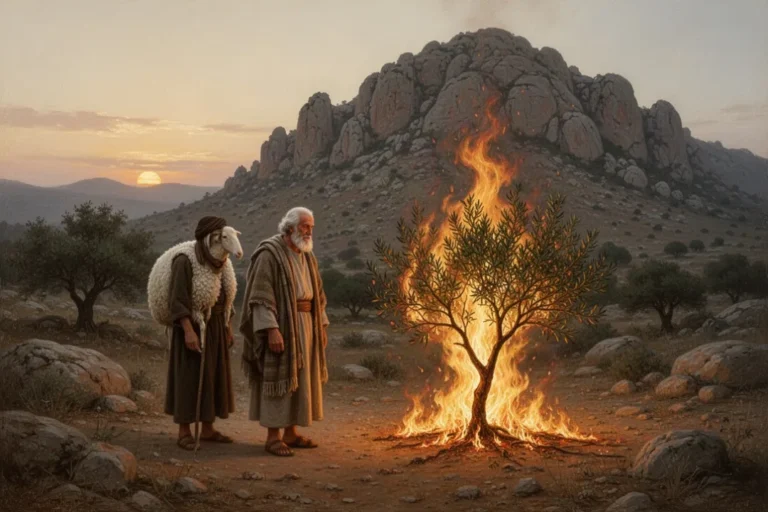
While guiding the flock through the wilderness, Moses came to Horeb. He noticed a bush that was surrounded by fire but was not destroyed. That unusual sight drew him closer, and the encounter changed the direction of his life.
The scene is connected to Israel’s larger story. God had promised Abraham, Isaac, and Jacob that their descendants would become a people and receive a land. The Israelites were now oppressed in Egypt, and Exodus 3 presents God as responding to their cries and remembering the covenant promises made to their ancestors.
The central movement of the passage: Moses notices a strange sign, God calls him by name, God identifies himself as the God of Israel’s ancestors, and God sends Moses back to Egypt with a mission.
What happens at the burning bush step by step
Moses sees the bush burning. The shrub is on fire but does not burn up, making the sight different from an ordinary wilderness fire.
Moses decides to investigate. He turns aside to examine why the bush remains intact, showing curiosity and attention to what God is revealing.
God calls Moses by name. Moses answers, and the encounter becomes personal rather than merely visual.
Moses is told to remove his sandals. The ground is declared holy because of God’s presence, not because the soil has magical power.
God identifies himself. He is described as the God of Abraham, Isaac, and Jacob, connecting the moment to Israel’s covenant history.
Moses hides his face. He is afraid to look directly toward God, reflecting reverence and fear before divine holiness.
God describes Israel’s suffering. God says he has seen the oppression of his people, heard their cries, and knows their pain.
God gives Moses a mission. Moses is sent to Pharaoh to bring the Israelites out of Egypt.
Moses raises objections. He questions his own importance, asks what to say to Israel, worries that the people will not believe him, and points to his difficulty speaking.
God promises to be with him. The mission depends not on Moses’ natural confidence but on God’s presence and power.
This sequence matters because the vision does not stand alone. The burning bush is the beginning of a conversation, a commission, and a promise. The sign attracts Moses’ attention, but God’s words explain its meaning.
Why the bush burns without being consumed
The Bible does not give a single sentence that explains every detail of the fire. Still, the image strongly communicates God’s living presence: the flame is real and powerful, yet the bush remains. The scene presents fire as both visible and mysterious, intense but not destructive in the ordinary way.
Fire often signifies God’s presence, holiness, judgment, guidance, or power in the Bible. The pillar of fire later guides Israel through the wilderness, and fire appears in other biblical encounters with God. The burning bush belongs to that wider pattern, while remaining a distinct sign connected to Moses’ calling.
The bush itself may also be significant because it is an ordinary, humble plant rather than a grand tree or royal symbol. The text does not identify a particular species, and readers should be cautious about treating botanical guesses as established meaning. The emphasis falls on what God is doing through the bush, not on the plant’s scientific identity.
Some interpreters see the unconsumed bush as a picture of Israel: afflicted by the fire of oppression but not destroyed. That can be a meaningful theological reflection, especially because the vision occurs as God announces Israel’s suffering and coming deliverance. However, Exodus 3 directly explains the fire as a sign of God’s presence more clearly than it explains the bush as a symbol of the nation.
What the burning bush reveals about God
God sees and hears suffering
God tells Moses that he has seen the misery of the Israelites, heard their cries, and knows their suffering. These statements present God as attentive rather than distant. Israel’s pain is not overlooked, even though deliverance has not yet arrived.
The wording also gives the mission a moral foundation. Moses is not being sent on a personal adventure or political campaign. He is being sent because God has heard an oppressed people and intends to act on their behalf.
God is holy
When Moses approaches, God tells him to remove his sandals because the ground is holy. The holiness comes from God’s presence, and Moses must respond with humility. He cannot treat the encounter as an ordinary curiosity or approach it carelessly.
Holiness in this passage includes both nearness and otherness. God comes close enough to speak to Moses, yet remains worthy of reverence and awe. The scene does not portray holiness as mere emotional excitement; it calls for a changed posture and a serious response.
God introduces himself as the God of Moses’ ancestors: Abraham, Isaac, and Jacob. This identification reassures Moses that the coming rescue is part of a long-standing promise rather than a sudden change of plan.
The names also connect the present generation with the generations before it. Israel’s identity is grounded in a relationship with God that began before the people entered Egypt. The burning bush therefore links personal calling, national deliverance, and covenant faithfulness.
God is present with the person he sends
Moses repeatedly focuses on his inadequacy. He asks who he is to go to Pharaoh and later worries that the Israelites will question the authority behind his message. God’s primary answer is not a list of Moses’ qualifications but a promise of divine presence.
This is one of the passage’s most important ideas: the success of the mission rests on God being with Moses. Moses is not told that he is naturally powerful, persuasive, or fearless. He is told that he will not face the task alone.
Read the commission carefully: God does not erase Moses’ weakness before sending him. Instead, God promises help, provides signs, gives Aaron as a spokesperson, and remains the source of authority throughout the mission.
Why Moses takes off his sandals
Removing sandals is a physical expression of reverence. Moses is being told that he stands in a place set apart by God’s presence, so he must approach with humility rather than control or casual familiarity.
The action also slows the scene down. Moses has been moving through the wilderness as a shepherd, but now he must stop, listen, and receive instructions. The command to remove his sandals marks a transition from ordinary work to a direct encounter with the holy.
The passage does not teach that every location where someone prays must be treated in exactly the same way. Instead, it shows that genuine awareness of God changes how a person responds. Reverence may be expressed through physical actions, silence, confession, worship, or careful attention to God’s word.
What God’s name means in the burning bush account
Moses asks what he should say if the Israelites ask for God’s name. In response, God uses the Hebrew name represented in English translations as “I AM” and then gives Moses the divine name traditionally rendered as the LORD, often shown in capital letters in English Bibles.
Because Bible translations handle the surrounding Hebrew in different ways, it is better to focus on the meaning than to reduce the passage to a slogan. God presents himself as the living God who is not defined by a human ruler, an idol, or a temporary force. He is the God who exists, remains faithful, and will be present with his people.
The name also answers Moses’ concern about authority. Moses is not inventing a message for Israel. He is representing the God of their ancestors, the God who has heard their suffering and is acting to fulfill his promises.
The divine name becomes especially significant across the Old Testament. It identifies Israel’s God as personal and covenantal, while also affirming that God cannot be reduced to an image or controlled by a human institution. The burning bush is therefore a revelation of identity as well as a call to action.
How Moses responds to God’s call
Moses does not respond with immediate confidence. His questions and objections reveal fear, uncertainty, and an awareness of the danger involved. Returning to Egypt means confronting Pharaoh and speaking to an enslaved people who may not accept Moses as their leader.
His concerns develop in stages:
“Who am I?” Moses doubts that he has the status or ability to approach Pharaoh.
“What is your name?” He wants to know how to answer Israel’s questions about the God who sent him.
“What if they do not believe me?” He fears rejection and asks for evidence that will confirm his commission.
“I am not eloquent.” He points to a speech difficulty or lack of confidence in speaking.
“Please send someone else.” His resistance becomes direct, showing how strongly he wants to avoid the assignment.
God answers these objections with presence, promises, signs, instruction, and finally Aaron’s assistance. The exchange does not make Moses’ fears meaningless. It shows that obedience can involve real apprehension, while also showing that fear does not have to have the final word.
When Moses worries that the Israelites will not believe him, God gives him signs. Moses’ staff becomes a serpent and then returns to a staff, his hand becomes diseased and is restored, and water from the Nile is described as becoming blood when poured on the ground. These signs are presented as evidence of God’s authority, not as entertainment or personal magic.
The staff is especially important because it is an ordinary tool from Moses’ work as a shepherd. God uses what Moses already carries, turning a familiar object into a sign of authority. Later, the staff is associated with acts of judgment and deliverance during the confrontation with Egypt.
The signs also prepare Moses for the kind of leadership he will exercise. He will not lead through his own strength alone. The signs point beyond Moses to the God who sends him and who has power over nature, health, water, and the forces opposing Israel’s release.
How the burning bush connects to the exodus
The encounter begins the public mission that leads to the plagues, the Passover, the departure from Egypt, and the crossing of the sea. The bush is therefore not an isolated miracle. It is the opening scene of the central rescue story in the book of Exodus.
God tells Moses that the Israelites will be brought out of Egypt and led toward the land promised to their ancestors. The language of deliverance includes both freedom from forced labor and movement toward a new communal home. Israel is not merely escaping one place; the people are being formed into a covenant nation.
The burning bush also anticipates the role of divine presence throughout Exodus. God speaks from the bush, leads Israel through the wilderness, meets the people at Sinai, and later makes his presence known in the tabernacle. The first sign near Horeb introduces a theme that continues through the entire book.
Why Moses’ location as a shepherd matters
Moses encounters God while doing ordinary work. He is not in a sanctuary built by human hands, serving as a priest, or seeking a vision. He is caring for sheep in a remote landscape when an unexpected sign interrupts his routine.
That setting does not mean ordinary work is unimportant or that every unusual event carries a divine message. It does show that Moses’ earlier years in Midian are not wasted time. His life as a shepherd may have developed patience, endurance, attentiveness, and familiarity with wilderness terrain—qualities that would matter during Israel’s long journey.
The location also contrasts with Egypt. Moses is called away from the center of imperial power and sent back into it. He must leave the relative obscurity of Midian and return to the place associated with his failure, fear, and unfinished identity.
What the burning bush can mean for readers today
The account can speak to readers who feel unqualified for a responsibility. Moses’ response suggests that a person may recognize a task as important while still feeling unable to perform it. The passage directs attention away from self-confidence alone and toward the character and presence of the God who calls.
It also challenges indifference toward suffering. God’s response to Israel’s oppression is not abstract sympathy. God hears, knows, comes down to deliver, and sends a human leader to participate in that work. For many readers, this creates an ethical question: how should awareness of another person’s suffering shape action?
The story further encourages careful attention. Moses could have walked past the bush, but he stopped to see why it was not consumed. His curiosity did not create God’s presence, yet it became the means by which he noticed the sign and heard the call.
These applications should be made thoughtfully. The burning bush is a unique biblical revelation tied to Moses and Israel’s exodus, not a promise that every believer will receive a supernatural sign or a national leadership assignment. Its lasting lessons come from the passage’s themes of holiness, compassion, faithfulness, calling, and dependence on God.
Common symbols associated with the burning bush
Several symbols are commonly connected with the scene. Some arise directly from the text, while others are theological interpretations developed from the broader biblical story.
Fire: God’s powerful and holy presence, with possible associations with guidance, judgment, and purification.
The unconsumed bush: A sign of divine power that does not operate like ordinary destructive fire; some readers also connect it with Israel’s survival under oppression.
Sandals removed: Humility and reverence before God’s holy presence.
The wilderness: A place of solitude, testing, preparation, and encounter, rather than simply an empty wasteland.
Moses’ staff: An ordinary tool that becomes an instrument associated with God’s authority.
The divine name: God’s self-revelation as the living, faithful, and present God of Israel.
These meanings should not be separated from the narrative. A symbol becomes clearer when read alongside God’s words and actions. The fire is not meaningful merely because it is dramatic; it matters because it accompanies God’s call to rescue an oppressed people.
The main account is in Exodus 3, but the burning bush is mentioned elsewhere. Moses later refers to God as the one who appeared in the bush when blessing the tribes of Israel in Deuteronomy 33:16. That reference shows that the event remained part of Israel’s memory as a defining revelation.
The New Testament also recalls Moses and the bush. In Mark 12:26–27, Jesus refers to the passage when discussing the resurrection and God’s continuing relationship with Abraham, Isaac, and Jacob. Luke 20:37–38 records the same teaching, and Acts 7:30–34 retells the encounter in Stephen’s speech.
These later references emphasize different aspects of the event. Deuteronomy connects it with blessing, Acts highlights Moses’ calling and Israel’s deliverance, and the Gospel accounts use the revelation of God to the patriarchs in an argument about life and resurrection. Together, they show that the burning bush continued to carry theological importance beyond Exodus.
How to read the burning bush responsibly
A careful reading begins with the passage’s own details. Ask who is present, what God says, what Moses is commanded to do, and how the vision connects to Israel’s suffering. This prevents the image from becoming detached from its narrative purpose.
It also helps to distinguish clear statements from later speculation. The text clearly says that the bush burns without being consumed, that the ground is holy, that God identifies himself as the God of the patriarchs, and that Moses is sent to Pharaoh. It does not identify the exact species of bush or provide a complete symbolic explanation of every visual detail.
Readers can also compare related passages without treating them as identical. The fire at Sinai, the pillar of fire, and the tabernacle all involve divine presence, but each scene has its own setting and purpose. Biblical themes often develop across multiple stories while retaining the specific meaning of each passage.
Finally, the account should be read as a call to trust and obedience rather than as a formula for demanding signs. Moses receives signs because God chooses to confirm his commission. The enduring emphasis is that God sees the oppressed, keeps covenant promises, and equips the person he sends.
Questions the burning bush leaves Moses—and readers
The scene raises questions that shape the rest of Exodus. Will Moses return to Egypt? Will Israel believe him? Will Pharaoh release the people? How will Moses speak and lead? The narrative answers these questions through the events that follow, not through the vision alone.
For readers, the questions become personal without becoming simplistic. Where have you ignored suffering because responding seemed beyond your ability? What does reverence look like in your understanding of God? When you feel unqualified, do you assume that ability must come before obedience?
The burning bush does not promise that every difficult assignment will become easy. Moses faces resistance, discouragement, and conflict after the encounter. It does present a foundation for faithful action: God’s holiness deserves reverence, God’s compassion moves toward the oppressed, and God’s presence accompanies the person who is sent.
Frequently asked questions
Was the burning bush a real plant or only a vision?
Exodus presents Moses as seeing a bush that was visibly burning without being consumed, so the event functions as a real encounter within the biblical narrative. The text does not explain the phenomenon through natural causes or identify the plant’s species. It emphasizes what Moses learns from the sign: God is present, holy, attentive to Israel’s suffering, and commissioning him.
Where was Moses when he saw the burning bush?
Moses was tending the flock of his father-in-law, Jethro, in the wilderness of Midian. Exodus places the encounter near Horeb, described as the mountain of God. The location is also associated with Sinai in biblical tradition, although the passage’s main concern is the divine encounter and Moses’ commission rather than giving modern geographic coordinates.
Did God speak from inside the fire?
Exodus describes an angel of the LORD appearing in the flame and then says that God called to Moses from the bush. The passage presents the fire and the voice together as a manifestation of God’s presence. It does not describe God as physically contained by the flames; instead, the bush serves as the setting for revelation and Moses’ calling.
Why is the burning bush important in Judaism and Christianity?
In Judaism, it marks Moses’ call and God’s faithfulness to Israel’s covenant, while also beginning the exodus from Egypt. In Christianity, the account is recalled in the New Testament in discussions of Moses, God’s identity, and resurrection. Both traditions treat the scene as a major revelation of God’s holiness, presence, and concern for an oppressed people.



Leave a Reply