The golden calf was an idol made by the Israelites at Mount Sinai while Moses was away receiving God’s covenant. The episode in Exodus 32 shows how quickly fear, impatience, and the desire for a visible substitute can turn people away from faithful worship.
After the Israelites left Egypt, they asked Aaron to make a physical image to lead them. He fashioned a calf from their gold jewelry, and the people held a feast around it. Moses returned, confronted the sin, broke the stone tablets, and interceded for the nation. The story is also connected to later calf worship established by King Jeroboam in the northern kingdom.
The golden calf primarily represents idolatry: giving created things the honor, trust, and devotion that belong to God. Gold made the image valuable, but it did not give the statue life or power. The Israelites treated a manufactured object as a focus for divine presence and protection.
The story also represents impatience with unseen leadership. Moses had been gone on the mountain for an extended period, and the people did not know when he would return. Instead of continuing to trust God’s direction, they demanded something visible that they could gather around and control.
There is a further warning about religious compromise. The people did not necessarily describe themselves as abandoning every connection to the God who brought them out of Egypt. Aaron announced a festival associated with the Lord, yet the calf still violated the covenant. A familiar religious label could not make an unauthorized image acceptable.
Central idea: The golden calf is not merely a story about an ancient statue. It asks what you depend on when God seems distant, leadership is uncertain, or waiting becomes uncomfortable.
The short context behind the golden calf
The Israelites had escaped slavery in Egypt and crossed the Red Sea. At Mount Sinai, God established a covenant with them, giving commands that shaped their communal and spiritual life. Moses then went up the mountain to receive further instructions, including the stone tablets associated with the covenant.
Before Moses’ departure, the people had already witnessed dramatic acts of deliverance. They had seen the plagues in Egypt, the crossing of the sea, and God’s provision in the wilderness. Yet recent experience did not remove their fear. When Moses remained on the mountain, uncertainty exposed how fragile their trust was.
Exodus 32 follows the covenant instructions in Exodus 20–31. That placement matters. The golden calf is not presented as a random mistake; it appears immediately after commands prohibiting other gods and the making of images for worship. The incident therefore becomes a direct breach of the relationship God had just established.
How the golden calf story unfolds
Moses remains on Mount Sinai. The people see that he is delayed and become anxious about what has happened to him.
The people pressure Aaron. They ask him to make a visible god or divine image that can lead them.
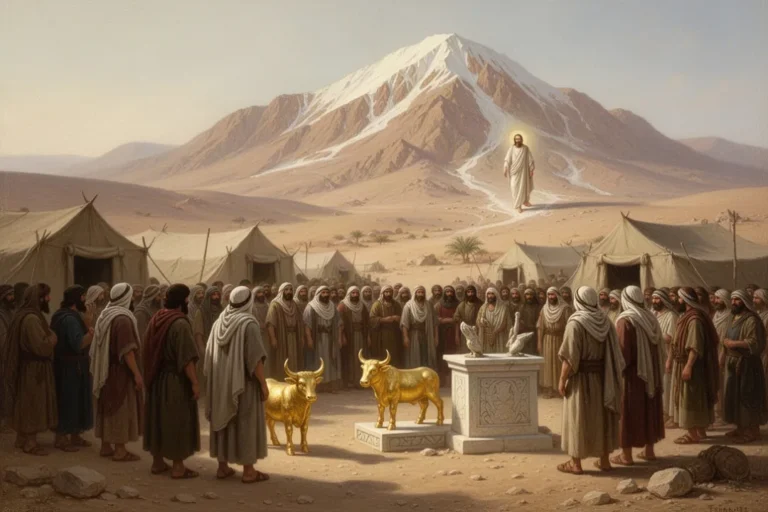
Aaron gathers their gold. He collects gold earrings from the people and uses the material to form a calf.
The people celebrate. They offer sacrifices and hold a festival that combines worship, eating, drinking, and uncontrolled behavior.
God tells Moses what is happening. Moses learns that the people have corrupted themselves and broken the covenant.
Moses confronts the nation. He descends with the tablets, sees the calf and the celebration, and smashes the tablets at the foot of the mountain.
The idol is destroyed. Moses burns the calf, grinds it into powder, scatters it on water, and makes the Israelites drink it.
Judgment follows. The Levites rally to Moses, and a severe judgment falls on the community. Exodus also describes a later plague.
Moses intercedes. He pleads for the people and returns to God’s presence, seeking mercy and continued guidance.
The covenant is renewed. New stone tablets are made, and God continues to lead Israel, although the sin has lasting consequences.
Why the Israelites made a calf
The text gives a clear immediate reason: the people were frightened by Moses’ absence. They wanted a visible leader and a concrete object that could represent the divine presence. Their request shows how uncertainty can create pressure for immediate, tangible solutions.
The Israelites had also come from a culture filled with visible religious images. Egypt used animal symbolism in its religious practices, and the ancient Near East commonly represented divine power through statues and sacred objects. The biblical account does not excuse the Israelites because of that background, but it helps explain why a calf seemed like a recognizable symbol.
The calf may have drawn on bull imagery associated with strength, fertility, and royal power. Scholars discuss the precise symbolism, but the text itself emphasizes the violation of Israel’s covenant rather than giving a full explanation of the image’s artistic origin.
Another factor was the role of group pressure. The people did not quietly make private choices; they gathered as a community and pushed Aaron to act. Aaron, who had been appointed as a major religious leader, failed to resist the demand. The episode shows how fear can spread through a group and how leaders can reinforce rather than correct collective panic.
What Aaron did and why his response matters
Aaron played a central role in the episode. Instead of reminding the people of the covenant or waiting for Moses, he asked them to remove their gold earrings. He then shaped the material into a calf and built an altar before it.
When Moses questioned him, Aaron gave an explanation that minimized his responsibility. He described the people’s behavior and claimed that the calf emerged from the fire after he threw in the gold. The narrative presents this as evasive rather than credible. Aaron had made a series of deliberate decisions, even if the crowd had pressured him.
Aaron’s failure is significant because he later becomes Israel’s high priest. The Bible does not portray its leaders as flawless. His later role does not erase the golden calf incident, and the incident does not prevent God from continuing to work through him. That tension allows the story to address both accountability and the possibility of restoration.
Leadership responsibility appears in another way as well. Moses is not passive when he returns. He confronts the people, destroys the idol, calls for decisive action, and then pleads for mercy. The story presents responsible leadership as both truthful confrontation and intercession.
Why Moses broke the stone tablets
Moses’ breaking of the tablets dramatizes the broken covenant. The tablets represented God’s commands and the binding relationship between God and Israel. When Moses shattered them, the physical action showed that the people had already violated what the tablets signified.
This act should not be confused with simple uncontrolled anger. Exodus describes Moses’ anger, but the larger narrative gives the action symbolic meaning. The tablets were not merely objects; they represented a covenant that had been broken before Moses even reached the camp.
Later, Moses returns to the mountain and receives new tablets. The renewal does not pretend that the first breach never occurred. Instead, it shows that judgment and mercy can exist together. The people face consequences, but the covenant relationship is not abandoned.
What happened to the golden calf
Moses burned the calf and ground it into powder. He then scattered the powder on water and required the Israelites to drink it. The unusual procedure demonstrates that the idol was powerless and destructible. The object that the people had treated as a divine guide could be reduced to ordinary material.
The action also reverses the calf’s public status. It had been displayed as an object of communal devotion; now it is destroyed, dispersed, and consumed. The Israelites are forced to confront the fact that their supposed source of security was only gold shaped by human hands.
The narrative does not suggest that the gold itself was inherently evil. Gold had been used for valuable and permitted purposes in the tabernacle. The problem was the object’s purpose and worship. A material that could be used in service to God became an idol when people placed it at the center of their allegiance.
Was the golden calf meant to represent God?
Readers often ask whether the Israelites were worshiping a completely different deity or trying to represent the God who brought them out of Egypt. The passage contains language that has led interpreters to discuss both possibilities.
Aaron associates the celebration with the Lord, and the people’s actions occur soon after their deliverance from Egypt. This may suggest that some Israelites believed the calf represented the God who had saved them. At the same time, the command to make the calf and the celebration around it clearly violate God’s instructions.
The distinction matters because biblical idolatry is not limited to worshiping an unrelated god. Trying to reduce the invisible God to a manageable object is also condemned. A person may use correct religious language while still replacing faithful obedience with a form of worship invented for personal comfort.
In that sense, the story warns against remaking God in a preferred image. The problem is not only choosing the wrong deity. It is also attempting to define God through an object, ritual, or system that people can manufacture and control.
How the golden calf differs from later calf worship
The golden calf at Sinai should be distinguished from the two calves established by King Jeroboam in 1 Kings 12. After the kingdom divided, Jeroboam placed one calf at Bethel and another at Dan. He presented them as religious centers for the northern kingdom, reducing the need for his people to travel to Jerusalem in the southern kingdom.
Jeroboam’s decision was connected to political security as well as religious practice. He feared that continued worship in Jerusalem would reunite the people with the house of David. The calves therefore became part of a state-sponsored system that protected his authority and created an alternative to Jerusalem’s temple.
Exodus 32: The people make one calf at Mount Sinai while Moses is absent.
1 Kings 12: Jeroboam establishes two calves at Bethel and Dan after the kingdom divides.
Exodus 32’s setting: The crisis occurs during the formation of the covenant community.
Jeroboam’s setting: The calves support a competing national religious system.
Shared warning: Both stories show people replacing faithful worship with visible symbols shaped by fear, convenience, or political goals.
The later account deliberately echoes the earlier one. Jeroboam’s policy is condemned because it repeats the same basic error: constructing a rival focus of worship rather than following the pattern God had given Israel.
What the golden calf teaches about idolatry
Idolatry is more than bowing before a statue. In biblical terms, it includes assigning ultimate value, trust, and loyalty to something created. That created thing might be wealth, power, success, reputation, a nation, a relationship, or even a religious institution.
The golden calf makes this idea visible. Gold is valuable, but it cannot lead a people through the wilderness. A calf can symbolize strength, but it cannot speak, judge, forgive, or guide. The people transferred expectations that only God could fulfill onto an object they had made themselves.
Modern forms of idolatry can be harder to recognize because they may not look religious. A career can become an idol when identity depends entirely on achievement. Money can become an idol when safety and worth are measured only by possessions. Political power can become an idol when loyalty to a leader overrides moral truth.
A practical test: Ask what you protect at any cost, what you trust when afraid, and what loss would make life seem meaningless. Those answers can reveal where a good thing has begun to receive ultimate importance.
Why waiting is central to the story
The crisis begins with delay. Moses is not declared dead; he is simply absent longer than the people expected. Their impatience turns uncertainty into a demand for immediate action. The golden calf therefore illustrates how waiting can expose the difference between stated faith and practiced trust.
Waiting does not mean refusing to act in every situation. The Israelites had responsibilities in the camp, and Moses had given them leadership arrangements through Aaron and the elders. The problem was their decision to solve uncertainty by violating the covenant rather than seeking faithful counsel.
The story also warns against confusing visibility with safety. A physical object can feel reassuring because it is easy to see and gather around. Yet visibility does not equal reliability. The calf is present, but it cannot do what the people need.
That lesson applies whenever a person demands immediate certainty. A quick answer, influential leader, financial guarantee, or public symbol may calm fear temporarily while leading away from wisdom. The biblical narrative treats impatience under pressure as a serious spiritual and communal danger.
How the golden calf reveals the danger of group pressure
The Israelites act collectively, and collective behavior intensifies the crisis. People who might hesitate alone can participate when everyone around them appears committed. Once the altar is built and the festival begins, the group’s momentum makes correction more difficult.
Aaron’s behavior shows that authority does not automatically produce courage. Leaders can be tempted to satisfy immediate demands rather than protect a community’s long-term welfare. Avoiding conflict may feel compassionate in the moment, but it can permit serious harm.
Healthy communities need people who can slow down a fearful crowd. That may involve asking what has actually happened, remembering established commitments, consulting trustworthy leaders, and refusing to turn anxiety into a public decision. The golden calf story gives those practices moral weight.
Separate facts from fear: Moses was delayed, but the people did not know that he was gone forever.
Examine the proposed solution: A visible object could not perform the role the people wanted it to fill.
Remember prior commitments: Recent fear did not cancel the covenant already accepted.
Identify pressure on leaders: A demand from a crowd is not automatically a legitimate command.
Expect consequences: Public choices can damage an entire community, not only the people who first proposed them.
How Moses’ intercession balances judgment and mercy
Moses does not treat the golden calf as a minor mistake. He names the seriousness of the people’s rebellion and takes concrete action against the idol. At the same time, he returns to God and pleads for the nation rather than abandoning it.
Exodus 32 records Moses asking God to forgive the people and, in effect, offering his own standing on their behalf. The passage presents a leader who identifies with the community even after confronting its wrongdoing. He does not excuse the sin, but he seeks mercy for sinners.
This combination is important. Mercy without truth would make the covenant meaningless, while judgment without intercession would leave no path toward restoration. The story holds both together: the people are accountable, and God’s relationship with them continues through forgiveness and renewed covenant.
Later biblical writers use the golden calf as a lasting example of Israel’s rebellion. Psalm 106 recalls the incident as a failure to remember God’s saving acts. Nehemiah 9 also recounts the calf while praising God’s compassion. These references show that the event became a lens for understanding both human unfaithfulness and divine patience.
How the phrase “golden calf” is used today
In ordinary speech, a golden calf is anything treated as an object of excessive admiration or devotion. The phrase often describes money, luxury, status, material success, or economic growth when these become more important than moral responsibility and human well-being.
The expression keeps the biblical image but broadens its application. It does not mean that every valuable possession is an idol. The issue is whether a good or useful thing has become the highest loyalty, the main source of identity, or the standard by which every decision is judged.
For example, earning money to provide for a family is not automatically worshiping wealth. The concern arises when wealth determines a person’s worth, excuses injustice, or receives sacrifices of integrity, relationships, and compassion. The same principle applies to achievement, influence, appearance, and political identity.
Questions to ask when identifying a modern idol
The golden calf story can become a practical tool for self-examination. Instead of looking only for literal religious images, consider the patterns that direct your attention and decisions.
What do you turn to first when you feel afraid? Your instinctive refuge may reveal what you trust most.
What are you unwilling to question? Absolute loyalty can attach itself to a leader, cause, institution, or ideology.
What do you sacrifice to maintain? Repeatedly trading honesty, rest, family, or compassion for one pursuit may signal misplaced devotion.
What gives you a sense of worth? If identity depends entirely on performance, possessions, or approval, that source is fragile.
Can you accept limits? Idols often promise control, while faithful living requires humility about what you cannot manage.
These questions are not meant to produce quick accusations against other people. The Israelites did not need only a better theory of idolatry; they needed to recognize their own participation in the crisis. The story invites personal honesty before public criticism.
Where the golden calf appears elsewhere in Scripture
The account in Exodus 32 is the best-known reference, but later biblical passages return to it. Deuteronomy reviews the incident as Moses prepares Israel to live in the promised land. The retelling emphasizes the people’s rebellion and Moses’ intercession.
Psalm 106 remembers the calf as an example of exchanging God’s glory for the likeness of an animal. The psalm places the episode within a larger pattern of forgetting God’s works and seeking substitutes. Its purpose is not merely historical; it calls the community to remember and remain faithful.
Nehemiah 9 recounts the calf during a public confession of Israel’s history. The people acknowledge repeated rebellion while also praising God’s willingness to forgive. In the New Testament, Stephen refers to Israel’s idolatry in Acts 7 as part of his argument about resistance to God’s messengers.
Hosea and other prophetic books condemn the northern kingdom’s calf worship and connect it with national unfaithfulness. The later prophets treat the calves as evidence that political convenience and false worship had become intertwined.
How to read the story responsibly
Read Exodus 32 in its surrounding chapters rather than isolating the most dramatic scene. The commands about worship, the covenant ceremony, the tabernacle instructions, and the later renewal all clarify what is at stake. The golden calf is about broken relationship, not merely bad craftsmanship.
Also distinguish the biblical text from artistic assumptions. Paintings often show a large, polished statue, but the passage does not provide a complete physical description. It does say that the image was made from gold and shaped as a calf, while the exact technique and appearance remain less important than the people’s response to it.
Finally, avoid using the story only as a weapon against people with different practices. Its first target is the covenant community itself. The most faithful application begins with examining personal and communal substitutes for God before assigning the label to others.
The golden calf remains memorable because it joins several human tendencies in one event: fear of absence, pressure for visible certainty, submission to the crowd, leadership failure, and the hope that something people make can save them. Its answer is not simply to reject every symbol or possession. It is to keep created things in their proper place and to direct ultimate trust toward the God the story says cannot be reduced to an object.
Frequently asked questions
What exactly was the golden calf?
It was a calf-shaped image made from gold jewelry collected from the Israelites at Mount Sinai. Exodus 32 presents it as an unauthorized focus of worship created while Moses was on the mountain. The image was not valuable because gold had divine power; its importance came from the role the people assigned to it as a visible substitute for faithful trust.
Did Aaron create the golden calf by himself?
Aaron directed the collection of gold and made the image, but the episode involved the wider community. The people demanded a visible object, supplied the material, and celebrated around the altar. Aaron was responsible as a leader, while the Israelites were also held accountable for participating in the worship and rejecting the covenant’s requirements.
Is the golden calf the same as the calves made by Jeroboam?
No. The Sinai calf in Exodus 32 was made during Israel’s wilderness journey. Centuries later, Jeroboam established two calves at Bethel and Dan after the kingdom divided. The events are separate, but the later account intentionally echoes the earlier one because both involve visible calf images replacing the worship pattern God had established.
What is the main lesson of the golden calf for Christians and other readers?
The story warns against turning anything created into an ultimate source of identity, security, or authority. It also addresses impatience, group pressure, and leaders who accommodate harmful demands. Its message includes both accountability and mercy: wrongdoing must be confronted, yet restoration remains possible through repentance, intercession, and renewed faithfulness.



Leave a Reply