If you have ever wondered how one person could face a powerful ruler, lead an entire nation through danger, and still struggle with fear and frustration, the Bible’s Moses offers a clear answer. Moses is the central human leader of the book of Exodus: God calls him to deliver the Israelites from slavery in Egypt, form them into a covenant people, and guide them through the wilderness.
Moses is also presented as a prophet, lawgiver, mediator, shepherd, and servant of God. His life is told mainly in Exodus, Leviticus, Numbers, and Deuteronomy. Although he performs extraordinary signs and speaks with unique authority, the biblical account also shows his weaknesses, hesitation, anger, and dependence on God.
Moses first appears in Exodus 1–2, during a period when the Israelites are living in Egypt and facing forced labor and violent oppression. His story continues through the remaining books of the Torah, also called the Pentateuch: Exodus, Leviticus, Numbers, and Deuteronomy.
He is mentioned throughout the rest of the Old Testament as the leader who brought Israel out of Egypt and received God’s law. The New Testament also refers to him as an important figure in Israel’s history. Jesus, the Gospel writers, Stephen, Paul, and the book of Hebrews all discuss Moses or the law associated with him.
The Bible’s account of his life can be followed through these major stages:
Birth and rescue: Moses is born to Hebrew parents during a time when Pharaoh has ordered the death of Hebrew baby boys.
Life in Pharaoh’s household: He is raised in Egypt but remains connected to his Hebrew identity.
Exile in Midian: After killing an Egyptian who was beating a Hebrew slave, Moses flees Egypt and lives as a shepherd.
God’s call: God speaks to him through the burning bush and sends him back to Egypt.
The exodus: Moses confronts Pharaoh and leads Israel out of slavery.
Covenant and wilderness leadership: He receives God’s commands, oversees the nation, and guides the people toward Canaan.
Final days: Moses sees the promised land from Mount Nebo but dies before Israel enters it.
Core answer: Moses is the Bible’s main leader of Israel’s deliverance from Egypt and the mediator through whom God gives the covenant law at Mount Sinai.
How Moses was saved as a baby
Moses was born into the tribe of Levi, one of the tribes of Israel. At that time, Pharaoh feared that the growing Hebrew population might become a political threat. He ordered that Hebrew sons be killed, creating a dangerous setting for Moses’ birth.
Moses’ mother hides him for several months. When she can no longer conceal him, she places him in a carefully prepared basket among the reeds along the Nile River. His older sister watches from a distance, and Pharaoh’s daughter discovers the child.
The princess recognizes that the baby is Hebrew but takes pity on him. Through a carefully arranged conversation, Moses’ sister helps bring his own mother into the household to nurse him. Moses therefore survives through an unexpected connection between his Hebrew family and the Egyptian royal household.
Pharaoh’s daughter gives him the name Moses, commonly associated with being drawn out of the water. He is eventually raised in the royal environment, yet the story continues to identify him with the oppressed Hebrew people rather than with the power of Egypt.
This beginning establishes an important pattern in Moses’ life: he is preserved from death so that he can later become an instrument of deliverance. His rescue does not immediately make him a confident leader. Instead, he grows up between two worlds and must eventually decide where his deepest loyalty lies.
Why Moses leaves Egypt and lives in Midian
As an adult, Moses goes out to observe the suffering of his Hebrew people. He sees an Egyptian beating a Hebrew man and kills the Egyptian. When he realizes that the killing is known, Moses becomes afraid and flees Egypt.
He travels to Midian, where he helps the daughters of a priest named Reuel, also called Jethro in the biblical account. Moses settles there, marries Zipporah, and spends many years working as a shepherd. This period is a major change from the palace environment associated with his childhood.
In Midian, Moses becomes a foreigner, husband, father, and shepherd. The wilderness experience gives him knowledge of the landscape through which he will later lead Israel. It also shows that God’s call comes after a long season that might appear ordinary or disconnected from Moses’ earlier life.
Moses’ earlier attempt to intervene by his own strength does not deliver Israel. The biblical story presents his later mission as something that begins with God’s initiative and authority, not simply Moses’ anger at injustice.
While Moses is tending sheep near Horeb, also known as Mount Sinai, he sees a bush that burns without being consumed. God calls to him from the bush and tells him to remove his sandals because he is standing on holy ground.
God identifies himself as the God of Abraham, Isaac, and Jacob and tells Moses that he has seen the Israelites’ suffering in Egypt. God’s plan is to bring the people out of slavery and into the land promised to their ancestors. Moses is chosen to speak to Pharaoh and lead the Israelites to freedom.
Moses does not respond like someone eager for public leadership. He raises several objections:
He asks who he is to approach Pharaoh or bring Israel out of Egypt.
He wonders what he should say if the Israelites ask for God’s name.
He worries that the people will not believe that God has appeared to him.
He explains that he is not an effective speaker.
He finally asks God to send someone else.
God answers these concerns with promises of his presence and signs that will confirm the message. God also appoints Moses’ brother Aaron to help him speak. The exchange reveals that Moses’ authority does not come from natural confidence or royal status; it comes from the God who sends him.
How Moses confronts Pharaoh and leads the exodus
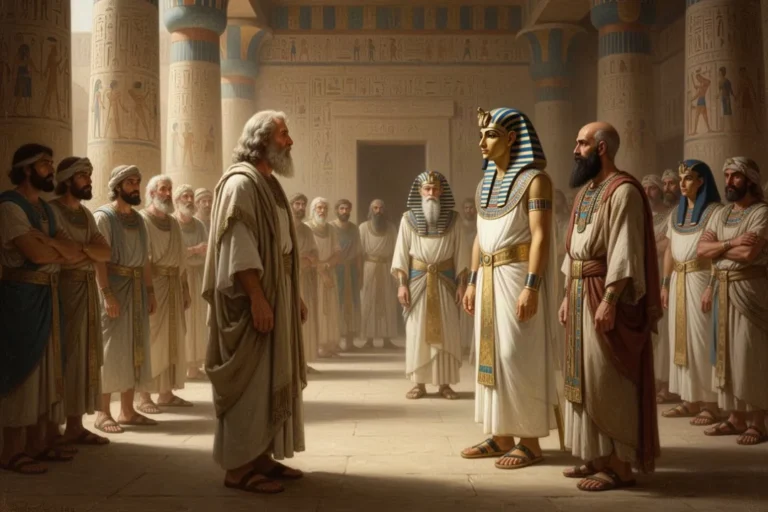
Moses and Aaron tell Pharaoh that the God of Israel commands him to release the Hebrew people so they can worship in the wilderness. Pharaoh refuses and increases the Israelites’ workload. This response makes Moses’ task more difficult before it becomes easier.
God then sends a series of judgments on Egypt, commonly called the ten plagues. They affect the land, water, animals, health, crops, darkness, and ultimately the firstborn. The plagues expose the limits of Pharaoh’s power and demonstrate that Israel’s release depends on God rather than on a negotiated human victory.
The final plague is connected with the first Passover. Israelite families are instructed to prepare a lamb, mark their doorways with its blood, and eat a meal ready for departure. The event becomes the foundation of the annual Passover celebration, which remembers God’s protection and Israel’s release from Egypt.
After the death of the Egyptian firstborn, Pharaoh allows the Israelites to leave. The departure is not a quiet relocation. It is a mass escape involving families, livestock, and possessions, with the Egyptian ruler soon changing his mind and sending forces after them.
At the sea, the Israelites appear trapped between the water and the approaching army. God makes a way through the sea, and the people cross safely. The Egyptian forces that follow are overwhelmed when the waters return. This event becomes one of the Bible’s strongest pictures of deliverance from oppression and trust in God during an impossible situation.
Moses’ leadership begins with a command to trust God’s presence rather than rely on personal strength.
Why the wilderness years test Moses’ leadership
Freedom from Egypt does not immediately produce a peaceful nation. The Israelites face hunger, thirst, unfamiliar surroundings, fear, and uncertainty. They repeatedly complain to Moses and sometimes long to return to Egypt, even though Egypt represents the slavery from which they have been rescued.
Moses must bring their needs before God, communicate God’s instructions, settle disputes, and respond to rebellion. God provides food called manna, quail, and water in the wilderness. These provisions sustain the people while also teaching them to depend on God daily.
The pressure of leadership becomes visible when Moses’ father-in-law advises him to appoint capable leaders over groups of people. Moses had been trying to hear every dispute himself. The advice creates a more sustainable structure, showing that biblical leadership includes delegation, shared responsibility, and practical organization.
Moses also faces direct challenges from within his own family and community. Miriam and Aaron criticize him in one episode, while Korah and other leaders later question his authority. These conflicts are not presented as minor disagreements; they expose the strain created when a large community must learn how to live under a new covenant.
What Moses receives at Mount Sinai
At Mount Sinai, God establishes a covenant with Israel. A covenant is a binding relationship with promises, obligations, and consequences. Israel is no longer simply a group escaping Egypt; the people are being formed into a nation devoted to God.
Moses goes up the mountain as the representative of the people and receives God’s commandments. The Ten Commandments provide the best-known part of this revelation, but the Sinai covenant includes many other instructions about worship, justice, community life, festivals, servants, property, and restitution.
The law addresses both religious devotion and everyday behavior. It teaches Israel to reject other gods, honor parents, protect life, practice truthfulness, respect marriage, and avoid taking what belongs to others. Other laws give guidance for caring for vulnerable people, handling disputes, observing sacred times, and maintaining worship.
God also gives Moses instructions for the tabernacle, a portable sanctuary where God’s presence will be associated with Israel’s journey. Priests, sacrifices, sacred objects, and rituals are described in detail. The tabernacle communicates that the holy God is dwelling among the people, while also emphasizing the seriousness of approaching that holiness.
Moses serves as mediator between God and Israel. He receives the covenant, communicates it to the people, and intercedes when they fail. This role explains why later biblical writers connect Moses so closely with the law and with the identity of Israel as God’s covenant people.
What the golden calf reveals about Moses
While Moses is on Mount Sinai, the Israelites make a golden calf and worship it. The event represents a direct violation of the covenant immediately after the people have agreed to follow God’s commands. Moses comes down the mountain carrying the stone tablets and breaks them when he sees the people’s rebellion.
The golden calf story reveals the fragility of Israel’s commitment, but it also highlights Moses’ role as an intercessor. He pleads for mercy and asks God not to abandon the people. His concern is not merely personal reputation. Moses is willing to identify himself with the community and ask that God’s presence continue to guide them.
At the same time, Moses responds with intense anger and decisive action. The episode shows that he is not a detached or emotionless leader. He cares deeply about God’s honor and the people’s future, but his strong reactions can also create serious consequences.
Helpful perspective: The Bible does not portray Moses as flawless. His faithfulness is real, but so are his fear, anger, exhaustion, and mistakes.
Why Moses cannot enter the promised land
One of the most difficult parts of Moses’ story occurs at Meribah. The people need water and again quarrel with Moses. God tells Moses to speak to a rock, but Moses acts in anger and strikes it with his staff. Because Moses does not honor God before the people in the required way, God tells him that he will not lead Israel into the promised land.
The account is found in Numbers 20. The judgment may seem severe because Moses has carried the people for so many years. Yet the story emphasizes that leaders who represent God publicly are accountable for how they present God’s authority. Moses’ long service does not cancel the consequences of this act.
Before his death, Moses is allowed to see the land from Mount Nebo. He does not cross the Jordan River with Israel, but he has completed the central assignment of bringing the people out of Egypt and preparing them to enter the land.
Deuteronomy describes Moses as dying in Moab at an advanced age. The text says that God knows his burial place, while Israel does not. Joshua succeeds him as leader, and Moses’ death marks a transition from the generation that left Egypt to the generation that will take possession of the land.
What Moses teaches about leadership and faith
Moses’ life connects divine calling with human limitation. He begins by asking why he should be the one to confront Pharaoh, yet he becomes the person who repeatedly stands before kings, crowds, elders, and God on behalf of Israel.
His story also distinguishes faith from self-confidence. Moses often feels inadequate, but God does not wait until he feels powerful. Instead, God promises to be with him and provides Aaron, elders, judges, signs, and instructions.
Several themes make Moses especially significant in the Bible:
Deliverance: He leads Israel out of slavery, making the exodus a central memory of God’s saving action.
Covenant: He receives and communicates the law that defines Israel’s relationship with God.
Intercession: He repeatedly prays and pleads for the people after they sin.
Justice: He establishes laws and procedures intended to govern community life fairly.
Presence: He seeks God’s guidance rather than treating military success or national survival as self-sufficient.
Succession: He prepares Joshua and the next generation to continue the mission.
The Bible describes Moses as unusually close to God compared with other prophets, especially in Numbers 12. This does not make Moses divine. He remains a human servant whose authority is received rather than possessed by nature.
How Moses is viewed in Judaism and Christianity
In Judaism, Moses is known as Moshe Rabbeinu, meaning Moses our teacher. He is the foundational prophet and the central human figure in the giving of the Torah. The festivals, laws, and worship patterns connected with the exodus and Sinai remain essential to Jewish religious identity.
Christianity also treats Moses as a major figure in salvation history. The law given through Moses is part of the Christian Bible, and Jesus frequently engages with its teachings. The Gospel accounts place Moses at the Transfiguration with Elijah, presenting Moses as a representative of the law alongside Elijah, a representative of the prophets.
The book of Hebrews discusses Moses as a faithful servant in God’s household while presenting Jesus as having a greater status. Christians therefore generally honor Moses without treating him as the final or complete revelation of God’s purposes.
The Bible also connects Moses with the future hope of God’s people. The exodus becomes a model for later acts of rescue, while the covenant and wilderness experience provide themes that appear throughout both Testaments.
Common mistakes when reading Moses’ story
Moses’ story is familiar, but several assumptions can make the account harder to understand. These practical reading tips help keep the major themes in view.
Do not reduce Moses to the Ten Commandments. The commandments are important, but Moses’ story also includes deliverance, worship, intercession, community organization, and preparation for Israel’s future.
Do not assume Moses was confident from the beginning. His repeated objections show that reluctance and calling can exist together.
Do not overlook Aaron and Miriam. Moses is the central leader, but his family and other elders play significant roles in the story.
Do not treat the wilderness complaints as random interruptions. They reveal the practical difficulty of forming a people who trust God after generations of slavery.
Do not ignore Moses’ failure at Meribah. The Bible includes it to show that even a great leader remains accountable.
Do not read the law as a list disconnected from rescue. The Sinai covenant comes after God delivers Israel from Egypt, not as a way for enslaved people to earn freedom.
Do not assume every biblical tradition answers modern historical questions in the same way. The biblical text focuses on Moses’ theological and covenant role, while scholars continue to discuss the composition and historical setting of the Pentateuch.
Where to read about Moses first
If you want to follow Moses’ story in the Bible, begin with selected sections rather than trying to read every law in one sitting. Each passage adds a different part of his identity and mission.
Exodus 1–2: Moses’ birth, rescue, upbringing, and flight to Midian.
Exodus 3–4: The burning bush and God’s call.
Exodus 5–15: Moses’ confrontation with Pharaoh, the Passover, and the crossing of the sea.
Exodus 19–24: The Sinai covenant and the Ten Commandments.
Exodus 32–34: The golden calf, Moses’ intercession, and the renewal of the covenant.
Numbers 12–14: Conflict, fear, and the refusal of the first generation to enter Canaan.
Numbers 20: Moses’ failure at Meribah.
Deuteronomy 31–34: Moses’ final instructions, blessing, view of the land, and death.
Reading these passages together presents a balanced portrait. Moses is a courageous advocate for the oppressed, a teacher of God’s law, and a leader who bears heavy responsibility. He is also a man who sometimes hesitates, loses his temper, depends on others, and faces consequences for his actions.
The answer to “Who is Moses in the Bible?” is therefore larger than “the man who parted the Red Sea.” Moses is the servant through whom God rescues Israel, shapes its worship and law, and leads the people through the difficult transition from slavery to covenant life. His story combines calling, deliverance, responsibility, failure, mercy, and faithful service.
Frequently asked questions
Was Moses an Egyptian or an Israelite?
Moses was born to Hebrew parents from the tribe of Levi, so he was an Israelite by birth. He was raised in Pharaoh’s household after Pharaoh’s daughter rescued him from the Nile. His Egyptian upbringing gave him access to the royal environment, but the biblical story consistently presents him as identifying with the enslaved Israelites and serving their God.
Did Moses write the first five books of the Bible?
Jewish and Christian tradition has long associated Moses with the Torah, and the Bible presents him as its central mediator and teacher. The texts themselves do not simply describe Moses writing every passage, especially since they include the account of his death. Modern scholars have different views about how the Pentateuch was composed and edited.
Why did God choose Moses despite his mistakes?
Moses is chosen because God calls and equips him, not because he is portrayed as naturally fearless or flawless. He hesitates, becomes angry, and fails at Meribah, yet he also obeys, intercedes for Israel, and carries out a demanding mission. His story emphasizes God’s purpose and presence more than human perfection.
How old was Moses when he died?
Deuteronomy 34 states that Moses was 120 years old when he died. The account also says that his eyesight had not failed and that his strength remained. He died in the land of Moab after viewing Canaan from Mount Nebo, and Joshua then became Israel’s leader.

Leave a Reply