Idolatry in the Bible: Meaning, Examples, and Warnings
Idolatry in the Bible: Meaning, Examples, and Warnings
Have you ever wondered whether idolatry only means bowing before a statue, or whether it can include the things that quietly control your choices? In the Bible, idolatry is giving ultimate worship, trust, loyalty, or identity to anything other than God. Ancient idols were often physical images of gods, but Scripture also describes idolatry through misplaced desire, compromise, greed, and dependence on political or military power.
The central issue is not simply the presence of an image. It is who or what receives the devotion that belongs to the Creator. A person may own money, appreciate art, pursue a career, or love family without committing idolatry. The problem begins when a created thing becomes a person’s highest authority, deepest security, or source of worth.
The Bible presents God as the one true object of worship and repeatedly warns Israel not to serve other gods. The first commandment prohibits placing other gods before the Lord, while the second rejects making and worshiping images as substitutes for him (Exodus 20:1–6). These commands establish the basic biblical distinction: worship belongs to God alone, not to a created power or representation.
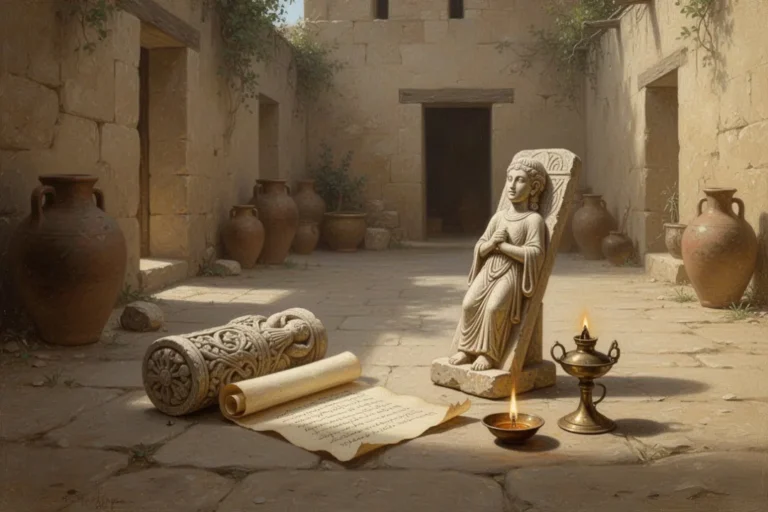
Idolatry can involve several related actions. People may make an image, bow to it, bring offerings, seek guidance from it, trust it for protection, or organize their lives around the deity it represents. In the ancient world, these practices were connected with local temples, fertility rituals, royal power, and the belief that a god could control crops, health, war, or family prosperity.
Scripture also uses idolatry as a spiritual description of the heart. A person can claim to honor God while being ruled by another master. Jesus connects divided loyalty with wealth in Matthew 6:24, and Paul describes greed as idolatry in Colossians 3:5. The outward object may change, but the inward exchange remains the same: something created takes the place of God.
Central test: Ask what you trust most for security, obey most consistently, fear losing most deeply, and rely on to tell you who you are. Those answers can reveal where a good gift may have become a ruling power.
How idolatry appears step by step
Biblical accounts show that idolatry rarely begins with a public declaration that God no longer matters. It often develops through a series of smaller decisions: forgetting God’s character, adopting surrounding practices, seeking immediate security, and eventually giving a created thing spiritual authority.
God is forgotten or treated as insufficient. The person begins to believe that God’s provision, wisdom, or timing cannot be trusted.
A substitute promises control or certainty. An image, ritual, possession, relationship, institution, or ideology appears to offer protection or success.
The substitute receives practical dependence. Time, money, attention, obedience, and emotional energy increasingly flow toward it.
Compromise becomes normal. The person excuses actions that violate God’s commands because the idol seems to deliver a desired result.
The idol shapes identity and worship. It is no longer merely useful; it becomes the source of meaning, status, safety, or belonging.
This pattern helps explain why biblical warnings are so direct. Idolatry is not merely an incorrect opinion about religion. It changes behavior and relationships. It can produce injustice, sexual exploitation, violence, dishonesty, oppression of the vulnerable, and the sacrifice of people for prosperity or power.
Why the Old Testament repeatedly condemns idols
Israel’s covenant with God required exclusive worship. The Lord had brought Israel out of slavery in Egypt, and the covenant called the nation to trust and obey him rather than imitate the worship systems of neighboring peoples. The repeated commands against idols were therefore connected to covenant loyalty, moral obedience, and Israel’s identity.
In Exodus 32, the Israelites make a golden calf while Moses is on Mount Sinai. The calf is not presented as an abstract philosophical mistake. It becomes a visible focus of worship and celebration, and it represents a serious breach of the covenant soon after God’s deliverance of the people. The episode shows how quickly fear and impatience can lead people to create a manageable substitute for the living God.
In the book of Judges, idolatry is part of a recurring cycle. Israel turns from the Lord, adopts the worship of surrounding nations, experiences oppression, cries out, and receives deliverance through a judge. The cycle demonstrates that idolatry is not only a private matter. It affects the whole community and weakens its faithfulness, justice, and stability.
The prophets Isaiah, Jeremiah, and others mock the powerlessness of handmade idols, but their criticism is more than a comment about craftsmanship. An idol is made from material that people themselves control, yet people then ask it to save them. Isaiah 44 describes this contradiction through a person using part of a piece of wood for ordinary fuel and shaping the rest into an object of worship.
Prophetic criticism also focuses on the social results of false worship. Jeremiah links idolatry with abandoning the covenant, while Hosea describes Israel’s unfaithfulness through marriage imagery. The prophets repeatedly call the people back to exclusive devotion, justice, mercy, and trust in God.
Major examples of idolatry in the Bible
The golden calf and the demand for a visible god
The golden calf in Exodus 32 is one of the Bible’s clearest examples. While Moses is away, the people become anxious and ask Aaron to make a visible object to lead them. Their impatience reveals a common temptation: replacing a God who cannot be controlled with something concrete, immediate, and socially reassuring.
The episode also warns against confusing religious language with faithful worship. The people use the calf in a festival connected with the Lord, but adding God’s name to a forbidden form does not make the practice acceptable. Sincere intention does not turn disobedience into worship that honors God.
The worship of Baal and Asherah
Baal worship appears throughout Israel’s history. In 1 Kings 18, the prophet Elijah confronts the prophets of Baal on Mount Carmel. The contest exposes the difference between a silent, powerless idol and the living God who answers prayer. The account is not a general license for religious hostility; it is a covenant confrontation within Israel over which God the nation will serve.
Asherah poles and related practices also appear in the biblical record. Israel’s kings are evaluated partly by whether they remove or tolerate these objects and forms of worship. The repeated removal and return of such practices shows that spiritual reform can be temporary when the deeper loyalties of leaders and communities remain unchanged.
The bronze serpent and the danger of misusing a good object
Numbers 21 records that Moses made a bronze serpent during a period when God provided healing for the Israelites. Centuries later, King Hezekiah destroyed that serpent because the people had begun burning incense to it (2 Kings 18:4). The object had once served a specific purpose in God’s instruction, but it later became an object of unauthorized devotion.
This account offers an important qualification. Not every religious symbol, object, or tradition is automatically an idol. Yet any object can become idolatrous when people treat it as sacred power, trust it instead of God, or give it worship. Even something connected with a genuine act of faith must not replace the one to whom faith is directed.
Money, greed, and the idol of wealth
Jesus warns that a person cannot serve both God and money as rival masters (Matthew 6:24). He does not teach that possessing money is inherently sinful. Scripture includes responsible work, generosity, wise planning, and care for dependents. The danger is that wealth can become a master that demands obedience and promises security.
Paul’s statement that greed is idolatry in Colossians 3:5 makes the point more precise. Greed is not simply having a large amount; it is an insistent desire to possess what belongs to someone else or to accumulate without contentment. It treats material gain as a source of ultimate fulfillment. Jesus’ parable of the rich fool in Luke 12:13–21 similarly warns against storing possessions while failing to be rich toward God.
Political and military power as false security
The Bible also challenges the temptation to treat national strength as salvation. Israel’s kings often sought military alliances instead of trusting God, and the prophets criticized dependence on Egypt, Assyria, or other powers when such dependence replaced covenant faithfulness. The issue was not that diplomacy or defense were always forbidden; it was the transfer of ultimate trust from God to human power.
Modern readers can apply this warning carefully. Civic responsibility, political participation, and concern for public safety are not automatically idolatrous. They become spiritually dangerous when a nation, leader, movement, or party receives unquestioning loyalty, moral exemption, or the expectation that only it can save society.
Self-made worship and the idol of personal autonomy
The biblical story begins with humanity rejecting God’s command in Genesis 3 and seeking wisdom on its own terms. The temptation is not simply to possess knowledge; it is to decide good and evil independently of God. Later, the book of Judges describes a society in which people do what seems right to them (Judges 21:25), revealing the disorder that follows when each person becomes the final authority.
Personal freedom is a valuable good, but the Bible does not define freedom as complete independence from God. Idolatry can appear as self-worship when personal preference, self-image, or private judgment becomes more authoritative than God’s truth and commands.
How the New Testament develops the warning
The New Testament continues the Old Testament’s insistence that believers must not worship idols. In Acts 17, Paul speaks in Athens about an altar dedicated to an unknown god and redirects attention from human-made shrines to the Creator. His speech recognizes the people’s religious interest while correcting their understanding of God.
Paul’s letters warn Christian communities to flee idolatry rather than treating participation in pagan temple meals as spiritually harmless. In 1 Corinthians 10, he explains that worship involves genuine spiritual allegiance and that Christians must not share in incompatible forms of devotion. His concern is not merely what food is present but what fellowship and worship the activity represents.
First John ends with a short warning to keep away from idols. The letter has emphasized love, obedience, truth, and confidence in the true God, so the warning fits the whole message: believers must not return to substitute objects of trust after receiving life in Christ.
Revelation portrays idolatry as part of humanity’s resistance to God. Its visions describe people worshiping the beast and its image, combining false worship with political coercion and economic pressure. The imagery shows how idolatry can involve both religious symbols and systems that demand conformity, allegiance, and compromise.
What idolatry is not
A careful definition prevents unnecessary accusations. The Bible does not call every strong interest idolatry, and it does not require people to reject every material possession. Enjoying food, art, nature, education, friendship, work, or recreation can be part of ordinary human life. These gifts become spiritually disordered when they receive the place, trust, and obedience owed to God.
Having money is not automatically idolatry; loving wealth more than God and neighbor can be.
Respecting a leader is not automatically idolatry; treating that leader as incapable of error can be.
Loving your family is not automatically idolatry; allowing family approval to override God’s commands can be.
Using religious art is not automatically idolatry; worshiping an object or treating it as a source of divine power can be.
Working toward success is not automatically idolatry; defining your worth entirely by achievement can be.
Christian traditions differ in how they understand religious images, statues, icons, and devotional practices. Some reject the use of images in worship, while others distinguish between honoring an image and worshiping God. Whatever tradition a person follows, the biblical question remains useful: Is the object directing worship toward God, or has it become a substitute for God?
How to examine your own life for modern idols
Modern idolatry is often less visible than an ancient statue. It may appear in a schedule, bank account, browser history, conversation pattern, or repeated compromise. The goal of self-examination is not to label every strong desire sinful but to identify what has gained ruling power.
Notice what occupies your imagination. What do you think about when you have no immediate task? Repeated attention can reveal what your heart treats as significant.
Identify your deepest source of security. Consider whether you rely primarily on savings, health, appearance, career status, relationships, political influence, or God.
Look at your reactions to loss. Grief is natural, but panic, rage, despair, or moral compromise may show that a good thing has become indispensable.
Compare your spending and time with your stated beliefs. Patterns do not tell the whole story, but they can expose priorities that words conceal.
Find the commands you keep excusing. An idol often demands dishonesty, secrecy, exploitation, resentment, or neglect of people you should love.
Ask what you would refuse to surrender. A desire for something is not necessarily idolatry, but an absolute refusal to place it under God’s authority deserves honest attention.
Scripture’s response to idolatry is not merely to remove one object and leave an empty space. The biblical call is to return to God, receive forgiveness, renew obedience, and replace false worship with love of God and neighbor. In 1 Thessalonians 1:9, the believers are described as turning from idols to serve the living and true God. Repentance means changing both direction and allegiance.
A practical prayer: “God, show me what I trust, fear, or love more than you. Help me release anything that rules me, repair the harm it has caused, and serve you with an undivided heart.”
How to respond when an idol has harmed your life
Recognizing idolatry can bring shame, especially when the pattern has damaged finances, relationships, health, or faith. Scripture calls for honest repentance, but repentance is not the same as despair. The God who condemns idols also repeatedly invites people to return to him.
Begin by naming the substitute plainly. “I have made success my identity” is more useful than a vague admission that you are “too busy.” Then identify the behavior that supports it, such as chronic overwork, deceptive reporting, neglect of family, or inability to rest. Specific confession makes specific change possible.
Next, remove practical access where necessary. A person controlled by gambling may need financial safeguards and professional help. Someone shaped by compulsive approval-seeking may need boundaries around social media, honest friendships, and counseling. Someone whose political loyalty excuses cruelty may need to listen to affected neighbors and submit convictions to the moral demands of Scripture.
Finally, replace the idol with practices that restore proper worship. Prayer, Scripture, gathered Christian worship, generosity, service, Sabbath rest, confession, and accountability can redirect desire. These practices do not earn God’s acceptance; they help train a life to depend on him rather than on a substitute.
What the Bible says about freedom from idolatry
The biblical answer to idolatry is not simply stronger willpower. Israel repeatedly failed when reform depended only on external destruction of images. The deeper need is a changed heart that knows God, trusts his character, and loves what he commands.
God’s warnings against idols are therefore protective, not arbitrary. Idols cannot speak, save, forgive, or give life, even when the systems built around them appear impressive. Psalm 115 contrasts human-made images with the living God and emphasizes that those who trust powerless idols become like them. The point is that worship shapes the worshiper.
Jesus summarizes faithful living through love for God and love for neighbor (Matthew 22:37–40). These commands provide a practical countermeasure to idolatry. Love for God reorders ultimate loyalty, while love for neighbor prevents self-centered worship from consuming other people’s dignity and wellbeing.
Idolatry in the Bible is therefore both an ancient practice and a continuing warning. It includes carved images and forbidden rituals, but it also includes any created thing that claims God’s place. The most faithful response is to identify false trust, turn back to the living God, and let worship shape every part of life according to truth, love, and obedience.
Frequently asked questions
Does the Bible say every idol is a physical statue?
No. Physical images are the clearest ancient examples, but the Bible also identifies greed as idolatry and warns against trusting wealth, political power, human wisdom, or self-rule in place of God. An idol is best understood by the role it plays: anything treated as an ultimate authority, source of salvation, or object of worship can function as an idol.
Is loving someone or something deeply a form of idolatry?
Not necessarily. The Bible affirms love for family, work, creation, and community. Love becomes idolatrous when it requires disobedience to God, defines your entire identity, or becomes a source of security that you cannot imagine living without. The question is not whether you value something, but whether that value has become ultimate and controlling.
Why did God forbid idols if people intended to worship him through them?
Scripture treats worship as something God defines, not something people redesign according to preference. An image can make God seem manageable or reduce him to a created form. The golden calf shows that religious language and sincere intentions do not make a forbidden substitute acceptable. Biblical worship depends on God’s revealed character and commands.
How can someone break free from a modern idol?
Start with honest confession and identify the specific behavior, fear, or desire involved. Remove practical opportunities for the pattern, seek accountability, and repair harm where possible. Replace the old dependence with prayer, Scripture, worship, generosity, service, and wise pastoral or professional help. Freedom usually involves repeated acts of renewed loyalty rather than one emotional moment.




Leave a Reply