Mount Sinai location: Where is the biblical mountain?
Mount Sinai location: Where is the biblical mountain?
The traditional Mount Sinai location is Jebel Musa, or “Moses’ Mountain,” in Egypt’s southern Sinai Peninsula. It stands near the town of Saint Catherine and the ancient Saint Catherine’s Monastery, about 250 miles (400 kilometers) southeast of Cairo by road.
Jebel Musa is widely identified with the mountain where, according to the Bible, Moses received the Ten Commandments. However, the Bible does not provide modern coordinates, and the mountain’s exact identity remains historically unproven. Other proposed locations include nearby peaks in Egypt and mountains across the Gulf of Aqaba in what is now Saudi Arabia.
Where the traditional Mount Sinai location is in Egypt
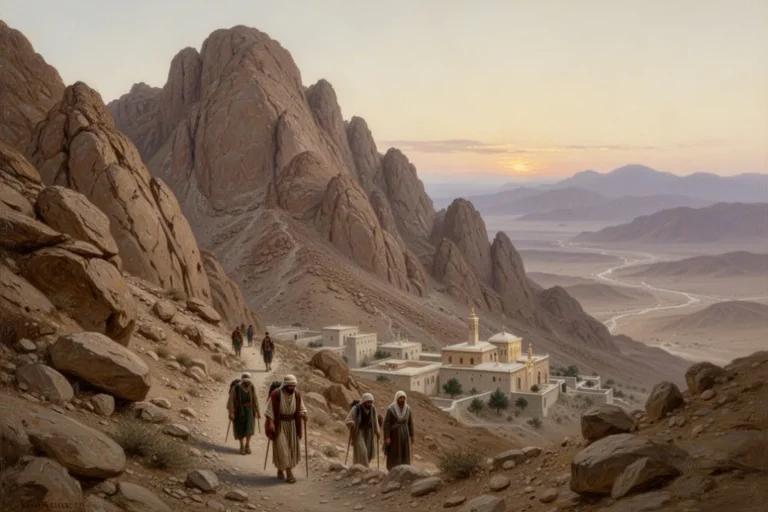
Jebel Musa lies in the rugged southern Sinai Peninsula, an arid region administered by Egypt. The mountain is part of the broader South Sinai mountain range, where granite peaks rise sharply above narrow valleys, dry riverbeds, and desert plains.
The summit is approximately 2,285 meters, or 7,497 feet, above sea level. It is not the highest mountain in the area: nearby Mount Catherine rises higher, at roughly 2,629 meters. Even so, Jebel Musa is the best-known peak because of its strong connection with the biblical story of Moses and the long-standing Christian tradition associated with the site.
On a modern map, the mountain is near Saint Catherine, a small town in South Sinai. The area is also close to the monastery traditionally called Saint Catherine’s Monastery, formally the Monastery of Saint Catherine. The monastery sits at the foot of the mountain range and has been associated with Christian pilgrimage for many centuries.
Country: Egypt
Region: South Sinai, in the southern part of the Sinai Peninsula
Traditional peak: Jebel Musa
Nearby settlement: Saint Catherine
Approximate elevation: 2,285 meters, or 7,497 feet
Nearby landmark: Saint Catherine’s Monastery
Direct answer: If you are looking for the location shown in most Christian pilgrimage guides and travel references, search for Jebel Musa near Saint Catherine, Egypt. That identification is traditional rather than conclusively established by archaeology.
The word “Sinai” can refer to more than the mountain itself. It may describe the peninsula, the wilderness through which the Israelites traveled, or a broader biblical region. That distinction matters because a reference to the “wilderness of Sinai” does not necessarily identify one isolated peak.
Why Jebel Musa became identified with Mount Sinai
Jebel Musa’s identification developed through a combination of religious tradition, geography, and pilgrimage. Early Christian communities in the Sinai region preserved memories about biblical events and connected several local sites with the stories of Moses, Elijah, and the Israelites.
By late antiquity, Christian pilgrims were visiting the mountain and the surrounding wilderness. Monks established communities in the area, seeking the isolation associated with desert spirituality. The monastery below Jebel Musa became a major religious center and helped preserve the mountain’s traditional identity.
The mountain is also associated with the biblical account of Moses’ encounter with God at the burning bush. The Book of Exodus describes Moses being called at Horeb, the “mountain of God,” and later describes the Israelites arriving at Sinai, where they received the covenant and commandments. Because the biblical text uses both Sinai and Horeb in related passages, interpreters have debated whether the names refer to the same mountain, different places, or different traditions within the text.
The New Testament also refers to Sinai. Galatians 4:25 connects Sinai with Arabia, although the ancient geographic meaning of “Arabia” does not map neatly onto modern national borders. That reference is one reason researchers have proposed locations outside Egypt, but it does not by itself identify a particular mountain.
Jebel Musa became especially influential because it fits the expectations of a dramatic desert mountain. Its high granite summit, remote valleys, and longstanding monastic presence create a landscape that feels consistent with the biblical setting. Those features support the tradition, but they do not prove that Jebel Musa is the precise mountain described in Exodus.
What visitors see at Jebel Musa
At the summit, visitors find a small chapel traditionally linked with Moses and a simple lookout over the surrounding mountains. A small mosque also stands on the summit area. The buildings reflect the mountain’s continuing importance to both Christian and Muslim communities.
Below the summit, Saint Catherine’s Monastery contains churches, chapels, manuscripts, icons, and other historic religious objects. Its library has preserved important early Christian texts, although access to particular collections can be restricted and may change according to conservation or security arrangements.
The mountain should not be understood as an archaeological site with a clear marker reading “Mount Sinai.” Its importance comes from the combined weight of pilgrimage tradition and sacred landscape, not from a single inscription or excavation that settles the question.
What the Bible says about Sinai’s location
The Bible gives a narrative route rather than a modern geographical description. Exodus says that the Israelites traveled through the wilderness after leaving Egypt and reached Sinai, where Moses went up the mountain. The text names surrounding locations and describes movement between camps, but it does not provide distances, coordinates, or a map that can be matched confidently to present-day terrain.
Several biblical passages shape the search for the mountain:
Exodus 3: Moses encounters the burning bush at Horeb, described as the mountain of God.
Exodus 19–20: The Israelites arrive at Sinai, and Moses receives the covenant and commandments.
Deuteronomy: Moses recalls events connected with Horeb and the wilderness journey.
1 Kings 19: The prophet Elijah travels to Horeb, reinforcing the mountain’s role in biblical tradition.
Galatians 4:25: Paul refers to Sinai in connection with Arabia, a term whose ancient geographic scope is debated.
The route descriptions create several interpretive challenges. The starting point, the exact location of the Israelites’ crossing, the meaning of place names, and the size of the group all affect how a proposed route would be evaluated. Natural features may also have changed over time, especially paths through valleys, water sources, and coastal plains.
The term Horeb creates another difficulty. Some readers treat Horeb and Sinai as two names for one mountain. Others see them as names associated with different locations or textual traditions. The Bible’s wording has allowed both views to persist, and the text alone does not provide enough information to resolve the matter with certainty.
How to read the evidence: A biblical reference to Sinai establishes the mountain’s religious importance, but it does not offer the kind of precise geographic data needed to identify a modern summit conclusively.
Descriptions of thunder, fire, smoke, clouds, and a mountain boundary are central to the biblical story, but they are theological and narrative details rather than topographic coordinates. They may help readers understand the event’s meaning without identifying the exact physical peak.
The biblical phrase “in Arabia” should also be handled carefully. In the ancient world, regional names could cover areas much larger or different from their modern equivalents. Therefore, Galatians 4:25 cannot be treated as a simple statement that Mount Sinai must be in the present-day country of Saudi Arabia.
Other proposed locations for Mount Sinai
Jebel Musa is not the only proposed location. Researchers, religious writers, and explorers have suggested other peaks based on different readings of the Bible, ancient geography, travel routes, geology, or regional traditions. No alternative has achieved universal acceptance.
Jebel al-Lawz in Saudi Arabia
One of the most widely discussed alternatives is Jebel al-Lawz, a mountain in northwestern Saudi Arabia, east of the Gulf of Aqaba. Some proponents argue that the biblical reference to Arabia, along with descriptions of fire and a mountain environment, points toward this region.
Supporters have also drawn attention to dark rocks near the summit and other features they interpret as evidence of a biblical event. However, those claims are disputed. Dark rock can have ordinary geological explanations, and alleged archaeological evidence has not produced broad scholarly agreement that Jebel al-Lawz is Mount Sinai.
Access to parts of the region may also be controlled or restricted. Photographs and popular accounts can make the location appear more certain than the evidence allows, so claims about Jebel al-Lawz should be separated from verified archaeological findings.
Jebel Baghir and other Arabian candidates
Other proposed mountains in northwestern Saudi Arabia and the broader Arabian Peninsula have been suggested for similar reasons. These theories often focus on the wording of biblical place names, the route from Egypt, or the possibility that the Israelites crossed the Gulf of Aqaba.
The main challenge is that these proposals usually depend on several uncertain assumptions at once. A candidate must fit the biblical route, the ancient meaning of regional names, the landscape, the presence of water or camp areas, and the historical record. Matching one feature does not establish the identity of the mountain.
Serabit el-Khadim and northern Sinai proposals
Some researchers have looked to Serabit el-Khadim, an ancient turquoise-mining area in west-central Sinai. The site contains remains of a temple dedicated to Hathor and inscriptions that make it significant for understanding ancient religion and writing in the Sinai. Its importance, however, does not make it a confirmed Mount Sinai location.
Other proposals place the mountain in northern Sinai or in the Negev and Edom regions. These theories may connect Sinai with different readings of the wilderness itinerary. They demonstrate how much depends on interpreting ancient place names and reconstructing a route for which the surviving evidence is incomplete.
Some dramatic claims also point to underwater land bridges, volcanic formations, or unusual rocks as evidence. Such arguments should be treated cautiously. A visually striking feature is not automatically an ancient landmark, and an interpretation becomes stronger only when it is supported by multiple independent lines of evidence.
How historians and archaeologists assess the candidates
There is no single test that can identify Mount Sinai. Scholars compare several kinds of evidence, then ask whether the proposed location fits the evidence as a whole. A mountain that matches one biblical detail but conflicts with the likely travel route remains a weak candidate.
The most useful questions include:
Does the location fit ancient geography? Researchers compare place names with known regions, trade routes, and descriptions from ancient sources.
Can the proposed route be traveled? The surrounding terrain must be considered, including deserts, mountain passes, water sources, and potential camping areas.
Is there archaeological evidence? Inscriptions, settlements, religious structures, and artifacts can help date human activity, although they rarely identify a mountain by name.
Does the geology fit the claim? Rock formations may explain a landscape, but geological features alone are rarely proof of a biblical event.
How old is the tradition? A location documented by early pilgrims has historical value, even if the tradition began long after the events described in the Bible.
Do independent sources agree? Strong claims require more than repeated references in modern books, documentaries, or online posts.
Archaeology can reveal where people lived, traveled, worshiped, and worked. It cannot usually prove that a particular summit was the site of a miraculous event. The absence of remains is also difficult to interpret because a mobile population may leave little durable evidence, and desert environments can erase or bury traces over long periods.
Historical tradition deserves careful treatment rather than automatic acceptance or dismissal. The tradition identifying Jebel Musa is old and connected with a continuous pilgrimage landscape. That makes it a significant historical tradition, but a tradition is not the same as direct proof from the period of Moses.
The phrase “most likely location” therefore depends on the question being asked. For the location recognized by Christian pilgrimage, tourism, and centuries of regional tradition, Jebel Musa is the clear answer. For the historically exact mountain named in the biblical narrative, the evidence remains inconclusive.
How to visit the traditional Mount Sinai location
Travelers visiting Mount Sinai generally go to Saint Catherine in Egypt, then arrange access to the Jebel Musa area. Routes and security requirements can change, so visitors should confirm current information with Egyptian authorities, an established local guide, or a reputable tour operator before traveling.
The climb is physically demanding because of the elevation, uneven ground, and desert conditions. Many visitors begin during the night to reach the summit around sunrise, while others climb during daylight. The timing affects temperature, visibility, crowd levels, and transportation arrangements.
Two commonly described routes lead toward the summit:
The Camel Trail: A longer, more gradual path that local camel handlers may use. Hikers typically complete the final section on foot.
The Steps of Repentance: A steeper route made up of thousands of uneven stone steps, traditionally associated with a more direct ascent.
The route is not a casual walk. You may encounter loose stones, steep sections, cold wind before sunrise, and little shade. Good footwear, layered clothing, water, a flashlight, and basic sun protection are practical necessities. A walking pole can also help on the descent.
Visitors should respect the religious character of the site. Dress modestly, follow local instructions, avoid climbing onto fragile structures, and do not remove rocks or other objects. Photography may be limited in parts of the monastery or during services.
Saint Catherine’s Monastery has its own visiting arrangements and may not be open at every hour. A mountain climb does not guarantee entry to every part of the monastery complex. Check opening information in advance, especially if your trip is organized around a sunrise hike.
Weather can change quickly in the mountains. Even a warm desert day may become very cold before dawn, and poor visibility can make the descent hazardous. Visitors with heart, breathing, balance, or mobility concerns should discuss the physical demands with a medical professional and avoid treating the hike as an easy sightseeing excursion.
The wider South Sinai region includes protected landscapes and communities with their own customs and security concerns. Travel advisories, road conditions, checkpoint procedures, and access rules can change. Reliable current guidance is more useful than relying on old travel blogs or assuming that a route described several years ago remains available.
For many visitors, the value of Jebel Musa lies in the combination of biblical tradition, desert geography, monastic history, and personal pilgrimage. You can appreciate that significance while still recognizing that the exact historical location of Mount Sinai has not been proven.
Frequently asked questions
Is Mount Sinai in Egypt or Saudi Arabia?
The traditional location is in Egypt at Jebel Musa, in the southern Sinai Peninsula. Some researchers propose mountains in northwestern Saudi Arabia, especially Jebel al-Lawz, but those alternatives remain disputed. The biblical reference to “Arabia” uses an ancient regional term and cannot be equated automatically with the modern country of Saudi Arabia.
Can you see Mount Sinai from Cairo?
No. Jebel Musa is roughly 250 miles, or 400 kilometers, southeast of Cairo by road in the mountainous South Sinai region. It requires a separate journey to the Saint Catherine area. Travel time depends on the route, road conditions, checkpoints, and current access rules.
Is Jebel Musa the same as Mount Sinai?
Jebel Musa is the mountain traditionally identified as Mount Sinai by Christian pilgrims and many travel references. The identification has a long history and is connected with Saint Catherine’s Monastery. However, the Bible does not give enough precise geographic information to prove that Jebel Musa is the exact historical mountain.
How difficult is the climb up Mount Sinai?
The climb is strenuous rather than technical. It involves uneven desert terrain, elevation gain, cold conditions before sunrise, and either a long gradual route or a steeper staircase route. Fitness, footwear, water, lighting, weather, and the need to descend safely all matter. Local access requirements and available guiding arrangements should be checked before setting out.







Leave a Reply