You may have heard someone refer to “the first five books of the Bible” or mention the Torah in a religious discussion and wondered what those terms mean. The answer is the Pentateuch: the opening five books of the Old Testament, called the Hebrew Bible’s Torah in Jewish tradition.
Those books are Genesis, Exodus, Leviticus, Numbers, and Deuteronomy. Together, they tell the story of creation, the ancestors of Israel, the exodus from Egypt, the covenant at Mount Sinai, Israel’s worship, and the people’s journey toward the promised land. They also contain laws and instructions that shape Jewish religious life and strongly influence Christianity.
Quick answer: “Pentateuch” means “five books.” In Judaism, these books are called the Torah, meaning instruction or teaching, and are traditionally associated with Moses.
The Pentateuch establishes the foundation for much of the Bible’s language, theology, and story. Later books refer back to its creation account, the promises made to Abraham, the liberation from Egypt, the covenant at Sinai, and the laws given to Israel.
Its influence is not limited to historical information. The Pentateuch raises central questions about God, humanity, sin, justice, worship, community, and responsibility. It presents both sweeping narratives and detailed instructions, placing Israel’s identity within a story that begins with creation and continues through the formation of a covenant people.
For Jews, the Torah is the central written foundation of religious life. For Christians, the Pentateuch is part of the Old Testament and provides essential background for understanding the rest of Scripture. The two traditions read these books in distinct ways, but both treat them as foundational texts.
The five books of the Pentateuch in order
Each book has its own focus, although the books are connected as one continuous story. Their English names come largely through Greek and Latin traditions, while their Hebrew names commonly come from the opening words of each book.
Genesis: Describes creation, the early human story, the flood, Babel, and the lives of Abraham, Isaac, Jacob, and Joseph.
Exodus: Tells how God delivers the Israelites from Egypt, makes a covenant with them, and gives instructions for worship and community life.
Leviticus: Focuses on sacrifices, priestly duties, ritual purity, holy living, festivals, and social responsibilities.
Numbers: Follows Israel’s journey through the wilderness, including censuses, rebellions, challenges, and preparations to enter the promised land.
Deuteronomy: Presents Moses’ speeches to Israel before entering the land, reviewing the covenant and urging faithfulness.
The word Pentateuch comes from Greek terms connected with “five” and “book” or “scroll.” In ancient settings, these works could be treated as a collection of five scrolls rather than one bound volume. The division into five books gives the larger work a clear shape.
Genesis explains beginnings and the ancestors of Israel
Genesis opens with accounts of creation and the first humans. It then describes the spread of violence and disorder through stories involving Adam and Eve, Cain and Abel, the flood, and the tower of Babel. These chapters address humanity’s relationship with God and the consequences of rebellion, without presenting themselves as a modern scientific textbook.
The second major movement begins with Abraham. God calls him to leave his homeland and promises to make him the ancestor of a great people through whom blessing will reach others. The stories of Abraham, Sarah, Isaac, Rebekah, Jacob, and Rachel include faith, family conflict, deception, grief, and reconciliation.
Genesis ends with Joseph in Egypt. Joseph’s brothers sell him, but he eventually rises to power and helps preserve his family during famine. The book closes with Jacob’s descendants living in Egypt, setting the stage for Exodus.
Important themes in Genesis include creation, promise, blessing, family, land, and divine providence. The book often shows God working through imperfect people. Its characters are not presented as flawless heroes; their failures and decisions are part of the story.
Exodus tells how Israel becomes a covenant people
Exodus begins with the Israelites oppressed in Egypt. Moses becomes the central human figure as God commissions him to confront Pharaoh and lead the Israelites toward freedom. The account includes the plagues, the first Passover, the departure from Egypt, and the crossing of the sea.
The escape is only the beginning. At Mount Sinai, God enters into a covenant with Israel. The covenant describes a committed relationship involving worship, loyalty, ethical conduct, and communal obligations. The Ten Commandments are among the best-known parts of this material, but Exodus includes many additional laws.
The book also gives detailed instructions for the tabernacle, a portable sanctuary associated with God’s presence among the people. These instructions are followed by the account of the Israelites’ failure with the golden calf. The contrast is significant: the people receive a covenant, break faith, and yet the relationship is renewed.
Exodus therefore combines a liberation story with a story about responsibility. Freedom from oppression leads to a new way of life. The book asks what it means for a rescued people to worship God, practice justice, and live together under a shared covenant.
Leviticus explains holiness, worship, and community life
Leviticus is often the book readers find most unfamiliar because it contains extensive instructions about sacrifices, priests, ritual cleanliness, bodily conditions, food, festivals, and the sanctuary. Its setting is largely the wilderness camp, where the Israelites are learning how to live as a people devoted to God.
The book’s central concern is holiness. In this context, holiness means being set apart for God and ordering life according to that relationship. Some instructions distinguish between what is clean and unclean, while others address moral behavior, worship, property, labor, and treatment of vulnerable people.
The Day of Atonement receives major attention. It is presented as a sacred occasion for dealing with the community’s sins and impurities. Leviticus also describes festivals and regular offerings, creating a structured rhythm of worship.
Leviticus is not only about ceremonies. The so-called Holiness Code includes commands concerning neighbors, workers, the poor, honesty, and land. The call to love one’s neighbor appears in Leviticus 19, alongside instructions about fair treatment and concern for people who are economically vulnerable.
Reading tip: Ancient sacrificial and purity laws make more sense when read within the Pentateuch’s tabernacle-centered setting. Ask what the instruction says about holiness, worship, justice, community, or God’s presence rather than isolating one rule from its context.
Numbers follows Israel through the wilderness
Numbers takes its English name from the censuses recorded near the beginning and end of the book. The Hebrew tradition uses a name meaning “in the wilderness,” which reflects the book’s setting more directly. Much of the narrative concerns Israel’s difficult journey between Sinai and the edge of the promised land.
The book includes lists, camp arrangements, priestly responsibilities, travel accounts, laws, and stories of conflict. Israel repeatedly struggles with fear, dissatisfaction, and distrust. The most consequential crisis occurs when scouts return from the land of Canaan and the people refuse to enter because they are afraid of its inhabitants.
As a result, the wilderness generation is described as spending years in the desert, while a new generation prepares to enter the land. Numbers also includes challenges to Moses’ leadership, disputes over authority, complaints about food and water, and encounters with neighboring peoples.
Despite the repeated failures, the book also emphasizes God’s guidance and provision. The people receive direction for travel, food in the wilderness, and continuing instruction for life as a covenant community. Numbers presents the journey as both a physical trek and a test of trust.
Deuteronomy renews the covenant before entry into the land
Deuteronomy is structured around speeches attributed to Moses on the plains of Moab, east of the Jordan River. Moses reviews the people’s past, restates the law, and prepares them for life in the land they are about to enter.
The book repeatedly urges Israel to remember: remember slavery in Egypt, remember God’s care in the wilderness, and remember the covenant. Forgetfulness is treated as a spiritual and social danger because prosperity could lead the people to abandon the God who delivered them.
Deuteronomy restates the Ten Commandments and expands on issues such as worship, leadership, courts, warfare, debt, care for the poor, and treatment of foreigners. It presents obedience not merely as compliance with rules but as a response to a relationship with God.
The book contains blessings and warnings connected with Israel’s choices. It ends with Moses viewing the land from a mountain, commissioning Joshua, and dying before the Israelites cross the Jordan. The story then stands at a transition point between the Pentateuch and the books that follow.
How the Pentateuch is organized as one continuous story
The five books are easier to understand when you follow their main movement rather than treating them as unrelated texts. A simple sequence looks like this:
Creation and human beginnings: Genesis describes the world, humanity, and the spread of sin and violence.
Family promises: God’s promises develop through Abraham’s family and the generations that follow.
Deliverance from Egypt: Exodus turns a family into a growing people and tells how God frees them from oppression.
Covenant and worship: Exodus and Leviticus explain how Israel is to live near God’s presence.
Wilderness testing: Numbers portrays the difficulties of becoming a faithful community.
Preparation for the land: Deuteronomy renews the covenant before Israel’s next stage begins.
This structure also explains why the Pentateuch includes both narrative and law. The laws are not presented in isolation from Israel’s story. They emerge after creation, promise, liberation, and covenant, and they provide a framework for life as a distinct people.
Torah is often translated as “law,” but “instruction” or “teaching” better conveys its broader sense. It can refer specifically to the five books of Moses, to the written Torah in contrast with later traditions, or more broadly to Jewish teaching depending on context.
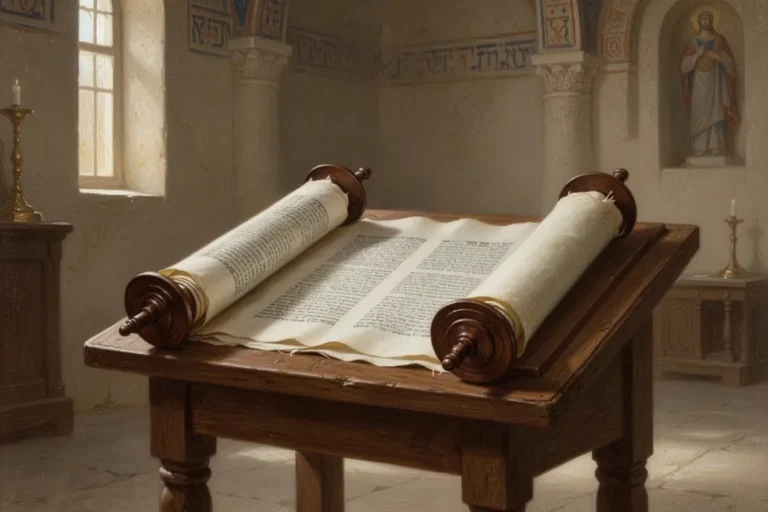
In Jewish religious life, the Torah is read publicly in a yearly cycle. The text is divided into portions, and readings are accompanied by interpretation and study. A handwritten Torah scroll used in worship is treated with great reverence and is written according to careful scribal practices.
The Torah is not simply a collection of legal rules. It includes stories, poetry, genealogies, speeches, ritual instructions, and moral teaching. Jewish interpretation has developed through centuries of discussion about how its commandments should be understood and practiced.
Christians generally use the term “Pentateuch” when discussing these books as part of the Old Testament, although Christians may also use “Torah” when referring to Jewish Scripture or its theological significance. The terms overlap, but their religious settings are not identical.
Why Moses is associated with the five books
Jewish and Christian tradition has long connected the Pentateuch with Moses. He is a central character in Exodus, Leviticus, Numbers, and Deuteronomy, and Deuteronomy presents his speeches and death. Because of this strong connection, the books are often called the “books of Moses.”
That traditional association does not answer every question about how the books reached their final form. The Pentateuch contains passages that appear to describe events after Moses’ lifetime, including the account of his death in Deuteronomy. It also contains repeated laws, changes in viewpoint, and variations in wording that have led scholars to study its composition carefully.
Many modern scholars describe the Pentateuch as a complex work shaped over time through oral traditions, written sources, editing, and preservation by communities. The details of proposed models differ, and no single explanation is accepted by every Jewish or Christian reader.
A careful distinction helps: traditional attribution and modern source criticism are different ways of asking how the text came to be. One emphasizes Moses’ authority and the books’ connection with him; the other examines literary patterns, language, repetition, and historical development.
How the Pentateuch differs from the rest of the Old Testament
The Pentateuch forms the opening section of the Hebrew Bible. In Jewish ordering, it is followed by the Prophets and the Writings. In most Christian Bibles, the Pentateuch is followed by historical books such as Joshua, Judges, Samuel, and Kings.
The difference in arrangement affects how the Bible’s larger story is perceived. The Hebrew Bible ends with the Writings, while the Christian Old Testament commonly ends with the prophetic books. The books themselves remain the same in substance, but their order and grouping vary between traditions.
The Pentateuch also differs from the later books because it establishes the covenant, priesthood, sacrificial system, festivals, and foundational laws. Later narratives often show how Israel follows or violates these arrangements. The prophets regularly appeal to covenant responsibilities first set out in the Torah.
Major themes to watch for while reading
The Pentateuch contains many subjects, but several themes recur across all five books. Tracking them can make long legal or genealogical sections easier to understand.
Creation: God brings order to the world and gives humanity a distinctive role.
Promise: God’s commitments to the ancestors shape the story of Israel.
Covenant: The relationship between God and Israel includes promises, obligations, signs, and consequences.
Presence: The tabernacle and related rituals address how God dwells among a people.
Holiness: Worship and everyday conduct are connected to being set apart for God.
Memory: Israel is repeatedly told to remember creation, slavery, deliverance, and wilderness care.
Land: The promised land is a gift, a responsibility, and the setting for the next stage of the story.
Justice: Laws address honest dealings, workers, debt, foreigners, widows, orphans, and the poor.
These themes often appear together. For example, remembering slavery in Egypt becomes a reason to treat foreigners and disadvantaged people fairly. The memory of deliverance is meant to shape conduct, not remain a detached historical claim.
How to read difficult passages responsibly
Some passages in the Pentateuch are challenging because they reflect an ancient world with different social structures, legal customs, and assumptions. Others are difficult because they describe violence, judgment, slavery, ritual restrictions, or family behavior that modern readers may find troubling.
Begin by identifying the passage’s genre and setting. A creation narrative, a genealogy, a case law, a priestly instruction, and a speech may communicate in different ways. Reading the surrounding chapters can also show whether a rule is part of worship, civil life, moral instruction, or a specific narrative situation.
It helps to distinguish between what a passage describes and what it commands. Genesis, for example, records deception, favoritism, and family conflict without automatically approving every action. The narrative may be showing consequences rather than giving a model to imitate.
Readers should also avoid treating one line as though it represents the whole Pentateuch. A law about debt, a story of war, or a ritual instruction belongs within a larger collection that also emphasizes mercy, justice, hospitality, rest, and protection for vulnerable people.
A practical reading plan for the Pentateuch
Reading all five books can feel demanding, especially when the narrative pauses for detailed instructions. A plan helps you see how the parts fit together without rushing through difficult material.
Read Genesis first: Mark the promises, family relationships, and repeated references to blessing, land, and descendants.
Read Exodus in two movements: Notice both the deliverance from Egypt and the instructions for covenant life and worship.
Approach Leviticus by theme: Group chapters around sacrifices, priests, purity, festivals, holiness, and social ethics.
Track the journey in Numbers: Note changes in generation, leadership, location, and the people’s responses to hardship.
Read Deuteronomy as covenant teaching: Pay attention to Moses’ calls to remember, love God, practice justice, and choose faithfulness.
Keep a question list: Record unfamiliar customs, repeated phrases, difficult laws, and connections with earlier chapters.
Comparing several Bible translations can clarify wording, but translations should not be treated as identical in every detail. Study notes, maps, cultural background resources, and Jewish and Christian interpretations can add context without replacing your own careful reading.
What the Pentateuch contributes to Judaism and Christianity
In Judaism, the Torah shapes worship, ethics, festivals, identity, and communal practice. It is read aloud, studied closely, and interpreted through a long tradition of rabbinic discussion. The Torah’s commandments are understood within Jewish frameworks that include later interpretation and practical application.
In Christianity, the Pentateuch provides the background for concepts such as sin, covenant, sacrifice, priesthood, Passover, holiness, and redemption. The New Testament frequently refers to these books, and Christian traditions interpret them in relation to Jesus and the rest of the Bible.
Christian communities differ in how they understand the continuing role of Old Testament laws. Some emphasize moral principles, some distinguish ceremonial and civil laws, and others approach the commandments through covenantal or historical frameworks. Jewish interpretation should not be reduced to Christian categories, and Christian interpretation is not uniform.
For both traditions, the Pentateuch remains more than an ancient record. It is a foundational body of Scripture that continues to shape worship, teaching, moral reflection, and the understanding of God’s relationship with humanity.
The simplest way to remember what the Pentateuch is
If you need a concise definition, remember three facts: the Pentateuch is the first five books of the Bible; those books are Genesis through Deuteronomy; and Judaism calls this collection the Torah.
Its content moves from creation to the edge of the promised land. Along the way, it tells of ancestral promises, liberation from Egypt, covenant obligations, worship, wilderness failure, and preparation for a new future. Its stories and laws provide the foundation for the Bible that follows and remain central to Jewish and Christian thought.
Frequently asked questions
Is the Pentateuch the same as the Torah?
In most contexts, the Pentateuch and the Torah refer to the same five books: Genesis, Exodus, Leviticus, Numbers, and Deuteronomy. “Pentateuch” is a Greek-derived term commonly used in Christian and academic settings. “Torah” is the Jewish term, often translated as “instruction” or “teaching,” and can also carry broader meanings within Jewish tradition.
Why does the Pentateuch include so many laws?
The laws explain how Israel should worship, organize community life, handle disputes, observe festivals, and practice justice. They appear within a larger story about creation, liberation, and covenant. Their ancient setting matters, so individual commands should be read in context rather than treated as isolated rules detached from the people, place, and religious system described by the text.
Did Moses write every word of the Pentateuch?
Traditional Jewish and Christian views strongly associate the five books with Moses and his authority. Modern scholars also study repetitions, differences in style, historical references, and the account of Moses’ death, leading many to describe the Pentateuch as shaped through multiple stages of composition and editing. Readers disagree about the details, so the issue is not settled by one universal explanation.
What should I read after Deuteronomy?
Joshua is the natural next book for following the narrative, because it describes Israel’s entry into the land after Moses’ death. In the Hebrew Bible, Joshua begins the section known as the Prophets. In many Christian Bibles, it begins the historical books. Reading Joshua after Deuteronomy also shows how later events are presented in relation to the covenant established in the Pentateuch.



Leave a Reply