Exodus 6:6 meaning: God’s promise to rescue Israel
Exodus 6:6 meaning: God’s promise to rescue Israel
When life feels controlled by circumstances you cannot change, you may wonder whether God sees what is happening or has the power to help. Exodus 6:6 answers with a promise of action: God tells Moses that he will bring Israel out of slavery, rescue them from forced labor, redeem them with power, and claim them as his people.
The verse comes at a difficult moment. Moses has obeyed God by confronting Pharaoh, but Israel’s workload has become heavier rather than lighter. The people are discouraged, and Moses is struggling to understand why his obedience seems to have made things worse. God responds by repeating his covenant name and describing what he himself will do.
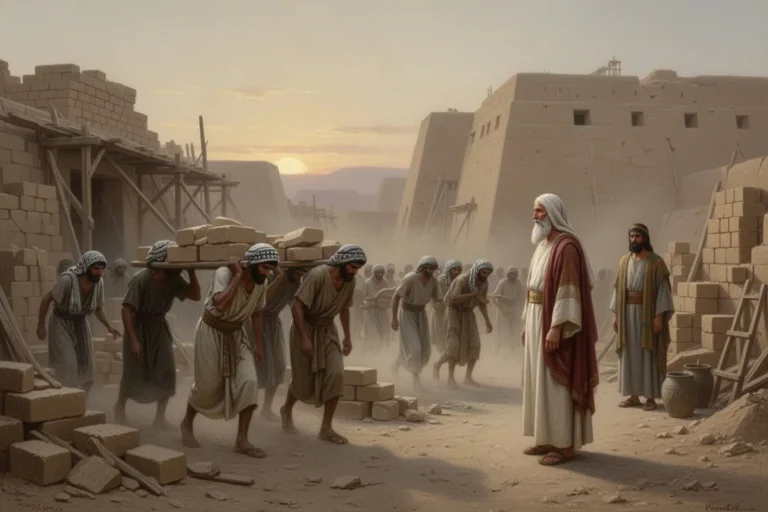
Exodus 6:6 is part of God’s answer to Moses after the first confrontation with Pharaoh. In Exodus 5, Moses and Aaron ask Pharaoh to let Israel go into the wilderness to worship the Lord. Pharaoh refuses and orders the Israelites to gather their own straw while producing the same number of bricks. The result is increased oppression.
Israel’s foremen blame Moses and Aaron for making them look guilty in Pharaoh’s eyes. Moses then brings his complaint to God. He asks why God has brought trouble on the people and why he sent him if deliverance has not followed. That setting matters because Exodus 6:6 is not spoken to people enjoying visible success. It is spoken to people who have received a promise but are still under pressure.
God begins his response by reaffirming his identity as the Lord. He then gives Moses a series of promises, most of them beginning with what God himself will do. The emphasis is not on Israel’s strength, strategy, or political influence. It is on divine faithfulness when human effort appears powerless.
The verse has four closely related movements:
Bringing Israel out of the burdens imposed by Egypt.
Rescuing Israel from slavery and forced labor.
Redeeming Israel through acts of judgment and power.
Taking Israel as his people and establishing the relationship promised to their ancestors.
These promises anticipate the plagues, the Passover, the departure from Egypt, and the crossing of the Red Sea. Exodus 6:6 does not describe an instant change in Israel’s circumstances. Instead, it announces the complete direction of God’s work before the deliverance becomes visible.
Key idea: Exodus 6:6 does not promise that hardship will disappear immediately. It assures God’s people that oppression does not have the final word and that God is committed to acting on their behalf.
What “I will bring you out” means for Israel
The first promise addresses the physical and social reality of slavery: God will bring Israel out from under Egypt’s burdens. The wording points to a change of position. Israel is not merely given better conditions inside the same system; the people are brought out from beneath Pharaoh’s authority.
Egypt’s burdens included exhausting labor, harsh oversight, and the loss of freedom. Pharaoh treated the Israelites as a labor force that existed to serve his projects. God’s promise therefore concerns more than comfort. It concerns release from an unjust power and the restoration of a people who have been treated as property.
This first phrase also shows that biblical salvation often has a concrete dimension. God is not rescuing Israel only from fear, guilt, or inner discouragement. He is acting in history to free bodies, families, and communities from oppression. The promise is spiritual because it comes from God, but it is also practical and public.
For readers today, the phrase should not be used as a careless guarantee that every difficult situation will end on a preferred schedule. Some people remain in danger because of abuse, exploitation, war, poverty, or discrimination. Exodus 6:6 can encourage hope, but it should never be used to silence someone who needs protection or to tell a suffering person to endure preventable harm without seeking help.
The verse does affirm that God sees systems that crush people. Pharaoh’s policy is not treated as normal or morally neutral. God identifies the suffering of Israel and announces that he will confront the power causing it. That gives the promise an important ethical dimension: God’s deliverance opposes dehumanizing control.
How the promise moves from rescue to redemption
The second part of the verse promises that God will rescue Israel from forced labor. The language becomes more direct: the people will not merely be moved away from Egypt; they will be released from the service that has consumed their lives. Their identity will no longer be defined by Pharaoh’s demands.
The next promise uses the language of redemption. In the ancient world, redemption could involve the recovery of a person or possession from a difficult situation, sometimes through a payment or an act of intervention by a relative. In Exodus 6:6, God presents himself as the one who will personally take responsibility for Israel’s rescue.
Redemption is stronger than relief. Relief may reduce pressure for a time, while redemption describes a decisive act that changes ownership, status, and future. Israel belongs neither to Pharaoh nor to the system that has enslaved them. God claims them and acts to bring them into freedom.
The phrase about God’s outstretched arm communicates visible strength and decisive authority. It is figurative language for God’s ability to act, not a description of a physical limb. The expression appears elsewhere in the Old Testament when God’s power is displayed in public acts of judgment and salvation.
Exodus 6:6 also refers to great acts of judgment. These judgments are directed against Egypt’s rulers, gods, and oppressive order. The coming plagues are not random displays of force. Within the story, they expose Pharaoh’s refusal to acknowledge the Lord and show that Egypt’s authority is limited.
That does not make every use of power automatically righteous. The text presents God’s judgment as a response to entrenched oppression and repeated refusal to release the enslaved people. It also places the initiative with God rather than with Israel’s revenge. Israel is not told to imitate Pharaoh or create its own empire. God promises to judge the oppressor and lead his people into a different kind of life.
Why God repeats his covenant name and promises
Before describing the coming deliverance, God identifies himself as the Lord, using the covenant name associated with his relationship with Israel. In English Bibles, this name is commonly printed as the LORD in small capitals. The name connects Exodus 6 with the earlier promises made to Abraham, Isaac, and Jacob.
God had promised the patriarchs that their descendants would become a people and would receive the land of Canaan. The Israelites’ residence in Egypt and their slavery might have made those promises seem forgotten. Exodus 6 says the opposite: God remembers his covenant and is acting according to it.
“Remember” in this context does not mean that God had lost information and suddenly recovered it. It means that he turns his attention to the covenant obligation and acts faithfully upon it. God’s awareness produces action. When the text says that God has heard Israel’s groaning and remembered his covenant, it presents him as a God who listens and responds.
The covenant name also gives the promises a foundation. Israel’s hope does not rest on Moses’ eloquence, Pharaoh’s kindness, or the people’s ability to organize a successful escape. It rests on who God is and on the commitments he has already made.
That connection helps explain why God repeats the promises after Moses reports the people’s discouragement. They are not hearing an entirely new plan. They are being reminded that Pharaoh’s resistance has not cancelled God’s purpose. The delay is real, the pain is real, and the promise remains real.
Later passages develop the same theme. The book of Deuteronomy looks back on the exodus as an act of covenant faithfulness. The Psalms remember God’s rescue from Egypt as evidence that he can be trusted. The prophets also use exodus language when describing future restoration. The New Testament writers connect Jesus’ saving work with themes of liberation, redemption, and a new covenant, while still preserving the historical importance of Israel’s exodus.
What Exodus 6:6 teaches about faith during delay
One of the most useful features of this verse is its timing. God speaks the promise before Israel sees the outcome. Pharaoh has not relented. The work quota has not been reduced. The people are not yet free. Faith in this passage exists in the space between God’s word and visible change.
That space can be deeply uncomfortable. Moses has already done what God asked, yet the immediate result is suffering. The Israelites have heard Moses’ message, but their discouragement prevents them from receiving it. Exodus 6:9 says that they do not listen because of their broken spirit and harsh bondage.
The passage therefore makes room for honest distress. God does not treat Israel’s inability to listen as proof that they are beyond care. He continues to speak and continues to act. Their emotional exhaustion is part of the story, not an inconvenient detail removed from it.
At the same time, the verse does not redefine faith as pretending everything is fine. Moses voices confusion. The people express anger. God responds by restating his character and promise rather than criticizing them for noticing the severity of their circumstances.
For personal prayer or reflection, Exodus 6:6 can help you separate three questions:
What is happening now? Name the burden honestly instead of minimizing it.
What has God promised? Ground hope in Scripture rather than in an assumed timetable.
What faithful action is possible? Seek wise help, protect vulnerable people, pray, speak truth, and continue the work God has given you.
The verse does not provide a formula for predicting when a problem will end. It provides a way to understand God’s character while the problem remains. Hope here is not optimism based on favorable circumstances. It is confidence that God’s covenant purpose is stronger than the power opposing it.
How Christians can read Exodus 6:6 responsibly today
Christians often read the exodus as both a historical account of Israel’s deliverance and a pattern that helps explain God’s saving work. The New Testament uses exodus themes in several ways, including freedom from slavery to sin, redemption through Christ, and the formation of a people who belong to God.
Those connections should be made carefully. Exodus 6:6 first speaks about Israel’s literal enslavement in Egypt. It should not be spiritualized so completely that the suffering of enslaved people disappears from view. Nor should the verse be used to claim that every modern political movement automatically carries divine approval.
A responsible application holds together several truths:
God cares about physical suffering, not only private spiritual experiences.
God opposes oppression and does not endorse the exploitation of human beings.
Deliverance belongs to God, even though he may work through leaders, communities, laws, advocacy, and practical acts of mercy.
God’s people are meant to belong to him, not to any ruler, ideology, economy, or institution.
Waiting does not mean abandonment, although waiting can include grief, protest, and difficult obedience.
The verse can also shape the way churches respond to suffering. A community formed by the God who hears enslaved people should take exploitation seriously. It should listen to those carrying burdens, reject spiritual manipulation, support safety and justice, and offer concrete care rather than only reassuring words.
For someone facing a personal crisis, the promise may provide courage without pretending to answer every question. You may not know how God will act or how long the process will take. You can still bring your complaint to him, seek trustworthy support, resist isolation, and remember that your worth is not determined by the power currently controlling your circumstances.
A careful application: Use Exodus 6:6 to affirm God’s concern for the oppressed and his power to redeem. Do not use it to promise a specific deadline, excuse harmful behavior, or pressure someone to remain in immediate danger.
Exodus 6:6 ultimately centers on God’s initiative. He hears, remembers, brings out, rescues, redeems, judges, and claims a people for himself. Israel’s deliverance unfolds through later events, but the direction is already clear in this promise: Pharaoh’s power is temporary, God’s covenant is dependable, and freedom is part of God’s purpose for his people.
That message remains meaningful when circumstances seem to contradict what God has said. The verse does not deny the reality of suffering or demand quick emotional certainty. It directs attention to the God who remains faithful before the rescue is visible and who turns promises into action in his own time and way.
Frequently asked questions
What is the main message of Exodus 6:6?
The main message is that God promises to act decisively for Israel’s deliverance from Egyptian slavery. He will remove the people from oppressive burdens, rescue them from forced labor, redeem them through powerful judgment, and establish them as his own people. The verse emphasizes God’s covenant faithfulness and initiative rather than Israel’s ability to free itself.
Who is God speaking to in Exodus 6:6?
God is speaking to Moses, who has become discouraged after Pharaoh responds to his request by increasing Israel’s workload. Moses has questioned why God sent him, and the Israelites are too crushed by slavery to listen easily. God answers by restating his identity and promising what he will do for Israel.
Does Exodus 6:6 promise that every believer will immediately escape suffering?
No. The verse describes God’s covenant promise to deliver Israel from Egypt, and its fulfillment unfolds through several events rather than happening instantly. It can encourage trust in God’s care and justice, but it should not be treated as a guaranteed timetable for every personal hardship or as a reason to ignore practical help and safety.
How does Exodus 6:6 relate to Christian ideas about redemption?
The verse provides an important Old Testament picture of redemption: God intervenes to free people from bondage and claim them as his own. Christian teaching later uses related themes when describing salvation through Jesus Christ. The original setting remains Israel’s historical deliverance from Egypt, while the broader pattern helps explain freedom, covenant belonging, and God’s saving action.




Leave a Reply