Samaria in the Bible: history, meaning, and key stories
Samaria in the Bible: history, meaning, and key stories
Samaria in the Bible is both a region and a city in the central hill country of ancient Israel. The city became the capital of the northern kingdom of Israel, while the wider region later became associated with the Samaritan people. Samaria appears throughout the Old and New Testaments in stories about political conflict, exile, worship, compassion, and the spread of the gospel.
Its significance is not limited to one famous passage. Samaria helps explain the division between the kingdoms of Israel and Judah, the fall of the northern kingdom to Assyria, the strained relationship between Jews and Samaritans, and Jesus’ decision to give Samaritans a prominent place in his teaching and ministry.
The name Samaria can refer to several related things, so the meaning depends on the passage. It may describe the capital city built by King Omri, the surrounding territory of the northern kingdom, or the people known as Samaritans who lived in that area during the time of Jesus.
The city stood in the hill country of central Israel. After the kingdom of Israel split from the kingdom of Judah, Samaria served as the northern kingdom’s political center. In later biblical books, the name can function almost like a name for the whole northern kingdom, much as Jerusalem can represent Judah or its people.
By the first century, Samaria was a distinct region between Galilee in the north and Judea in the south. Jewish and Samaritan communities had different religious traditions and a long history of political and social tension. That background makes Jesus’ interactions with Samaritans especially significant.
Quick distinction: Samaria is not only the name of a people. In biblical usage, it can mean the capital city, the northern territory, or the broader cultural region associated with the Samaritans.
How Samaria became the capital of the northern kingdom
Samaria became important after the united kingdom of Israel divided following the reign of Solomon. The northern tribes formed the kingdom of Israel, while the southern kingdom of Judah centered on Jerusalem. The biblical books of Kings and Chronicles describe the political, religious, and military consequences of that division.
King Omri purchased the hill of Samaria from Shemer and built a city there, according to 1 Kings 16. The location was strategically useful because it occupied a defensible hill and had access to routes through the central highlands. Omri made Samaria the capital of the northern kingdom, and his son Ahab continued to rule from there.
The city became associated with the royal family of Omri and with the religious policies of Ahab and Jezebel. Ahab built a temple for Baal in Samaria, while the prophet Elijah confronted the worship of Baal during Ahab’s reign. The conflict on Mount Carmel in 1 Kings 18 takes place outside Samaria, but the city remains central to the story because it was the seat of the royal power supporting Baal worship.
Samaria’s rulers often faced prophetic criticism because of idolatry, injustice, and political alliances. The prophets did not treat the northern kingdom’s military strength or wealth as evidence of God’s approval. Instead, they connected national disaster with the kingdom’s unfaithfulness and oppression of vulnerable people.
Samaria and the prophets of Israel
Several prophets spoke directly against Samaria. Their messages show that the city represented more than a government headquarters. It symbolized the northern kingdom’s religious compromise, economic inequality, and confidence in its own defenses.
Amos condemned the wealthy elites of the northern kingdom for exploiting the poor while living in comfort. He referred to the complacent leaders of Samaria in the context of luxury, injustice, and indifference to national danger. His message in Amos 3–6 presents social corruption as a spiritual problem rather than a private matter.
Hosea used the northern kingdom as an example of covenant unfaithfulness. He described Israel’s pursuit of other gods and foreign alliances through strong images of marital betrayal and political instability. Hosea’s message combines judgment with appeals for repentance, showing that the prophetic criticism of Samaria was not merely a political complaint.
Isaiah also referred to Samaria during the period when Assyria threatened the region. In Isaiah 7, the northern kingdom and its capital appear in the context of an alliance against Judah. Isaiah 8 and later passages emphasize that military plans, foreign powers, and political calculations cannot protect a nation that refuses to trust God.
Micah pronounced judgment on both Samaria and Jerusalem in Micah 1. He treated the capitals of the northern and southern kingdoms as accountable for their leaders’ wrongdoing. Samaria’s fall therefore becomes a warning to Judah as well: religious privilege and political status do not remove responsibility for injustice.
Why Assyria conquered Samaria
The northern kingdom ended when the Assyrian Empire conquered Samaria. The biblical account in 2 Kings 17 describes the final stage of the kingdom’s collapse after years of rebellion, military pressure, and shifting alliances. Assyria captured the city after a prolonged siege and brought the northern kingdom under imperial control.
Assyria’s conquest took place in the late eighth century BC. The fall of Samaria is commonly dated to 722 BC, although ancient records and chronological systems can produce discussion about the exact year. The event marked the end of the independent northern kingdom of Israel.
Second Kings explains the disaster in theological terms. It lists Israel’s worship of other gods, imitation of foreign religious practices, rejection of prophetic warnings, and failure to obey the covenant. The biblical writer does not deny the military reality of Assyria, but interprets that reality as judgment for persistent unfaithfulness.
Assyria used imperial relocation policies in conquered territories. People from parts of the northern kingdom were deported, and other populations were settled in the region. This produced a population with mixed origins and contributed to the later disputes surrounding the identity and worship of the Samaritans.
Political result: the northern kingdom lost its independence.
Demographic result: deportations and resettlement changed the population of the region.
Religious result: local worship developed amid competing traditions and outside influences.
Biblical result: Samaria became a lasting example of judgment, warning, and divided identity.
How the Samaritan people developed
The Bible gives one account of the population changes after Assyria conquered the northern kingdom. Second Kings 17 describes foreign settlers who encountered difficulty because they did not know how to worship the God of the land. A priest was then sent to teach them the local religious practices, though the passage says the people continued to combine worship of the Lord with the worship of other gods.
Later Jewish and Samaritan history is more complex than this brief biblical account. The Samaritans regarded themselves as connected to the ancient Israelites, especially the tribes associated with the northern kingdom. Jewish communities, however, often viewed them as a mixed population whose worship was not fully legitimate.
These competing claims shaped the relationship between the two communities. The disagreement involved ancestry, territory, scripture, priesthood, and the proper place of worship. It was not simply a personal dislike between neighbors. It reflected centuries of political change and religious dispute.
The Samaritans accepted the Torah, or Pentateuch, as their foundational scripture, but their textual tradition differed in certain details from the Jewish form of the Hebrew Bible. They also associated worship with Mount Gerizim in the region of Samaria, while Jews regarded the temple in Jerusalem as the proper center of worship.
Why Jews and Samaritans were divided
The hostility between Jews and Samaritans is visible in several New Testament passages. John 4 says that Jews and Samaritans did not ordinarily share social relations. Luke 9 records a Samaritan village refusing to welcome Jesus because he was traveling toward Jerusalem, prompting James and John to suggest a harsh response that Jesus rebuked.
The conflict had both religious and social dimensions. Jews traveling between Galilee and Judea could take a route through Samaria, but some chose a longer route through the Jordan Valley to avoid the region. This was not an absolute rule for every person or occasion, yet it shows how serious the tension could be.
Religious disagreements centered especially on the correct place of worship and the community’s identity. In John 4, the Samaritan woman refers to Mount Gerizim, while Jesus addresses the future of worship in terms that move beyond a dispute over one mountain or one city.
Jesus does not pretend that the disagreement does not exist. He acknowledges the difference between Samaritan and Jewish understanding, but he also presents God’s purposes as greater than inherited boundaries. His conversation treats the Samaritan woman as a serious theological partner rather than as someone to ignore.
Jesus and the Samaritan woman in John 4
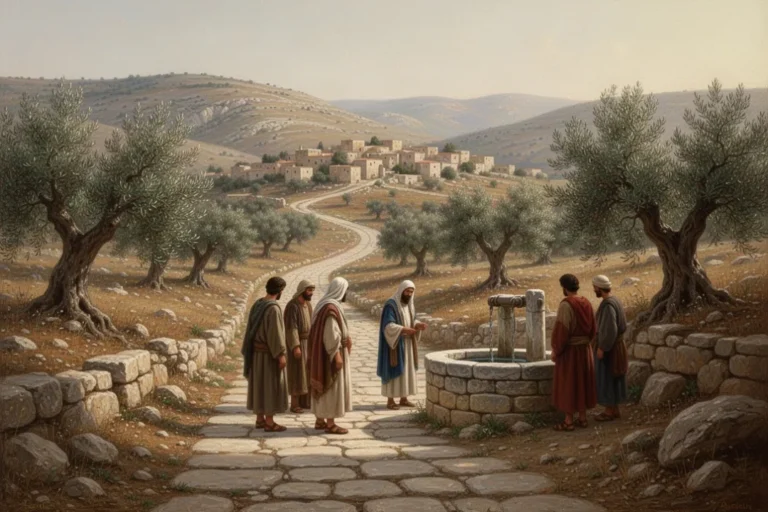
The encounter between Jesus and the Samaritan woman is one of the most important passages about Samaria in the Bible. John 4 places Jesus near Sychar, close to land associated with Jacob, and describes him speaking with a Samaritan woman at a well. The conversation crosses several social boundaries at once: ethnicity, religious tradition, gender, and public reputation.
Jesus asks her for a drink, which opens a conversation about water, worship, and spiritual life. He explains that the water from Jacob’s well meets a temporary physical need, while the life he gives has a lasting spiritual source. John presents this exchange as a revelation of Jesus’ identity and mission.
The woman raises the dispute between Mount Gerizim and Jerusalem. Jesus responds that the time is coming when worship will not be defined by either location alone. He describes true worship as directed toward God in spirit and truth, and he identifies himself to her as the promised Messiah.
Her testimony leads other people from the town to meet Jesus. Many Samaritans believe because of the woman’s message, and others believe after hearing Jesus themselves. The passage gives a Samaritan community a significant role in recognizing Jesus, even though many religious leaders elsewhere reject him.
John 4 presents worship as centered on God’s truth and presence rather than controlled by a rivalry between sacred locations.
The story also corrects assumptions about who can carry important spiritual news. The woman is not introduced as a respected religious authority, yet her encounter becomes the means by which others hear about Jesus. John’s account gives her a public and effective witness within her community.
What the parable of the Good Samaritan teaches
Jesus’ parable of the Good Samaritan appears in Luke 10. A legal expert asks what he must do to inherit eternal life and then asks Jesus to define his neighbor. Jesus responds with a story about a traveler attacked by robbers on the road from Jerusalem to Jericho.
A priest and a Levite see the injured man but pass by. A Samaritan then approaches, treats the wounds, transports the man to an inn, and pays for his care. Jesus asks which person acted as a neighbor, and the answer is the one who showed mercy.
The parable would have challenged the listener’s expectations. The Samaritan is presented as the person who obeys the command to love a neighbor, while respected religious figures fail to act. Jesus does not use the story to erase the historical tension between Jews and Samaritans. He uses that tension to make the command to love more demanding.
The Samaritan’s compassion is practical rather than abstract. He:
moves toward an injured stranger instead of avoiding him;
uses available resources to treat the man’s immediate needs;
takes responsibility for transportation and safety;
pays for continued care and offers to cover additional expenses.
The point is not that every Samaritan was morally superior or that every priest and Levite was uncaring. The parable focuses on a single act of mercy and asks the listener to identify neighbor-love by behavior, not by group identity or social status.
Samaria in Jesus’ teaching about mission
Samaria also appears in Jesus’ instructions to his disciples. In Matthew 10, Jesus sends the Twelve to proclaim the kingdom and initially tells them not to enter Samaritan towns or Gentile territory during that particular mission. This instruction belongs to a specific stage of Jesus’ ministry and should not be separated from the later expansion of the mission.
After his resurrection, Jesus names Samaria as part of the geographic spread of the disciples’ witness in Acts 1. The movement is described outward from Jerusalem through Judea and Samaria and then to the ends of the earth. Samaria occupies a significant middle position in this pattern, showing that the message is crossing an established religious and ethnic boundary.
These passages should be read together. The Gospels show both the historical limits of a particular mission and Jesus’ broader purpose to reach Samaritans. Samaria is not treated as permanently excluded. It becomes one of the first regions beyond Judea to receive the Christian message.
Philip brings the gospel to Samaria in Acts
Acts 8 describes a major expansion of the early Christian movement into Samaria. After persecution scatters believers from Jerusalem, Philip travels to a city in Samaria and proclaims the Messiah. The people listen to his teaching, observe signs of healing, and respond with joy.
Many Samaritans are baptized, including Simon, a man known for practicing magic who had previously impressed the population. The apostles in Jerusalem hear that Samaria has accepted the word of God and send Peter and John. They pray for the new believers and lay hands on them so that they receive the Holy Spirit.
This episode shows that the Samaritan mission was recognized by the Jerusalem church rather than treated as an unauthorized movement. Peter and John’s visit also connects the Samaritan believers with the wider community of disciples. The gospel crosses a deep historical divide, but the story still acknowledges the need for relationship and confirmation.
The account of Simon Magus warns against confusing spiritual power with personal status or financial control. Simon tries to obtain the ability to confer the Holy Spirit by offering money. Peter sharply rejects the idea and calls him to repentance, making clear that God’s gift cannot be bought.
Acts 8 later describes Philip meeting an Ethiopian official on the road toward Gaza. That encounter is not set in Samaria, but it follows the Samaritan mission and continues the geographical movement outward described in Acts. The chapter presents the gospel reaching people across ethnic, regional, and social boundaries.
Samaria’s place in the Old Testament narrative
Samaria appears in many political and prophetic settings beyond the main stories already mentioned. The city was a royal center during conflicts with Aram, also called Syria in some translations. In 2 Kings, Samaria experiences siege, famine, political upheaval, and eventual deliverance before its final fall.
Second Kings 6–7 describes a severe siege of Samaria during the reign of Jehoram. The famine becomes extreme, but the story then records a sudden reversal when the besieging army abandons its camp. The biblical writer presents the event as an example of God’s ability to rescue the city despite apparently impossible conditions.
Samaria also features in the history of Jehu’s violent purge of Ahab’s dynasty and Baal worship. Jehu destroys the temple of Baal in Samaria, yet the biblical evaluation of his reign remains mixed because he does not fully turn away from the worship practices associated with the northern kingdom’s golden calves.
This repeated pattern is significant. A ruler may remove one form of idolatry while retaining another. Biblical writers therefore evaluate Samaria’s kings not only by military success or political reform but by whether they follow the covenantal worship associated with Israel’s God.
Common mistakes when reading Samaria in the Bible
Samaria’s history spans many centuries, so readers can easily combine details from different periods. Keeping the city, region, kingdom, and people distinct makes the passages easier to understand.
Do not treat Samaria as only a city. In some passages it means the capital; in others it means the northern kingdom or the surrounding region.
Do not assume every reference concerns the first-century Samaritans. Prophetic references to Samaria usually concern the northern kingdom centuries before Jesus.
Do not reduce the conflict to simple ethnic prejudice. The division included disputes about scripture, worship, territory, ancestry, and political history.
Do not assume Jesus ignored the conflict. His conversations acknowledge real differences while challenging people to cross them through truth and mercy.
Do not read the Good Samaritan as a claim about an entire population. It is a parable centered on one person’s merciful action.
Do not confuse the Samaritan mission with the later Gentile mission. Samaritans had a distinctive relationship to Israel and were not simply interchangeable with all non-Jewish peoples.
Do not overlook the Old Testament setting. The New Testament references become clearer when you understand Samaria’s fall, resettlement, and religious disputes.
Practical ways to study Samaria in Scripture
A focused study works best when you read the passages in historical order rather than beginning with only the Good Samaritan. The story of Samaria develops from a capital city into a symbol of national failure, then into a region where Jesus demonstrates the reach of God’s mercy.
Start with the city’s origin. Read 1 Kings 16:21–34 to see how Omri established Samaria as the capital and how Ahab’s reign shaped its reputation.
Read the prophetic warnings. Compare Amos 3–6, Hosea, Micah 1, and selected passages in Isaiah to observe how prophets connect Samaria with injustice and idolatry.
Study the Assyrian conquest. Read 2 Kings 17 to understand the fall of the northern kingdom and the biblical interpretation of exile and resettlement.
Read the Gospel passages together. Compare John 4, Luke 9, Luke 10, and Matthew 10 to see how Jesus addresses Samaritans in conversation, parable, travel, and mission.
Finish with Acts 1 and Acts 8. These passages show Samaria becoming a significant stage in the spread of the Christian message.
Ask what changes in each period. Note whether Samaria is functioning as a capital, a conquered territory, a religious rival, or a community receiving the gospel.
Study tip: Mark every reference to Samaria as city, region, kingdom, or people. That simple distinction prevents many chronological and interpretive mistakes.
What Samaria reveals about mercy and reconciliation
Samaria’s biblical significance rests partly in the way its history exposes the consequences of division. The region was shaped by conquest, migration, disputed identity, and competing claims about true worship. Those realities produced suspicion that lasted for generations.
Jesus does not solve the tension by pretending that history is irrelevant. Instead, he places Samaritans in stories of faith, mercy, theological insight, and mission. The Samaritan woman becomes a witness, the Samaritan traveler becomes an example of neighbor-love, and Samaritan towns become part of the movement receiving the gospel.
At the same time, the biblical texts preserve the seriousness of the past. Samaria’s capital fell because of sustained rebellion and injustice, and the later conflict with Judea was not imaginary. The message is therefore not sentimental agreement but a call to recognize truth, practice mercy, and refuse to let inherited hostility determine who can receive dignity or bear witness.
For readers today, the strongest themes are clear: God’s concern reaches across boundaries, worship cannot be separated from truth, and neighbor-love is demonstrated through concrete action. Samaria’s story moves from political collapse to unexpected spiritual significance, showing how a place associated with division can become central to teaching about compassion and reconciliation.
Frequently asked questions
Where was Samaria located in the Bible?
Samaria was located in the central hill country of ancient Israel, between Galilee to the north and Judea to the south. The city of Samaria stood on a hill and served as the capital of the northern kingdom of Israel. In the New Testament period, Samaria referred both to the region and to the community of people associated with it.
Why did Jews and Samaritans dislike each other?
Their conflict developed through centuries of political, ethnic, and religious disagreement. The communities disputed ancestry, scripture, the proper place of worship, and control of the land. Assyrian conquest and resettlement also shaped Samaritan identity. By Jesus’ time, these historical differences had produced strong social tension, although the relationship was not identical in every place or situation.
What is the most famous Samaritan story in the Bible?
The parable of the Good Samaritan in Luke 10 is probably the best-known story. Jesus describes a Samaritan helping a badly injured traveler after a priest and Levite pass by. The story teaches that being a neighbor means showing practical mercy, even across deep social and religious boundaries.
Did Christianity spread to Samaria?
Yes. Acts 8 describes Philip preaching in a Samaritan city, where many people believed and were baptized. Peter and John later visited from Jerusalem, prayed for the believers, and laid hands on them. Acts 1 also identifies Samaria as a major stage in the spread of Jesus’ message from Jerusalem toward the wider world.










Leave a Reply