Damascus in the Bible: History, Prophecy, and Paul
Damascus in the Bible: History, Prophecy, and Paul
Damascus is one of the Bible’s oldest and most frequently mentioned cities outside Israel.
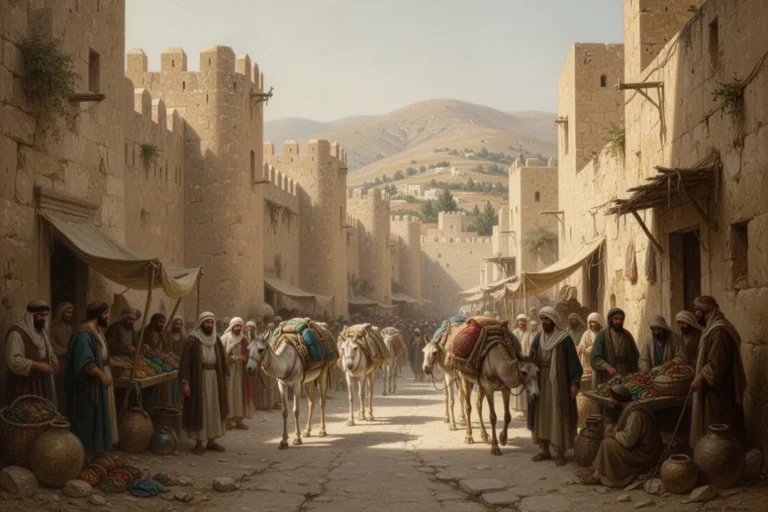
Located in what is now Syria, Damascus appears in the Bible as a place of trade, royal power, military conflict, prophetic judgment, and Christian mission. Its location made it especially significant: the city stood near major routes connecting Mesopotamia, Arabia, the Mediterranean coast, and the lands of Israel and Judah.
The city’s biblical importance grows across the biblical story. In the Old Testament, Damascus is closely associated with Aram, the kingdom centered in Syria, and with repeated wars against Israel and Judah. In the New Testament, it becomes the setting for Saul’s encounter with the risen Jesus and the beginning of his ministry as the apostle Paul.
The earliest biblical reference to Damascus is connected with Abram, later called Abraham. After Abram rescued Lot from a coalition of kings, the text mentions a servant named Eliezer of Damascus in Genesis 15:2. Abram’s concern was that, if he remained childless, his household servant might become his heir.
Genesis 14:15 also refers to Hobah, north of Damascus, while describing Abram’s pursuit of the invading kings. The passage does not tell a detailed story about Damascus itself, but it shows that the city was already a recognizable geographic landmark in the patriarchal period.
Later references make Damascus much more prominent. The Bible often uses “Damascus” to mean either the city or the Aramean kingdom associated with it. This distinction matters because some passages focus on the city’s inhabitants, while others describe the actions of its kings and armies.
Genesis connects Damascus with Abram’s household and the region north of the city.
2 Samuel and Kings describe wars between Israel, Judah, and Aram-Damascus.
Isaiah, Jeremiah, Amos, and other prophets announce judgment against Damascus and its rulers.
Acts and Paul’s letters describe Damascus as the place where Saul encountered Jesus and began his Christian mission.
Damascus was not simply a background location. Its position and political influence brought it repeatedly into contact with the kingdoms of Israel and Judah. The city could be an ally, an enemy, a trading center, or a symbol of foreign power depending on the passage.
Key idea: Biblical references to Damascus cover many centuries, so each passage should be read in its own historical setting rather than treated as one continuous event.
Why Damascus mattered in Israel’s history
Damascus became the capital of Aram-Damascus, a powerful Aramean kingdom north of Israel. Aram was not identical to modern Syria in every historical detail, but the biblical writers regularly associate Damascus with the territory and rulers known as Aram.
During the reign of David, the Arameans of Damascus came into conflict with Israel. According to 2 Samuel 8, David defeated forces connected with Hadadezer, king of Zobah, and then established control over Aramean territory. The passage presents David’s victories as part of the expansion and security of his kingdom.
After Solomon’s reign, Damascus became a major adversary of the divided northern kingdom of Israel. Ben-Hadad, king of Aram, fought against Israel during the reign of Baasha, according to 1 Kings 15. King Asa of Judah appealed to Ben-Hadad for military help against Israel, giving him treasures from the temple and royal palace. Ben-Hadad then attacked several Israelite towns, forcing Baasha to stop fortifying Ramah.
This episode shows that Damascus was involved not only in direct warfare but also in the shifting diplomacy of the divided monarchy. Judah, Israel, and Aram sometimes fought one another, while at other times they formed temporary alliances against a larger threat.
The prophet Elisha had a significant relationship with Damascus and its rulers. In 2 Kings 8, he went to the city while Ben-Hadad, king of Aram, was ill. The king sent Hazael to ask whether he would recover. Elisha predicted that Hazael would become king and would bring severe suffering upon Israel.
Hazael later ruled Aram and became one of Israel’s most dangerous enemies. Second Kings 10 describes his attacks on Israelite territory east of the Jordan, and 2 Kings 12 says he captured the Philistine city of Gath before turning toward Jerusalem. King Jehoash of Judah paid him to withdraw from the city, using sacred and royal treasures.
Under Hazael and his son Ben-Hadad, Damascus exerted intense pressure on the northern kingdom. Second Kings 13 says that Israel’s military strength was greatly reduced, although the Lord later provided relief through King Jehoahaz. These accounts portray Damascus as a serious regional power rather than a minor neighboring city.
Aram-Damascus also fought Judah during the reign of King Ahaz. Rezin, king of Aram, joined Pekah, king of Israel, in attacking Jerusalem. Their campaign created fear in Judah, but they did not capture the city. Isaiah 7 presents this crisis as the setting for the prophet’s message to Ahaz.
Isaiah told Ahaz that the coalition of Aram and Israel would not ultimately succeed. The prophet also challenged the king to trust God rather than respond to the crisis only through political calculations. Ahaz chose another strategy: he appealed to Tiglath-pileser III, king of Assyria, asking him to rescue Judah from Aram and Israel.
The Assyrian king responded by attacking Damascus. Second Kings 16 records that Tiglath-pileser captured the city, killed Rezin, and deported its people. Ahaz then traveled to Damascus to meet the Assyrian king and copied the design of an altar he saw there for use in Jerusalem.
This episode reveals a painful irony in Judah’s history. Ahaz sought help from Assyria against Damascus, but the alliance also brought Assyrian influence into Judah’s worship and politics. Damascus fell, yet Judah’s dependence on a larger empire created new dangers.
What the prophets said about Damascus
Several biblical prophets announced judgment against Damascus. These prophecies should be understood within the broader pattern of divine accountability applied to surrounding nations. Damascus was not judged merely because it was foreign; the prophets condemned violence, cruelty, oppression, arrogance, and hostility toward God’s people.
Amos 1:3-5 condemns Damascus for its brutal treatment of Gilead. The image used by the prophet describes an especially harsh method of threshing, emphasizing the severity of the Aramean attacks. Amos announces that fire will consume the strongholds of Damascus and that its people will be exiled.
Isaiah 17 focuses on Damascus and describes the city’s future decline. The prophecy presents Damascus as losing its status and becoming a weakened remnant. It also links the judgment of Damascus with the weakening of the northern kingdom of Israel, reflecting the political alliance between the two powers during Isaiah’s time.
The chapter does not function simply as a modern prediction about one isolated event. It uses poetic language to portray the collapse of hostile powers and to call attention to Israel’s failure to rely on its Creator. The prophecy moves between judgment, human fear, and the need to look toward God rather than military strength.
Jeremiah 49:23-27 also speaks against Damascus. The passage describes distress in the city, fear among its people, and fire against its walls. Its language conveys the collapse of confidence in a city that had been known for strength and influence.
The prophets often used city walls, gates, fortresses, and fire as images of political collapse. These details were not merely decorative. A walled city represented security, royal authority, and the ability to resist invasion. When the prophets announced that Damascus’s defenses would burn, they were declaring that its political order could not protect it forever.
Amos, Isaiah, and Jeremiah each address Damascus in different circumstances. Amos speaks from the period of the divided monarchy, Isaiah addresses a crisis involving Judah, Israel, and Aram, and Jeremiah speaks in the era of expanding Babylonian power. Reading the passages together shows a recurring biblical theme: regional power is temporary, and violence brings accountability.
Damascus is also mentioned in Ezekiel 27:18 as a trading partner of Tyre. The verse lists wine from Helbon and wool from Zahar as goods associated with Damascus. This reference adds an economic dimension to the city’s biblical identity. Damascus was not known only for armies and kings; it participated in long-distance commerce.
Zechariah 9:1 places a divine message against the land of Hadrach and Damascus, suggesting that the city would be associated with the movement of judgment through the region. The wording is poetic and difficult in places, but the main emphasis remains clear: Damascus lies within the nations accountable to God.
Reading prophecy carefully: Biblical judgments against Damascus use poetry, symbolism, and historical context. They should not be reduced to a simple one-to-one prediction without considering the passage’s original setting and purpose.
What happened to Saul on the road to Damascus
Damascus becomes central again in the New Testament through the conversion and calling of Saul. Before this event, Saul was a zealous persecutor of Jesus’ followers. Acts 8 and 9 describe his opposition to the early church, and Acts 22 and 26 retell his encounter in Paul’s own defense speeches.
Saul obtained authorization from the high priest to travel to Damascus and arrest followers of Jesus. He intended to bring them back to Jerusalem for punishment. On the journey, a bright heavenly light surrounded him, and he heard Jesus challenge his persecution of the church.
Acts 9 says that Saul fell to the ground and became blind. His companions led him into Damascus, where he stayed for three days without seeing, eating, or drinking. The experience marked a complete reversal: the man arriving as an enemy of Jesus’ followers would leave as a witness to Jesus.
In Damascus, a disciple named Ananias received a vision directing him to visit Saul. Ananias knew Saul’s reputation and feared him, but God told him that Saul had been chosen to carry Jesus’ name to Gentiles, kings, and the people of Israel.
Ananias laid hands on Saul, and Saul’s sight was restored. He was baptized and began to spend time with the disciples in Damascus. Acts 9 then says that he began proclaiming in the synagogues that Jesus is the Son of God.
The city therefore became the first major setting of Saul’s Christian ministry. Damascus was not merely where he recovered physically. It was where his identity, allegiance, and public message changed.
Paul later gave additional details about the event. In Galatians 1:15-17, he explains that after God called him, he did not immediately consult the Jerusalem apostles. Instead, he went away to Arabia and later returned to Damascus. His point in that letter is that his gospel and calling came from God, not from dependence on human authorization.
In 2 Corinthians 11:32-33, Paul recalls that the governor under King Aretas guarded the city of Damascus in order to arrest him. His fellow believers lowered him in a basket through an opening in the city wall, allowing him to escape. This detail indicates that opposition began early in his ministry.
Acts 22 describes the Lord’s instruction to Paul in the city through Ananias. Acts 26 emphasizes the heavenly commission Paul received: he was sent to open people’s eyes and turn them from darkness to light. The three accounts share the central facts but present them for different audiences and purposes.
Saul traveled toward Damascus intending to arrest Jesus’ followers.
Jesus confronted him through a heavenly appearance and voice.
Saul entered the city blind and waited for further direction.
Ananias visited him, prayed for him, and explained his calling.
Saul was baptized and began proclaiming Jesus in the synagogues.
Opposition followed, and believers helped him escape through the city wall.
The phrase “Damascus road experience” comes from this event, although the Bible’s emphasis is not on a generic moment of personal inspiration. Saul encountered Jesus, received mercy, accepted a new mission, and entered the fellowship of the people he had persecuted.
How Damascus connects the Old and New Testaments
The biblical portrait of Damascus changes as the story moves from the Old Testament to the New Testament. Earlier passages usually present the city as a center of foreign power that threatens Israel and Judah. The New Testament presents it as the place where God redirects one of Christianity’s most influential missionaries.
That contrast does not erase the earlier history. Damascus remains a real city with a long record of political conflict and trade. Its significance in Acts depends partly on its location: it was an established urban center with Jewish communities, synagogues, commercial routes, and connections across the eastern Mediterranean and Near East.
The presence of disciples in Damascus shows that the message about Jesus had already reached beyond Jerusalem. Saul’s mission there also demonstrates that the early Christian movement was not confined to one city. Damascus became a base from which the gospel could spread through the region.
The city’s role in Paul’s life also highlights the importance of Ananias. Paul’s calling was dramatic, but his restoration and welcome involved an ordinary disciple who obeyed a difficult instruction. Ananias represents the local church that received Saul when his past made trust difficult.
Damascus therefore carries several connected biblical meanings:
A historic crossroads: Its location connected major regions and helped make it politically and commercially influential.
A rival kingdom: Aram-Damascus repeatedly challenged Israel and Judah.
A subject of prophecy: The prophets used the city to illustrate judgment on violence, pride, and military power.
A place of transformation: Saul’s encounter with Jesus changed the direction of his life and ministry.
A bridge between communities: The city contained Jewish and Christian communities beyond Jerusalem and helped carry the gospel outward.
The most important lesson is not that Damascus has only one symbolic meaning. Its meaning depends on the passage. In Genesis, it marks a geographic and household connection; in Kings, it represents regional conflict; in the prophets, it symbolizes accountable power; in Acts, it becomes the setting for grace and mission.
For readers studying Damascus in the Bible, the most useful approach is to examine each reference in context. Ask whether the passage is describing geography, a king, a war, a prophecy, trade, or Paul’s ministry. That method prevents the city from becoming a vague symbol and allows its many biblical roles to remain visible.
Frequently asked questions
Is Damascus the oldest city in the world?
Damascus is often described as one of the world’s oldest continuously inhabited cities, but the Bible itself does not make that claim or provide a founding date. Its early appearance in Genesis and its prominent role in later biblical history show that it was already an established and recognizable city in the ancient Near East.
Did Paul become a Christian in Damascus?
Paul encountered Jesus while traveling toward Damascus, but the city was where the consequences of that encounter unfolded. There he received help from Ananias, regained his sight, was baptized, joined the disciples, and began preaching. Acts presents Damascus as the first major setting of his new life and ministry.
What did Damascus represent in biblical prophecy?
In prophetic passages, Damascus often represented a powerful foreign kingdom accountable for violence and pride. Amos, Isaiah, and Jeremiah describe judgment against the city in different historical settings. These texts emphasize the temporary nature of military power and God’s judgment on oppression rather than assigning Damascus one universal symbolic meaning.
What is the Street called Straight?
The Street called Straight was a known location in Damascus where Saul was staying after his encounter with Jesus, according to Acts 9:11. The passage does not provide a detailed map or modern identification, but it places Saul inside the city and shows that Ananias was given a specific destination for his visit.









Leave a Reply