King Hezekiah: faith, reforms, and the Assyrian crisis
King Hezekiah: faith, reforms, and the Assyrian crisis
When a powerful enemy threatens your city, should you negotiate, fight, or trust God? That question stands at the center of King Hezekiah’s story. Hezekiah ruled the southern kingdom of Judah during a dangerous period when the Assyrian Empire dominated the ancient Near East. He inherited a weakened nation from his father, Ahaz, yet became known as one of Judah’s most faithful kings.
Hezekiah’s reign was not simple or flawless. He reopened and repaired the Jerusalem temple, removed unauthorized worship practices, and encouraged the people to return to the worship of the Lord. He also strengthened Jerusalem’s defenses and faced a major Assyrian invasion. Later, however, he displayed his wealth to Babylonian visitors and received a serious warning from the prophet Isaiah.
Hezekiah was the son of King Ahaz and became king of Judah after his father’s death. The biblical accounts in 2 Kings 18, 2 Chronicles 29, and Isaiah 36 describe him as a ruler who sought to follow God more faithfully than many of Judah’s earlier kings. His reign lasted about 29 years, although the exact calendar dates are presented somewhat differently by modern historians.
Hezekiah ruled from Jerusalem over Judah, the smaller southern kingdom formed after Israel’s united monarchy divided. The northern kingdom, often called Israel or Samaria, had already been conquered by Assyria during Hezekiah’s reign. That defeat created a stark warning for Judah: a much larger imperial power stood close to its borders, and resistance could bring destruction.
His father, Ahaz, had responded to international pressure by seeking help from Assyria. That decision gave Judah short-term relief from some enemies but placed the kingdom under Assyrian influence. Hezekiah inherited the consequences: political dependence, religious disorder, and the continuing threat of invasion.
At a glance: Hezekiah’s story combines spiritual reform, careful preparation for war, confidence under pressure, and a later warning about pride. His example is strongest when viewed as a whole rather than reduced to either heroic faith or personal failure.
Why Hezekiah began religious reforms
The biblical narrative presents Hezekiah’s first major priority as restoring worship in the temple at Jerusalem. According to 2 Chronicles 29, the temple had been neglected during Ahaz’s reign. Its doors were closed, its furnishings were damaged or removed, and the priestly service had been disrupted.
Hezekiah gathered the priests and Levites and instructed them to consecrate the temple. In the account, the work involved removing impurity, repairing what had been damaged, and reestablishing worship through sacrifices, music, and prayer. The reform was not merely a private religious preference. It was an attempt to reshape the public life of Judah around the covenant traditions associated with Jerusalem.
Hezekiah also removed high places, sacred pillars, and Asherah symbols. These objects and locations represented forms of worship that the biblical writers viewed as incompatible with exclusive devotion to the Lord. He even destroyed the bronze serpent associated with Moses because people had begun treating it as an object of worship. The account in 2 Kings 18 calls it Nehushtan, emphasizing that a religious object could become spiritually harmful when it displaced God.
That detail gives Hezekiah’s reforms a practical dimension. A symbol that once had a legitimate place in Israel’s story could still become an idol. The king’s action was therefore not a rejection of history but a rejection of misdirected devotion.
How Hezekiah celebrated Passover across Judah
After restoring the temple, Hezekiah invited people from Judah and from the remnant of the northern tribes to celebrate Passover in Jerusalem. The invitation crossed the old political boundary between Judah and Israel. Since the northern kingdom had suffered conquest and displacement, the appeal also carried a message of shared identity and hope.
According to 2 Chronicles 30, messengers traveled through the land calling people to return to the Lord and gather in Jerusalem. Some mocked the invitation, while others responded. The account describes a large celebration involving worship, teaching, sacrifice, music, and communal meals.
The Passover initiative mattered for several reasons:
It linked reform with national renewal. Hezekiah did not treat worship as a private matter separated from the condition of the nation.
It reached beyond Judah. The invitation recognized the continuing connection among the descendants of Israel despite political division.
It centered Jerusalem’s temple. The city became a focal point for religious identity and public unity.
It acknowledged imperfect preparation. The biblical account presents Hezekiah praying for people who had not followed every ritual detail correctly, while still seeking God sincerely.
The festival also reveals Hezekiah’s leadership style. He acted decisively, but the narrative does not portray every participant as equally prepared or enthusiastic. Reform required communication, patience, and a willingness to call people back rather than assume that a damaged society could be repaired instantly.
How Hezekiah strengthened Jerusalem before Assyria attacked
Hezekiah understood that religious reform did not remove the need for practical preparation. As Assyria expanded westward, he fortified Jerusalem and organized defenses. The biblical accounts mention repairs to walls and the creation of weapons and shields. They also describe efforts to secure Jerusalem’s water supply.
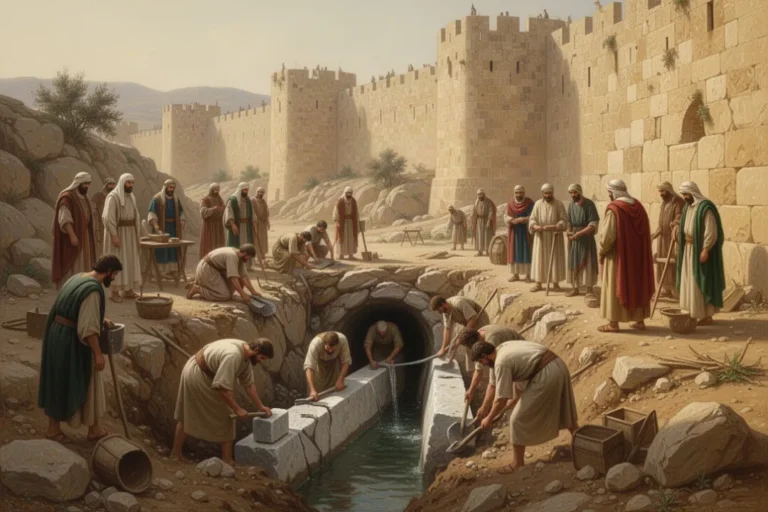
The most famous project is the Hezekiah tunnel, a water channel that brought water from the Gihon Spring to the Pool of Siloam inside the city. Its construction is described in the Siloam Inscription, an ancient text found near the tunnel. The inscription records workers cutting toward one another through the rock and meeting near the middle.
By bringing water inside the city walls, Jerusalem could better withstand a siege. A city with food and weapons but no reliable water would remain vulnerable. Hezekiah’s preparations therefore included both spiritual dependence and engineering skill.
He also built or strengthened defensive structures, including sections of Jerusalem’s fortifications. Archaeological evidence from the City of David and other areas is often discussed alongside the biblical descriptions, though the exact identification and dating of every wall remain subjects of scholarly study.
Outside Jerusalem, Hezekiah appears to have prepared Judah for a wider conflict. He stopped paying tribute to Assyria and confronted Assyrian control over the region. That decision may have been encouraged by changing international conditions, including Assyria’s attention to other parts of its empire, but it carried enormous risk.
Practical lesson from the preparations: Biblical trust is not presented as passivity. Hezekiah prayed and relied on God, but he also repaired walls, secured water, organized resources, and faced the military realities around Judah.
What happened when Sennacherib invaded Judah
Assyrian King Sennacherib invaded Judah during Hezekiah’s reign. The campaign is described in 2 Kings 18–19, Isaiah 36–37, and 2 Chronicles 32. Assyrian records also mention Sennacherib’s campaign in the region, including the capture of many Judean towns and the confinement of Hezekiah in Jerusalem.
The Assyrian army captured fortified cities in Judah, including Lachish. From there, an Assyrian delegation approached Jerusalem and tried to force its surrender. The chief spokesman, commonly called the Rabshakeh in the biblical account, spoke in a way designed to weaken the confidence of both the king and the population.
He argued that Judah could not rely on Egypt, its military strength was insufficient, and the Lord would not rescue Jerusalem. He also appealed directly to the people in their own language rather than speaking only to the officials. This was psychological warfare: the message aimed to produce fear, division, and surrender before the city had to be taken by force.
Hezekiah responded by tearing his clothes, putting on sackcloth, and going to the temple. He sent officials to consult Isaiah the prophet. The king’s reaction shows that he understood the crisis as more than a military problem. The survival of Jerusalem would test the claims of both Assyrian power and Judah’s faith.
Isaiah encouraged Hezekiah not to surrender to the Assyrian threats. When the Assyrians sent a written message repeating their demands, Hezekiah spread it before the Lord and prayed. The prayer acknowledged Assyria’s power but appealed to God’s reputation and authority over the nations.
The biblical accounts then describe the Assyrian army’s defeat or withdrawal without capturing Jerusalem. The texts attribute the outcome to divine intervention. Assyrian records do not claim that Sennacherib conquered Jerusalem; instead, the Assyrian king presents Hezekiah as shut up in the city and emphasizes the tribute he received.
These accounts are not identical in emphasis. The biblical writers focus on Jerusalem’s deliverance and God’s response to Hezekiah’s prayer. The Assyrian royal account focuses on imperial success and tribute. Read together, they show that Hezekiah survived a catastrophic campaign, even though Judah suffered heavily and remained under pressure.
Why Hezekiah’s response to Assyria matters
Hezekiah’s conduct during the crisis is remembered because he neither ignored the danger nor treated military power as ultimate. He listened to the enemy’s message, recognized its persuasive strategy, sought prophetic counsel, and prayed openly. That sequence differs from impulsive confidence or denial.
The story also distinguishes between humility before God and humiliation before an empire. Hezekiah did not pretend that Assyria was weak. He recognized the threat and the suffering it had already caused. His faith involved bringing the threat before God rather than allowing the threat to define reality.
At the same time, the biblical text does not erase the cost of the invasion. Judah’s towns had been taken, residents had suffered, and Hezekiah had previously offered tribute in an attempt to stop the campaign. Jerusalem’s survival was not the same as an easy victory. The account presents deliverance within a wider picture of war, loss, and political vulnerability.
What the Bible says about Hezekiah’s illness and recovery
After the Assyrian crisis, or in a narrative sequence that may not follow strict chronology, Hezekiah became seriously ill. Isaiah told him to put his affairs in order because he would die. Hezekiah turned toward the wall and prayed with tears, asking God to remember his faithful service.
The account then says that God answered through Isaiah and extended Hezekiah’s life. A sign involving the movement of the shadow was given to confirm the promise. The biblical text describes the event but does not provide a scientific explanation that resolves every question about it.
Hezekiah responded with a prayer or song that reflects on mortality, grief, and renewed life. Its imagery emphasizes that a person cannot praise God from the grave in the same way as someone living. The passage offers a window into the king’s personal experience: he was not simply a public reformer or military leader but a vulnerable man facing death.
After his recovery, Hezekiah became proud, according to 2 Chronicles 32. The account says that God left him for a time in order to test him and reveal what was in his heart. This shift matters because it prevents an overly simple portrait. A leader may respond faithfully in one crisis and still need correction in another.
Why Hezekiah showed Babylonian visitors his treasures
Visitors came from Babylon after hearing that Hezekiah had been ill. Babylon at that time was connected to the broader political world resisting Assyria. The visitors’ arrival may have had diplomatic motives, although the biblical account emphasizes Hezekiah’s response rather than explaining every political calculation behind the visit.
Hezekiah showed them his storehouses, treasures, weapons, and other possessions. Isaiah then asked what the visitors had seen. When Hezekiah admitted that he had shown them everything, Isaiah announced that a future generation would see these treasures carried away to Babylon and that members of Hezekiah’s own royal line would be taken there.
The story exposes a different weakness from the one seen during the Assyrian invasion. Under pressure from Assyria, Hezekiah turned to prayer. In the Babylonian episode, he appears eager to display the resources of his kingdom. The issue is not merely that he gave a tour; it is that his confidence had become attached to wealth and political prestige.
Hezekiah’s response to Isaiah is also troubling. He accepted the word because the announced judgment would not occur during his own lifetime, and he noted that there would be peace and security in his days. The passage suggests a limited perspective: relief for the present could matter more to him than consequences for his descendants.
Babylon later conquered Jerusalem, though long after Hezekiah’s reign. The biblical writers therefore connect Hezekiah’s display of wealth with a future national disaster, not because his action single-handedly caused the exile, but because it revealed the pride and misplaced security that continued to weaken Judah.
Common mistakes when interpreting King Hezekiah
Hezekiah’s story is often reduced to a few familiar moments. A careful reading avoids turning him into either a perfect hero or a failed ruler. These are the most common interpretive mistakes:
Calling him flawless. Hezekiah is praised for his faithfulness, but the accounts also describe his pride and the consequences of displaying his wealth.
Separating faith from preparation. Hezekiah’s prayers did not replace practical defense, water management, or military organization.
Assuming Assyria was defeated everywhere. Jerusalem survived, but Assyria conquered many Judean towns and imposed severe pressure on the kingdom.
Treating the bronze serpent as inherently evil. The problem was not its historical association with Moses; the problem was that it had become an object of worship.
Reading the Babylon episode as harmless diplomacy. The biblical narrative presents the display of wealth as a revelation of pride and a warning about future judgment.
Ignoring the northern tribes. Hezekiah’s Passover invitation shows that his religious vision extended beyond the political borders of Judah.
Confusing biblical chronology. The accounts in Kings, Chronicles, and Isaiah arrange some events differently. Their shared themes remain clear even where the sequence is debated.
What Hezekiah’s leadership teaches about reform
Hezekiah began reform with visible action. He opened the temple, organized religious leaders, removed objects associated with idolatry, and called the people to worship. Reform required him to challenge habits that had become normal under previous leadership.
His example also shows that reform has both institutional and personal dimensions. Institutions needed repair, but the people also needed invitation and instruction. The Passover gathering gave the reforms a communal shape rather than leaving them as royal orders imposed from above.
Another lesson concerns discernment. Hezekiah did not preserve every inherited practice simply because it had a respected history. The bronze serpent had once been connected with a significant moment in Israel’s past, but it had become a substitute for proper worship. Faithfulness sometimes requires distinguishing between a valuable symbol and the misuse of that symbol.
The reforms were also incomplete. The biblical books do not present Judah as permanently transformed. Later kings reversed or damaged much of what Hezekiah had done. His son Manasseh became associated with practices the biblical writers strongly condemn. A good reforming reign could not guarantee that future rulers would preserve its gains.
How Hezekiah is remembered in the Bible and history
The biblical evaluation of Hezekiah is unusually positive. Second Kings compares him favorably with the kings who came before him and highlights his trust in the Lord. Second Chronicles gives extensive attention to his temple reforms, Passover celebration, preparations for invasion, and organization of worship.
Isaiah 36–39 tells a closely related version of the Assyrian crisis, illness, recovery, and Babylonian visitors. The repeated material shows how central these episodes were to the memory of Judah’s monarchy. Hezekiah’s reign stood at the intersection of religious renewal, imperial expansion, and the future threat of exile.
Archaeological and historical evidence adds context. The Siloam Inscription supports the existence of a major water-construction project in Jerusalem. Assyrian records and reliefs from Sennacherib’s reign confirm the campaign against Judah and the capture of Lachish. These sources do not answer every question, but they place Hezekiah within a well-attested era of Assyrian expansion.
Hezekiah’s legacy is therefore larger than the question of whether he was a successful king by military standards. He attempted to restore worship, defend his capital, unite a divided people, and resist the pressure to measure security only by imperial power or royal wealth.
How to read Hezekiah’s story in a balanced way
Begin with the pressures surrounding him. Hezekiah did not rule in peaceful isolation. He inherited the effects of Ahaz’s policies, watched the northern kingdom fall, faced Assyrian armies, and governed a nation that could not match the resources of the empire threatening it.
Then hold together the different parts of his character. He was a reformer who removed idols, a planner who secured Jerusalem’s water, a king who prayed under pressure, a patient recipient of healing, and a proud ruler who exposed his treasures. The story gains depth when all of these details remain visible.
Finally, pay attention to the contrast between temporary success and lasting faithfulness. Jerusalem’s deliverance did not remove every future danger. Hezekiah’s recovery did not make him immune to pride. His reforms mattered, but they required continued faithfulness from later generations.
For that reason, King Hezekiah remains a compelling biblical figure. He demonstrates that wise leadership includes worship, preparation, courage, humility, and correction. His strongest moments show what trust can look like under imperial threat; his weakest moments warn that success can quietly redirect confidence toward possessions, reputation, and present comfort.
Frequently asked questions
Was King Hezekiah a good king?
Hezekiah is generally remembered as one of Judah’s most faithful kings. He restored temple worship, removed idolatrous practices, encouraged Passover, and sought God during the Assyrian invasion. However, he was not portrayed as perfect. His pride after recovery from illness led him to display Judah’s wealth to Babylonian visitors, and Isaiah connected that action with future judgment.
Did Hezekiah defeat the Assyrian army?
Hezekiah did not defeat Assyria in a conventional campaign. Assyria conquered many Judean cities and placed Jerusalem under severe threat. According to 2 Kings, Isaiah, and Chronicles, the Assyrian army failed to capture Jerusalem and withdrew after God answered Hezekiah’s prayer. Assyrian records also describe Hezekiah as confined in Jerusalem rather than claiming that the city was conquered.
What was Hezekiah’s tunnel used for?
Hezekiah’s tunnel carried water from the Gihon Spring to the Pool of Siloam inside Jerusalem. Its purpose was to protect the city’s water supply during an expected siege. The tunnel is associated with the Siloam Inscription, which describes workers cutting through the rock from opposite directions until they met.
Who succeeded King Hezekiah?
Hezekiah was succeeded by his son Manasseh. Manasseh’s reign is presented very negatively in Kings and Chronicles because of religious practices that opposed the reforms associated with his father. His long reign illustrates that Hezekiah’s restoration of worship did not automatically determine the direction of Judah’s future leadership.






Leave a Reply