Mount Gerizim: Meaning, History, and Biblical Significance
Mount Gerizim: Meaning, History, and Biblical Significance
Gerizim, usually called Mount Gerizim, is a mountain near Nablus in the central West Bank. It is sacred above all to the Samaritan community, which regards it as the place chosen by God for worship and as the true holy mountain of ancient Israel.
In the Bible, Mount Gerizim is linked with blessing, while nearby Mount Ebal is linked with a public declaration of curses. The mountain also appears in the story of the Samaritan woman in John 4, where Jesus discusses the proper place of worship with a woman from the nearby Samaritan community.
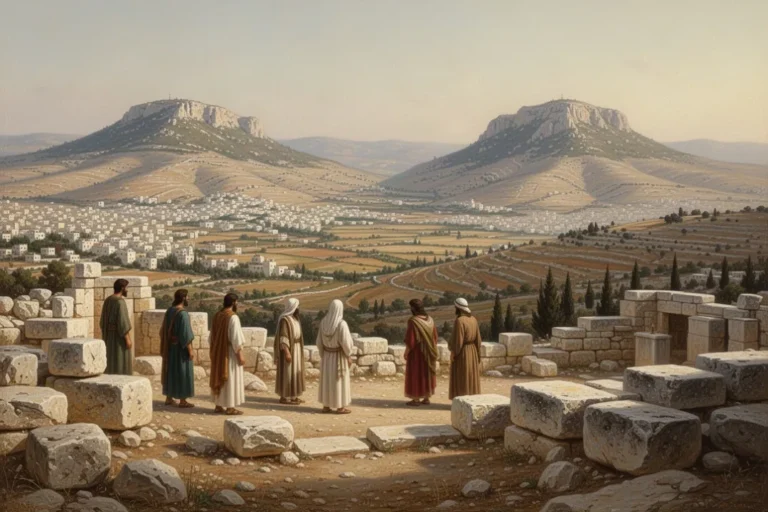
Mount Gerizim rises on the southern side of the valley containing Nablus, an ancient city in the hill country of Samaria. Mount Ebal stands across the valley to the north. Together, the two mountains create the geographical setting for several important biblical passages about covenant, obedience, worship, and the identity of Israel.
The mountain reaches roughly 880 meters above sea level, although the exact elevation may be given somewhat differently by different sources. Its position gives it a broad view over the surrounding central highlands, including the approaches to Nablus and the ancient route through the region.
For Samaritans, Gerizim is not simply a location mentioned in Scripture. It is the center of their faith. Samaritan tradition holds that the mountain was the original sanctuary selected by God and that worship at Jerusalem represents a later departure from the proper place of worship.
The central idea: Mount Gerizim represents blessing and authentic worship in Samaritan tradition, while biblical passages also connect it with covenant ceremonies and the history of the people of Israel.
A short context for understanding Gerizim
The Samaritans share important religious roots with ancient Israel but developed a distinct religious identity. They accept the Torah, or five books of Moses, as their central Scripture, but their textual tradition and interpretation differ from those of Judaism. Their religious community has preserved its own customs, priesthood, calendar, and sacred traditions.
The dispute over Gerizim and Jerusalem is part of a much larger disagreement about the correct place of worship. Jewish tradition centers the Temple in Jerusalem, whereas Samaritan tradition places the chosen sanctuary on Mount Gerizim. This disagreement appears in the background of the conversation recorded in John 4.
The mountain’s significance therefore has several layers. It is a biblical landscape, an archaeological site, a place of living Samaritan worship, and a symbol of a long-standing religious division. Treating it only as an ancient ruin misses the fact that Samaritans continue to celebrate important religious festivals there.
How to understand Gerizim step by step
Start with the geography. Gerizim and Ebal face one another across the valley of Nablus, making them a natural pair in the biblical account of covenant blessings and curses.
Read the Torah references together. Deuteronomy connects Gerizim with blessing and Ebal with curse, while also commanding a covenant ceremony after the Israelites enter the land.
Consider Joshua’s ceremony. Joshua 8 describes the people gathered between the two mountains as the law is read publicly and the covenant is reaffirmed.
Separate biblical traditions carefully. The Jewish Masoretic Text and the Samaritan Pentateuch differ at a key point concerning the location of the altar, so the two communities read the evidence differently.
Recognize the later sanctuary. Archaeological remains show that a Samaritan temple and related settlement existed on or near Gerizim during the Second Temple period.
Connect the mountain with John 4. The Samaritan woman’s reference to worship on the mountain reflects the continuing dispute over Gerizim and Jerusalem.
Remember the living community. Samaritan religious life has not ended with the ancient temple; the community still gathers on Gerizim for major observances.
What Deuteronomy says about Mount Gerizim
Deuteronomy 11:26–30 presents two mountains in direct contrast. The people are told that Gerizim represents blessing and Ebal represents a curse. The passage places the mountains near the settlements of Shechem, an ancient center in the area now associated with Nablus.
The wording is part of a larger appeal to choose faithfulness to God’s covenant. The mountain pair works as a visible lesson: one side symbolizes the consequences of obedience, and the other symbolizes the consequences of disobedience. Gerizim’s importance comes from this covenant framework rather than from scenery alone.
Deuteronomy 27 gives further instructions for a ceremony after the Israelites cross the Jordan River. An altar is to be built, sacrifices are to be offered, and the law is to be written and publicly read. The people are also instructed to divide into groups associated with Gerizim and Ebal as blessings and curses are proclaimed.
A major interpretive issue concerns the altar’s location. In the Masoretic Jewish text, Deuteronomy 27:4 refers to Mount Ebal. In the Samaritan Pentateuch, the corresponding passage refers to Mount Gerizim. This difference is central to the Samaritan claim that Gerizim, not Jerusalem, was the divinely appointed place of worship.
That textual difference should be described accurately rather than reduced to a simple argument about which mountain is “really” biblical. The two communities preserve different textual traditions and interpret the history of Israel through those traditions. Gerizim’s religious meaning is inseparable from this continuing difference.
What happens in Joshua 8
Joshua 8 describes a covenant ceremony in the region of Shechem after the Israelites enter the land. The people gather near Mount Gerizim and Mount Ebal, the law is read aloud, and the ceremony publicly places Israel under the terms of the covenant.
The account emphasizes that the law is heard by the whole community, including men, women, children, and foreigners living among the Israelites. This makes the event more than a private ritual. It is presented as a public declaration of communal responsibility.
The landscape is significant because the two mountains form a natural setting for a dramatic division between blessing and curse. Gerizim’s association with blessing does not mean that the mountain functions as a magical source of good fortune. Its meaning comes from the covenant ceremony and the community’s response to God’s commands.
Joshua 8 is also important because it links the mountain with public reading of Scripture. For later Jewish and Samaritan interpreters, the passage provides evidence that the area near Shechem held a major place in Israel’s early religious history.
How Judges and later biblical books use Gerizim
Mount Gerizim appears again in Judges 9 during the story of Jotham’s parable. Jotham stands on Mount Gerizim and speaks to the people of Shechem below. His words use trees and kingship to criticize the violent rule of Abimelech.
In this passage, the mountain is a physical platform from which a warning is delivered. Its connection with blessing and covenant gives the scene additional force, but the story focuses on political corruption, false leadership, and the consequences of violence.
Gerizim also appears in the background of the New Testament conversation recorded in John 4. A Samaritan woman speaks with Jesus near the town of Sychar and raises the question of whether worship should take place on Mount Gerizim or in Jerusalem.
Jesus’ response, as described in John 4:21–24, moves the discussion toward worship that is not restricted to one mountain. The passage does not erase the historical dispute. Instead, it places the dispute within a larger claim about worshiping God sincerely and in accordance with truth.
Why Mount Gerizim is sacred to Samaritans
Samaritan belief identifies Gerizim as the chosen place where God’s sanctuary should stand. Samaritan tradition connects the mountain with the patriarchs, Joshua, the ancient sanctuary, and the proper worship of the God of Israel.
The Samaritan Pentateuch’s reference to Gerizim in Deuteronomy 27 supports this position. Samaritan interpretation also understands several biblical events as pointing toward Gerizim’s priority. These interpretations differ from mainstream Jewish readings, which place the central sanctuary in Jerusalem.
For Samaritans, the destruction of their ancient temple did not make the mountain irrelevant. Gerizim remains holy because sacred status depends on divine choice, not on whether a particular building survives. The mountain continues to function as a place of prayer, festival observance, and community identity.
The community’s religious calendar includes major celebrations connected with the Torah. The most widely known is the Samaritan Passover sacrifice, held on or near Mount Gerizim under the supervision of the community’s religious leaders. Because access and arrangements can change, visitors should not assume that a public festival is open in the same way as an ordinary archaeological visit.
What archaeology reveals on Mount Gerizim
Archaeological work on Mount Gerizim has identified remains associated with a substantial Samaritan sacred center. Excavated features include parts of a temple complex, public buildings, residential areas, fortifications, and other structures that indicate a large settlement rather than an isolated shrine.
The site is especially important for understanding the Second Temple period, when several Jewish and Samaritan communities lived in the region and held competing views about religious authority. The remains show that Samaritan worship had institutional scale and architectural permanence.
The ancient temple on Gerizim was destroyed during the late second century BCE, commonly associated with the expansion of the Hasmonean state under John Hyrcanus. The destruction formed part of the broader political and religious conflict between the Hasmonean rulers and the Samaritan center at Shechem.
Archaeology does not settle every theological question. Excavated stones can show the existence, size, and development of a sanctuary, but they cannot prove which community’s interpretation of sacred history is correct. What archaeology can do is provide physical evidence for the importance of Gerizim as a major religious and urban center.
Later remains on the mountain reflect continued use and changing political circumstances. Archaeologists have also found evidence connected with later Roman, Byzantine, and other periods. The site’s layers demonstrate that Gerizim remained part of the region’s religious and political landscape long after the original temple was destroyed.
Gerizim, Jerusalem, and the Samaritan-Jewish disagreement
The disagreement between Gerizim and Jerusalem involves more than a choice between two locations. It concerns which community preserves the authentic religious tradition, which texts should guide interpretation, and how the history of ancient Israel should be understood.
Jewish tradition views Jerusalem and its Temple as the central sanctuary selected for Israel. Samaritan tradition rejects that conclusion and maintains that Gerizim was the proper place from the beginning. Each tradition reads the biblical past through its own textual history and communal memory.
When the Gospel of John mentions the dispute, its audience would have recognized that the question carried centuries of historical weight. The Samaritan woman is not asking a casual question about local customs. She is raising a major question about religious legitimacy and the identity of her people.
Modern readers should avoid describing Samaritans as simply a branch of Judaism or as an entirely unrelated religion. The Samaritan faith shares the Torah and many ancient Israelite traditions with Judaism, yet it also has distinct Scripture, worship, priesthood, and theology.
Who the Samaritans are today
The Samaritan community is very small, but it has maintained a distinct identity into the present. Community members live primarily in the area of Mount Gerizim and in Holon, near Tel Aviv. Their religious leadership, traditions, and family structures remain closely connected with the mountain.
Modern Samaritans continue to speak of themselves as descendants of the ancient Israelites of the northern and central highlands. Their identity has been shaped by preservation, adaptation, and the need to maintain religious practices within a much larger surrounding population.
The community’s connection with Gerizim can be seen most clearly during major festivals. Ceremonies on the mountain bring together religious practice, ancestral memory, and communal continuity. These events are not historical reenactments; they are living acts of worship.
Visitors may see Samaritan priests and worshipers at certain times, but respectful observation is essential. A sacred festival should not be treated as a performance or tourist spectacle. Photography restrictions, access rules, and security conditions may apply.
What visitors can see at Mount Gerizim
The Mount Gerizim archaeological area includes remains from several periods. Depending on the area open to visitors, you may encounter traces of the ancient temple complex, fortifications, residential buildings, streets, ritual spaces, and later structures.
The site also provides a powerful view of the valley and the opposite mountain. Seeing Gerizim and Ebal together helps explain why the biblical writers used the landscape so effectively. The geography makes the contrast between the two mountains immediately understandable.
Ancient sanctuary remains: Foundations and architectural fragments help identify the scale and organization of the Samaritan sacred center.
Settlement remains: Houses and public buildings show that the mountain supported a substantial community.
Views toward Nablus: The valley below corresponds to the ancient setting associated with Shechem and Sychar.
Modern Samaritan religious areas: Some places remain connected with living worship and may have limited access.
Layers from later periods: Roman, Byzantine, and other remains show that the site continued to change over time.
Because Mount Gerizim is in the West Bank, travel conditions can vary. Check current access information, local guidance, opening hours, and transportation arrangements before setting out. A tour guide familiar with the area can help distinguish archaeological remains from modern religious spaces and explain local etiquette.
Respectful visiting tip: Dress modestly, follow posted instructions, ask before photographing people or ceremonies, and avoid entering restricted areas during Samaritan worship.
How Gerizim differs from Mount Ebal
Gerizim and Ebal are often discussed together, but they carry different symbolic roles in the biblical account. Gerizim is associated with blessing, while Ebal is associated with curse. The two mountains create a paired setting for the covenant ceremony described in Deuteronomy and Joshua.
Their meanings are not based simply on which mountain is higher, greener, or more visually impressive. The distinction is theological and literary. The mountains serve as visible markers for the two possible outcomes of covenant faithfulness.
Their proximity also explains why the story works as a public ceremony. The mountains stand across from one another, with the valley providing a natural gathering place. The setting allows the community to hear the law and associate each side with a different declaration.
For readers studying the Bible, comparing the passages about both mountains is more useful than reading only the word “Gerizim” in isolation. The meaning emerges from the relationship between Gerizim, Ebal, Shechem, covenant, and worship.
Important Bible passages connected with Gerizim
Deuteronomy 11:26–30: Describes Gerizim as the mountain of blessing and Ebal as the mountain of curse.
Deuteronomy 27: Gives instructions for the covenant ceremony and the building of an altar, with a major textual difference between Jewish and Samaritan versions.
Joshua 8:30–35: Describes the public reading of the law and the gathering of Israel near Gerizim and Ebal.
Judges 9:7–20: Places Jotham on Mount Gerizim as he delivers his warning to the people of Shechem.
John 4:4–26: Records the conversation about worship on Mount Gerizim or in Jerusalem.
These passages should be read in context. Deuteronomy and Joshua focus on covenant renewal, Judges uses the mountain in a political parable, and John presents Gerizim within a theological conversation about worship. The same place can therefore carry different meanings in different biblical settings.
What the name Gerizim may mean
The exact meaning and linguistic history of the name Gerizim are not fully certain. Some explanations connect it with ideas such as cutting or dividing, while others relate the name to the mountain’s landscape or to ancient place-name traditions.
Proposed word origins should be treated cautiously. The religious significance of Gerizim does not depend on a single agreed translation of its name. Its importance comes from the biblical narratives, Samaritan tradition, archaeological evidence, and the mountain’s continuing role in worship.
Why Gerizim still matters
Mount Gerizim matters because it brings together text, landscape, archaeology, and living religion. A reader can study it as a biblical location, but the mountain cannot be separated from the Samaritan community that continues to regard it as sacred.
It also offers a clearer view of the diversity of the ancient Levant. The history of Israel and the broader biblical world was not shaped by one uniform religious tradition. Different communities preserved different texts, memories, and claims about where God should be worshiped.
For Christian readers, Gerizim helps illuminate the setting of John 4 and the significance of the Samaritan woman’s question. For Jewish readers, it provides context for the long historical relationship between Jerusalem and Samaritan worship. For travelers and students of archaeology, it offers a rare chance to see a major ancient religious center alongside a continuing community.
Mount Gerizim is therefore more than a mountain associated with one biblical verse. It is a place where the meaning of blessing, covenant, sacred space, and communal memory has been debated and lived for centuries.
Frequently asked questions
Is Mount Gerizim the same place mentioned in the Bible?
Yes. The Mount Gerizim near modern Nablus is the mountain associated with blessing in Deuteronomy and Joshua, Jotham’s speech in Judges, and the Samaritan woman’s question in John. The biblical setting is the central hill country of ancient Samaria, near the city historically known as Shechem.
Why do Samaritans worship on Mount Gerizim?
Samaritans believe Gerizim was the original place chosen by God for Israel’s sanctuary. Their version of the Pentateuch supports this interpretation, and their religious tradition regards Jerusalem as a later departure from the proper location. The mountain remains central to Samaritan prayer and festival observance.
Can tourists visit Mount Gerizim?
Visitors can generally reach the archaeological area, but access depends on local conditions, site rules, transportation, and security arrangements. Some religious areas may be restricted, especially during ceremonies. Check current information before traveling, dress respectfully, and ask permission before photographing worshipers or community members.
What is the connection between Mount Gerizim and Mount Ebal?
The two mountains face each other across the valley near Nablus. Deuteronomy associates Gerizim with blessing and Ebal with curse, while Joshua describes a covenant ceremony held between them. Their paired geography gives the biblical ceremony a visible setting for the two possible outcomes of covenant faithfulness.



Leave a Reply