“Of the tribe of Judah” means that a person belongs by descent to Judah, one of the twelve sons of Jacob and one of the twelve tribes of Israel. In the New Testament, the phrase chiefly identifies Jesus as a descendant of Judah, David’s royal line, and the promised Messiah.
The phrase also carries a wider biblical meaning. Judah’s tribe became associated with kingship, Jerusalem, worship, and messianic hope. To understand the expression, it helps to follow the story from Judah’s family background to Israel’s monarchy and then to the New Testament references to Jesus.
Judah was the fourth son of Jacob and Leah, according to Genesis. Jacob was later given the name Israel, and his twelve sons became the ancestors of the twelve tribes of Israel. The tribe of Judah therefore began as a family line and developed into a major political and religious community within ancient Israel.
The name Judah is related to the idea of praise or thanksgiving. Genesis describes Leah naming her son Judah in connection with praising God. The name’s meaning does not explain every later event involving the tribe, but it provides the original family context for the biblical name.
Judah was not the oldest tribe, nor was it initially the only important one. Joseph’s descendants became two tribes through his sons Ephraim and Manasseh, while Levi was set apart for priestly service and generally did not receive land in the same way as the other tribes. Still, Judah eventually became the leading tribe in the southern kingdom.
How Judah became Israel’s royal tribe
Genesis 49 records Jacob’s blessings and statements about his sons. In the section concerning Judah, Jacob connects the tribe with leadership and royal authority. The passage is often read as pointing ahead to Judah’s future prominence, although different Jewish and Christian interpreters explain its details in different ways.
Judah’s position became especially significant through King David. David came from Bethlehem in Judah and belonged to the family of Jesse. When David became king, God’s covenant with him established a lasting expectation that a future ruler would come from David’s line.
Because David belonged to Judah, later biblical promises about the coming king were connected with both Davidic descent and Judahite identity. The two ideas overlap but are not identical: Judah names the broader tribe, while David’s family identifies the particular royal line within Judah.
Keep the family lines distinct: Jesus is described as being from the tribe of Judah and from the house, or family line, of David. Judah is the tribal ancestry; David is the royal ancestor within that tribe.
Jesus and the tribe of Judah, step by step
Judah was Jacob’s son. His descendants formed one of Israel’s twelve tribes.
David came from Judah. His royal family became the central line of Israel’s messianic promises.
Jesus was born into David’s family line. The New Testament presents him as the expected descendant of David.
Hebrews identifies Jesus with Judah. Hebrews 7:14 says that the Lord arose from Judah, while also observing that Moses’ instructions about priests focused on another tribe, Levi.
Revelation uses Judah as a messianic title. Revelation 5:5 calls Jesus “the Lion of the tribe of Judah,” referring to his victory and authority.
These connections explain why the phrase is more than a genealogical label. It identifies Jesus with Israel’s royal hope and places his mission within the story of God’s covenant with Israel.
What “the Lion of the tribe of Judah” means
The expression “the Lion of the tribe of Judah” appears in Revelation 5:5. In the scene, John is told that the Lion from Judah has conquered and is worthy to open the scroll. The title presents Jesus as the victorious ruler promised through Judah’s line.
Revelation then describes the one who appears in the vision as a slaughtered Lamb. This deliberate contrast is central to the passage. Jesus is portrayed as both the conquering king and the sacrificial Lamb, combining royal authority with self-giving suffering.
The lion image draws on biblical associations between Judah, strength, and kingship. It does not mean that Judah’s descendants were literally lions or that every member of the tribe had the same character. It is symbolic language describing the Messiah’s authority and victory.
For Christian readers, the title also connects Jesus’ death and resurrection with the fulfillment of Israel’s Scriptures. Revelation does not present Jesus as disconnected from Israel’s history. Instead, it identifies him as the one who fulfills the promises associated with Judah and David.
Judah’s place among the twelve tribes of Israel
The twelve tribes originated in the family of Jacob, whose name became Israel. The tribal names usually refer to Jacob’s sons, but the biblical lists are not always arranged identically. Levi may be listed separately because of its priestly role, and Joseph may be represented through Ephraim and Manasseh.
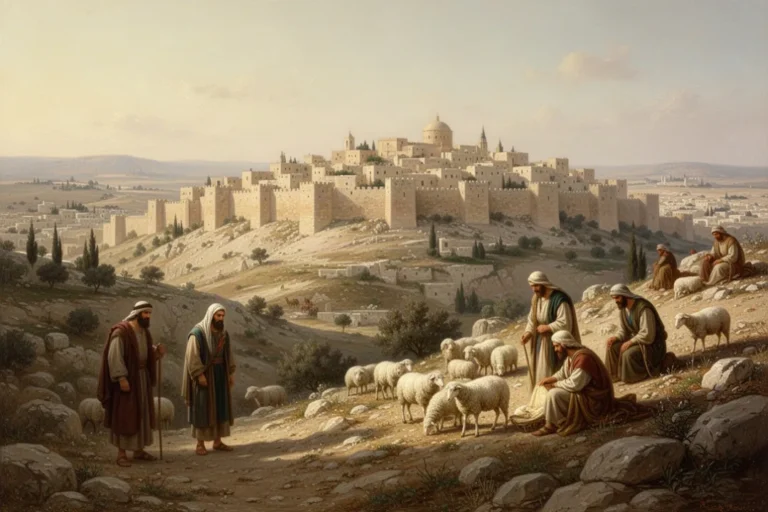
Judah occupied territory in the southern part of the land of Israel after the tribes received their inheritances. Joshua describes Judah’s territory in detail, including the hill country and areas around Jerusalem, Bethlehem, and Hebron. Tribal boundaries changed in practical importance over time, but Judah remained a major geographic and political identity.
Several biblical figures are associated with Judah’s territory or community:
David, who was born in Bethlehem and became Israel’s most prominent king.
Caleb, one of the faithful spies and a leader associated with Judah.
Isaiah, who ministered in the kingdom of Judah and spoke about the coming Davidic ruler.
Micah, who announced Bethlehem’s importance in connection with a future ruler.
Jesus, whom the New Testament identifies with David’s line and the tribe of Judah.
The tribe should not be confused with every person living in the southern kingdom. After Israel divided, the southern kingdom was called Judah, but it included people from more than one tribe. “Judah” can therefore refer to a tribe, a kingdom, a region, or a people, depending on the passage.
Judah and the divided kingdoms of Israel
After Solomon’s reign, the united kingdom divided. The northern kingdom retained the name Israel, while the southern kingdom became known as Judah. Judah’s capital was Jerusalem, the city associated with the temple and the Davidic monarchy.
The southern kingdom included Judah and Benjamin, along with members of other tribes who remained connected to Jerusalem and the temple. This is why the terms “Judah,” “Israel,” and “Jew” can overlap in later biblical history without meaning precisely the same thing.
The northern kingdom fell to Assyria in the eighth century BC. The southern kingdom survived longer but was conquered by Babylon, which destroyed Jerusalem and the temple and carried many people into exile. After the exile, the community centered on Judah became increasingly important in preserving Israel’s Scriptures, worship, and identity.
The later term Jew is connected historically with Judah and the people of Judah. Over time, it became a broader designation for the Jewish people, not merely for someone who could prove descent from the specific tribe of Judah. Biblical and modern uses of these terms should therefore be considered in context.
Why Jesus was not a priest from Levi
A common question arises from the New Testament: if Jesus is the Messiah, why was he from Judah instead of Levi, the tribe traditionally associated with priests? Hebrews addresses this question by stating that Jesus came from Judah, a tribe not assigned to the altar under the Mosaic priestly system.
The book of Hebrews presents Jesus’ priesthood as belonging to a different order, associated with Melchizedek rather than the ordinary Levitical line. The argument is not that Judah had become a priestly tribe. Instead, it explains that Jesus’ priesthood has a distinct basis and does not depend on descent from Aaron.
This distinction matters because the New Testament presents Jesus in multiple roles: Messiah, king, Savior, and high priest. His tribal identity supports his royal and messianic role, while Hebrews explains his priestly role through a different biblical pattern.
How the Gospel genealogies relate to Judah
Matthew 1 traces Jesus’ ancestry through Abraham and David and continues to Joseph, the husband of Mary. Luke 3 also connects Jesus with David, though the two genealogies differ in names and structure. Christians have proposed several ways to understand those differences, and the Gospel texts themselves do not spell out every genealogical relationship for modern readers.
Both genealogies serve a clear purpose: they place Jesus within Israel’s covenant history and connect him with David’s family. Matthew emphasizes the royal and legal significance of the line leading to Jesus, while Luke presents a genealogy reaching back to Adam. Neither Gospel needs to list the word “Judah” at every stage for the connection to be understood.
Hebrews 7:14 provides the New Testament’s direct statement that Jesus arose from Judah. This is especially significant because the author uses Jesus’ tribal origin to explain why his priesthood cannot be understood simply through the Levitical regulations.
It is wise to avoid stating more than the texts establish. The New Testament clearly connects Jesus with David and Judah. It does not provide a modern genealogical document proving every intervening generation, and it does not present a complete explanation of how Matthew’s and Luke’s genealogies relate to each other.
Judah’s role in biblical messianic promises
Several strands of Scripture come together in the idea that the Messiah would arise from Judah. Genesis links Judah with authority. The covenant with David establishes a royal dynasty. Prophets such as Isaiah and Micah speak of a future ruler connected with David and Bethlehem. The New Testament identifies Jesus as the fulfillment of these expectations.
One important passage is Isaiah 11, which describes a future ruler coming from Jesse’s family. Jesse was David’s father, so the passage points to the Davidic branch of Judah. Micah 5 connects a future ruler with Bethlehem, David’s hometown in Judah.
The New Testament applies these expectations to Jesus in different ways. Matthew connects Bethlehem with the prophetic hope, while Luke emphasizes Jesus’ connection with David’s house. Revelation uses the title from Judah to interpret Jesus’ victory over evil and his authority over history.
These passages should not be treated as isolated proof texts. Their significance comes from the way they form a continuing storyline: Judah produces the royal line, David receives a lasting promise, and Jesus is presented as the king who fulfills that promise.
Judah’s family history and moral complexity
Judah’s biblical story is not a simple record of flawless leaders. Genesis 37–50 includes Judah’s involvement in the sale of Joseph, his younger brother. Later, Judah accepts responsibility in a way that contrasts with his earlier actions, especially when he offers himself for Benjamin’s safety before Joseph.
This development is part of the Bible’s wider treatment of character and family history. The royal and messianic line comes through people who are not presented as morally perfect. Judah’s story includes failure, responsibility, and change, rather than a claim that tribal ancestry automatically makes someone righteous.
Genesis 38 also includes Judah’s relationship with Tamar. The account is difficult and complex, but it is significant for understanding the family line. Matthew includes Tamar among the women named in Jesus’ genealogy, showing that the Gospel’s presentation of the Messiah’s ancestry does not hide the complicated parts of the family story.
The point is not that every detail of these narratives has one easy explanation. Rather, the biblical account treats ancestry as part of a larger story of promise and grace. Being “of the tribe of Judah” establishes a place in that story, but it does not remove the need for repentance, faithfulness, or moral accountability.
Judah, Judea, Jews, and Jerusalem: related terms
Readers can easily confuse several words that share a historical connection. Judah may identify Jacob’s son, the tribe, the southern kingdom, or the region associated with that kingdom. Judea is the later Greek and Roman form of the name for the region centered on Jerusalem.
Jew developed from the name Judah and eventually became the common designation for the Jewish people. It does not usually mean that a person belongs only to the tribal line of Judah. After the exiles and centuries of historical change, specific tribal records were not generally available for most Jewish people.
Jerusalem was located in the territory associated with Benjamin near Judah’s northern boundary, yet it became the capital of the Davidic kingdom and the religious center of the southern kingdom. Its importance therefore cannot be reduced to a simple tribal boundary.
When reading a passage, ask what kind of reference the word makes:
Is Judah being used as a person’s name, referring to Jacob’s son?
Does it mean the tribe descended from him?
Does it describe the southern kingdom after the division of Israel?
Does it refer to a geographic region or its population?
Is it being used symbolically for the Messiah’s royal identity?
This simple distinction prevents many misunderstandings. The same name can carry a family meaning in one passage and a political or geographic meaning in another.
How to study a passage about the tribe of Judah
Start with the immediate wording. If a passage says someone is “of the tribe of Judah,” determine whether it is discussing genealogy, land, kingship, priesthood, or symbolism. The surrounding verses usually clarify which meaning is intended.
Next, identify the historical setting. A reference in Genesis belongs to the family period; a passage in Joshua may concern tribal land; a verse in Kings may concern the southern monarchy; and a statement in Revelation may use Judah as a symbolic messianic title.
Then trace the major connections without treating every passage as identical. The most useful links are:
Judah and Jacob: Judah is one of Israel’s founding tribal ancestors.
Judah and David: David’s royal family came from Judah.
Judah and Bethlehem: Bethlehem became associated with David and the expected ruler.
Judah and Jerusalem: the tribe became linked with the southern kingdom and its capital.
Judah and Jesus: the New Testament identifies Jesus with Judah and David’s line.
Judah and Revelation: the Lion of Judah represents the victorious Messiah.
Finally, distinguish direct statements from theological conclusions. Hebrews directly says that Jesus arose from Judah. Revelation directly uses the Lion of Judah title. Other connections, such as the precise relationship between Gospel genealogies, require interpretation and should be described carefully.
For Christians, Jesus’ identity as one of Judah’s descendants confirms that the Christian claim about the Messiah is rooted in Israel’s Scriptures rather than detached from them. Jesus is presented as the fulfillment of promises given through Abraham, Judah, David, and the prophets.
The phrase also emphasizes continuity between Jesus’ humanity and Israel’s history. He is not described as an abstract spiritual figure without ancestry. The New Testament places him within a real people, a real family line, and the particular story of God’s dealings with Israel.
At the same time, Christian teaching does not treat tribal descent as the basis of salvation for everyone who belongs to Judah. The New Testament presents Jesus as the one through whom God’s blessing reaches the nations. His Judahite identity is essential to his messianic claim, while his mission extends beyond one tribe or ethnic group.
The image of the Lion of Judah therefore combines particularity and universal significance. Jesus is specifically connected with Judah, David, and Israel, yet Revelation presents his authority as reaching every people and nation.
What “of the tribe of Judah” does not mean
The phrase does not mean that everyone from Judah was a king, a priest, or a prophet. Tribal identity describes ancestry, not automatic spiritual status or personal character. Judah produced important leaders, but most Judahites were ordinary members of the community.
It also does not mean that Judah was the only tribe with a continuing role in God’s purposes. The other tribes remain part of Israel’s history, and biblical promises often address Israel as a whole. Judah’s prominence comes from its royal line and later historical position, not from the erasure of the other tribes.
Finally, the phrase should not be used casually as proof that a modern individual belongs to the biblical tribe of Judah. Some people may have Jewish ancestry, but identifying a specific ancient tribal line requires evidence that is generally unavailable. Biblical references to Judah should be handled with historical care and textual precision.
Key references for understanding Judah
A focused reading can begin with Genesis, where Judah’s family identity and Jacob’s blessing are introduced. Continue with Joshua to see Judah’s territorial inheritance, then read the historical books about David and the kingdom of Judah. These passages show how a family name became a tribal and royal identity.
For the connection to Jesus, read Matthew 1, Luke 3, Hebrews 7, and Revelation 5. Matthew and Luke connect Jesus with David’s family, Hebrews directly names Judah in discussing Jesus’ priesthood, and Revelation develops the title “Lion of the tribe of Judah”.
Read each reference in context rather than treating the phrase as a stand-alone label. Together, these passages present Judah as a tribe within Israel, the source of David’s royal line, and the ancestry through which the New Testament identifies Jesus as the promised Messiah.
Frequently asked questions
Was Jesus literally descended from the tribe of Judah?
Yes. The New Testament explicitly identifies Jesus with Judah, especially in Hebrews 7:14, and connects him with David’s family. Matthew and Luke place him within Israel’s genealogical story. Christians therefore understand his Judahite ancestry as part of his historical identity and as evidence of his connection to the royal and messianic promises made to Israel.
Why is Jesus called the Lion of Judah?
Revelation 5:5 uses this title to describe Jesus as the victorious Messiah. The lion represents authority, royal power, and triumph, while Judah recalls the tribe linked with David’s kingship. The surrounding vision also presents Jesus as a sacrificial Lamb, showing that his victory is connected with suffering and self-giving rather than political force alone.
Is the tribe of Judah the same as the Jewish people?
Not exactly. Judah was one of Israel’s twelve tribes, while “Jew” developed from Judah and eventually became a broader name for the Jewish people. After the kingdoms, exiles, and later historical changes, most Jewish people could not identify a specific tribal line. The terms are historically related but should not be treated as interchangeable in every passage.
Did the tribe of Judah include priests?
Ordinary priests came from the tribe of Levi, particularly from Aaron’s family. Judah was associated primarily with kingship, including David’s line. Hebrews uses this distinction when explaining Jesus’ priesthood: Jesus came from Judah, but his priesthood is presented through the pattern associated with Melchizedek rather than the ordinary Levitical system.










Leave a Reply