Salt in the Bible: Meaning, symbolism, and key verses
Salt in the Bible: Meaning, symbolism, and key verses
Salt in the Bible commonly symbolizes covenant faithfulness, preservation, purity, wisdom, and judgment. Its meaning depends on the passage: salt may be added to an offering, used as a picture of lasting commitment, or serve as a warning about spiritual compromise. Jesus also uses salt to describe the distinct influence his followers should have in the world.
Because salt was familiar and valuable in the ancient world, biblical writers could use it to communicate ideas about durability, goodness, protection, and responsibility. Understanding those everyday associations helps make sense of passages that mention salt, from the laws of Israel’s worship to Jesus’ teaching about being “the salt of the earth.”
Salt was more than a seasoning. People used it to improve food, preserve certain foods, and support ordinary household and agricultural life. It was also a trade item and could have practical value in a society where refrigeration did not exist.
Salt’s ability to slow decay made it a natural image for preservation and endurance. Its flavor made it a fitting picture of goodness and usefulness. At the same time, salt could damage soil in excessive amounts, which allowed biblical authors to use it as an image of barrenness and judgment.
The Bible does not assign one fixed meaning to salt every time it appears. A passage about salt in a sacrifice should be read in its worship context, while a passage about a salty land may concern destruction. The surrounding words and the larger biblical theme determine the sense.
Key idea: Salt usually carries a positive meaning when it describes covenant, sacrifice, speech, or faithful influence. It can carry a negative meaning when connected with desolation, corruption, or judgment.
Salt represents an enduring covenant with God
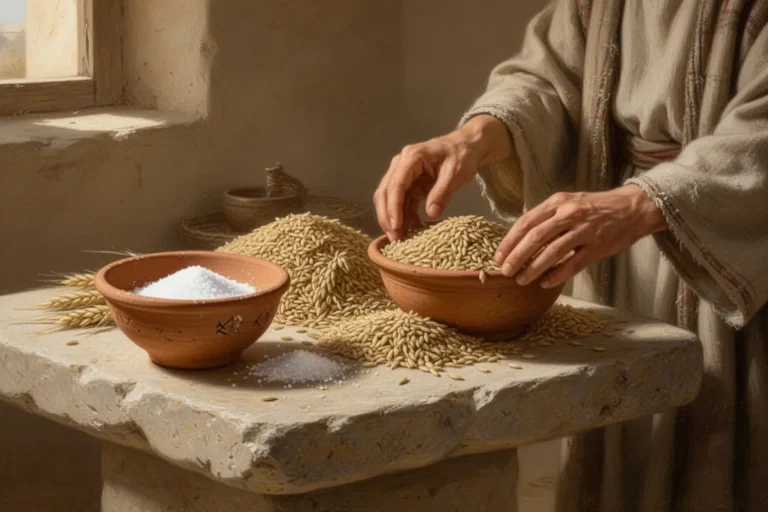
One of the most important biblical meanings of salt is lasting covenant commitment. Leviticus 2:13 instructs the Israelites to include salt with their grain offerings and describes it as connected with the covenant between God and his people. The verse places salt alongside the offering rather than treating it as an optional household ingredient.
Numbers 18:19 refers to a lasting agreement between God and the priests and describes it as a “covenant of salt.” The expression communicates permanence and reliability. In 2 Chronicles 13:5, God’s enduring promise to David’s descendants is also described with this language.
These passages do not suggest that salt possesses magical power. Instead, salt functions as a visible sign of a relationship understood to be firm, binding, and enduring. A covenant of salt points to faithfulness rather than to a ritual formula that forces God to act.
In the ancient Near Eastern setting, sharing salt could also be associated with fellowship and loyalty. The Bible’s use of this imagery would therefore have suggested more than simple preservation. It could evoke a bond that should not be treated casually or abandoned without consequence.
What “covenant of salt” means
A covenant of salt means a lasting and dependable covenant. It emphasizes the permanence of the promise, not a special type of covenant with a separate set of rules. When Scripture uses the phrase for God’s commitments, the focus is on his reliability.
For readers applying this theme today, the main lesson is that worship and faithfulness are not meant to be temporary performances. Biblical covenant language calls for steadfast trust, honest obedience, and a serious view of promises.
Salt in offerings points to faithful worship
Leviticus 2:13 specifically requires salt with grain offerings. The same verse prohibits the omission of salt from the offering and connects it with the covenant. This instruction shows that salt had a recognized place in Israel’s worship practices.
The passage does not explain every symbolic detail, so it is wise not to claim more than the text says. Still, the connection between salt and the covenant makes a clear point: worship was to be offered within a relationship of faithfulness and commitment to God.
Mark 9:49–50 also connects salt with offerings and then moves to the instruction for Jesus’ disciples to have salt in themselves and to live at peace with one another. The wording has generated different interpretations, but the surrounding emphasis includes spiritual seriousness, usefulness, and peaceful relationships.
Salt in worship can therefore remind readers that religious activity is not enough by itself. A person may bring an offering, say a prayer, or participate in a religious practice while lacking integrity. The biblical picture joins worship to a life shaped by loyalty and peace.
Salt with an offering: Worship belongs within the covenant relationship with God.
Salt as endurance: Faithfulness should not disappear when circumstances become difficult.
Salt and peace: Devotion to God should influence how people treat one another.
Salt as usefulness: Spiritual commitment should produce a life that benefits others.
Jesus calls his followers the salt of the earth
In Matthew 5:13, Jesus tells his disciples that they are the salt of the earth. He then warns that salt can lose its usefulness and asks how it could be made salty again. The image appears in the Sermon on the Mount, where Jesus is teaching about the character and conduct of his followers.
Jesus is not presenting a scientific explanation of salt chemistry. He is making a vivid comparison: his disciples should have a recognizable, beneficial effect on the world around them. Their lives should not blend into the surrounding culture so completely that their allegiance to God becomes invisible.
The phrase can include several related ideas. Salt may suggest preserving what is good, bringing moral distinctiveness, adding wisdom, and making a constructive difference. No single modern slogan captures every part of the image, but the passage clearly describes a responsibility rather than a compliment that requires no response.
The next image in Matthew is light, which reinforces the public nature of discipleship. Followers of Jesus are not meant to hide their faith or keep its effects private. Their actions should help others recognize the goodness of God, as Matthew 5:16 explains in its broader context.
What it means for salt to lose its saltiness
Jesus’ warning about salt losing its usefulness emphasizes spiritual ineffectiveness. A disciple who no longer lives according to Jesus’ teaching has lost the distinctiveness that gives the metaphor its force. The issue is not that a Christian must be flawless, but that discipleship should produce a real and recognizable difference.
This warning also challenges shallow influence. A person may have a religious label, public platform, or knowledge of biblical language without bringing patience, justice, mercy, truthfulness, or reconciliation into daily life. The salt image asks whether faith is actually affecting conduct.
Being salt does not mean trying to control everyone around you or treating other people as projects. It means remaining faithful, useful, and morally distinct while serving neighbors with humility. Influence in the biblical sense is measured by the quality and consistency of a person’s life, not merely by visibility.
Salt can describe wise and gracious speech
Colossians 4:6 tells believers that their speech should be gracious and seasoned with salt. The verse connects the image with knowing how to answer each person. Here salt points to speech that is thoughtful, appropriate, and beneficial.
Seasoned speech is not necessarily blunt, entertaining, or clever. It is speech shaped by grace and good judgment. A salty answer, in this biblical sense, should not be tasteless, careless, cruel, or needlessly provocative. It should fit the person and the situation.
This teaching is especially useful in conversations involving disagreement. Biblical wisdom does not require you to avoid truth, but it does require you to consider tone, timing, accuracy, and the other person’s dignity. Grace and honesty belong together.
Tell the truth without using humiliation as a weapon.
Choose words that address the real issue rather than exaggerating it.
Listen before answering, especially when the other person is confused or hurt.
Adjust your explanation to the person’s question and level of understanding.
Leave room for patience when a conversation cannot be resolved immediately.
Job 6:6 uses salt in a different but related way when Job asks whether tasteless food can be eaten without salt. The image concerns the lack of flavor or appeal in something being consumed. It shows how ordinary salt could serve as a picture of what makes an experience useful or satisfying, even though the passage is not a direct command about Christian communication.
Salt can symbolize purity and protection from corruption
Since salt was associated with preserving food, it can represent resistance to decay. This does not mean the Bible teaches that salt physically purifies every person or object. Rather, biblical imagery uses a familiar property of salt to communicate the need for moral steadiness and protection against corruption.
Jesus’ teaching in Mark 9:50 links salt with the disciples’ inner character and with peace among them. Read alongside the surrounding warnings about causing others to stumble, the passage points toward a life that takes holiness seriously while maintaining peaceful relationships.
Salt’s preservative association can also help explain why Christian influence should be steady rather than occasional. A person who acts with integrity only when being watched is not providing durable influence. Faithfulness in private decisions, business practices, family life, and speech gives credibility to public beliefs.
Purity does not mean withdrawing from every person who disagrees or living as though ordinary work and society are inherently unclean. Jesus’ salt metaphor assumes contact with the world. The challenge is to remain faithful within that contact rather than allowing the surrounding environment to determine every value and behavior.
Salt appears in biblical scenes of judgment and desolation
Salt does not always carry a positive meaning. In Genesis 19:26, Lot’s wife becomes a pillar of salt after looking back toward Sodom. The event is part of the judgment on the city and its surrounding region. The passage is not merely a lesson about curiosity; it presents a serious warning about attachment to a condemned way of life.
Deuteronomy 29:23 describes a devastated land with burning sulfur and salt, making it unable to produce crops. Judges 9:45 reports Abimelech sowing salt over a destroyed city. In these settings, salt communicates barrenness, ruin, and the lasting effects of judgment.
Salt can harm productive land when present in excessive concentration. That practical reality gave biblical writers a concrete image for a place made unfruitful. The symbolism is the opposite of Jesus’ call for disciples to be useful: one image describes a life-giving presence, while the other describes a landscape unable to support life.
These judgment passages should not be used carelessly to label ordinary hardship as proof of divine punishment. Scripture itself presents many different reasons for suffering, and individual circumstances require humility. The salt imagery describes the meaning of a particular judgment scene; it does not authorize people to make confident accusations about every disaster.
Lot’s wife and the warning of divided loyalty
The account of Lot’s wife is one of the Bible’s most recognized salt references. After the angels lead Lot’s family away from Sodom, she looks back and becomes a pillar of salt, according to Genesis 19:26. Jesus later refers to the days of Lot in Luke 17 and tells his listeners to remember Lot’s wife.
The warning concerns more than turning one’s head for a moment. In context, the story follows a command to escape and not look back. Jesus’ reference places the episode within a broader call for alertness, readiness, and freedom from destructive attachments.
Readers should avoid pretending to know every detail of her inner thoughts. The text does not provide a psychological explanation. It does, however, present her action as significant in the middle of divine judgment and uses the event as a warning against a divided response.
The practical question is whether a person wants the safety of leaving an old pattern while still clinging to the values and comforts that sustained it. Biblical repentance involves a change in direction, not merely regret over consequences.
Salt in the Bible is not a magical substance
Because salt appears in sacrifices, covenants, healing narratives, and religious language, some readers assume that the Bible gives salt supernatural power. It does not. The passages use salt in ordinary and symbolic ways, and none establishes a general practice of using salt to guarantee protection, prosperity, healing, or spiritual authority.
In 2 Kings 2:19–22, the prophet Elisha throws salt into a spring after the Lord’s power brings healing to the water. The event is a specific prophetic sign. The account emphasizes that the Lord healed the water through Elisha’s prophetic action; it should not be turned into a universal technique for treating contaminated water or solving personal problems.
Likewise, placing salt in a home, carrying it for protection, or adding it to a ritual does not automatically create a biblical blessing. Symbolic actions can remind a person of truth, but the object itself is not the source of spiritual power.
Important distinction: Biblical symbolism can teach you about faithfulness, wisdom, and judgment, but salt is not presented as a charm, formula, or substitute for trust and obedience to God.
Common mistakes when interpreting salt in Scripture
Salt imagery is memorable, which makes it easy to apply too quickly. A careful reader asks what salt is doing in the specific passage before drawing a lesson. The following habits help prevent common interpretive errors.
Assuming salt always means preservation. In judgment passages, salt can represent desolation rather than protection.
Taking one meaning as the whole meaning. “Salt of the earth” involves distinctiveness and influence, while Colossians 4:6 focuses on wise speech.
Turning a symbol into a ritual. Biblical references to salt do not instruct believers to use it as a protective object.
Ignoring the surrounding passage. Read the verses before and after the reference, especially in poetic or highly symbolic sections.
Making every hardship a judgment message. A salt-covered land in a biblical judgment account does not give permission to condemn people facing modern suffering.
Using “salty” to justify harshness. Colossians connects salted speech with grace, not insult, aggression, or sarcasm.
Forgetting the covenant context. Leviticus, Numbers, and 2 Chronicles use salt language to emphasize enduring commitment.
A useful study method is to write down the action involving salt, the people involved, and the result. Ask whether salt is being added, lost, spread over land, associated with an offering, or used in a comparison. Those details often clarify the intended image.
How to apply the biblical meaning of salt today
Salt imagery becomes practical when it shapes behavior rather than remaining a topic of word study. Jesus’ teaching asks whether your life contributes something good and recognizable. Colossians asks whether your words are gracious and well suited to the person hearing them. The covenant passages ask whether your commitments have substance and endurance.
You can apply these themes in ordinary settings:
At work: Practice honesty when cutting corners would be easier or more profitable.
In family relationships: Use steady patience rather than reacting to every irritation.
In conversation: Give answers that are truthful, kind, and appropriate to the listener.
In community life: Preserve what is good by serving people and opposing injustice without contempt.
In private decisions: Let your convictions remain consistent when no audience is present.
In conflict: Seek peace without confusing peace with avoidance of every difficult truth.
Being “salt” does not require constant public speaking or an impressive religious profile. A dependable neighbor, an honest employee, a patient parent, or a gracious friend may influence others more deeply through consistent conduct than through dramatic declarations.
The image also includes self-examination. If your words regularly wound people, if your commitments disappear under pressure, or if your behavior is indistinguishable from the values you claim to reject, the biblical metaphor raises a serious question about usefulness and faithfulness.
What the main salt passages teach together
Read as a whole, the Bible’s salt passages present a balanced picture. Salt can signify permanence in covenant, integrity in worship, wisdom in speech, influence in society, and the consequences of judgment. These meanings are connected by the ordinary properties and uses of salt, but they should not be flattened into one definition.
The positive passages call for a life that preserves what is good, adds wisdom, and remains faithful. The warning passages show what happens when land becomes barren or when a person refuses to leave a destructive setting. Together they encourage both constructive influence and sober self-examination.
The central application is straightforward: live in a way that is faithful to God, beneficial to others, and distinct from corruption. Let your commitments endure, let your speech show grace, and let your conduct give substance to your profession of faith.
Frequently asked questions
What does salt symbolize in the Bible?
Salt symbolizes different things in different passages, including covenant permanence, faithful worship, preservation, wisdom, moral distinctiveness, and judgment. Its meaning depends on the context. Salt added to an offering points toward covenant faithfulness, while salt covering a ruined land represents barrenness. Jesus’ reference to salt describes the useful and distinctive influence his followers should have.
What does “salt of the earth” mean?
“Salt of the earth” refers to the beneficial, distinctive influence Jesus’ followers should have in the world, based on Matthew 5:13. The image calls for a life that reflects faith through integrity, mercy, wisdom, and service. It is not a command to control others or to be harsh; Christian influence should remain useful and recognizable.
Does the Bible say salt has spiritual or protective power?
No. Although salt appears in sacrifices, covenant language, and a prophetic healing account, Scripture does not present it as a charm or universal spiritual treatment. Biblical references use salt symbolically or within specific instructions and events. Using salt for protection, prosperity, or guaranteed healing goes beyond what these passages teach.
Why did Lot’s wife become a pillar of salt?
Genesis 19:26 presents Lot’s wife becoming a pillar of salt during the judgment on Sodom. The passage does not explain every detail of her thoughts, but the event is treated as a warning about refusing to leave a condemned way of life wholeheartedly. Jesus later refers to her as a warning about readiness and divided attachment.











Leave a Reply