The name Samaritans refers to both an ancient population and a surviving religious community. In biblical and later historical sources, they lived mainly in the central hill country of the land of Israel, especially around Samaria and Shechem. Their traditions connected them with the northern tribes of Israel, while many Jews regarded them as a separate and unfaithful population.
The disagreement was not simply about ethnicity. Samaritans and Jews shared belief in the God of Israel, accepted the Torah in some form, and preserved traditions connected with Moses. They differed over which place God had chosen for worship, which books belonged to Scripture, and how the history of Israel should be understood.
That combination of closeness and conflict explains why the Samaritans appear so often in the New Testament. They were not complete strangers to Jewish society. They were neighboring people with related origins, shared sacred history, and deep religious disagreements.
How Samaritan identity developed
The origins of the Samaritans are disputed because ancient sources present competing accounts. Their own tradition says that they are descendants of Israelites who remained faithful to the original worship centered at Mount Gerizim. Jewish biblical and later historical traditions often describe the Samaritan population as the result of foreign groups being settled in the former northern kingdom after the Assyrian conquest.
Modern historians generally treat both accounts carefully. The Samaritan community likely developed from a continuing Israelite population in the north, together with later changes in identity, political control, and religious practice. It is too simple to describe the Samaritans as either wholly foreign settlers or exactly identical to the Jews of Jerusalem.
The northern kingdom of Israel, often called Samaria after its capital, fell to the Assyrian Empire in the late eighth century BCE. Assyrian imperial policy sometimes involved moving populations from one region to another. Biblical texts describe such movements and use them to explain religious mixture in the area.
After the Babylonian exile, the Jewish community centered in Jerusalem became increasingly distinct from the people living in Samaria. Disputes arose over participation in the rebuilding of Jerusalem’s temple and over political and religious authority. These conflicts helped turn an older regional distinction into a sharper boundary between Judeans and Samaritans.
Historical caution: Ancient Jewish writings often portray Samaritans negatively, while Samaritan tradition tells its own story of continuity and faithfulness. A balanced account compares both perspectives rather than treating one polemical description as the whole history.
A step-by-step guide to who the Samaritans were
They were connected to ancient Israel. Samaritan tradition traces the community to the Israelites of the northern kingdom, especially the tribes associated with Ephraim and Manasseh.
They lived in the central highlands. Their main territory included Samaria, Shechem, and the area around Mount Gerizim, between Galilee and Judea.
They accepted the Torah. The Samaritan Pentateuch contains the five books of Moses, with differences in wording and interpretation from the Jewish Masoretic tradition.
They worshiped at Mount Gerizim. Samaritans believed this mountain, not Jerusalem’s Temple Mount, was the place chosen by God for the sanctuary.
They became separated from Judean Judaism. Political disputes, different institutions, and rival interpretations of Israel’s history strengthened the division.
They had their own priests and sanctuary. A Samaritan temple stood on Mount Gerizim in the Persian or early Hellenistic period and was later destroyed, probably during the Hasmonean period.
They remained neighbors of the Jews. Contact continued through trade, travel, marriage, conflict, and shared regional life.
A small Samaritan community still exists. Modern Samaritans live mainly in and around Mount Gerizim and in Holon, Israel, preserving their religious traditions and communal identity.
What the name “Samaritan” originally meant
The meaning and history of the name are connected with Samaria, the capital of the northern kingdom of Israel. In Hebrew, the term often translated “Samaritans” is related to the people of Samaria. Another interpretation connects the name with the idea of guardians or keepers, reflecting a Samaritan understanding of themselves as guardians of the true Israelite faith.
The word did not always function as a precise ethnic label. It could refer to people from the region, members of the religious community, or those associated with Samaritan customs. Greek and Latin writers also used related forms of the name, and the exact meaning could depend on the period and context.
In the New Testament, “Samaritan” generally identifies a person from this neighboring community. The term therefore carries both a geographic and a religious meaning. It does not mean simply “a helpful person,” although the parable of the Good Samaritan later made that association familiar in Christian speech.
What Samaritans believed about Scripture and worship
Samaritan religion is closely related to ancient Israelite religion but has its own authoritative tradition. The central scripture is the Samaritan Pentateuch, the Samaritan version of the first five books of the Bible: Genesis, Exodus, Leviticus, Numbers, and Deuteronomy.
The Samaritan Pentateuch is not merely a modern translation. It is an ancient textual tradition preserved in the Samaritan script and community. It contains many passages that are substantially similar to the Jewish Torah, along with differences in wording and emphasis. One significant difference concerns the location of worship: Samaritan readings support the holiness of Mount Gerizim.
Samaritans do not traditionally give the same authority to the rest of the Jewish Bible that Jews do. Their religious worldview focuses on the Torah, the role of Moses, the chosen place of worship, and the continuing significance of the Samaritan priesthood. They also expect a future restorer or figure known as the Taheb, though interpretations of this expectation have varied.
Mount Gerizim is central to Samaritan identity. Located near the ancient city of Shechem, it is understood as the mountain selected by God for the sanctuary. Samaritan tradition links it with major events in Israel’s sacred history and regards Jerusalem’s later religious importance as a departure from the original command.
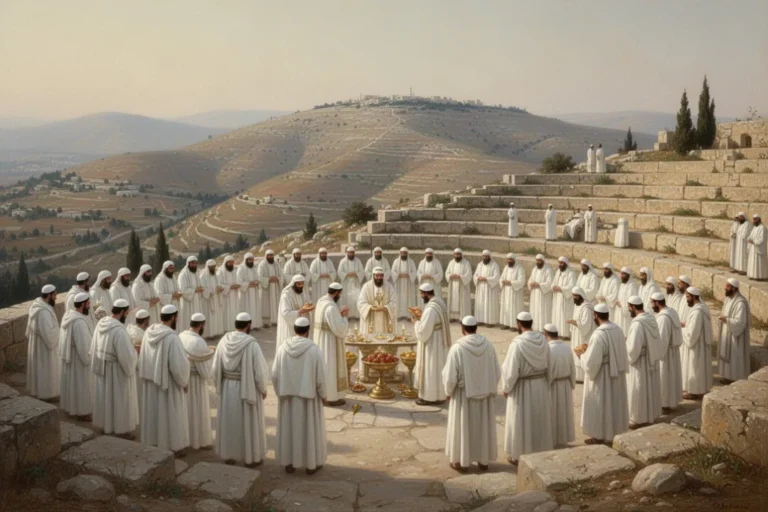
The Samaritan calendar includes festivals that correspond in broad ways to festivals known from the Jewish Torah, including Passover, Unleavened Bread, and the Feast of Booths. The most publicly recognizable ceremony is the Samaritan Passover sacrifice, traditionally carried out on Mount Gerizim under priestly supervision.
Scripture: The five books of Moses are the foundation of Samaritan belief.
Sacred location: Mount Gerizim, rather than Jerusalem, is the chosen place of worship.
Religious leadership: Priests, especially the high priest, have a central role in communal life.
Holy days: Festivals follow the Samaritan calendar and include distinctive local customs.
Language and tradition: Hebrew, Aramaic, and Arabic have all played important roles in Samaritan history.
Why Mount Gerizim mattered so much
The conflict over Mount Gerizim and Jerusalem was at the heart of Samaritan-Jewish division. Jewish worship centered on the Temple in Jerusalem, which Jews understood as the place chosen by God for sacrifice. Samaritans believed that the correct sanctuary had always been on Mount Gerizim.
Mount Gerizim stands beside Mount Ebal near Shechem. The book of Deuteronomy describes blessings and curses being proclaimed in connection with these mountains, and the book of Joshua presents the area as significant in Israel’s entry into the land. Samaritans interpreted such traditions as evidence that Gerizim had the original claim to holiness.
A Samaritan temple was built on the mountain during the centuries after the Babylonian period. Ancient evidence suggests that it was a substantial sanctuary. It was destroyed by the forces of the Hasmonean ruler John Hyrcanus in the late second century BCE, an event that deepened the hostility between the two communities.
The destruction of the temple did not end Samaritan worship on Mount Gerizim. The mountain remained the community’s sacred center, and Samaritan religious life continued through priests, festivals, local traditions, and pilgrimage. The site is still important to Samaritans today.
How Jews and Samaritans became separate communities
The division between Jews and Samaritans developed over centuries rather than through one single event. The fall of the northern kingdom, Assyrian population policies, the rise of Jerusalem-centered Judaism, and disputes after the Babylonian exile all contributed to the separation.
One major point of tension appears in accounts of the rebuilding of Jerusalem’s temple. Some biblical passages describe people from Samaria offering assistance and being rejected. The reasons are presented in religious and political terms, including questions about ancestry, loyalty, and the legitimacy of worship outside Jerusalem.
Later conflicts made the boundary more severe. Samaritan and Jewish communities had rival sanctuaries, priests, and interpretations of Israelite history. Political rulers sometimes favored one side, and violence occurred during periods of regional instability.
Even so, the groups were not isolated from one another. They spoke related languages, lived in nearby territories, followed comparable agricultural cycles, and shared many stories about Moses and the ancestors of Israel. Religious conflict often becomes most intense between communities that recognize one another as close rivals, and that pattern helps explain their relationship.
What the Bible says about the Samaritans
The Hebrew Bible contains references to Samaria and its people, although the category is not always identical to the later religious community known as the Samaritans. The books of Kings describe the northern kingdom, its rulers, its conquest by Assyria, and the religious practices of the region. Later biblical books reflect the growing importance of Jerusalem and the difficulties between Judeans and their neighbors in Samaria.
The New Testament reflects the established separation between Jews and Samaritans. Its references show that Jews and Samaritans could share roads and interact, but that social and religious distrust was common. The Gospel of John describes a conversation between Jesus and a Samaritan woman near a village in Samaria, where the dispute over the proper mountain of worship is directly mentioned. The passage presents worship as being redefined around Jesus rather than settled by the older rivalry alone.
The parable commonly called the Good Samaritan appears in Luke 10:25–37. Jesus uses a Samaritan traveler as the example of a person who acts compassionately toward an injured man when respected religious figures do not. The force of the story comes partly from the audience’s expectation that a Samaritan would be viewed with suspicion, not as the obvious moral example.
Another New Testament episode, in Luke 17:11–19, tells of ten people healed from a serious skin disease, with only one returning to give thanks. That person is identified as a Samaritan. The story again gives a Samaritan a positive role while preserving the historical reality of division.
In Acts 8, the early Christian movement reaches Samaria through the preaching of Philip. The account describes Samaritans responding to the message and becoming part of the expanding movement. This reflects an important Christian claim: the message was not limited to Judeans but crossed an existing religious and ethnic boundary.
Reading the New Testament carefully: Biblical references to Samaritans are not all interchangeable. Some describe an actual neighboring population, while others use Samaritan characters to challenge prejudice, question religious assumptions, or show that God’s work crosses established boundaries.
How the Samaritan community changed under later empires
After the destruction of the Samaritan temple, the community continued under changing political powers, including Roman rule and later Byzantine administration. Samaritans lived in villages and towns across the central region and maintained their own religious practices.
Relations with the Roman government and local populations varied. Samaritan revolts occurred during the Byzantine period, and these conflicts brought severe losses. Political suppression, economic pressure, disease, conversion, and changing settlement patterns gradually reduced the community’s size.
Under Islamic rule, Samaritans remained a recognized religious minority in parts of the region, though their circumstances differed from one period to another. Some held administrative or commercial roles, while others faced restrictions or pressure to convert. Their numbers continued to decline over the centuries.
By the modern era, only a small number of Samaritans remained. The community preserved its identity through religious observance, family networks, priestly succession, endogamy, and attachment to Mount Gerizim. Modern political changes have placed Samaritans within both Israeli and Palestinian social settings, creating a distinctive communal situation.
Who the Samaritans are today
Modern Samaritans are a small ethnoreligious community with roots in the ancient population of Samaria. Many live in Kiryat Luza, a neighborhood on Mount Gerizim near Nablus, while others live in Holon, near Tel Aviv. Members may hold Israeli or Palestinian citizenship depending on where they live and their family circumstances.
The community continues to observe its own calendar, preserve Samaritan Hebrew and liturgical traditions, and maintain the authority of its priests. Mount Gerizim remains the center of major festivals, especially Passover. Families often gather for ceremonies that connect present-day practice with the community’s understanding of ancient Israelite worship.
Modern Samaritans are not simply Jews who follow unusual customs. They identify as a distinct people and religious community with their own scripture, clergy, calendar, language traditions, and historical memory. At the same time, they share substantial ancestry and cultural history with other populations of the region.
Because the community is small, marriage patterns have required careful attention to health and family relationships. Samaritans have also used marriage with women from other communities under specific religious and communal conditions, particularly to help sustain the population. These arrangements do not erase the community’s identity; they are managed within Samaritan religious and social rules.
How Samaritan and Jewish traditions compare
Samaritan and Jewish traditions have enough in common to be recognized as related, but their differences are fundamental. Both honor the God of Israel and the Torah, yet they disagree about sacred geography, textual authority, priesthood, and the proper interpretation of Israel’s past.
Shared foundation: Both traditions center on the God of Israel and the teachings associated with Moses.
Different sanctuary: Jews look to Jerusalem, while Samaritans look to Mount Gerizim.
Different scriptural canon: Samaritans give primary authority to the Pentateuch and do not share the full Jewish biblical canon in the same way.
Different historical identity: Jews generally connect their communal history with Judah and the Jerusalem tradition; Samaritans connect theirs with the northern tribes and Gerizim.
Different religious institutions: Samaritan priests and the high priest remain central to Samaritan communal life.
Related festivals: Both traditions observe festivals rooted in the Torah, but their calendars and practices can differ.
These similarities and differences are why scholars usually describe Samaritanism as a distinct Israelite religious tradition rather than as a minor branch of Judaism. Labels can vary depending on the historical period, but the community’s own self-understanding should be taken seriously.
Common misunderstandings about the Samaritans
They were not simply foreigners
The claim that all Samaritans were foreign settlers comes mainly from an ancient polemical account and does not settle the question of their ancestry. The historical population likely included people who remained in the northern region, people moved there by imperial policy, and groups whose identities changed over time.
They were not identical to Jews
Shared ancestry and scripture do not mean the two communities were the same. Samaritans maintained distinct worship, priesthood, festivals, and historical claims. Describing them as “the same as Jews” overlooks the religious boundary that both communities recognized.
They were not always enemies
Ancient sources record conflict, but neighboring communities also exchanged goods, traveled through one another’s territory, and interacted in ordinary ways. The stories of Jesus meeting Samaritans make sense precisely because contact between the groups was possible even when trust was limited.
The biblical “Samaritan” is not only a symbol
The Good Samaritan has become a general expression for compassionate behavior, but the original story depends on the Samaritan’s specific identity. Its challenge is sharper when readers understand that many Jewish listeners would have viewed Samaritans as religious rivals rather than neutral strangers.
Why the Samaritans still matter for understanding the Bible
Knowing who the Samaritans were clarifies many passages that otherwise seem confusing. It explains why the route through Samaria could be socially uncomfortable, why a conversation at a well could carry religious weight, and why a Samaritan character could surprise an audience.
Their history also shows that the ancient world was not divided into only two simple groups. The region contained overlapping identities, competing claims to Israel’s heritage, and communities that shared traditions while disagreeing about their proper meaning.
Most importantly, Samaritan history preserves the voice of a living community rather than only the descriptions written by its rivals. Ancient debates about ancestry and legitimacy should not obscure the fact that Samaritans have maintained a continuous religious identity, with Mount Gerizim at its center, into the present.
Frequently asked questions
Are Samaritans Jewish?
Samaritans and Jews share ancient Israelite roots and honor the Torah, but Samaritans are a distinct religious and ethnic community. They recognize Mount Gerizim rather than Jerusalem as the chosen place of worship, follow the Samaritan Pentateuch, and maintain their own priests, calendar, and traditions. Calling them simply Jewish or simply foreign does not accurately represent their identity.
Where do Samaritans live today?
Most modern Samaritans live in two main places: Kiryat Luza on Mount Gerizim near Nablus and the city of Holon in Israel. Their homes and citizenship arrangements reflect the region’s modern political divisions. Mount Gerizim remains their principal religious center, especially during major festivals and communal ceremonies.
What language did the Samaritans speak?
Samaritans have used several languages throughout their history. Samaritan Hebrew is used in religious texts and worship, while Samaritan Aramaic appears in parts of their literary tradition. Arabic became important in everyday life for many communities under Islamic rule and remains significant among modern Samaritans, alongside Hebrew for those living in Israel.
Do Samaritans still sacrifice animals for Passover?
Yes. The Samaritan Passover sacrifice continues to be performed on Mount Gerizim under the supervision of the community’s priests. The ceremony follows Samaritan religious rules and is distinct from Jewish Passover practice. Because the community is small and the ritual is highly specific, it is best understood as a continuing Samaritan observance rather than a general model of ancient Israelite worship.








Leave a Reply