Jehoshaphat in the Bible: His Life, Faith, and Legacy
Jehoshaphat in the Bible: His Life, Faith, and Legacy
Jehoshaphat in the Bible was the fourth king of Judah after the kingdom divided, and he ruled Jerusalem for 25 years. He is remembered for seeking God, teaching Judah’s people, strengthening the nation, and trusting God during a serious military threat.
His record is mainly found in 1 Kings 15–22 and 2 Chronicles 17–21. These accounts present a faithful but imperfect ruler: Jehoshaphat pursued religious reform and wise justice, yet he repeatedly formed dangerous alliances with the wicked king Ahab and Ahab’s family.
Jehoshaphat was the son of King Asa and the father of King Jehoram. He ruled the southern kingdom of Judah after Asa and was based in Jerusalem. The biblical account says that he was 35 years old when he became king and that he ruled for 25 years, placing his reign in the period when Judah and the northern kingdom of Israel were separate monarchies.
Judah and Israel shared the same ancestral faith but had different royal dynasties and political centers. Israel’s capital was Samaria, while Judah’s capital was Jerusalem. Jehoshaphat therefore governed a smaller southern kingdom that faced pressure from neighboring nations, internal religious compromise, and the continuing danger of conflict with Israel.
The meaning of the name Jehoshaphat is commonly connected with the idea that “the Lord judges” or “the Lord has judged.” The name fits several themes in his story, especially his interest in justice and his belief that God would judge the conduct of kings and nations. The Bible describes him as a ruler who generally did what was right in the Lord’s sight, although it also records decisions that brought serious trouble.
Jehoshaphat’s reign included several practical strengths:
Military preparation: He fortified cities in Judah and maintained a substantial army.
Religious instruction: He sent officials, Levites, and priests through Judah to teach the people from the Book of the Law.
Judicial reform: He established judges and instructed them to judge fairly, without corruption or favoritism.
Regional influence: Surrounding nations recognized Judah’s strength during part of his reign and were less willing to attack.
His story is therefore not simply about a king who won a famous battle. It shows how personal faith, public administration, diplomacy, and moral judgment were connected in the life of an ancient ruler.
How Jehoshaphat strengthened Judah and promoted faith
Early in his reign, Jehoshaphat focused on making Judah secure. According to 2 Chronicles 17, he placed troops in fortified cities and strengthened the defenses of Judah’s territory. The account also says that the Lord was with him because he followed the earlier ways of David rather than depending on the worship practices associated with the Baals.
This description does not mean that Jehoshaphat was flawless. It does show that his reign began with a deliberate effort to turn Judah toward the worship of Israel’s God. He removed some pagan religious practices and sought to make the nation’s public life reflect the covenant responsibilities expected of a king.
One of the most distinctive actions of his reign was an organized teaching mission. In the third year of his rule, Jehoshaphat sent officials from his government together with Levites and priests to teach throughout the cities of Judah. They carried the Book of the Law and instructed the population rather than limiting religious knowledge to the royal court or the temple.
A central lesson from Jehoshaphat’s reforms: He treated religious instruction as a public responsibility. His reforms involved not only removing false worship but also teaching people what faithful worship and just conduct required.
The result was increased stability and respect from neighboring peoples. Second Chronicles says that the surrounding kingdoms feared the Lord and that they did not wage war against Jehoshaphat during this period. Some nations also brought tribute, which strengthened Judah’s resources.
Jehoshaphat also understood that military strength alone could not make a kingdom just. Later in his reign, he traveled through Judah from Beersheba to the hill country of Ephraim and brought people back to the worship of the Lord. He then appointed judges in the fortified cities and gave them a serious warning about their responsibility.
His instructions to the judges, recorded in 2 Chronicles 19, emphasized several principles:
Judges were serving on behalf of the Lord, not merely acting as agents of the king.
They were expected to reject injustice, partiality, and bribery.
They had to judge with reverence for God and with integrity toward the people.
Disputes involving religious law and civil matters were to be handled through an organized system.
Amariah the chief priest and Zebadiah, a leader from Judah, were given supervisory responsibilities over different kinds of cases.
This reform reveals an important part of Jehoshaphat’s leadership. He did not see prayer and worship as substitutes for competent government. He worked to create institutions that would protect ordinary people from arbitrary decisions, while reminding judges that authority carried accountability before God.
Jehoshaphat’s strongest weakness was his relationship with Ahab, king of Israel. Ahab was condemned in the biblical narrative for idolatry, injustice, and opposition to the prophets of the Lord. Even though Jehoshaphat generally followed God, he formed a political alliance with Ahab, apparently strengthened by a marriage connection between their royal families.
The alliance led Jehoshaphat into a military campaign against Ramoth-gilead, a city controlled by Aram. Ahab wanted to recover the city, and Jehoshaphat agreed to join him. Before proceeding, Jehoshaphat asked that they seek a word from the Lord. A group of prophets gave Ahab an encouraging answer, but Jehoshaphat recognized that their message did not carry the authority he was seeking.
Ahab then summoned Micaiah son of Imlah, a prophet who usually opposed him. Micaiah warned that the campaign would end badly and described Israel as scattered without a shepherd. His message directly challenged the confident predictions of the other prophets, and Ahab responded by having Micaiah imprisoned.
Although Jehoshaphat had asked for God’s guidance, he still went to battle with Ahab. Ahab attempted to protect himself by disguising his identity, while Jehoshaphat wore his royal clothing. The opposing army initially pursued Jehoshaphat because they believed he was the king of Israel. He cried out, and the soldiers recognized that he was not Ahab and stopped pursuing him.
Ahab was not spared. A soldier shot an arrow without aiming at a particular target, and it struck Ahab between the joints of his armor. Ahab died later that day, and the battle ended as Micaiah had predicted.
The incident exposes the danger of good intentions joined to bad alliances. Jehoshaphat was not portrayed as sharing Ahab’s religious corruption, but he placed himself in a situation where Ahab’s agenda controlled the campaign. His request for prophetic guidance was commendable; his decision to proceed despite the warning was not.
After Jehoshaphat returned safely to Jerusalem, the prophet Jehu son of Hanani confronted him. Jehu asked why he had helped the wicked and shown affection toward those who hated the Lord. The prophet also acknowledged that Jehoshaphat had done some good and had removed Asherah poles from the land.
That response is significant because it holds two truths together. Jehoshaphat’s faithfulness was real, but it did not excuse his compromises. The biblical narrative does not reduce him to either a hero without faults or a failure without virtues. His conduct had to be judged as a whole.
How Jehoshaphat responded to the Moabite and Ammonite invasion
The most famous episode in Jehoshaphat’s life appears in 2 Chronicles 20. A large force came against Judah from the region east and southeast of the Dead Sea. The attackers are identified chiefly as the Moabites, Ammonites, and people from the hill country of Seir.
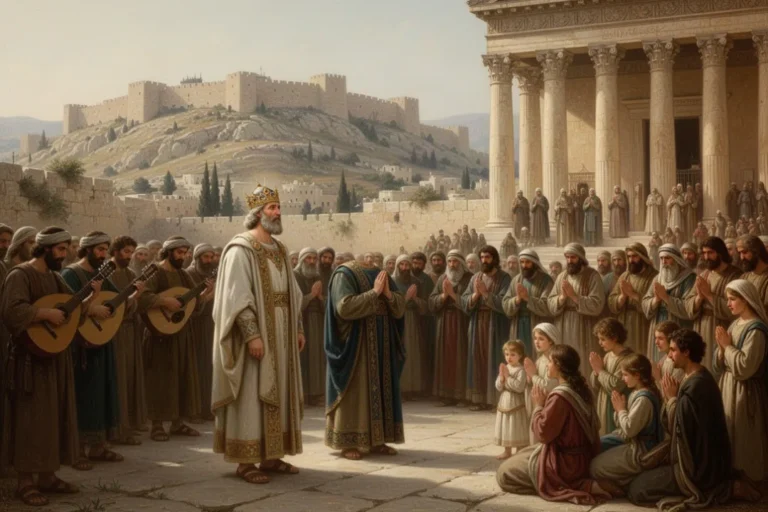
Jehoshaphat was afraid, but his response was not panic or self-reliance. He proclaimed a fast throughout Judah and gathered the people to seek help from the Lord. Men, women, and children stood before the temple in Jerusalem while the king prayed publicly.
Jehoshaphat’s prayer reviewed God’s past faithfulness, acknowledged God’s authority over the nations, and recalled the relationship between Judah and the descendants of Abraham. He also admitted that Judah did not know what to do and directly asked God for help. The prayer is one of the clearest biblical examples of a national leader bringing a military crisis before God in front of the people.
Jehoshaphat’s prayer openly admitted that Judah did not know what to do while looking to God for direction.
During the assembly, the Spirit of the Lord came upon Jahaziel, a Levite. Jahaziel announced that Judah would not need to win the battle by its own military power. The people were told to go out the next day, take their positions, and watch the Lord deliver them.
The message did not tell Judah to remain permanently passive. The people still had to leave Jerusalem, move toward the threat, and take their assigned positions. Faith involved obedient action after prayer, not simply waiting without responsibility.
Jehoshaphat responded by bowing before the Lord. Levites and other worshipers praised God, and singers went ahead of the army as it moved toward the battlefield. The biblical account emphasizes worship before the outcome was visible, which made the procession a public declaration of trust.
When Judah arrived near the wilderness overlooking the area, the opposing forces had turned against one another. The Moabites and Ammonites attacked the people from Seir, and then they destroyed one another. Judah found abandoned equipment and possessions, but the people did not have to initiate the battle in the ordinary way.
The place was named the Valley of Berakah, meaning the Valley of Blessing, because Judah blessed the Lord there. The people returned to Jerusalem with music and joy, and neighboring kingdoms heard that the Lord had fought against Judah’s enemies. The account says that Jehoshaphat’s kingdom became peaceful afterward.
This event explains why many readers associate Jehoshaphat with prayer during crisis. Several practical patterns stand out:
He acknowledged the threat honestly. Fear was not denied or hidden from the people.
He gathered the community. The crisis became a shared spiritual and national concern.
He remembered God’s character and past actions. His prayer was rooted in history rather than vague optimism.
He admitted human limitations. The king openly said that Judah needed divine help.
He acted on the instruction received. Judah still traveled toward the danger and took its position.
He gave thanks before and after deliverance. Worship shaped the response to the crisis.
The story should not be used to promise that every difficult situation will end through a miraculous military victory. Its emphasis is that God’s people are called to seek God sincerely, act faithfully, and refuse to treat fear as the final authority.
What Jehoshaphat’s later decisions reveal about his weaknesses
Jehoshaphat’s alliance with Ahab did not end with the battle at Ramoth-gilead. Later, he cooperated with Ahaziah, Ahab’s son and successor in Israel, in a maritime venture. The kings built ships at Ezion-geber, a port near the Gulf of Aqaba, apparently intending to conduct trade or obtain wealth by sea.
The prophet Eliezer son of Dodavahu opposed the partnership because Jehoshaphat had joined himself to Ahaziah. The ships were wrecked and could not sail. Second Chronicles presents the disaster as a direct warning against Jehoshaphat’s continued cooperation with the house of Ahab.
The accounts in Kings and Chronicles describe the episode with different details, but both preserve the central point: Jehoshaphat’s partnership with Israel’s royal house created spiritual and practical danger. His earlier experience with Ahab should have taught him to separate Judah from corrupt leadership, yet he again entered a joint project with Ahab’s son.
This repeated pattern helps explain why the Bible gives Jehoshaphat a mixed evaluation. He was serious about worship, justice, and prayer, but he was not always discerning about the people he trusted. A person can have strong religious convictions and still make poor decisions through political pressure, family connections, financial opportunity, or a desire for peace.
Warning from Jehoshaphat’s alliances: Shared goals do not make every partnership wise. Before joining another leader’s plan, consider that person’s character, methods, and loyalties—not only the immediate advantage.
Jehoshaphat’s family also experienced the consequences of his alliance with Ahab. His son Jehoram married into Ahab’s family, and Jehoram later followed practices that the biblical writers judged harshly. The marriage connection helped tie Judah’s royal house to the religious and political problems of Ahab’s dynasty.
Jehoshaphat’s example therefore includes both constructive reform and compromising diplomacy. His good policies did not eliminate the consequences of his weaker decisions. The narrative encourages careful judgment rather than simplistic admiration.
What the Bible says about Jehoshaphat’s death and legacy
Jehoshaphat eventually died and was buried with the kings of Judah in the city of David. His son Jehoram succeeded him. The biblical accounts do not describe Jehoshaphat as a perfect king, but they do place him among Judah’s more faithful rulers.
His legacy rests on several lasting contributions. He strengthened Judah’s cities, maintained military readiness, promoted teaching from the Law, established judicial oversight, and led the nation in public prayer. These actions show a king who understood that a stable nation required more than soldiers and wealth.
At the same time, his alliances with Ahab and Ahaziah show the limits of his wisdom. The Bible’s evaluation is morally serious: a faithful king could still be held responsible for helping ungodly rulers. His record warns against assuming that good motives can make a dangerous partnership harmless.
The name Jehoshaphat also appears in the expression “Valley of Jehoshaphat” in Joel 3. In that passage, God gathers and judges the nations. The name can be understood as referring to the Lord’s judgment, and the passage does not clearly identify this valley with a specific location from Jehoshaphat’s life.
Later tradition connected the name with an area near Jerusalem, but the biblical text itself does not say that the military deliverance in 2 Chronicles 20 took place in a valley called the Valley of Jehoshaphat. In Chronicles, the place connected with the victory is called the Valley of Berakah, or Valley of Blessing.
Reading the passages together gives a balanced picture of Jehoshaphat:
He sought God and encouraged Judah to do the same.
He taught the people and developed a system for public justice.
He prayed honestly when Judah faced an overwhelming threat.
He trusted God’s direction and led the nation to act on it.
He made unwise alliances with Ahab’s family despite clear warnings.
He left a complicated legacy that included both reform and compromise.
For readers studying leadership, Jehoshaphat’s life presents a particularly useful biblical case study. His strengths were visible in public policy, worship, education, and crisis response. His failures appeared in discernment and relationships. The account invites you to ask not only whether a leader has faith, but also whether that faith shapes the leader’s choices about power, partnerships, justice, and responsibility.
Where to read about Jehoshaphat in the Bible
The most complete account is in 2 Chronicles 17–20. These chapters describe his accession, military organization, teaching mission, judicial reforms, prayer during the invasion, and the defeat of the coalition against Judah. Chapter 21 begins by describing his death and the succession of Jehoram.
The parallel account appears in 1 Kings 22, with additional context in 1 Kings 15–16. This passage focuses especially on Jehoshaphat’s relationship with Ahab, the campaign at Ramoth-gilead, Micaiah’s prophecy, Ahab’s death, and the later naval project connected with Ahaziah.
Other passages help clarify related themes. Joel 3 uses the name Jehoshaphat in connection with God’s judgment of the nations. The reference to Jehoshaphat son of Ahilud in 2 Samuel 8:16 and several later passages refers to a royal official, not the king of Judah. Distinguishing these references prevents the different people named Jehoshaphat from being combined into one figure.
A focused reading plan can follow this order:
Read 2 Chronicles 17 for Jehoshaphat’s early reforms and military preparation.
Read 2 Chronicles 18 alongside 1 Kings 22 for his alliance with Ahab and the conflict involving Micaiah.
Read 2 Chronicles 19 for his judicial reforms and the prophet’s correction.
Read 2 Chronicles 20 for the national crisis, Jehoshaphat’s prayer, and the Valley of Berakah.
Read 2 Chronicles 21 for the transition to Jehoram and the consequences within Judah’s royal family.
Read Joel 3 separately to understand the prophetic use of the name “Jehoshaphat.”
These passages show why Jehoshaphat remains memorable: he was a king who could organize a nation, seek justice, pray under pressure, and lead worship, yet still make alliances that contradicted his devotion. His life calls for both imitation and caution—imitating his dependence on God while avoiding his failure to judge partnerships by character and faithfulness.
Frequently asked questions
Was Jehoshaphat a good king in the Bible?
Yes, the Bible generally presents Jehoshaphat as a faithful king of Judah. He sought God, promoted teaching, strengthened Judah, and improved the court system. However, his record was not without serious faults. His alliances with Ahab and Ahaziah exposed Judah to harmful influence and led to prophetic correction. His evaluation is best understood as positive but qualified.
What was Jehoshaphat’s most famous prayer?
His best-known prayer appears in 2 Chronicles 20 during an invasion by Moab, Ammon, and their allies. Jehoshaphat praised God’s authority, recalled God’s promises, acknowledged Judah’s helplessness, and asked for help. The prayer is especially remembered because he openly admitted that the nation did not know what to do while turning its attention toward God.
Did Jehoshaphat fight in the battle against Moab and Ammon?
Jehoshaphat led Judah toward the battlefield, but the opposing forces turned against each other before Judah needed to win the battle through direct combat. Judah still had to obey the instruction to go out and take its position. The victory was remembered at the Valley of Berakah, where the people praised God for deliverance.
Is the Valley of Jehoshaphat the same as the Valley of Berakah?
The Bible does not clearly identify them as the same place. Second Chronicles calls the location connected with Judah’s victory the Valley of Berakah, meaning Valley of Blessing. Joel uses “Valley of Jehoshaphat” in a prophecy about God judging the nations. Later tradition connected that name with a location near Jerusalem, but the biblical passages serve different purposes.




Leave a Reply