When you read about Assyria in the Bible, you may wonder why this ancient empire appears so often—and why its role changes from one passage to another. The answer is that Assyria was the dominant imperial power confronting Israel and Judah during a crucial period of biblical history. It conquered the northern kingdom of Israel, threatened Jerusalem, carried out forced deportations, and later became an example of a proud nation judged by God.
Assyria was not a minor background kingdom. Its rulers shaped the political world of the prophets Isaiah, Hosea, Micah, Nahum, and Jonah. The Bible presents Assyria both as a real historical empire and as a theological subject: God could use it to discipline his people, yet Assyria itself remained accountable for violence, arrogance, and cruelty.
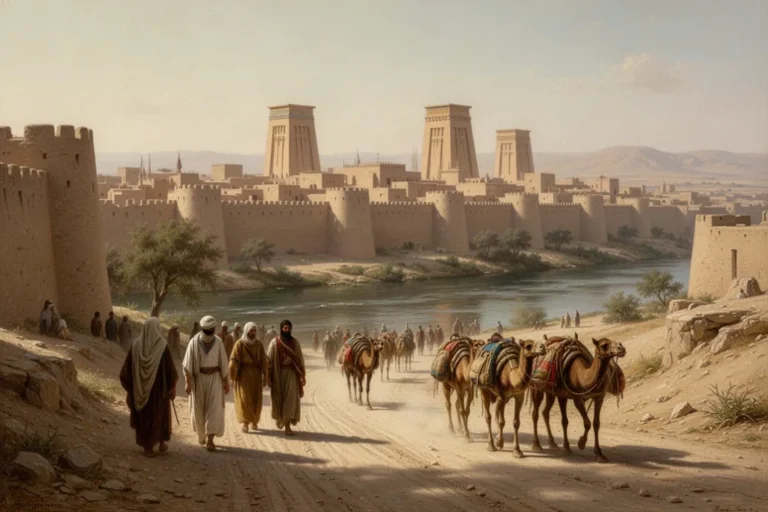
Assyria was an ancient kingdom centered in northern Mesopotamia, in the region that is now largely northern Iraq and parts of northeastern Syria and southeastern Turkey. Its earliest major centers included Ashur, the city from which the kingdom took its name, and later Nimrud and Nineveh. The empire controlled important routes along and across the Tigris River.
The biblical name “Assyria” can refer to the people, their land, or the imperial government that expanded across the Near East. In the Old Testament, Assyria is also connected with Asshur, a name used in genealogical and geographic passages. Genesis 10 associates Asshur with the development of major Assyrian cities, although the passage is presented within the Bible’s account of the nations rather than as a detailed political history.
Assyria became especially powerful during the ninth through seventh centuries BC. Its kings built a highly organized military state that relied on professional armies, siege warfare, tribute, provincial administration, and population transfers. When Assyria defeated a kingdom, it might replace its rulers, demand tribute, annex territory, or relocate large groups of people.
That policy explains why the Bible often describes Assyria with fear. Assyrian power was not limited to winning a single battle. It could permanently alter a nation’s leadership, economy, borders, and population. The empire’s royal inscriptions also celebrated military victories and harsh treatment of defeated enemies, giving historical context to the Bible’s descriptions of Assyrian intimidation.
A useful distinction: Assyria was an empire, while “Assyria” in a particular biblical verse may mean its army, king, territory, or imperial system. The surrounding passage usually shows which meaning is intended.
How Assyria conquered the northern kingdom of Israel
The most decisive Assyrian event in the Bible is the destruction of the northern kingdom of Israel, also called Samaria or Ephraim in different passages. After the united monarchy divided, Israel occupied the northern part of the land, while Judah continued in the south with Jerusalem as its capital.
Israel faced pressure from Assyria during the reigns of several kings. The biblical account names Tiglath-pileser III, who is also called Pul in 2 Kings 15:19. During the reign of King Menahem, Israel paid tribute to Assyria rather than being immediately destroyed. Later, Tiglath-pileser conquered or absorbed several northern territories during the reign of King Pekah, as described in 2 Kings 15:29.
Those campaigns reduced Israel’s territory and brought deportations. The biblical text names areas such as Galilee and the region east of the Jordan, including Gilead. This was part of a larger Assyrian practice: removing populations from their homeland made organized rebellion more difficult and allowed the empire to redistribute labor and communities.
Israel’s final crisis came when King Hoshea rebelled against Assyria and sought support elsewhere. According to 2 Kings 17, Assyrian forces besieged Samaria. The siege began under Shalmaneser V, and the city fell after the transition to Sargon II, who later claimed the conquest in Assyrian records. The fall is generally placed around 722 or 721 BC.
Second Kings 17 explains the event in political and religious terms. Israel had broken its obligations to Assyria, but the biblical writer also interprets the catastrophe as the result of long-standing unfaithfulness to God. The passage recalls idolatry, rejection of prophetic warnings, and practices associated with worship at unauthorized shrines.
This does not mean the Bible treats Assyrian violence as morally good. Instead, it presents two levels of explanation. Politically, Assyria invaded and conquered Israel. Theologically, Israel’s collapse was understood as judgment for persistent covenant disobedience. The same biblical tradition can condemn Assyria’s brutality while also saying God used the empire as an instrument of judgment.
After Samaria fell, Assyria brought people from other parts of its empire into the region. Second Kings 17 lists several places from which settlers came. Over time, this contributed to the mixed population of the former northern kingdom. Later Jewish and Christian discussions connect this history with the background of the Samaritans, although the social and religious relationship between Jews and Samaritans developed over many generations and should not be reduced to one event.
Israel’s political rebellion triggered direct Assyrian intervention.
Assyrian deportations weakened the northern kingdom and reshaped its population.
Samaria’s fall ended the northern kingdom as an independent state.
2 Kings 17 interprets the disaster as judgment after repeated warnings.
Why Assyria threatened Judah and Jerusalem
Assyria did not stop after conquering Israel. Its campaigns also brought Judah under pressure. The most famous confrontation occurred during the reign of King Hezekiah, when the Assyrian king Sennacherib invaded Judah and captured many fortified cities.
The biblical accounts appear in 2 Kings 18–19, 2 Chronicles 32, and Isaiah 36–37. Assyrian forces advanced through Judah and then threatened Jerusalem. Sennacherib’s representative, often called the Rabshakeh, delivered a speech designed to weaken the city’s confidence. He argued that Judah’s God could not rescue Jerusalem, just as the gods of other conquered nations had failed to save them.
Hezekiah responded by seeking God through prayer and by consulting the prophet Isaiah. The biblical account emphasizes that Jerusalem did not win through superior military strength. Instead, God protected the city from the immediate Assyrian assault. The exact historical details behind the withdrawal are debated, but the biblical narrative clearly presents the event as a major deliverance.
Isaiah’s account gives the confrontation a wider meaning. Assyria had become arrogant, treating its victories as proof that its own power was unlimited. Isaiah 10 portrays Assyria as a tool permitted to punish an unfaithful people, but the empire is then judged for its pride and violent ambition. The message is not that Assyria was righteous. It is that no empire remains outside God’s authority.
Second Kings also records Hezekiah’s earlier attempt to pay tribute to Sennacherib. This detail shows that the crisis involved diplomacy as well as warfare. Judah was a smaller kingdom caught between imperial demands, military threats, and the question of whether political survival should depend on foreign alliances or trust in God.
The Bible’s treatment of Hezekiah and Assyria should not be read as a simple claim that faith removes every danger. Jerusalem was surrounded, Judah suffered losses, and the kingdom faced real devastation. The central point is more specific: Assyria could conquer cities without having the final word over Jerusalem.
Read the parallel accounts together: 2 Kings highlights the political crisis, Isaiah emphasizes prophetic interpretation, and 2 Chronicles gives additional attention to Hezekiah’s preparations and leadership. Comparing them shows how the same event can carry historical and theological meaning.
What the prophets said about Assyria
Assyria appears in biblical prophecy as both an instrument of judgment and an object of judgment. This tension is one of the most important ideas for understanding the subject. The prophets did not praise imperial power simply because God could use it. They insisted that Assyria would answer for its own actions.
Isaiah 7–12 speaks to a period when Judah faced threats from neighboring kingdoms and the expanding Assyrian empire. Assyria could be called upon as a political force, but dependence on it carried serious danger. Isaiah warned that the empire Judah might seek as protection could become a source of oppression.
Isaiah 10 uses striking imagery to describe Assyria as an instrument in God’s hand. The passage compares the empire to an implement used for a task, while criticizing the Assyrian ruler for failing to recognize that his success was limited and permitted. The king plans conquest for his own glory, not for the purpose God assigns.
The chapter therefore rejects two opposite errors. One error is to imagine that Assyria acts independently of God’s rule. The other is to assume that divine use makes Assyria innocent. Providence does not erase responsibility. Assyria’s ambition, cruelty, and boasting remain subject to judgment.
Nahum announces Nineveh’s downfall
The book of Nahum is directed against Nineveh, the great Assyrian capital. Its language is severe because Nineveh represents an empire known for conquest and oppression. Nahum announces that the city’s power will collapse and that those who suffered under Assyria will receive relief.
Nahum should be read alongside Isaiah rather than as a contradiction of it. Isaiah focuses especially on Assyria’s threat to Judah and its arrogance before God. Nahum focuses on the empire’s violence and the certainty that imperial dominance will not last forever.
Historically, Nineveh fell to a coalition of Babylonians and Medes in 612 BC. The Assyrian state continued for a short time in diminished form, but its imperial dominance ended soon afterward. The fall of Nineveh gives historical shape to the prophetic claim that violent power can appear permanent and still be brought down.
Jonah shows mercy toward Assyria’s capital
The book of Jonah presents a different side of Assyria. Jonah is sent to Nineveh, where he announces impending judgment. The people respond with repentance, and God shows mercy rather than bringing the announced destruction at that time.
The book does not make Assyria harmless. Nineveh was still identified with a violent imperial power. Instead, Jonah explores the uncomfortable breadth of God’s compassion. The prophet is angry that mercy has been extended to an enemy, while God teaches him to care about a large population that does not belong to Israel.
Jonah’s historical setting and literary purpose have been discussed by interpreters for centuries. Regardless of how one evaluates its precise date or genre, its theological point is clear: God’s concern is not restricted to Israel, and repentance can lead to mercy even for a feared foreign population.
Which Assyrian kings appear in the Bible
Several Assyrian rulers are named directly or indirectly in biblical books. Knowing their sequence helps connect the narratives with the broader history of the ancient Near East.
Tiglath-pileser III, also called Pul in 2 Kings 15:19, expanded Assyrian control over Israel and neighboring regions. He appears in 2 Kings, 1 Chronicles, and related prophetic contexts.
Shalmaneser V began the siege of Samaria during the reign of Hoshea, according to 2 Kings 17:3–6.
Sargon II is named in Isaiah 20:1. His reign followed Shalmaneser V, and Assyrian records associate him with the capture of Samaria.
Sennacherib invaded Judah during Hezekiah’s reign. His campaign is recorded in 2 Kings 18–19, 2 Chronicles 32, and Isaiah 36–37.
Esarhaddon appears in 2 Kings 19:37 and Isaiah 37:38 in connection with the succession after Sennacherib.
Ashurbanipal is named in Ezra 4:10 under the form Asnapper, in a passage concerning populations settled in Samaria.
Assyrian royal names can look different across translations because ancient names moved through several languages. A biblical text may use a Hebrew form, while a modern history book uses a form based on Akkadian or another scholarly convention. Comparing the surrounding events is often more helpful than focusing only on spelling.
The books of Kings and Chronicles also have different emphases. Kings frequently explains national disasters through Israel’s and Judah’s covenant failures. Chronicles gives more attention to temple worship, reform, prayer, and the leadership of Davidic kings. Their references to Assyria should be read with those larger purposes in mind.
How to read Assyria’s role in the Bible today
Assyria’s story helps readers see how the Bible handles empire, suffering, and divine judgment. The biblical writers do not romanticize political power. Assyria has strong armies, skilled administrators, and impressive cities, yet its greatness cannot prevent accountability.
The narrative also warns against reducing history to a single explanation. Assyria’s victories involved military strategy, geography, diplomacy, internal politics, and imperial administration. The Bible adds a theological interpretation without denying those visible causes. That combination is why the Assyrian passages remain both historically grounded and spiritually serious.
Several reading principles can keep the subject clear:
Identify the period and king. A reference to Tiglath-pileser belongs to a different stage of Assyrian expansion than a reference to Sennacherib.
Distinguish Israel from Judah. Samaria’s fall and Jerusalem’s deliverance are related but separate events.
Notice the speaker. A boast from an Assyrian official is not the Bible’s own endorsement of that claim.
Read prophecy in context. Isaiah, Nahum, and Jonah address different situations and emphasize different aspects of Assyria.
Hold judgment and mercy together. Assyria is condemned for violence, yet Nineveh’s repentance in Jonah is met with compassion.
For a focused study, begin with 2 Kings 15–19 and Isaiah 7–10, 36–38. Then read Nahum for the judgment of Nineveh and Jonah for the question of mercy toward Assyria. Ezra 4 and selected references in Chronicles can fill in later traditions about Assyrian settlement and influence.
Assyria in the Bible ultimately represents more than an ancient enemy. It is a case study in the limits of empire, the seriousness of national injustice, and the freedom of God to judge, protect, warn, or show mercy. Its cities and kings dominated the region for generations, but the biblical record insists that no empire—not even one as formidable as Assyria—stands beyond moral accountability.
Frequently asked questions
Was Assyria the same as Babylon?
No. Assyria and Babylon were separate Mesopotamian powers, although they sometimes controlled the same territories and influenced one another. Assyria dominated much of the region before Babylon rose to prominence. Babylon later conquered Judah, destroyed Jerusalem, and carried out the Babylonian exile. Assyria is especially associated with the fall of Samaria and the northern kingdom of Israel.
Why did God use Assyria to punish Israel?
The biblical explanation is that Israel had persisted in idolatry, injustice, and rejection of prophetic warnings. Assyria became the foreign power through which judgment came. At the same time, Scripture condemns Assyria for its own pride and cruelty. The text therefore presents divine use of an empire and that empire’s moral responsibility as two truths held together.
Did Assyria destroy Jerusalem?
No. Assyria invaded Judah and captured many fortified cities, but Jerusalem survived Sennacherib’s campaign during Hezekiah’s reign. The accounts in 2 Kings, 2 Chronicles, and Isaiah describe the city’s deliverance. Jerusalem was destroyed later by Babylon, not Assyria, during the reign of Nebuchadnezzar.
What is the importance of Nineveh in the Bible?
Nineveh was Assyria’s major capital and appears prominently in Jonah and Nahum. Jonah emphasizes that God showed mercy when Nineveh responded to the warning, while Nahum announces the city’s judgment because of its violence and oppression. Together, the books highlight both the possibility of repentance and the certainty of accountability.










Leave a Reply