Lot in the Bible: His story, choices, and lasting lessons
Lot in the Bible: His story, choices, and lasting lessons
When you hear the story of Lot in the Bible, you may wonder why Abraham’s nephew is remembered both as someone God rescued and as a man whose choices led to serious trouble. The answer is found mainly in Genesis 11–19: Lot separated from Abraham, settled near Sodom, became caught in a regional war, escaped the city’s destruction, and later fathered two nations through a deeply troubling episode with his daughters.
Lot’s story is not a simple portrait of either a hero or a villain. Scripture presents him as a man who experienced God’s mercy, made questionable decisions, suffered the consequences of living among corrupt people, and still received a favorable description in the New Testament. His life raises practical questions about how you choose your surroundings, what compromise can do over time, and how divine rescue relates to human responsibility.
Who Lot was and how he became part of Abraham’s household
Lot was the son of Haran, Abraham’s brother, which made Lot Abraham’s nephew. Genesis identifies Haran as the father of Lot and records that Haran died in Ur of the Chaldeans before the family moved toward the land of Canaan (Genesis 11:27–31). After Haran’s death, Lot traveled with his grandfather Terah and his uncle Abraham.
Lot therefore belonged to the same extended household as Abraham during a major period of movement and uncertainty. God had called Abraham to leave his homeland and go to a land that God would show him (Genesis 12:1–5). Lot went with him, sharing in the journey through Canaan and later into Egypt before the two men returned to the land.
The Bible does not give a detailed account of Lot’s childhood or personal faith during these early years. It does show that he became prosperous. Both Abraham and Lot had large flocks, herds, and tents, and the land could not support all their animals while they remained together. Their herdsmen began quarreling, creating a conflict that threatened the peace between the two households.
Abraham handled the dispute by allowing Lot to choose first. He did not insist on his seniority or claim the better territory for himself. Instead, he proposed that they separate, with Abraham taking the opposite direction from Lot. This decision preserved family peace, but Lot’s response shaped the rest of his life.
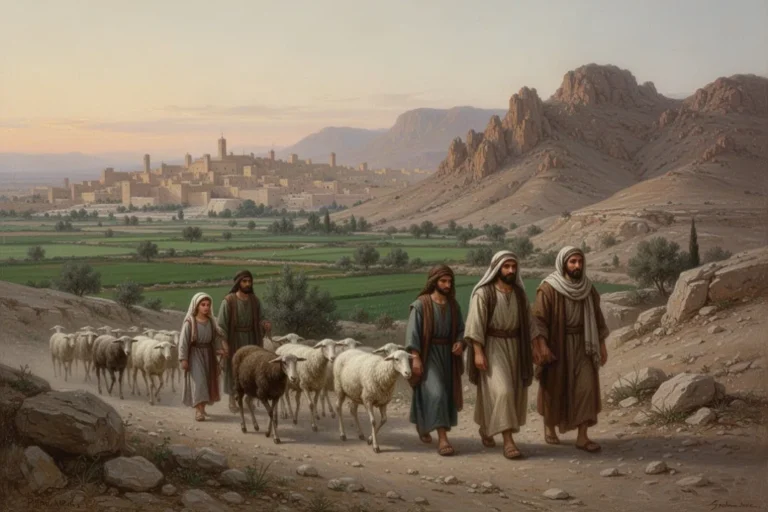
Lot looked across the Jordan Valley and saw that it was well watered, resembling a fertile garden. He chose the whole plain for himself and moved eastward, while Abraham remained in the land of Canaan (Genesis 13:5–12). The choice was understandable from an economic perspective: good pasture would support his livestock and household. Yet the passage also points out that the people of Sodom were extremely wicked.
Pay attention to the direction of Lot’s movement. Genesis first says that Lot looked toward the Jordan Valley, then that he settled in the cities of the plain, and later that he lived in Sodom. His movement appears gradual, showing how a decision based on visible advantage can bring you closer to influences you did not initially intend to embrace.
Why Lot chose the Jordan Valley and moved toward Sodom
Lot’s decision reveals a tension that appears throughout the Bible: what looks beneficial on the surface may carry serious spiritual and moral costs. The Jordan Valley offered water, land, and opportunity. Sodom offered an established city and access to an urban economy. By contrast, Abraham continued living as a temporary resident in tents, trusting God’s promise rather than securing the most obvious material advantage.
The text does not say that Lot chose Sodom because he approved of its evil. It would be too strong to claim that he deliberately sought wickedness. What Genesis does show is a sequence: he saw the fertile plain, chose it, lived near the cities, and eventually lived in Sodom itself. That progression matters because proximity can become participation, even when the original goal is simply comfort, security, or prosperity.
Lot’s location also affected his vulnerability. His possessions and household became tied to the city’s political and military environment. When four kings attacked the region, they defeated the rulers of Sodom and Gomorrah and carried away people and goods. Lot was among those captured because he was living in Sodom (Genesis 14:1–12).
One survivor escaped and reported the disaster to Abraham. Abraham responded by gathering trained men from his household and pursuing the invading forces. He defeated them, recovered the possessions, and brought Lot back along with the other captives. This rescue shows Abraham’s loyalty to his nephew, even after their separation, and it also demonstrates how Lot’s settlement left him exposed to dangers beyond his control.
After the victory, Abraham refused to enrich himself through the king of Sodom. His refusal contrasted with the king’s offer and showed that Abraham wanted his prosperity to be associated with God rather than with Sodom’s ruler. Lot’s story does not include a similar statement of independence. Instead, the narrative moves him back into the city from which he had just been rescued.
Several practical observations arise from this part of Lot’s life:
Visible abundance is not the same as lasting well-being. Fertile land can provide income while a surrounding culture weakens judgment and relationships.
Separation from a godly influence can increase vulnerability. Lot was no longer sharing daily life with Abraham, whose household had received God’s promises.
One rescue does not automatically change a pattern. Lot was delivered from captivity, but Genesis later finds him living in Sodom again.
Choices affect more than the chooser. Lot’s household, servants, daughters, and wife all lived within the consequences of his settlement.
These observations should not be used to blame Lot for every later event. Sodom’s evil belonged to the people who committed it, and each person remained morally responsible for individual actions. Still, Genesis presents Lot’s decisions as significant rather than accidental. His life shows how a choice can be reasonable in the short term and damaging in the long term.
What happened to Lot in Sodom
Genesis 18–19 shifts the focus from Abraham’s intercession to the coming judgment of Sodom and Gomorrah. God disclosed to Abraham that the outcry against the cities was great and that their wickedness required judgment. Abraham pleaded for the righteous people within the city, asking whether God would spare the place if a smaller number of righteous people could be found.
Two angels then came to Sodom in the evening. Lot was sitting at the city gate, a detail that may indicate a recognized civic position rather than the life of a newcomer on the outskirts. When he saw the visitors, he urged them to stay in his house. Lot offered them food and protection, but the men of Sodom surrounded the house and demanded that the visitors be brought outside.
The crowd’s demand was not ordinary curiosity or hospitality. It expressed a desire to abuse and humiliate the visitors through sexual violence. Lot went outside to confront the crowd and called their behavior wicked. He even made a shocking and morally unacceptable proposal involving his daughters in an attempt to protect the guests. The narrative does not commend this act; it exposes how deeply the crisis had affected the household and how distorted Lot’s judgment had become.
The angels pulled Lot back inside and struck the crowd with blindness. They then told Lot to bring out anyone belonging to him and leave the city because its destruction was imminent. Lot warned the men engaged to his daughters, but they treated his message as a joke. That response suggests that Lot’s authority within his family and community had been badly weakened.
At daybreak, the angels urged Lot to leave with his wife and daughters. Genesis says that Lot hesitated, so the angels took hold of the family and led them outside the city. The account emphasizes God’s mercy in rescuing Lot, not Lot’s strength in escaping. Once outside, the family was told not to look back or remain in the valley, but to flee to the mountains.
Lot objected to the destination and asked to flee to a smaller nearby city, later called Zoar. The request was granted, and he reached Zoar before the judgment fell. Genesis describes the destruction of Sodom and Gomorrah through burning sulfur from the sky, leaving the valley devastated. The event functions in the Bible as a judgment on severe communal wickedness and as a warning against refusing God’s call to leave evil behind.
The account includes several details that are easy to overlook but help explain Lot’s condition:
Lot recognized the evil around him. He called the crowd’s conduct wicked, even though he had chosen to live among them.
Lot’s household did not share his urgency. His future sons-in-law dismissed his warning, and his wife later disobeyed the command not to look back.
Lot hesitated when escape became necessary. The city had become home, even though it was under judgment.
God’s rescue came through direct intervention. The angels physically led Lot and his family out when hesitation might have left them behind.
Lot’s wife looked back and became a pillar of salt (Genesis 19:26). The passage does not explain every aspect of the transformation, but it clearly presents her backward look as disobedience. She had physically left the city while remaining emotionally attached to the life she was leaving. Jesus later referred to this event when warning his disciples to remember Lot’s wife and not cling to what must be abandoned (Luke 17:28–32).
Do not treat Lot’s rescue as approval of Sodom. God saved Lot from the city, but the surrounding culture had already shaped his household and weakened his decisions. Deliverance from danger does not erase the consequences of years spent close to it.
What happened to Lot and his daughters after Sodom fell
After leaving Zoar, Lot became afraid and moved with his two daughters into the mountains. They lived in a cave, apparently believing that they were isolated from the wider population. Genesis 19:30–38 records what happened next: the daughters became convinced that there was no man available to preserve their family line, so they made their father drunk on successive nights and became pregnant by him.
The older daughter gave birth to Moab, identified as the ancestor of the Moabites. The younger daughter gave birth to Ben-ammi, identified as the ancestor of the Ammonites. These names connect Lot’s family history to two neighboring peoples who later appear frequently in the Old Testament.
The Bible presents this episode as a tragic result of fear, isolation, drunkenness, and badly distorted family reasoning. It does not portray the daughters’ plan as a model of faithfulness, and it does not erase Lot’s responsibility for becoming intoxicated. The passage is descriptive rather than celebratory: it tells readers what happened and explains the origins of two nations without approving the conduct involved.
Moab and Ammon later had complicated relationships with Israel. Their peoples sometimes opposed Israel, though the biblical record also includes individual examples of compassion and loyalty. Ruth, for example, was a Moabite woman who joined herself to Israel and became part of the family line leading to David. The existence of difficult national relationships does not mean that every person from those nations was condemned or incapable of faithfulness.
Lot’s final years are not described in detail. Scripture does not tell us when he died, how he related to his daughters afterward, or whether he returned to Abraham. The silence itself prevents readers from filling the gaps with invented details. What can be said is that his story ended with severe personal and family consequences after the destruction of the city he had chosen as his home.
How the New Testament interprets Lot’s character
Some readers are surprised that the New Testament refers to Lot in a relatively favorable way. Second Peter 2:7–8 calls him a righteous man and says that his righteous soul was distressed by the lawless conduct he saw and heard. This description does not mean that Lot’s decisions were wise or that every action he took was morally acceptable.
Instead, the New Testament presents Lot as someone who belonged to God while being deeply troubled and compromised within a corrupt society. The language highlights his inner distress at Sodom’s lawlessness, not a record of consistent courage. His story therefore holds two truths together: God knew how to rescue Lot, and Lot’s life contained serious failures that harmed his family.
That tension is useful because it prevents two opposite mistakes. One mistake is to treat Lot as entirely wicked and ignore the New Testament’s description of him. The other is to excuse everything he did because God rescued him. Biblical mercy is not the same as moral endorsement.
Jesus also used Lot’s experience in Luke 17:28–32 when teaching about the suddenness of divine judgment. People in Sodom were carrying on with ordinary activities such as eating, drinking, buying, selling, planting, and building until destruction came. The warning is that normal routines can continue while people ignore the seriousness of their spiritual condition.
Jesus’ reference to Lot’s wife focuses on the danger of turning back. Her story is not merely about curiosity. It represents attachment to a condemned way of life after receiving a clear command to leave. The teaching calls for alertness, trust, and a willingness to release what stands against obedience.
Lot’s story also illustrates how Scripture can describe a person with genuine faith while showing that person’s weakness in detail. A person may feel grief over evil and still make poor decisions. Someone may receive God’s rescue and still carry damaged relationships. Spiritual identity and practical wisdom should not be separated.
What Lot’s life teaches about choices, influence, and rescue
Lot’s life offers guidance for decisions that seem primarily practical. Career opportunities, housing, relationships, financial security, and social acceptance can all look attractive on the surface. The question is not whether comfort or prosperity is automatically wrong. The question is whether the environment required to obtain them will steadily pull you away from what you believe is right.
Genesis does not say that Lot could have predicted every event in Sodom. It does show that he ignored warning signs that were visible from the beginning. The city was known for serious wickedness before he settled there, and his location eventually placed his household inside the city’s moral and political life.
Healthy discernment does not require withdrawing from every imperfect person or community. Abraham himself lived among people who did not share his faith. Lot’s problem was not simply that he encountered sinners; it was that he chose to build his life around a society whose corruption was obvious and then appeared unable to leave when danger came.
For practical decision-making, Lot’s story encourages you to ask:
What am I prioritizing: immediate benefit, or long-term faithfulness?
What will this choice expose my household to over time?
Am I moving gradually toward a situation I would have rejected at the beginning?
Do trusted people see risks that I am minimizing?
When a situation becomes clearly destructive, am I willing to leave it?
The account also shows that rescue may be urgent and uncomfortable. Lot did not leave Sodom with a carefully prepared plan. He hesitated, needed help, and had to accept an unfamiliar destination. Sometimes obedience requires leaving before you have every detail arranged. At other times, wise action includes seeking help from family, church leaders, counselors, or authorities, especially when abuse or immediate danger is involved.
Lot’s story should never be used to pressure someone to remain in an abusive or criminal situation. The biblical command to flee judgment is not a command to tolerate violence. The episode in Sodom includes sexual violence and an attempted assault, and victims are not responsible for the actions of abusers. Applying the story responsibly means taking danger seriously and protecting vulnerable people.
Finally, Lot’s life shows that God’s mercy can reach people whose judgment has been clouded. Abraham’s intercession, the angels’ intervention, and the New Testament’s recognition of Lot all point to mercy. Yet mercy should lead to repentance and wiser living, not to continued presumption. Lot was rescued from Sodom, but the scars of his choices remained in his household and family history.
The central lesson is not that every prosperous place is dangerous or that every difficult place is holy. It is that your surroundings, ambitions, relationships, and repeated compromises shape the person and household you become. Lot chose what looked fertile, moved closer to a corrupt city, hesitated when told to leave, and escaped only through God’s intervention. His story calls for honest self-examination, moral courage, and a willingness to respond when God makes the right direction clear.
Frequently asked questions
Was Lot Abraham’s son?
No. Lot was Abraham’s nephew, the son of Abraham’s brother Haran. After Haran died, Lot traveled with Abraham’s household from Mesopotamia toward Canaan. The two men later separated because their growing flocks and herds created conflict between their workers. Lot chose the fertile Jordan Valley, while Abraham remained in Canaan.
Why did Lot offer his daughters to the crowd in Sodom?
Genesis 19 records that Lot made this terrible proposal while trying to protect the angelic visitors from a violent mob. Scripture does not approve his action; it exposes the moral confusion and desperation surrounding the event. Lot’s response shows how severely Sodom had affected his judgment, even though he recognized the crowd’s behavior as wicked.
Did Lot choose Sodom because he was evil?
The Bible does not directly state that Lot wanted evil. He appears to have chosen the Jordan Valley because it was fertile and economically attractive. However, Genesis shows him moving progressively closer to Sodom, a city already known for serious wickedness. His choice may have begun with practical concerns, but it placed his household in a damaging environment.
What does Jesus mean by remembering Lot’s wife?
In Luke 17:28–32, Jesus uses Lot’s wife as a warning against turning back after being told to leave a condemned way of life. The point is more than looking out of curiosity; it concerns attachment to what must be abandoned. Her story calls for alertness, trust, and readiness to obey rather than clinging to former security.










Leave a Reply