Abimelech in the Bible: the people behind the name
Abimelech in the Bible: the people behind the name
Abimelech in the Bible refers to more than one person. The name belongs to kings connected with Gerar in Genesis, to Gideon’s son in Judges 9, and possibly to a royal title used for a Philistine ruler. It should not automatically be confused with Ahimelech, the priest who helped David.
The most prominent Abimelech in the Old Testament is Gideon’s son, who tried to become king over Shechem by murdering his brothers. The other major Abimelech figures appear in Genesis 20–21 and Genesis 26, where they are kings of Gerar who interact with Abraham and Isaac.
What the name Abimelech means and why it refers to several people
The Hebrew name Abimelech is commonly understood to mean something like “my father is king” or “father of a king.” Biblical names can be shared by different people, and this one may also have functioned as a royal designation rather than only as an individual personal name.
That possibility helps explain why Genesis mentions an Abimelech during Abraham’s life and another during Isaac’s life. The text does not require them to be the same man. They are both associated with Gerar, a city or region in the southern part of Canaan, but they belong to different generations.
The name appears in several distinct settings:
Abimelech of Gerar encounters Abraham in Genesis 20 and makes a covenant with him in Genesis 21.
Another Abimelech of Gerar deals with Isaac in Genesis 26.
Abimelech, son of Gideon, seizes power in Shechem in Judges 8–9.
Abimelech in Psalm 34 is linked with the king of Gath, who is called Achish in the narrative of 1 Samuel.
There is also a frequent spelling and memory problem involving Abimelech and Ahimelech. Ahimelech was a priest at Nob who gave David consecrated bread and Goliath’s sword, according to 1 Samuel 21. The names look and sound similar, but the priest and Gideon’s son are different people.
Reading tip: Always check the biblical reference before identifying Abimelech. The surrounding names, location, and events show whether the passage concerns a Gerarite king, Gideon’s son, or a different person with a similar name.
Abimelech, the king of Gerar, and Abraham
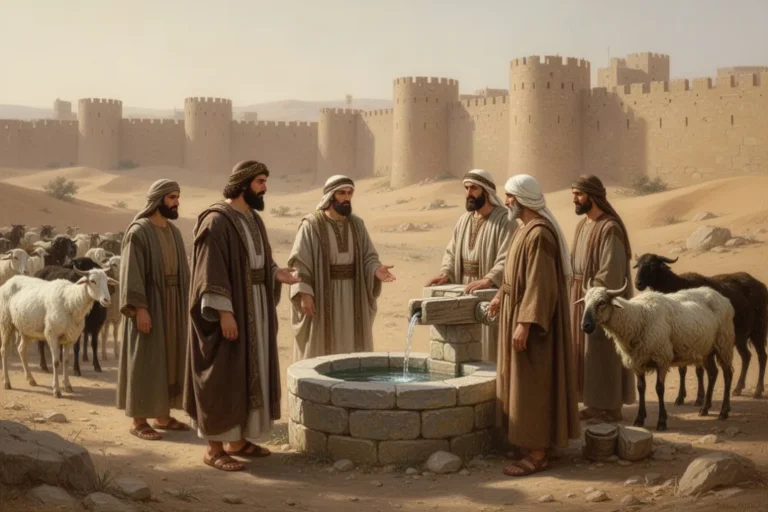
Genesis 20 introduces an Abimelech who is king of Gerar. Abraham travels through the area with Sarah, and he describes Sarah as his sister. Abraham’s statement contains a family connection, since Sarah was related to him, but it does not present the full truth that she was also his wife.
Abimelech takes Sarah into his household, but God intervenes before the marriage can be consummated. In a dream, God warns Abimelech that Sarah is married and that he is in danger because of the situation. Abimelech responds by insisting that he acted without knowing the truth and that he had not intentionally done wrong.
The account emphasizes both God’s protection of Sarah and the danger created by Abraham’s half-truth. Abimelech returns Sarah to Abraham, rebukes him for placing the household at risk, and gives Abraham livestock, servants, and other possessions. He also offers land for Abraham and Sarah to use.
After Abraham prays, God heals Abimelech, his wife, and the women in his household. Genesis presents the infertility in Abimelech’s household as connected with Sarah’s removal from Abraham. The restoration follows the king’s return of Sarah and Abraham’s prayer.
This Abimelech is not portrayed as an idol-worshiping caricature who ignores God. Instead, the narrative shows him responding seriously to divine warning. He recognizes that the situation is morally dangerous, corrects it, and challenges Abraham’s conduct.
Several themes stand out in Genesis 20:
God preserves the covenant family even when Abraham acts fearfully and speaks incompletely.
Abimelech’s ignorance matters; he argues that he acted with an innocent heart and clean hands.
Abraham’s status as a prophet includes responsibility to pray for Abimelech after the dispute.
Human power does not control the outcome; God directs the king through a dream and protects Sarah.
Genesis 21 describes a later meeting between Abraham and Abimelech. The king comes with Phicol, identified as the commander of his army, and acknowledges that God is with Abraham in everything he does. Abimelech asks Abraham to swear that he will deal honestly with him, his children, and his descendants.
The two men make a covenant at Beersheba. Abraham then raises a dispute over a well that Abimelech’s servants had seized. Abraham sets aside seven female lambs as a witness that he dug the well, and the place receives a name connected with the oath and the seven lambs.
The agreement shows Abimelech acting as a regional ruler concerned with stable relations. He recognizes Abraham’s growing influence and seeks a peaceful arrangement. Abraham, for his part, wants his access to water and his rights to the well publicly acknowledged.
Abimelech in Genesis 26 during Isaac’s life
Genesis 26 introduces another Abimelech, again described as king of Gerar. This time Isaac is the central figure. During a famine, Isaac settles in the region rather than going down to Egypt, following God’s direction. Like his father Abraham, Isaac tells people that Rebekah is his sister because he fears that he may be killed on account of her.
Eventually, Abimelech sees Isaac and Rebekah behaving in a way that makes their marriage clear. The king understands that Rebekah is Isaac’s wife and rebukes Isaac for exposing the people to possible guilt. He then commands the population not to harm either of them.
The similarity between Abraham’s actions in Genesis 20 and Isaac’s actions in Genesis 26 is deliberate. Isaac repeats his father’s fearful strategy, and the danger again involves concealing a marriage. The repeated story shows how patterns of behavior can pass from one generation to another.
Afterward, Isaac prospers greatly. His success creates tension with the Philistines, who fill in the wells Abraham’s servants had dug. Abimelech eventually tells Isaac to leave because Isaac has become too powerful for the surrounding population to accommodate comfortably.
Later, Abimelech visits Isaac with an army commander and a personal adviser. Isaac asks why they have come, since they had previously sent him away. They explain that they have clearly seen that the Lord is with Isaac and want a sworn agreement of peaceful treatment.
Isaac prepares a feast, and the men make an oath. They depart peacefully. The story closes with Isaac’s servants reporting that they have found water, connecting the peaceful agreement with the continuing importance of wells and land in the narrative.
The Abimelech of Genesis 26 may be a later ruler using the same royal name or title, rather than the exact same individual who met Abraham. The text places the encounters in separate generations. The repeated name and location highlight continuity in the political world around the patriarchs, but they do not prove that one king lived across both periods.
Abimelech, the son of Gideon, in Judges 8 and 9
The most violent biblical Abimelech appears at the end of Gideon’s story. Gideon, also called Jerubbaal, had many sons because he had several wives. He also had a son named Abimelech through a concubine who lived in Shechem. This family connection gives Abimelech ties to both Gideon’s household and the important city of Shechem.
After Gideon dies, Abimelech approaches his mother’s relatives and the leaders of Shechem. He asks whether it is better for them to be ruled by Gideon’s seventy sons or by one man who is their own relative. He presents himself as the natural local choice and receives money from the temple of Baal-berith.
With that money, Abimelech hires reckless men and attacks his seventy brothers. He kills them on one stone, apparently intending to eliminate every rival. Only Jotham, Gideon’s youngest son, escapes. The people of Shechem then make Abimelech king at the oak or pillar near Shechem.
Jotham responds from Mount Gerizim with a parable about trees seeking a king. The useful trees—the olive tree, fig tree, and vine—refuse because they would have to abandon their productive work. The thornbush accepts the honor and offers dangerous shelter. Jotham’s story portrays Abimelech as an unproductive and destructive ruler who offers protection that will ultimately consume both ruler and subjects.
Jotham declares that the people of Shechem and Abimelech have acted treacherously toward Gideon’s family. He calls for mutual destruction between them. Then he escapes to Beer and lives there because Abimelech is afraid of what he may do.
After three years, conflict develops between Abimelech and the leaders of Shechem. Judges describes this breakdown as part of God’s judgment against the violence done to Gideon’s sons and against the treachery of the Shechemites. The leaders place their trust in Abimelech, but their alliance proves unstable.
A man named Gaal son of Ebed arrives at Shechem and gains the confidence of its leaders. During a festival, Gaal insults Abimelech and boasts that he could defeat him. Zebul, the city’s governor, hears the remarks and secretly informs Abimelech, urging him to attack.
Abimelech sets an ambush outside the city. When Gaal sees the troops, Zebul challenges his interpretation of what he sees, but the attack soon becomes unmistakable. Abimelech defeats Gaal and his followers, and Zebul drives Gaal from Shechem.
The conflict does not end there. The people of Shechem continue their resistance, so Abimelech attacks the city. He captures it, kills its inhabitants, and destroys the city. He then scatters salt over the site, a symbolic act suggesting desolation and a desire to make the city unproductive.
Some people take refuge in the stronghold associated with the temple of El-berith. Abimelech burns the refuge, killing about a thousand men and women. His actions show that he is not merely suppressing a rebellion; he is answering opposition with escalating brutality.
How a woman kills Abimelech at Thebez
Abimelech then attacks Thebez, another fortified town. The inhabitants flee into a strong tower, and Abimelech approaches the entrance to burn it. A woman drops an upper millstone onto his head and severely wounds him.
Abimelech immediately orders his armor-bearer to kill him with a sword so that people will not say a woman killed him. The armor-bearer obeys, and Abimelech dies. The biblical account then records that the people of Israel returned to their homes after God had repaid Abimelech and the people of Shechem for their crimes.
His death fulfills the shape of Jotham’s warning. Abimelech destroys Shechem, but his own campaign ends when an unnamed woman defeats him from the city’s tower. The narrative also exposes his concern for reputation and masculine honor: even while dying, he focuses on how the story will be told.
Abimelech’s story warns against confusing political success with legitimate leadership. He gains authority through family manipulation, hired violence, and the elimination of rivals. His rule brings neither security nor justice, and the alliance that supports him eventually turns against him.
Other biblical references and the confusion with Ahimelech
Psalm 34 has a heading that connects David’s escape with Abimelech, king of Gath. The narrative in 1 Samuel 21 names that king Achish. Because of this difference, many readers understand Abimelech in the psalm heading as a royal title or dynastic designation rather than the king’s personal name.
In 1 Samuel, David pretends to be insane before Achish, and the king sends him away. Psalm 34 celebrates God’s deliverance and invites worship, while its heading connects the psalm with that episode. The title does not mean that the violent Abimelech of Judges was involved, nor does it identify the ruler of Gath with the kings of Gerar in Genesis.
Ahimelech is a separate biblical name. Ahimelech was the priest at Nob who helped David when David was fleeing from Saul. He gave David consecrated bread and Goliath’s sword, according to 1 Samuel 21. Saul later accused him of supporting David and ordered the slaughter of the priests at Nob.
Ahimelech’s son Abiathar escaped and later served David. Other passages mention Ahimelech in priestly genealogies or administrative lists. Variations in spelling across English translations and similar Hebrew names can make these references seem connected, but Abimelech son of Gideon and Ahimelech the priest are not the same person.
For quick identification, use the setting and action:
If the passage mentions Gerar, Abraham, Sarah, Isaac, Rebekah, wells, or covenants, it concerns a king named Abimelech in Genesis.
If it mentions Gideon’s sons, Shechem, Jotham, Gaal, or a millstone, it concerns Abimelech in Judges.
If it mentions David, Gath, or Psalm 34, Abimelech may be a title for the ruler identified elsewhere as Achish.
If it mentions Nob, priests, Saul, or David receiving bread and a sword, the name is Ahimelech, not Abimelech.
Central contrast: The Genesis Abimelechs respond to divine warning and seek formal peace, while Abimelech son of Gideon builds power through murder and ends in judgment. The shared name does not imply a shared character.
What Abimelech’s stories show about power, fear, and accountability
The Abimelech stories bring together several biblical concerns: fearful deception, political power, family conflict, and divine accountability. In Genesis, rulers with authority can still be corrected by God. Abimelech of Gerar is powerful enough to take Sarah into his household, yet he remains answerable for what happens under his rule.
At the same time, Genesis does not portray Abraham and Isaac as morally flawless. Both patriarchs fear for their lives and hide the fact that the women with them are their wives. The kings’ actions expose the danger created by that fear. These passages can therefore be read as accounts of divine protection without treating every decision by the patriarchs as exemplary.
Judges presents a darker use of authority. Abimelech turns family identity into a political weapon, persuades leaders to finance his ambition, and kills his brothers to remove competition. The people who support him are not passive victims; they help establish him as ruler and later suffer the consequences of the violence they enabled.
Jotham’s parable gives the story its interpretive center. Good leadership is compared with trees that provide oil, fruit, or refreshment. Abimelech resembles the thornbush: he offers the appearance of rule but cannot provide the kind of life-giving service expected from a true leader.
The end of Judges 9 also stresses that violence does not disappear simply because a powerful man controls a city. Abimelech’s campaign against Shechem leads to further destruction, and his attack on Thebez exposes the limits of his power. The judgment arrives through ordinary people, including an unnamed woman whose action defeats the would-be king.
When you see the name Abimelech in the Bible, the safest approach is to ask three questions:
Which book contains the reference? Genesis, Judges, Psalms, and Samuel point to different contexts.
Who is interacting with him? Abraham and Isaac indicate the Gerar stories; Gideon’s family indicates Judges; David may indicate the ruler of Gath or the priestly name confusion.
What kind of authority does the passage describe? The text may be discussing a regional king, a violent usurper, or a title attached to a foreign ruler.
Seen this way, Abimelech is not one biblical character with a single biography. The name opens several stories about rulers and would-be rulers, each showing a different relationship between authority, moral responsibility, and divine judgment.
Frequently asked questions
Was Abimelech the same person as Gideon?
No. Abimelech was one of Gideon’s sons, born through Gideon’s concubine in Shechem. Gideon, also known as Jerubbaal, had many other sons. After Gideon died, Abimelech killed most of his brothers and became ruler in Shechem. His story appears in Judges 8–9 and is separate from the accounts of the Gerarite kings in Genesis.
How many Abimelechs are mentioned in the Bible?
The Bible mentions several individuals or rulers associated with the name. The clearest examples are the Abimelech who met Abraham, the one who dealt with Isaac, and Gideon’s son in Judges. Psalm 34 also uses Abimelech in its heading for a ruler otherwise identified as Achish. The exact number depends on whether royal titles and textual name variations are counted separately.
Why did Abraham call Sarah his sister before Abimelech?
Abraham feared that people in the region would kill him to take Sarah because of her beauty. He therefore described her as his sister, which was partly true because she was a close relative, but he concealed that she was also his wife. Genesis presents this decision as dangerous and shows God protecting Sarah while also confronting Abraham’s lack of trust.
Is Abimelech a title or a personal name?
It may be either, depending on the passage. Abimelech was used as the personal name of Gideon’s son, but the repeated appearance of the name among rulers of Gerar suggests that it could also have functioned as a royal title or dynastic name. Psalm 34 provides another possible example of the name being used as a title for the king of Gath.










Leave a Reply