Rebekah in the Bible: Her story, faith, and legacy
Rebekah in the Bible: Her story, faith, and legacy
Rebekah is one of the most important women in Genesis. She becomes Isaac’s wife, the mother of Jacob and Esau, and an ancestor in the family through which God’s covenant promises continue. Her story appears mainly in Genesis 24–27, with later references to her burial and the significance of her two sons.
Rebekah is remembered for her generosity at the well, her willingness to leave home and marry Isaac, and her role in securing Jacob’s blessing. The Bible presents her with both admirable faith and serious family conflict, so her life cannot be reduced to either a simple hero story or a warning tale.
Rebekah was the daughter of Bethuel, the son of Nahor and Milcah, according to Genesis 22:20–23. Nahor was Abraham’s brother, which made Rebekah part of Abraham’s extended family. She lived in the region associated with Aram-naharaim or Paddan-aram, away from Abraham’s household in Canaan.
Her brother was Laban, who later became the father of Leah and Rachel. Laban appears in Rebekah’s story when Abraham’s servant arrives to find a wife for Isaac. His presence also connects Rebekah’s family with the later story of Jacob, who travels to the same household and marries Laban’s daughters.
Rebekah’s name is often associated with the idea of captivating or binding, although the Bible does not pause to explain the meaning of her name. What Scripture does emphasize is her character: she is active, observant, physically capable, generous with a stranger, and willing to make a major decision for herself.
How Rebekah met Isaac’s servant at the well
After Sarah’s death, Abraham wanted a wife for Isaac from his own wider family rather than from the surrounding Canaanite peoples. He sent his senior servant to Abraham’s relatives, asking him to find a suitable woman and bring her back to Canaan. Genesis 24 describes the servant praying for clear guidance before he reached the city.
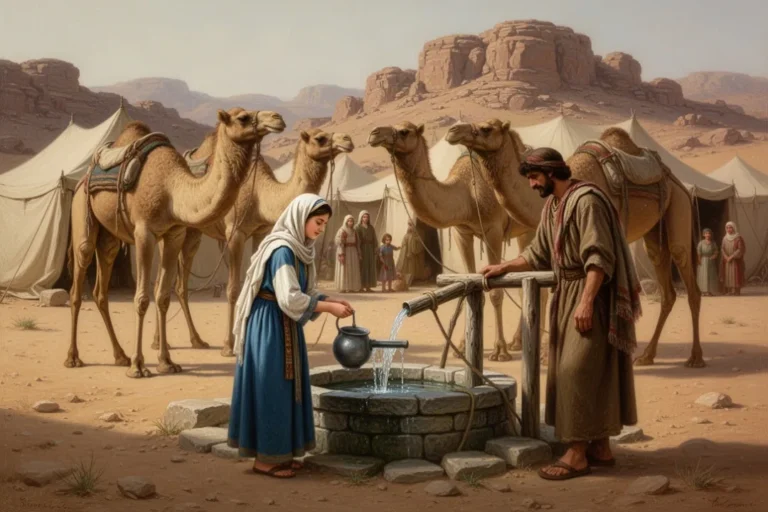
The servant asked God for a sign involving water. He would request a drink, and the woman who offered water not only to him but also to his camels would demonstrate exceptional kindness. This was a demanding act because camels can drink a considerable amount after a long journey. The request therefore tested more than politeness; it revealed initiative, endurance, and generosity.
Rebekah arrived with a water jar and gave the servant a drink. She then offered to draw water for the camels until they had enough. Genesis 24 presents her response as the answer to the servant’s prayer, and the servant recognized that God had guided him to Abraham’s relatives.
Her generosity was not a private feeling but a practical action. Rebekah did not merely agree to help; she kept working until the animals were cared for. The scene portrays her as someone who notices a need and responds fully, even when the task is inconvenient.
A detail worth remembering: Rebekah’s first major appearance is defined by what she does for someone else. Her hospitality is shown through sustained effort, not just a courteous offer.
After learning who she was, the servant gave Rebekah jewelry and asked about her family. She ran home and told them what had happened. Laban then came out to meet the servant, and the household provided a place for the visitor and his camels.
Why Rebekah chose to leave home for Isaac
The servant explained his mission to Rebekah’s family and described how God had led him to her. Bethuel and Laban accepted the proposal, recognizing that the events appeared to come from the Lord. They agreed that Rebekah could leave with the servant and become Isaac’s wife.
The family initially suggested that Rebekah remain for some additional time before traveling. When the servant pressed for an immediate departure, they asked Rebekah whether she would go. Her answer was brief and decisive: she was willing to leave.
This moment gives Rebekah unusual narrative agency. She was not simply carried into a marriage without a voice. The text shows her being asked directly and making a clear choice. Leaving her family meant traveling a long distance to an unfamiliar land and marrying a man she had not met in person.
Genesis 24 describes Rebekah seeing Isaac as the traveling group approached. She covered herself with a veil, and Isaac took her into his mother Sarah’s tent. The account says that he loved Rebekah and that she became his wife and a source of comfort after Sarah’s death.
The marriage also matters because Isaac’s family had experienced deep loss. Rebekah did not replace Sarah, but her arrival helped restore life and companionship to Isaac’s household. The narrative links their marriage with love, comfort, and the continuation of Abraham’s family line.
What Rebekah’s difficult pregnancy revealed
Rebekah was unable to conceive for a period of time, and Isaac prayed for her. The Lord answered, and she became pregnant with twins. The pregnancy was unusually painful and troubled, leading Rebekah to ask why this was happening to her.
She sought an answer from God, and the response in Genesis 25 explained that two nations were in her womb. The twins would become separate peoples, and the older would serve the younger. This oracle was central to the later story because it indicated that the younger son, contrary to ordinary birth order, would have the greater role in the family’s future.
The sons were named Esau and Jacob. Esau was born first and described as hairy and red, while Jacob came out grasping Esau’s heel. Their names and birth details anticipate differences that become increasingly visible as they grow.
Esau became a skilled hunter and a man of the open country. Jacob was described as quieter and more comfortable among the tents. Isaac favored Esau, while Rebekah favored Jacob. The divided loyalties within the household eventually contributed to deception, resentment, and separation.
The prophecy about the twins should not be confused with a statement that every action either son later took was approved. God’s declared purpose and the family’s conduct are related in the story, but the narrative still exposes dishonesty, favoritism, and manipulation as destructive forces.
Rebekah’s role in the conflict between Jacob and Esau
Genesis 27 describes the most controversial episode in Rebekah’s life. Isaac, old and with failing eyesight, prepared to bless Esau. Before this blessing, Genesis 25 records that Esau had sold his birthright to Jacob in exchange for food, but the family still faced a moment when Isaac intended to pronounce the formal blessing.
Rebekah overheard Isaac’s instructions to Esau and told Jacob what she had heard. She then devised a plan for Jacob to receive the blessing while Isaac believed he was speaking to Esau. Jacob would bring food, wear Esau’s clothing, and use goat skins on his hands and neck to imitate Esau’s hairiness.
The plan succeeded because Isaac was old and uncertain about what he was hearing and touching. Jacob received the blessing intended for Esau. When Esau later discovered what had happened, he was furious and planned to kill his brother after Isaac’s death.
Rebekah’s actions are difficult to evaluate. On one hand, she appears to act in line with the earlier divine word that the older son would serve the younger. She may have believed she was protecting God’s revealed purpose. On the other hand, she relied on deception rather than trust, involved Jacob in dishonesty, and helped create a family crisis.
The text does not present her scheme as a clean model of faith. Jacob’s disguise, Isaac’s confusion, Esau’s anger, and Rebekah’s fear all show the damage produced by the deception. Even when a person believes the desired outcome is right, the method can still cause lasting harm.
How Rebekah protected Jacob after the stolen blessing
After Esau threatened Jacob, Rebekah acted quickly. She warned Jacob to flee to her brother Laban in Haran and stay there until Esau’s anger subsided. She expected the separation to be temporary, but the biblical narrative never records Jacob returning to live with her.
Rebekah also approached Isaac with another concern: she did not want Jacob to marry one of the local Hittite women, as Esau had done. This concern gave the journey a respectable family explanation. Isaac then sent Jacob to Paddan-aram to find a wife from Rebekah’s relatives.
Her strategy protected Jacob’s life and helped preserve the family’s marriage customs. Yet it also exposed the cost of the earlier deception. Rebekah lost daily contact with the son she loved, and the household was divided by fear and anger.
The Bible does not record a later conversation between Rebekah and Jacob. It does not tell us whether she saw him again after he left. That silence adds emotional weight to her story: the woman who worked to secure Jacob’s future may never have enjoyed the family life she hoped to preserve.
Rebekah’s relationship with Isaac and her place in the family
Rebekah’s relationship with Isaac includes affection but also a pattern of divided parental loyalty. Genesis 24 says Isaac loved her, and Genesis 26 records an episode in which the Philistine king Abimelech discovered that she was Isaac’s wife after seeing their intimate behavior toward one another.
That incident occurred because Isaac had said Rebekah was his sister, fearing that local men might kill him to take her. The deception resembled an earlier incident involving Abraham and Sarah. Abimelech confronted Isaac after learning the truth and protected Rebekah from being taken.
The episode shows that Rebekah was placed in a vulnerable position by Isaac’s fear. It also shows that the family’s recurring use of misleading statements created risks for everyone involved. Rebekah herself does not appear to initiate that deception, but she bears its consequences.
Within the household, the favoritism toward different sons may have intensified the conflict. Isaac’s preference for Esau and Rebekah’s preference for Jacob divided the parents and encouraged rivalry between the brothers. Genesis does not say that Rebekah was solely responsible for this division; it presents a family in which several people made choices that reinforced the problem.
What Rebekah teaches about faith and decision-making
Rebekah’s story contains several positive examples of faith. She responded generously to a stranger, accepted an uncertain future, left her relatives, and trusted a providential arrangement that she could not fully see. Her decision to go with Abraham’s servant was a significant act of courage.
She also sought God when her pregnancy became painful and confusing. Instead of treating the situation as meaningless, she asked for understanding. Her question led to a divine message about the children and their future, giving her information that shaped how she viewed them.
At the same time, Rebekah’s life warns against trying to force a promise through manipulation. The birth oracle did not require her to deceive Isaac. The story leaves room for readers to see her motive as understandable while still recognizing that her method was wrong and destructive.
Generosity requires action: Rebekah’s kindness involved time, labor, and attention to a real need.
Faith may involve a difficult departure: She left familiar people and places without knowing every detail of her future.
Family favoritism has consequences: Unequal loyalties can deepen competition among children.
A correct goal does not justify every method: Deception brought fear and separation into Rebekah’s household.
Questions can be part of faith: Rebekah sought God when her circumstances were painful and confusing.
Common mistakes people make when reading Rebekah’s story
Rebekah is sometimes presented as either a flawless woman of faith or a manipulative mother. Both portraits leave out important evidence. Genesis gives her real strengths and real failures, and the tension between them is part of what makes her story valuable.
Do not confuse Rebekah with Rachel. Rebekah is Isaac’s wife and Jacob’s mother. Rachel is Jacob’s wife and the mother of Joseph and Benjamin.
Do not say Rebekah had only one child. She gave birth to twin sons, Esau and Jacob, whose descendants became distinct peoples.
Do not treat the well scene as only a romance. It reveals hospitality, perseverance, family identity, and God’s providential guidance.
Do not assume the blessing episode was morally uncomplicated. Rebekah may have remembered God’s word about the younger son, but she pursued the result through deception.
Do not claim that the Bible records Rebekah’s death in detail. Scripture does not give a death account for her, though she is associated with the family burial place later in Genesis.
Do not erase Isaac’s responsibility. The family conflict involved Isaac’s favoritism, Esau’s choices, Jacob’s participation, and Rebekah’s plan.
Reading tip: Pay attention to what Genesis explicitly says, what it leaves unstated, and how consequences unfold. That approach prevents assumptions from becoming part of the biblical text.
Where Rebekah appears in the Bible
Genesis 22:20–23 first introduces Rebekah through her family background. Genesis 24 contains the main account of her meeting Abraham’s servant, agreeing to marry Isaac, and entering the household in Canaan. These chapters establish her as a woman connected to Abraham’s family and characterized by hospitality and decisiveness.
Genesis 25:19–34 tells about her infertility, pregnancy, prayer, the oracle about the twins, and the birth of Esau and Jacob. It also introduces the brothers’ different personalities and the exchange involving Esau’s birthright.
Genesis 26:1–11 includes the account of Isaac presenting Rebekah as his sister in Gerar. The episode reveals Isaac’s fear and confirms that Rebekah was his wife. Genesis 27 records her role in obtaining Isaac’s blessing for Jacob and arranging Jacob’s departure.
Later references provide limited information. Genesis 35:8 mentions Deborah, Rebekah’s nurse, who died and was buried under an oak near Bethel. Genesis 49:31 lists Rebekah among those associated with the family burial place at Machpelah. These references show that Rebekah remained part of the remembered family history even though the narrative gives no detailed account of her final years.
Why Rebekah matters in the larger biblical story
Rebekah stands at a turning point in the covenant family. Through her marriage to Isaac, she becomes the mother of the twins whose descendants shape the history of Israel and Edom. Her decisions affect not only her household but also the direction of the biblical narrative.
The New Testament refers to Rebekah’s pregnancy in Romans 9:10–13 when Paul discusses God’s purpose concerning Jacob and Esau. The passage emphasizes that God’s purpose was announced before the twins were born or had performed good or evil deeds. It does not retell Rebekah’s well encounter or explain every decision she made.
This later reference highlights a major theological theme in Genesis: the continuation of God’s promise does not always follow ordinary expectations such as birth order, social status, or human planning. Jacob, the younger twin, becomes the one through whom the covenant line continues, even though the family’s path to that outcome is marked by conflict.
Rebekah therefore matters as both a participant in God’s unfolding purpose and a person responsible for her own choices. Her story holds those truths together. Divine providence does not turn deception into wisdom, and human failure does not prevent God from carrying forward his promise.
Practical ways to study Rebekah’s story
Read Genesis 24–27 as one connected account rather than isolating the well scene from the family conflict. The early chapter shows Rebekah’s generosity and courage; the later chapters show how family preferences, fear, and deception affected the same household.
As you read, separate description from approval. Genesis often reports what people did without declaring that every action was right. Rebekah’s plan worked in the immediate sense, but the resulting fear and separation invite careful moral reflection.
It can also help to compare the perspectives of the main characters. Isaac wanted to bless Esau, Rebekah wanted Jacob to receive the blessing, Jacob feared being discovered, and Esau felt robbed. Looking at all four perspectives reveals why the conflict became so severe.
Read Genesis 24 and list the actions that show Rebekah’s hospitality.
Read Genesis 25:19–34 and identify what Rebekah learned before the twins were born.
Read Genesis 26:1–11 and observe how fear influenced Isaac’s behavior.
Read Genesis 27 and mark each place where a character speaks truthfully, partially, or deceptively.
Read Genesis 35:8 and 49:31 for the later references connected with Rebekah’s household and burial.
When applying the story, avoid reducing it to a slogan such as “be like Rebekah” or “never trust Rebekah.” A more accurate lesson is that a person can show remarkable kindness and courage while still making choices that damage relationships. Scripture allows you to learn from her strengths without excusing her failures.
What Rebekah’s legacy means for readers today
Rebekah’s legacy begins with the way she treated an unfamiliar traveler. Her willingness to work hard for someone she did not know offers a concrete picture of hospitality. It is also a reminder that generosity often becomes visible through ordinary tasks rather than dramatic speeches.
Her story also speaks to people making decisions without complete information. Rebekah did not know Isaac personally before agreeing to leave her home. Her choice required courage, but it was not careless; she listened to the servant’s account, consulted her family, and then made her own decision.
At the same time, the conflict over Jacob’s blessing warns against controlling outcomes through secrecy and manipulation. When family members believe they must scheme to protect a preferred future, trust begins to disappear. Rebekah’s experience shows that even a plan connected to a genuine concern can produce painful consequences when carried out dishonestly.
Finally, Rebekah’s place in Genesis shows that biblical people are not presented as one-dimensional examples. She is a hospitable woman, a decisive traveler, a praying mother, a protective parent, and a participant in deception. Holding these details together gives a more honest understanding of her faith, her weaknesses, and her lasting role in the Bible.
Frequently asked questions
Was Rebekah a good or bad person in the Bible?
The Bible presents Rebekah as a complex person rather than giving her a simple moral label. She shows extraordinary hospitality, courage, and concern for her family. She also participates in a deceptive plan that creates serious conflict. Her story invites readers to recognize genuine faith and admirable character while still taking responsibility for choices that harm trust and relationships.
Why did Rebekah favor Jacob over Esau?
Genesis does not give one direct explanation for her preference. It states that Isaac favored Esau and Rebekah favored Jacob, and it also records God’s message that the older son would serve the younger. Rebekah may have viewed Jacob as the son connected with that promise, but the text does not say that her favoritism or deception was commanded.
Did Rebekah ever see Jacob again after he left?
Scripture does not record a reunion between Rebekah and Jacob after he fled to Laban’s household. She expected his absence to last until Esau’s anger passed, but the narrative moves on without describing his return to her. This silence means readers should not claim either that they definitely reunited or that Rebekah never saw him again.
Where was Rebekah buried?
The Bible does not provide a separate burial narrative for Rebekah. In Genesis 49:31, she is named among the family members associated with the burial place at Machpelah. Genesis also mentions the death and burial of her nurse Deborah near Bethel. These references connect Rebekah with the ancestral burial tradition without giving extensive details about her own death.






Leave a Reply