If you have wondered who Hagar is in the Bible, the short answer is this: Hagar was an Egyptian servant in Abraham’s household, the mother of Ishmael, and a woman whose life was shaped by decisions made by other people. Her story appears mainly in Genesis 16 and Genesis 21. She is also discussed symbolically in Galatians 4.
Hagar’s life includes forced movement, family conflict, pregnancy, rejection, wilderness, and divine promises. Yet the biblical account does not present her only as a servant or a source of conflict. It shows her as a person whom God sees, hears, protects, and addresses directly.
Hagar is introduced in Genesis 16 as an Egyptian servant belonging to Sarai, whose name was later changed to Sarah. The text does not explain how Hagar came into Sarah’s household. She may have entered it during Abraham and Sarah’s time in Egypt, but Genesis does not directly state that this was when she became their servant.
At this point in the story, Abraham and Sarah have no child together. God has promised Abraham descendants, but Sarah remains unable to conceive. Since children were closely connected with family security, inheritance, and social standing in the ancient world, Sarah proposes a solution involving Hagar.
Sarah gives Hagar to Abraham as a wife or secondary wife in order to have a child through her. This arrangement reflects an ancient household practice, but it does not make Hagar an equal partner in the family. She remains socially vulnerable because Sarah has authority over her and Abraham controls the household.
Hagar’s story therefore begins with a difficult imbalance of power. The Bible does not describe the arrangement as a simple romance. Instead, it presents a household attempting to produce an heir through human planning while waiting for God’s promise to unfold.
Hagar’s story in Genesis, step by step
The main events can be followed in two connected episodes. The first occurs after Hagar becomes pregnant with Ishmael; the second takes place years later after Isaac, Abraham and Sarah’s son, is born.
Sarah gives Hagar to Abraham. Sarah believes she can build a family through Hagar’s child.
Hagar becomes pregnant. The pregnancy changes the relationship between the two women and creates tension in the household.
Hagar leaves after being treated harshly. She encounters the angel of the Lord near a spring in the wilderness.
God promises a future for her son. Hagar is told to return, and she receives a promise concerning Ishmael and his descendants.
Hagar gives birth to Ishmael. Abraham is his father, and Hagar names him in response to God’s message.
Hagar and Ishmael are sent away later. After Isaac’s birth, Sarah asks Abraham to remove them from the household.
God preserves them in the wilderness. When their water runs out, God hears Ishmael’s cry and provides a way forward.
These events are separated by many years. Hagar does not simply leave one time and disappear. She first returns to Abraham and Sarah’s household, gives birth to Ishmael, and later faces expulsion with her son after Isaac’s birth.
Why Sarah sent Hagar to Abraham
Genesis 16 begins with Sarah’s inability to have children and God’s promise to Abraham. Sarah responds by offering Hagar to Abraham, saying in effect that she might obtain children through her servant. The plan may have fit the customs of the period, but it also places Hagar’s body and future under the control of her mistress.
After Hagar becomes pregnant, the relationship changes. Genesis says that Hagar looks at Sarah with contempt, or that Sarah is despised in Hagar’s eyes, depending on the translation. The precise emotional details are difficult to reconstruct, but the household tension is clear. Sarah blames Abraham, Abraham tells her to deal with Hagar as she sees fit, and Sarah treats Hagar harshly.
A difficult family arrangement: Hagar’s pregnancy does not give her secure status. She remains dependent on the household that arranged the pregnancy, which helps explain why her escape is both an act of distress and an attempt to survive.
The passage does not excuse the harsh treatment Hagar receives. Abraham’s decision to leave the matter in Sarah’s hands also reveals his failure to protect someone who is dependent on him. Hagar’s experience shows how quickly an arrangement that appears practical can produce resentment, fear, and injustice when people are treated as means to an end.
What happened when Hagar fled into the wilderness
Hagar runs away and travels toward a wilderness region on the way to Shur. She stops beside a spring, where the angel of the Lord finds her. The text calls her by name and asks where she has come from and where she is going. Hagar explains that she is fleeing from Sarah, giving the reader a direct glimpse of her situation.
The angel tells Hagar to return to Sarah and submit to the situation for the moment. That instruction can sound troubling to modern readers, especially because Hagar has already experienced harsh treatment. The passage should not be used to tell abused or exploited people that they must remain in danger. Within the story, the command is accompanied by a divine promise, and God’s later actions show that Hagar is not abandoned or forgotten.
Hagar receives a promise that her descendants will become too numerous to count. She is also told that she will bear a son and name him Ishmael. The name is connected with the idea that the Lord has heard her affliction. This is significant because Hagar, a foreign servant with little social power, is the first person in the Bible recorded as receiving a message from the angel of the Lord in this way.
The text also describes Ishmael’s future in terms of independence and conflict. Genesis 16 presents him as a person whose life will not fit easily within the expectations of the surrounding family. The prophecy is not a simple promise of a peaceful household; it acknowledges a difficult future while still affirming that God has heard Hagar.
After the encounter, Hagar gives a name to the Lord associated with seeing her. The Hebrew expression is commonly translated as “the God who sees me” or explained as referring to the God who sees her. She is astonished that she has encountered the one who sees her in her distress and remains alive.
This moment is one of the most memorable parts of Hagar’s story. God does not address her only through Abraham or Sarah. God meets her personally, hears her account, speaks about her child, and gives her a future-oriented promise.
Hagar then returns to the household. Genesis does not tell us everything about what happened after her return, but it does state that she gave birth to Ishmael and that Abraham named him. Hagar’s encounter in the wilderness becomes the foundation for her understanding of God: she has been seen in a place where others treated her as disposable.
The name connected with this encounter is often rendered El-roi. Readers should distinguish the theological meaning of the name from later assumptions about exactly how the Hebrew expression should be translated. The central idea is clear even when translations phrase it differently: Hagar recognizes God as the one who sees her suffering.
Who Ishmael was and how Hagar’s motherhood matters
Ishmael is Abraham’s first son named in Genesis. His mother is Hagar, and his birth occurs before Isaac’s birth. Genesis 16 says that Abraham is eighty-six years old when Ishmael is born, while Genesis 21 places Isaac’s birth later, when Abraham is one hundred. These details emphasize that Ishmael and Isaac belong to different stages of Abraham’s life.
Hagar’s motherhood matters because she is not merely a background character in Abraham’s family. She carries the pregnancy, gives birth, names Ishmael, raises him, and later protects him when they are sent into the wilderness. The biblical promises concerning Ishmael also make clear that God’s concern extends beyond the line through which the covenant promise is developed in Genesis.
Genesis later lists Ishmael’s sons and describes the growth of his family. The account presents him as the ancestor of a substantial people. Hagar therefore becomes the mother of a people, not simply the servant involved in an old household dispute.
At the same time, Genesis distinguishes Ishmael’s role from Isaac’s role. Isaac is the son through whom the covenant line is specifically continued in the Genesis narrative. That distinction does not mean Ishmael is worthless or rejected by God. It means the biblical text assigns different roles to the two sons.
Why Hagar and Ishmael were sent away again
Genesis 21 returns to Hagar after Isaac has been born and weaned. Sarah sees Ishmael in a way that creates concern about the two boys sharing the family inheritance. She asks Abraham to send Hagar and Ishmael away so that Ishmael will not inherit with Isaac.
The wording and exact scene in the passage have generated translation and interpretation questions, but the practical result is unmistakable: Hagar and Ishmael are expelled from Abraham’s household. Abraham is distressed, yet God tells him to listen to Sarah in this matter while also promising that Ishmael will become a nation.
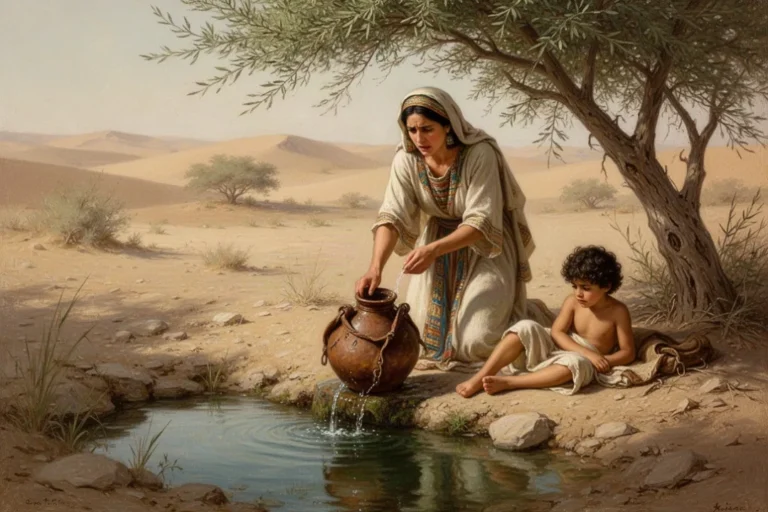
Abraham gives Hagar bread and a skin of water. She leaves with Ishmael and wanders in the wilderness of Beersheba. When the water is gone, Hagar places Ishmael under a shrub and moves away because she cannot bear to watch him die. She sits at a distance and weeps.
This scene presents Hagar at her lowest point. Earlier, she had fled while pregnant; now she is a mother responsible for a child in a barren place with no visible resources. The story emphasizes her grief rather than portraying her as fearless or untouched by hardship.
How God provided for Hagar and Ishmael
God hears the boy’s cry, and an angel of God calls to Hagar from heaven. She is told not to be afraid because God has heard Ishmael. The angel repeats the promise that Ishmael will become a great nation.
Then God opens Hagar’s eyes, and she sees a well. She fills the container with water and gives Ishmael a drink. The passage does not require the reader to imagine that the well suddenly came into existence; it presents the crucial point as divine provision and renewed perception. A resource is present, but Hagar needs help to recognize it.
God remains with Ishmael as he grows. The text says that he becomes an archer and lives in the wilderness of Paran. Hagar obtains an Egyptian wife for him, connecting the family back to her Egyptian background.
Several details are worth observing in this second wilderness account:
God hears Ishmael, even though the narrative focuses heavily on Hagar’s grief.
God speaks to Hagar again, rather than leaving Abraham to manage the situation.
God provides water at the moment when Hagar believes the child will die.
Ishmael’s future is preserved, and he becomes the ancestor of a nation.
Hagar continues to act; she gives water to Ishmael, raises him, and finds him a wife.
Genesis 21 does not record Hagar’s return to Abraham’s household. Instead, the story follows her and Ishmael into a separate future. Their survival is not dependent on reentering the household that expelled them.
What the wilderness reveals: Hagar’s story does not promise that every unjust situation will be repaired in the way a reader hopes. It does show that God sees her outside Abraham’s household and provides a future for her and Ishmael beyond their rejection.
What Hagar’s story teaches about God’s character
Hagar’s story offers several ways of thinking about God’s relationship with vulnerable people. These themes should be drawn from the narrative itself rather than turned into vague slogans.
God sees people who are overlooked
Hagar is an enslaved or servant woman, an Egyptian living among a family that is not her own. Her social position gives her little control over the decisions affecting her body, pregnancy, and child. Yet God calls her by name and meets her personally.
The phrase associated with Hagar’s encounter highlights a God who sees suffering that powerful people may ignore. Hagar is not invisible to God simply because she has low status in the household.
God hears cries of distress
The name Ishmael is tied to the idea of God hearing. In Genesis 16, God hears Hagar’s affliction; in Genesis 21, God hears the boy’s cry. The repeated theme links mother and son and shows that divine attention is directed toward their distress.
This does not mean the Bible treats suffering as unimportant because God eventually provides help. Hagar’s tears and fear are taken seriously. Her emotional response is part of the story, not a sign that she lacks faith.
God’s care is not limited to one family line
The Genesis account gives a special covenant role to Isaac, but it also gives Ishmael a promise of descendants and nationhood. God’s care for Hagar and Ishmael demonstrates that divine attention is wider than the line selected for a particular covenant purpose.
This distinction matters when reading the story. Isaac’s role does not erase Ishmael, and Ishmael’s importance does not replace Isaac in the Genesis narrative. Both sons matter, though they are presented differently.
God meets Hagar outside established centers of power
Hagar encounters God beside a spring and later in the wilderness, not in Abraham’s tent or through a formal public gathering. The settings underline her isolation and also show that she does not need social prominence to be addressed by God.
For readers, this can make Hagar’s story especially meaningful when they feel pushed aside, displaced, or unable to control the circumstances around them. The passage does not promise an easy path, but it insists that being overlooked by people does not mean being overlooked by God.
How the New Testament uses Hagar’s story
Paul refers to Hagar and Sarah in Galatians 4:21-31. He uses the two women and their sons as part of an argument about two covenants. Hagar is associated with Mount Sinai and slavery, while Sarah is associated with the free woman and the Jerusalem above.
Paul’s use is allegorical. He is applying the Genesis account to a debate about law, promise, freedom, and the identity of believers in Christ. He is not giving a second full biography of Hagar or claiming that Genesis was only a symbolic story with no historical characters.
Readers should also recognize that Paul’s argument is shaped by the needs of the Galatian churches. He focuses on a theological contrast between slavery and freedom, not on every aspect of Hagar’s experience as an Egyptian woman, servant, mother, and survivor.
That means Galatians should be read alongside Genesis, not used to cancel Genesis. In Genesis, Hagar is a real person who suffers, speaks, hears God’s promise, and raises a son. In Galatians, her story becomes part of a larger argument about how God’s promise is understood.
Paul’s use can feel difficult because Hagar is linked with slavery even though she herself is the enslaved person in the Genesis account. The comparison serves Paul’s theological argument, but it should not be used to dismiss Hagar’s dignity or minimize the injustice she experienced.
What Hagar’s story does not say
Several common assumptions go beyond the biblical text. Keeping the evidence clear helps prevent Hagar from being reduced to a stereotype.
The Bible does not identify Hagar as an Egyptian princess. Genesis calls her an Egyptian servant, but it does not give her royal status.
The Bible does not say Hagar seduced Abraham. Sarah arranged the relationship, and Hagar had less social power within the household.
The Bible does not call Hagar Abraham’s equal wife. Her position is connected to servitude and household hierarchy, even though Genesis describes her relationship with Abraham using marriage language in some translations.
The Bible does not record Hagar dying in the wilderness. God preserves her and Ishmael, and the story continues with Ishmael’s growth.
The Bible does not say Hagar became reconciled with Sarah. After the second separation, it does not report a reunion between the women.
The Bible does not say Ishmael was outside God’s concern. God promises him descendants and responds to his cry.
It is also wise not to claim more about Hagar’s inner thoughts than the text provides. Genesis records moments of contempt, fear, grief, and recognition, but it does not give a complete psychological portrait. Her story invites careful attention without requiring invented details.
Why Hagar remains significant for readers today
Hagar’s experience speaks to people who have been used for someone else’s plans, pushed out of a family or community, or forced to make decisions under severe pressure. Her circumstances are ancient, but the questions remain recognizable: Who sees me? Who hears me? What happens to my child? Is there a future after rejection?
Her story also challenges shallow readings of biblical families. Abraham and Sarah are central figures in Genesis, yet they make decisions that bring real harm to Hagar and Ishmael. The Bible’s inclusion of those failures allows readers to see that being part of a chosen family does not mean every action by its members is righteous.
Hagar’s voice matters because she is not remembered only through the people who had greater status. She names God in response to what she has experienced, and her son’s future is included in the divine promise. The story gives her a place in Scripture as a person known by God, not merely as a device in someone else’s family history.
A careful reading holds several truths together:
Sarah suffers from infertility and fear about the future.
Hagar suffers from exploitation, harsh treatment, and displacement.
Abraham bears responsibility for decisions affecting both women and both sons.
Isaac has a distinct role in the covenant story.
Ishmael is still heard, blessed, and given a future.
God’s care reaches Hagar in both the household and the wilderness.
Hagar is therefore best understood as an Egyptian servant, Abraham’s secondary wife in the Genesis household, Ishmael’s mother, and a woman personally encountered by God. Her story is not only about the origins of a family line. It is also about how God sees people who have been treated as expendable and sustains them when familiar protection disappears.
Where to read Hagar’s story in the Bible
The most useful passages are concentrated in three places. Genesis 16 tells of Hagar’s pregnancy, escape, encounter with the angel of the Lord, and return. Genesis 21:1-21 tells of Isaac’s birth, Hagar and Ishmael’s expulsion, and God’s provision in the wilderness.
Galatians 4:21-31 offers Paul’s symbolic interpretation of Hagar and Sarah. Reading these passages together helps you distinguish the original Genesis narrative from the later theological application.
As you read, pay attention to who speaks, who makes decisions, and who has power. Notice when Hagar is addressed by name, how Ishmael’s name is explained, and how the story changes when Hagar moves from Abraham’s household into the wilderness. Those details reveal why Hagar remains one of the Bible’s most significant stories about a marginalized woman who is seen and heard by God.
Frequently asked questions
Was Hagar Abraham’s wife or servant?
Hagar was Sarah’s Egyptian servant, and Sarah gave her to Abraham so that Hagar could bear a child on Sarah’s behalf. Genesis also uses language associated with marriage for Hagar’s relationship with Abraham, but her social position remained subordinate. Calling her only a wife or only a servant misses the complicated household arrangement described in Genesis 16.
Did Hagar have more than one child?
The Bible names only one child born to Hagar: Ishmael. Genesis does not say that she had additional children. Ishmael later became the father of twelve sons, according to Genesis 25, but those descendants belong to the next generation and should not be confused with Hagar’s own children.
Why did God tell Hagar to return to Sarah?
In Genesis 16, the angel of the Lord tells Hagar to return after meeting her in the wilderness and promises a future for her unborn son. The passage describes God’s intervention in her immediate situation, not a general command that people must remain in abusive circumstances. Genesis 21 later shows God preserving Hagar and Ishmael after they leave permanently.
Is Hagar connected to Islam as well as the Bible?
Hagar is also an important figure in Islamic tradition, where she is commonly known as Hajar and is associated with Ishmael. The Bible itself presents her story in Genesis 16 and 21, while Islamic sources develop additional traditions about her life and her search for water. Those traditions should be distinguished from the biblical account.







Leave a Reply