If you are reading the early chapters of Genesis and wondering, “Who was Abraham’s father?” the direct answer is Terah. Genesis names Terah as the father of Abram, who later receives the name Abraham, along with his other sons Nahor and Haran.
Terah appears in the family line that leads from Noah’s son Shem to Abraham. His story is brief, but it helps explain where Abraham came from, why the family moved from Mesopotamia toward Canaan, and how the biblical account begins to focus on one man and his descendants.
Genesis 11:24–32 gives Terah’s family record. It identifies him as the son of Nahor and the father of Abram, Nahor, and Haran. Haran was the father of Lot, who later becomes an important figure in Abraham’s story.
The name Abram is used throughout the earlier part of Genesis. In Genesis 17, God changes Abram’s name to Abraham as part of the covenant associated with his future descendants. Therefore, Abram and Abraham are the same person, and Terah is the father referred to in both parts of the story.
The genealogy in Genesis places Terah several generations after Shem. A simplified line is:
Noah
Shem
Arphaxad
Shelah
Eber
Peleg
Reu
Serug
Nahor
Terah
Abram, later called Abraham
These names come from the genealogical material in Genesis 11:10–26. Biblical genealogies often emphasize the line that matters for the narrative, so they should be read as theological and family records rather than as a modern family database with every generation explained in detail.
Short answer: Abraham’s father was Terah. Terah’s other named sons were Nahor and Haran, and Haran was the father of Lot.
What the Bible says about Terah’s family
Terah’s household was based in Mesopotamia, the region associated with the great river civilizations east of Canaan. Genesis presents the family as living first in Ur of the Chaldeans. The exact location of ancient Ur has been discussed by historians and archaeologists, but the biblical text clearly connects it with Abraham’s original homeland.
Terah had three sons named in Genesis: Abram, Nahor, and Haran. The text does not give a full description of their childhood or explain every family relationship. It does tell us that Haran died before Terah and that Haran’s son Lot became part of Abram’s household.
Haran also had two daughters named Milcah and Iscah, according to Genesis 11:29. Milcah married her uncle Nahor. Later chapters identify Rebekah, the wife of Isaac, as a descendant of Nahor’s family. This means Terah’s household becomes the source of several major family branches in Genesis.
The family relationships can be easier to follow when separated into branches:
Terah’s son Abram: later called Abraham, the central patriarch of the covenant family.
Terah’s son Nahor: ancestor of Rebekah and part of the family line connected with Isaac’s marriage.
Terah’s son Haran: father of Lot, Milcah, and Iscah; he died in Ur before the family moved to Haran.
These relationships matter because Abraham’s journey was not an isolated trip by one individual. It involved a larger household, including his wife Sarai, later called Sarah, and his nephew Lot. The movement from Mesopotamia to Haran and then toward Canaan is also a movement through a family story marked by loss, migration, and changing loyalties.
Where Terah and Abraham lived before Canaan
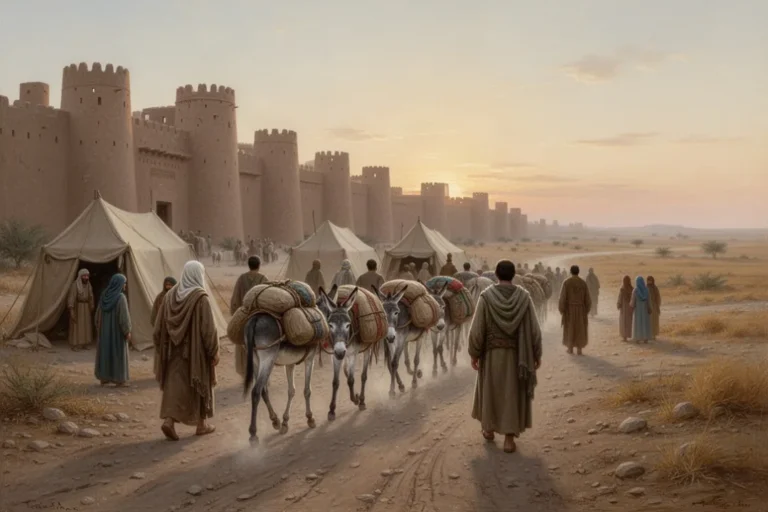
Genesis 11 says that Terah took Abram, Sarai, and Lot and set out from Ur of the Chaldeans to go to the land of Canaan. The family stopped at Haran, a city in northern Mesopotamia, and settled there. Terah died in Haran at the age of 205, according to Genesis 11:32.
After Terah’s death, Genesis 12 describes the Lord calling Abram to leave his country, relatives, and father’s household and go to a land that God would show him. Abram then traveled toward Canaan with Sarai and Lot. He eventually reached the land and built altars as he moved through it.
The text therefore presents two connected stages:
Terah’s migration: Terah took part of his family from Ur toward Canaan but settled in Haran.
Abraham’s continuation: Abram left Haran and continued toward Canaan in response to God’s call.
It is useful to distinguish the two movements. Terah is shown as the head of the household during the initial departure from Ur. Abraham becomes the central figure when God calls him to continue the journey and promises to bless him and make him a blessing to others.
Did Terah personally worship the God of Abraham?
The Bible gives limited information about Terah’s religious beliefs. Joshua 24:2 says that Abraham’s ancestors, including Terah, lived beyond the Euphrates and served other gods. This statement suggests that Terah belonged to a household shaped by the religious practices of Mesopotamia rather than by the exclusive worship later associated with Abraham’s covenant.
Genesis does not record a personal conversion experience for Terah. It does not describe him building an altar, receiving a divine promise, or entering a covenant in the way it does with Abraham. That difference is significant: Terah begins the family’s movement, but the biblical covenant narrative centers on Abraham.
At the same time, the text should not be stretched beyond what it says. It does not provide a detailed biography of Terah’s beliefs, name every deity he may have honored, or explain exactly why he decided to leave Ur. Joshua gives a general description of the ancestors’ religious background, while Genesis focuses mainly on the family’s movements and Abraham’s calling.
For readers comparing the passages, the basic picture is this: Terah came from a culture with its own religious traditions, and Abraham was called out of that setting to follow the Lord. The contrast helps explain why Abraham’s faith and obedience become such a central theme in Genesis.
What Terah’s age tells us—and what it does not
Genesis 11:26 says that Terah lived for 70 years before fathering Abram, Nahor, and Haran. Readers sometimes assume this means Abram was Terah’s oldest son. However, the verse lists the sons without explicitly stating their birth order.
That detail matters because the narrative later says Terah died at 205. Genesis 12 then describes Abram leaving Haran. Acts 7:2–4 says God appeared to Abraham in Mesopotamia and connects his departure with the period after his father’s death. Depending on how the passages are arranged and how the ages are interpreted, readers have identified a chronological tension between the accounts.
One possible explanation is that Genesis 11:26 introduces the period when Terah began having sons, not necessarily the exact year in which Abram was born. Another is that the sons may not be listed in birth order. Some readers also understand the wording in Acts as referring to Abraham’s departure from Haran after Terah’s death, while his earlier movement from Ur occurred before that point.
The safest conclusion is that Terah was Abraham’s father and that Terah died in Haran according to Genesis. The Bible does not give enough information to settle every question about the sons’ birth order and the timing of each stage of the journey without interpretation.
Reading tip: Do not confuse a genealogy’s order of names with a definite birth order. Genesis identifies Terah’s sons, but the passage does not plainly say which son was born first.
How Terah relates to Abraham’s covenant story
Terah is not presented as the recipient of the covenant promises that define Abraham’s role. God promises Abraham descendants, a land, and blessing for the families of the earth. These promises appear in Genesis 12, 15, 17, and related passages, and they shape the rest of the biblical narrative.
Terah nevertheless stands at the threshold of that story. Abraham does not appear without a family history or a homeland. He is introduced as Terah’s son, part of a household that has already moved from Ur to Haran. This setting highlights the change that takes place when Abraham leaves Haran and travels to Canaan.
Several parts of Abraham’s later life reflect the family circumstances associated with Terah:
Migration: Abraham continues a journey that began with Terah’s departure from Ur.
Family responsibility: Abraham travels with Sarai and Lot and later faces difficult decisions involving his nephew.
Inheritance: The promised future depends on descendants, yet Abraham and Sarah remain childless for many years.
Separation: Abraham eventually separates from Lot, while the covenant line continues through Isaac.
Homeland and identity: Abraham is called to live away from his original homeland while trusting God’s promise.
Terah’s role is therefore both historical and literary. Historically, he is Abraham’s named father and the head of the family during the first migration. Within the story, he marks the transition between the ancestral world of Mesopotamia and the covenant journey that begins with Abraham.
Why Haran matters in the story of Abraham’s father
Haran is more than a place name in the genealogy. It is where Terah settles after leaving Ur and where he dies. It is also the place from which Abraham departs when he begins the next stage of his calling.
This makes Haran a point of transition. Terah’s journey ends there, while Abraham’s journey toward Canaan begins there. The same location connects the father’s migration with the son’s obedience.
Haran also remains connected with Abraham’s extended family. After Abraham travels to Canaan, his servant later returns to the region of Aram-naharaim or the area associated with Nahor’s family to find a wife for Isaac. Rebekah comes from that family network. Jacob, Abraham’s grandson, also travels to the household of Laban, who is connected with the same wider kinship group.
The repeated references to this region show that Abraham’s family did not disappear when he left. Relationships remained across long distances, and the biblical story continued to bring those family branches together through marriage, inheritance, and conflict.
Common mistakes when identifying Abraham’s father
Several names in Genesis can make the answer confusing. A careful reading avoids mixing up Abraham’s father, grandfather, brothers, and descendants.
Calling Nahor Abraham’s father: Nahor was Terah’s father, according to Genesis 11. Nahor was also the name of one of Terah’s sons, which creates a repeated-name problem.
Calling Haran Abraham’s father: Haran was Abraham’s brother and the father of Lot, not Abraham’s father.
Confusing Terah with Terach: Terach is another spelling or transliteration of the same Hebrew name. English Bibles commonly use Terah.
Assuming Abram and Abraham were different people: Abram was Abraham’s earlier name. Genesis 17 describes the name change.
Assuming Terah completed the journey to Canaan: Genesis says Terah settled in Haran. Abraham later continued toward Canaan.
Assuming the Bible gives a full biography of Terah: The biblical record about him is brief and mainly appears in Genesis 11 and Joshua 24.
A family outline can keep the central relationships clear:
Nahor was Terah’s father.
Terah was Abraham’s father.
Abram was later renamed Abraham.
Haran was Abraham’s brother.
Lot was Haran’s son and Abraham’s nephew.
How later biblical passages remember Terah
Terah is mentioned directly in only a small number of biblical passages, but later references help clarify how his family was understood. Joshua 24:2 names Terah among Abraham’s ancestors and describes the family’s earlier worship of other gods. The reference places Abraham’s calling against a background of religious difference.
Acts 7:2–4 refers to God’s appearance to Abraham in Mesopotamia and describes Abraham’s movement from that region toward the land God would show him. The speech of Stephen in Acts retells the patriarchal story to show how God’s purposes unfolded across changing locations and generations.
These later references do not add a long account of Terah’s life. Instead, they use Terah and the ancestral household to frame Abraham’s calling. The focus remains on how God called Abraham away from his former setting and formed a new people through him.
Terah’s limited appearance should not be mistaken for unimportance. Biblical narratives often mention a person briefly because that person serves as a link in a larger family line. Terah connects Abraham to Shem, to Mesopotamia, and to the family that eventually produces Isaac, Jacob, and the tribes of Israel.
What Abraham’s relationship with Terah teaches readers
The story invites readers to hold together two truths. Abraham was shaped by a real family and culture, yet his calling required a decisive break from the life he had known. He did not begin as a person without a past; he began as Terah’s son in a household with its own homeland, beliefs, and relationships.
That pattern appears repeatedly in Genesis. A person’s family history matters, but it does not determine the entire direction of the person’s life. Abraham carries his family connections with him, especially through Lot and the relatives who remain in the north, while also responding to a new call that takes him into unfamiliar territory.
The account also shows that a parent’s role and a child’s role may differ. Terah starts the journey from Ur but settles in Haran. Abraham continues the journey to Canaan and becomes the person through whom the covenant promises are developed. The text does not need to portray Terah as a villain or a hero to show that his son’s calling took a different direction.
For a reader studying Genesis, Terah is best understood as the family patriarch who stands immediately before Abraham in the biblical storyline. He is Abraham’s father, the son of Nahor, the father of Haran and Nahor, and the head of the household that moved from Ur to Haran.
Where to read about Terah and Abraham
The main passage is Genesis 11:24–32, which gives Terah’s genealogy, names his sons, describes the family’s departure from Ur, and records Terah’s death in Haran. Genesis 12:1–9 then describes Abraham’s call and his movement into Canaan.
For additional context, Genesis 15 and 17 develop the covenant promises made to Abraham. Genesis 22 shows the testing of Abraham’s faith in relation to Isaac. Joshua 24:2 recalls the religious background of Abraham’s ancestors, while Acts 7:2–4 retells part of Abraham’s early calling.
Reading these passages together provides a fuller picture without assigning Terah details the text does not give. The central fact remains clear: Abraham’s father was Terah, and Terah’s household formed the immediate family setting from which Abraham’s journey began.
Frequently asked questions
Was Terah Abraham’s biological father?
Yes. Genesis identifies Terah as the father of Abram, later called Abraham. The passage also names Terah’s other sons as Nahor and Haran. The Bible presents this as a direct family relationship, not merely an adoptive or tribal connection.
Was Terah the father of Lot?
No. Lot was Terah’s grandson through Terah’s son Haran. After Haran died, Lot traveled with his uncle Abraham. This is why the narrative sometimes describes Lot as part of Abraham’s household even though he was not Abraham’s son.
Did Terah go to Canaan with Abraham?
Terah began the family’s journey from Ur toward Canaan, but Genesis says the family settled in Haran. After Terah died there, Abraham continued toward Canaan with Sarah and Lot. The Bible therefore distinguishes Terah’s migration from Abraham’s later journey.
What was Abraham’s father’s name in other Bible translations?
Most English translations call him Terah. Terach is an alternate spelling based on differences in transliteration from Hebrew. Both names refer to the same person, the father of Abram, who was later renamed Abraham.






Leave a Reply