The Bible never says that Abel had a wife, so it does not identify her, describe their marriage, or explain where she came from. The question usually arises because readers assume Abel must have been married before Cain killed him, or because Cain’s wife is mentioned later in Genesis.
Under the most common reading of Genesis, any wife Abel may have had would have come from Adam and Eve’s family. Genesis says that Adam and Eve had other sons and daughters besides Cain, Abel, and Seth. Yet the text does not specifically say that Abel married one of them, and it does not even say that Abel was married at all.
What Genesis actually says about Abel and his family
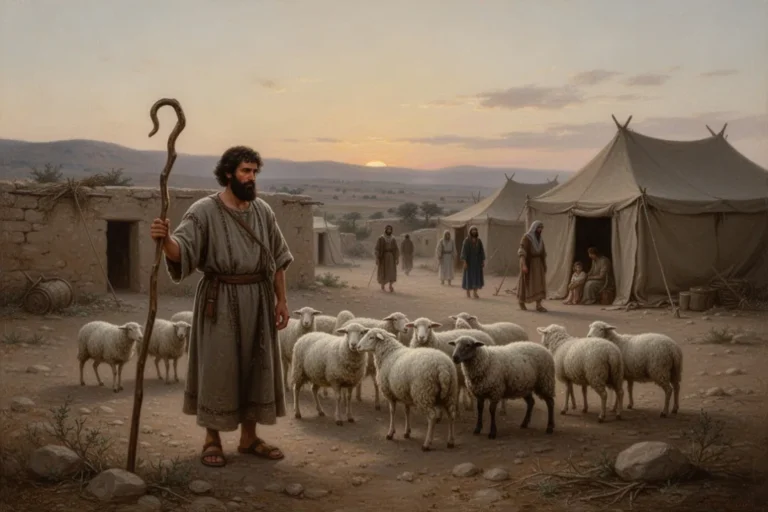
Genesis introduces Abel as the second son of Adam and Eve, after Cain. Abel becomes a shepherd, while Cain works the ground. When the brothers bring offerings to God, Abel’s offering is regarded favorably, whereas Cain becomes angry and later kills him. The account appears in Genesis 4:1–8.
That passage gives no information about Abel’s age, marital status, children, or household. Abel’s role in the story is centered on his worship, his relationship with Cain, and his death. The narrative moves quickly from his birth to the conflict between the brothers.
The Bible also does not record a conversation between Abel and a wife. No woman is named as his spouse, and no genealogy lists descendants through Abel. After Abel’s death, Adam and Eve have another son, Seth, who becomes central to the family line described in later chapters.
The direct answer: Scripture does not tell us where Abel’s wife came from because Scripture never explicitly says Abel had a wife. The idea that he was married is an inference, not a stated biblical fact.
Why many readers connect Abel’s wife with Adam and Eve’s daughters
Genesis 5:4 says that Adam had other sons and daughters after Seth was born. This statement is the main reason many readers believe Cain and Abel had sisters, even though Genesis does not name them individually. The text mentions these daughters only briefly, but they would account for additional members of the first family.
If someone reads Genesis as describing the first human family in a straightforward chronological way, Adam and Eve are the only parents named at the beginning. In that framework, a wife for Cain or Abel would have come from the children of Adam and Eve. The most natural possibility would be a sister, although the text does not tell us which daughter married which son.
This explanation is usually applied more directly to Cain because Genesis explicitly says that Cain knew his wife and that she gave birth to Enoch. Abel is different: the text records no wife for him. Readers sometimes transfer the explanation from Cain to Abel, but that transfer should be described as a possibility rather than a fact.
The phrase “sons and daughters” appears after the birth of Seth, but it does not necessarily mean Adam and Eve had no daughters before then. Genesis often gives a selected account rather than a complete list of every child and event. Cain and Abel are named because they are important to the story, while many other children are left unnamed.
Was Abel married before Cain killed him?
There is no reliable biblical basis for saying that Abel was married before his death. Abel may have been unmarried, or he may have had a wife whose presence was not relevant to the story. Both possibilities fit the limited information Genesis provides.
Readers often assume marriage because the question asks about “Abel’s wife,” but a question can contain an assumption that the source itself does not support. The passage about Abel is short and focused on his murder. It does not pause to describe his personal life beyond his work as a shepherd.
Even if Abel had a wife, the Bible gives no indication that she was present when Cain attacked him. Genesis 4 does not mention children, a home, a wedding, or a widow. Any reconstruction of those details must go beyond what the biblical text actually says.
The distinction matters because Cain’s wife is explicitly mentioned, while Abel’s wife is not. Cain’s account says that after he leaves the presence of the Lord, he is with his wife and she gives birth to a son. Abel’s account ends with his death and the later acknowledgment that his blood cries out from the ground.
How Cain’s wife affects the question
Cain’s wife is the person most often connected with the “where did she come from?” question. Genesis 4:17 says that Cain knew his wife, and the couple had a son named Enoch. Since Genesis has not previously named another woman, readers ask how Cain could have found a wife.
The answer commonly given is that Adam and Eve had more children than the few named in the early narrative. Genesis 5:4 supports this by saying that Adam had other sons and daughters. If the early chapters are read as presenting one original human family, Cain’s wife would most likely have been one of his sisters or another close relative from that family.
That answer does not prove anything specifically about Abel. It explains how Cain could have had a wife within the narrative’s early family structure. Abel might have married another daughter of Adam and Eve, but Genesis never confirms that such a marriage occurred.
Some readers also point to the possibility that the text compresses events and leaves out years between major episodes. Genesis may report births and deaths without giving a complete timeline. Adam and Eve could have had many children over a long period, so the unnamed family members could have included people not mentioned in the central storyline.
What “other sons and daughters” means in Genesis
Genesis 5:4 provides the key family detail: Adam lived for many years after Seth’s birth and had other sons and daughters. The verse does not name them, give their number, or say how many were born before Abel’s death. It simply shows that the named sons were not Adam’s only children.
This kind of selective genealogy is common in biblical narratives. A genealogy is not always a complete civil record of every child. It frequently follows a particular line or highlights people who matter to the author’s purpose. The absence of a name does not automatically mean that person did not exist.
At the same time, Genesis 5:4 should not be stretched beyond what it says. It establishes the existence of Adam’s other children, but it does not identify a particular daughter as Abel’s wife. It also does not say that Abel lived long enough to marry or that he fathered children.
A careful reading therefore holds two ideas together:
Adam and Eve had additional children, according to Genesis 5:4.
Abel’s wife is never identified, and Abel may not have had a wife at all.
Why sibling marriage is part of the traditional explanation
If Adam and Eve are understood as the first human parents and if Abel had a wife, the traditional explanation requires marriage within the immediate family. This is not an attempt to hide a missing person from the story; it follows from the family structure presented by a literal or near-literal reading of Genesis.
Later biblical law prohibits sexual relationships between close relatives. These rules appear much later in Israel’s history, especially in the laws given through Moses. The commands in Leviticus address a developed society with many families and are not presented as rules that had already been stated in the opening chapters of Genesis.
For that reason, interpreters who accept the traditional explanation often distinguish between what was permitted at the beginning and what was later prohibited for Israel. They may argue that close-family marriage was necessary or tolerated in the earliest generation, while later laws restricted it for moral, social, and family-order reasons.
Other readers do not accept that framework. They may understand Genesis as theological literature rather than a complete biological account of humanity’s first generations. They may also believe that the story assumes other people outside Adam and Eve’s immediate family, even though Genesis does not explain their origin. Those readings produce different answers.
Major interpretations of Abel’s possible wife
Christian and Jewish interpreters have not always handled the question in exactly the same way. The Bible gives only limited information, so conclusions often depend on how a reader understands Genesis as a whole.
Immediate-family interpretation: If Adam and Eve were the first human parents, Abel’s possible wife would have been one of their daughters or another close relative. This is the most common answer within a strict genealogical reading.
Unstated-wife interpretation: Abel may never have married. Since Genesis does not mention a wife, the question may be based on an assumption rather than a biblical statement.
Compressed-narrative interpretation: Genesis may summarize generations and leave many people unnamed. Abel’s wife, if he had one, could have come from a group of people not described in detail.
Symbolic or theological interpretation: Some readers focus on what the story teaches about worship, jealousy, violence, judgment, and human responsibility rather than treating every detail as a complete population account.
These interpretations should not be presented as equally explicit in the text. The first is an explanation drawn from Genesis’s family structure. The second follows directly from the silence about Abel’s marriage. The third and fourth depend more heavily on broader assumptions about genre, chronology, and the origin of humanity.
Common mistakes when answering the question
Several simple errors make discussions about Abel’s wife more confusing than they need to be. A careful answer starts by separating what Genesis says from what readers infer.
Confusing Cain with Abel: Genesis explicitly mentions Cain’s wife, not Abel’s. The two accounts should not be treated as though they contain the same details.
Calling an unnamed woman Abel’s wife: No biblical passage identifies a woman as Abel’s spouse. It is more accurate to say “if Abel had a wife” or “under the traditional interpretation.”
Ignoring Adam and Eve’s other children: Genesis 5:4 says Adam had other sons and daughters. Any answer that claims Cain and Abel were the only children overlooks that passage.
Claiming that the Bible gives her name: Scripture does not name Abel’s wife. Names found in later legends or other writings are not part of the Genesis account.
Assuming every narrative detail is recorded: Biblical stories often omit people and events that are not central to the account. Silence does not establish either marriage or singleness.
Presenting one interpretation as an explicit verse: The idea that Abel married a sister is an inference from the family structure, not a sentence that Genesis states directly.
A useful wording choice: Say, “If Abel had a wife, the traditional reading would place her among Adam and Eve’s other children.” That answer is both clear and faithful to the limits of the text.
What later traditions say about Abel’s wife
Later Jewish, Christian, and other religious traditions sometimes expand stories that Genesis leaves brief. These writings may assign names to unnamed people, describe family relationships, or imagine events surrounding Cain, Abel, and their parents. Such traditions can be valuable for studying how communities interpreted Genesis, but they should not be confused with the biblical text itself.
Genesis does not name Abel’s wife, and there is no universally accepted traditional name that carries the same authority as the text. A source may give a name in one tradition while another source gives a different name or says nothing about her.
When consulting a commentary, study Bible, sermon, or religious tradition, check whether it is explaining Genesis or adding material from later interpretation. The distinction is especially important when someone says, “The Bible says,” but the detail actually comes from a later legend or commentary.
How different views of Genesis change the answer
The answer depends partly on what a reader believes Genesis is trying to provide. A reader who treats the early chapters as a chronological account of the first human family will usually look for Abel’s wife among Adam and Eve’s descendants. A reader who sees the chapters as a theological account of humanity may not expect the text to answer population questions in modern historical detail.
Neither approach removes the central fact: Abel’s wife is not mentioned. The difference is in how readers account for what the narrative leaves unsaid. One approach fills the gap using the family information Genesis supplies; another accepts the gap without constructing a specific identity.
The same issue appears in discussions about Cain’s city. Genesis says Cain built a city and named it after his son, which raises questions about its population and purpose. The passage does not list everyone living there. Readers who expect a full demographic record may find the narrative incomplete, while readers familiar with selective biblical storytelling may see no contradiction.
That comparison helps explain why it is risky to demand a precise answer about Abel’s wife. Genesis may be answering theological questions about sin, worship, violence, and God’s dealings with people rather than documenting every marriage in the first generations.
What the story of Abel emphasizes instead
Abel’s importance in Genesis does not depend on whether he was married. The narrative emphasizes the brothers’ offerings, Cain’s resentment, and the serious consequences of violence. Abel is remembered as the victim of the first recorded human killing in the Bible, not through a family line of his own.
The account also highlights that God sees wrongdoing even when a human victim can no longer speak. In Genesis 4, God confronts Cain about Abel’s blood and describes the ground as receiving it. The story presents murder as an offense against both the victim and God’s moral order.
Later biblical references to Abel continue that emphasis. Jesus refers to Abel as a righteous figure when discussing the mistreatment of God’s messengers, and Hebrews presents Abel’s offering as an example of faith. These references do not add information about a wife or children; they focus on Abel’s character and worship.
That focus explains why Genesis may not mention a wife. Biblical narratives regularly concentrate on the people and events needed for a particular message. Abel’s marriage, if one existed, was not necessary for the account of his offering and death.
How to give a clear answer in one paragraph
A concise, accurate response could say: “The Bible never says Abel had a wife, so it does not tell us where she came from. If Abel was married, the traditional reading of Genesis would place his wife among Adam and Eve’s other children, since Genesis says they had other sons and daughters. However, that conclusion is an inference, not an explicit statement.”
This wording answers the question without pretending that Scripture gives details it does not give. It also distinguishes Abel from Cain, whose wife is explicitly mentioned in Genesis 4:17.
When discussing the issue with someone else, it helps to ask which question they mean. They may be asking about Abel specifically, about Cain’s wife, about the origin of Adam and Eve’s daughters, or about how the early human population could have grown. Each question involves a slightly different passage and a different level of certainty.
The most defensible conclusion remains modest: Genesis provides unnamed daughters in Adam’s family, but it does not record an Abel marriage. The traditional explanation is possible within one reading of the text, yet the Bible itself leaves Abel’s marital status unresolved.
Frequently asked questions
Does the Bible say Abel had a wife?
No. Genesis describes Abel as Adam and Eve’s son, a shepherd, and Cain’s victim, but it does not mention a wife, marriage, or children. The belief that Abel had a wife comes from an inference based on the statement that Adam and Eve had other sons and daughters. That inference may be reasonable within a traditional reading, but it is not an explicit biblical claim.
Who was Cain’s wife?
Genesis does not name Cain’s wife. The usual interpretation is that she came from Adam and Eve’s other children, because Genesis later says Adam had additional sons and daughters. Some readers accept that explanation as part of a first-family chronology, while others understand the opening chapters more symbolically or as a selective account that does not explain every person’s origin.
Did Abel have children?
The Bible does not say that Abel had children. His story ends with his murder, and Genesis does not give him a genealogy. Later references remember Abel for his righteous worship and as a victim of Cain’s violence, not as the ancestor of a recorded family line. Any claim about Abel’s children comes from speculation or later tradition rather than the Genesis account.
Why does Genesis mention Cain’s wife but not Abel’s?
Cain’s wife is mentioned because she belongs to the part of the story describing Cain’s life after he leaves his former home and begins a family. Abel’s narrative has a different purpose and ends with his death. Biblical stories often include only details relevant to their central purpose, so the omission does not prove Abel was unmarried; it simply leaves his marital status unknown.



Leave a Reply