The name Goshen appears mainly in the book of Genesis and the opening chapters of Exodus. In the central biblical account, Goshen is a fertile part of Egypt assigned to Jacob’s family after Joseph became a powerful administrator under Pharaoh.
Goshen is also associated with places in the land of Canaan. The Bible mentions a Goshen in Judah in Joshua 15:51, and Joshua refers to “the land of Goshen” in descriptions of Joshua’s military campaigns in Joshua 10:41 and 11:16. These references should not automatically be treated as the same location as the Egyptian Goshen.
When people ask about Goshen in the Bible, they usually mean the region in Egypt where the Israelites lived for several generations. That Goshen is central to the story of Joseph, the growth of Israel’s descendants, the beginning of their oppression, and the plagues before the Exodus.
How Joseph’s family came to live in Goshen
Joseph’s brothers had sold him into slavery, but God eventually raised him to authority in Egypt. Joseph interpreted Pharaoh’s dreams as a warning about seven years of abundance followed by seven years of severe famine. By storing grain during the plentiful years, Joseph helped preserve Egypt and surrounding peoples during the crisis.
Jacob’s family lived in Canaan, and the famine eventually forced Joseph’s brothers to travel to Egypt for food. Their journey led to reconciliation with Joseph, who had been presumed dead. Joseph then invited his father, brothers, and their households to move to Egypt so they could survive the remaining famine near him.
Joseph told his brothers to explain to Pharaoh that their family had always been keepers of livestock. This detail mattered because the Egyptians viewed some pastoral occupations unfavorably, while Pharaoh could provide a suitable area for them. Genesis 46:31-34 presents Goshen as the practical location for a family whose work and way of life differed from those of the Egyptian population.
Joseph specifically promised that his family would live in Goshen, where he could care for them. Genesis 46:28 describes Judah being sent ahead to guide the family to Goshen, while Joseph prepared to meet Jacob there. The scene marks the movement of Jacob’s household from a vulnerable famine-stricken family into a protected settlement.
Key idea: Goshen was not where Israel began as a nation. It was the place where Jacob’s family settled in Egypt, grew into a large people, and later faced oppression under a new Pharaoh.
What the land of Goshen was like
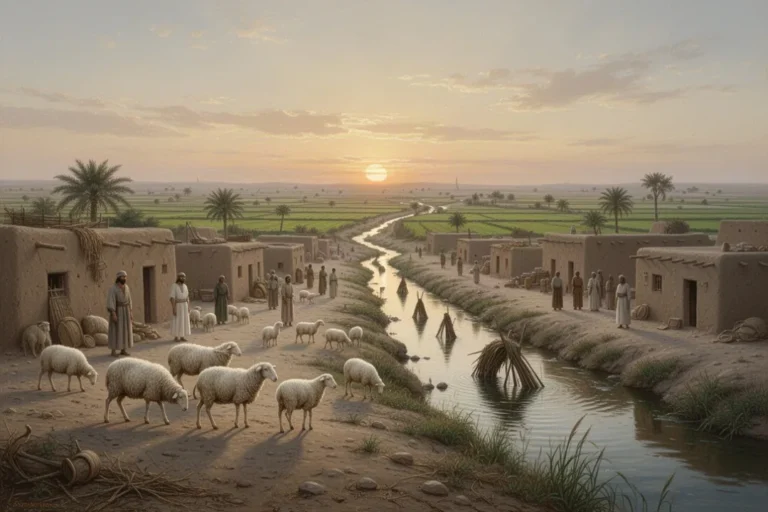
Goshen is presented as a fertile and productive region. Pharaoh instructed Joseph to settle Jacob’s family in the best part of the land, and Genesis 47:11 connects Goshen with the land of Rameses. The biblical text emphasizes that the area could support flocks, herds, and a growing population.
Most scholars place the Egyptian Goshen somewhere in or near the eastern Nile Delta, although the Bible does not provide enough information to establish a precise modern boundary. The Delta had access to water and pasture, which fits the description of a suitable place for shepherds and livestock keepers.
The exact relationship between Goshen and Rameses is discussed by interpreters because the names can refer to a region, a city, or a later designation. Genesis and Exodus use language associated with the northeastern part of Egypt, but the biblical account does not give modern coordinates. It is best to identify Goshen generally as a fertile area in northeastern Egypt rather than claim a location with certainty.
Goshen’s importance was not only agricultural. Its location appears to have allowed Jacob’s family to live somewhat apart from the central Egyptian population. That separation helped preserve the family’s identity during the generations before the Exodus.
Why Jacob’s family was placed apart from the Egyptians
Joseph’s brothers told Pharaoh that they were shepherds and had been shepherds from their youth. Genesis 46:34 says that shepherds were detestable to the Egyptians. The statement explains why Goshen was an appropriate place for Jacob’s family: it accommodated their occupation and reduced social friction with the surrounding population.
The separation should not be misunderstood as complete isolation. The Israelites lived under Egyptian authority, received land through Pharaoh’s administration, and depended on the larger Egyptian economy during the famine. Goshen was a distinct settlement within Egypt, not an independent country or a place outside Pharaoh’s control.
This arrangement also helped preserve a distinct family identity. Jacob’s descendants had inherited promises connected with Abraham, Isaac, and Jacob. Living together in one area made it easier for them to maintain family relationships, traditions, and communal practices as their numbers increased.
The biblical narrative therefore presents Goshen as both a gift and a temporary home. It provided safety and resources, but it was not the final destination promised to Abraham’s descendants. The Israelites would remain in Egypt for generations before God brought them out toward the land of Canaan.
How Goshen became a place of Israel’s growth
At the beginning of the Egyptian settlement, Jacob’s household was a relatively small extended family. Over time, the family expanded dramatically. Exodus 1:7 says that the Israelites were fruitful, increased greatly, became numerous, and filled the land.
Goshen gave the Israelites room and resources during this period of growth. Genesis 47:27 says that Israel settled in Goshen, acquired property there, and became fruitful and very numerous. The wording connects the region with both economic stability and population growth.
That growth fulfilled part of the wider promise God had made to Abraham. In Genesis 12:2, God had promised to make Abraham into a great nation. Similar promises appear in God’s covenant with Abraham in Genesis 15 and in the blessings given to Jacob. Goshen became one of the settings in which those promises began to take visible form.
At the same time, numerical growth changed how Egypt viewed the Israelites. A small immigrant family could be welcomed as useful guests during a famine. A large and rapidly increasing population could be treated as a political threat by a later Pharaoh who did not remember Joseph or did not value his contribution.
How Israel’s situation changed after Joseph
The book of Exodus opens with a sharp change in circumstances. Joseph’s generation and his brothers eventually died, but the Israelites continued to multiply. A new king arose over Egypt who did not know Joseph, and he viewed the Israelites as a potential danger.
Pharaoh responded with forced labor and increasingly severe policies. The Israelites were compelled to build store cities, identified in Exodus 1:11 as Pithom and Rameses. Their work became bitter and exhausting, yet the more they were oppressed, the more they continued to increase.
This change shows that Goshen was not a guarantee of permanent comfort. The same region that had sheltered Jacob’s family during famine became part of a system in which their descendants were oppressed. A favorable settlement under one ruler did not remove their need for God’s deliverance.
The story also warns against defining a place only by its first season. Goshen began as a place of provision, but it later became associated with slavery and the longing for freedom. The Israelites’ identity and hope depended on God’s covenant, not merely on the conditions of their residence.
How Goshen relates to the plagues of Egypt
Goshen is especially significant in the plague narratives. When Moses announced the fourth plague, a plague of flies, God said that the land of Goshen would be set apart so that the flies would not swarm there. Exodus 8:22-23 presents this distinction as a sign that the Lord was acting on behalf of his people.
The seventh plague, the plague of hail, also makes a distinction between the Egyptians and the Israelites. Exodus 9:26 says that hail did not fall in the land of Goshen, where the Israelites lived. These passages do not describe Goshen as magically protected by its geography. They portray its protection as an act of God during judgment on Egypt.
During the plague of darkness, Exodus 10:23 says that the Egyptians could not see one another or leave their places, while the Israelites had light where they lived. The verse does not repeat the word Goshen in that sentence, but it continues the broader pattern of a distinction between Egypt and Israel.
The Passover account takes place within this same setting. The Israelites were instructed to mark their houses with the blood of the Passover lamb and remain inside until morning, according to Exodus 12. Protection was connected with obedience to God’s command, not simply with living in Goshen.
Goshen therefore becomes a visible boundary in the plague stories. The point is not that every Israelite had an easier life than every Egyptian. Rather, the narratives show God identifying, preserving, and eventually delivering the people connected to his covenant.
Read the plague passages carefully: Goshen’s protection is described as God’s deliberate distinction between Israel and Egypt. The text does not teach that every believer will always live in a trouble-free place.
What Goshen teaches about God’s provision and protection
Goshen illustrates how provision can appear through ordinary circumstances. Joseph’s wisdom, Pharaoh’s decision, fertile land, and stored grain all played roles in preserving Jacob’s family. The biblical account presents these events within God’s larger providence without requiring the reader to treat every practical detail as a miracle in isolation.
The region also shows that provision and purpose can exist together. God used Goshen to preserve the family of Jacob during famine and to allow them to become a great people. The settlement was not merely a place where individuals escaped hardship; it served a role in the unfolding covenant story.
Goshen further illustrates the difference between protection and permanence. God protected the Israelites during particular plagues, but he did not intend for them to remain in Egypt forever. The people needed both preservation in Goshen and liberation from Egypt.
For readers of the Bible, that distinction matters. A season of safety may be genuine and valuable without being the final destination. Likewise, a place that once provided blessing may later become a place from which God calls people to move.
Is Goshen a symbol of safety for believers?
Many Christian teachers use “Goshen” as a symbol for a place of divine protection, provision, or separation from judgment. This application can be meaningful when it remains connected to the actual biblical story. Goshen did represent preservation during the plagues and provision during famine.
However, the Bible does not present Goshen as a universal formula for avoiding every crisis. The Israelites in Goshen still experienced the consequences of Pharaoh’s oppression, and their eventual deliverance required courage, obedience, and a journey into uncertainty.
A careful spiritual application might ask what the Goshen story reveals about God’s character: God can provide in hostile circumstances, preserve a community’s identity, distinguish his people in judgment, and lead them beyond a temporary refuge toward a larger purpose.
It is less accurate to use “Goshen” as a promise that a Christian household will be exempt from illness, financial difficulty, persecution, or grief. Biblical interpretation should begin with what the passage meant in its own setting before drawing broader principles for faith and practice.
What the other biblical references to Goshen mean
The book of Joshua uses Goshen in a different geographical context. Joshua 15:51 lists Goshen among the towns in the hill country of Judah, alongside places such as Holon and Giloh. This appears to be a town or local area in Canaan, not the Egyptian region where Jacob’s family lived.
Joshua 10:41 describes Joshua’s campaigns across a broad area, from Kadesh-barnea toward Gaza and throughout the land of Goshen. Joshua 11:16 similarly refers to the southern region, including Goshen. These passages may describe a wider district rather than the specific town named in Joshua 15.
The Bible does not explain why a location in Canaan shared the name Goshen. Place names can be repeated in different regions, and the text gives no reason to assume that the Egyptian and Judahite locations were identical. Their contexts are clearly different: Genesis and Exodus place Goshen in Egypt, while Joshua places Goshen within the land conquered and settled by Israel.
Egyptian Goshen: the fertile region where Jacob’s family settled and where the Israelites lived before the Exodus.
Goshen in Judah: a town listed among the cities of Judah in Joshua 15:51.
Land of Goshen in Joshua: a southern area mentioned in descriptions of Joshua’s campaigns.
The name’s precise meaning is uncertain. Some proposed explanations connect it with Egyptian or Semitic terms, but the biblical text does not provide a clear definition. It is safer to focus on how each passage uses the name than to build a theology on a speculative word meaning.
Common mistakes when studying Goshen in the Bible
Goshen is easy to oversimplify because it carries strong associations with safety and blessing. These practical guidelines can help you read the passages more accurately.
Do not confuse the two main settings. The Goshen of Genesis and Exodus is in Egypt; the Goshen named in Joshua is associated with Canaan.
Do not call Goshen the Promised Land. It was a temporary Egyptian settlement, while the covenant promise pointed toward the land of Canaan.
Do not assume Goshen was always peaceful. The Israelites eventually suffered forced labor under Pharaoh while living in Egypt.
Do not treat the word as a guaranteed prosperity formula. The Bible records God’s protection in specific events, not a promise of uninterrupted comfort.
Do not claim an exact modern location without qualification. Goshen is generally associated with the eastern Nile Delta, but its precise boundaries remain uncertain.
Do not ignore the surrounding narrative. Goshen makes sense only alongside Joseph’s administration, the famine, Israel’s growth, the oppression, the plagues, and the Exodus.
How to study the Goshen passages in context
A useful study begins with the references rather than with a modern slogan. Read the passages in their narrative order and observe how the meaning of Goshen develops.
Read Genesis 45–47. Notice why Joseph invites his family to Egypt, why shepherds are mentioned, and how Pharaoh assigns them the land.
Read Exodus 1. Compare the welcome given under Joseph with the oppression introduced by the new Pharaoh.
Read Exodus 8–12. Mark the passages that distinguish Goshen or the Israelites from Egypt during the plagues.
Read Joshua 10–15 separately. Identify the Canaanite references and avoid blending them with the Egyptian account.
Trace the themes. Consider provision, identity, population growth, oppression, judgment, protection, obedience, and deliverance.
It can also help to ask who is speaking and what problem the passage addresses. Genesis 46 addresses relocation and survival. Genesis 47 emphasizes settlement and growth. Exodus 8 and 9 emphasize God’s distinction during judgment. Joshua uses the name in geographical descriptions of Canaan.
That approach keeps the interpretation grounded in the text. Goshen can still offer meaningful spiritual lessons, but those lessons become stronger when they arise from the actual biblical context rather than from assumptions about the name.
Why Goshen matters in the larger story of Exodus
Goshen connects the family story of Genesis with the national story of Exodus. Joseph’s rise in Egypt explains how Jacob’s descendants entered the country. Goshen explains where they lived. Their growth in Goshen explains why Pharaoh later feared them. Their oppression explains why God called Moses to lead them out.
The region is therefore more than a geographical footnote. It is the setting where a family became a people. It links God’s promise to Abraham with the later formation of Israel as a nation brought out of Egypt.
Goshen also preserves the tension at the heart of the story. Israel was blessed in Egypt but did not belong there permanently. The people were protected during judgment but still needed rescue from oppression. They grew in a foreign land but were ultimately called toward the land promised to their ancestors.
Seen this way, Goshen represents a real historical place with theological significance. It was a place of food during famine, pasture for flocks, community for a growing family, protection during selected plagues, and preparation for a departure that would reshape Israel’s history.
What Goshen means for reading difficult seasons
The Goshen narrative can help you hold together truths that are often separated. God’s provision does not mean that circumstances will never change. A person or community may experience genuine care in one season and serious hardship in another without concluding that the earlier provision was false.
The story also encourages patience with long processes. Jacob’s family did not become a nation in a single event. Their growth took generations, and their deliverance came after a long period in Egypt. The Bible presents this history as part of God’s larger work, even when the people themselves experienced delay and suffering.
Finally, Goshen points beyond private comfort toward communal faithfulness. The Israelites were preserved as a people, not merely as isolated individuals. Their shared identity, obedience, worship, and journey mattered. The story invites readers to consider how faith is maintained within families and communities when they live among people with different beliefs and values.
Frequently asked questions
Was Goshen in Egypt or Israel?
The Goshen most often discussed in the Bible was in Egypt, probably in or near the eastern Nile Delta. Joshua also mentions a Goshen associated with Judah and a southern region in Canaan. These references describe different settings, so the Egyptian Goshen should not be confused with the place names in Joshua.
Did the Israelites own Goshen?
Genesis 47 says that Jacob’s family settled in Goshen and became fruitful there, but the land was granted under Pharaoh’s authority. The passage describes settlement and prosperity rather than Israelite national ownership. The Israelites remained residents within Egypt until the Exodus led them away from Pharaoh’s land.
Why did Pharaoh give Goshen to Joseph’s family?
Joseph’s family were livestock keepers, and Goshen was suitable for their flocks and herds. Pharaoh also wanted Joseph’s family settled near him during the famine. Their occupation and the Egyptians’ negative view of shepherding made Goshen a practical place for them to live somewhat apart from Egyptian society.
Does Goshen symbolize protection from every hardship?
Goshen can represent God’s provision and protection, especially during the plagues described in Exodus. It does not symbolize a guarantee of constant comfort, however. The Israelites later suffered oppression while living there. Its story includes both preservation and hardship, followed by deliverance and movement toward a new destination.








Leave a Reply