Abraham and Sarah are remembered as the couple through whom God’s covenant promise began to take shape. Their story includes migration, hospitality, family conflict, infertility, divine promises, and the birth of Isaac. It is not a simple account of perfect faith; it shows trust developing alongside fear, impatience, courage, and difficult decisions.
Abraham first appears in Genesis as Abram, while Sarah is introduced as Sarai. They lived in the ancient Near East and began their family story in Ur, then moved with Abram’s father, Terah, toward Canaan. Genesis later presents God calling Abram to leave his homeland and promising to make him the ancestor of a great people.
The biblical account gives Sarai a central place in that promise even though she initially could not have children. Her barrenness becomes one of the main tensions in the story because the promised family seems impossible from a human point of view. The narrative repeatedly places God’s promise beside circumstances that appear to contradict it.
Abram and Sarai’s names change later in Genesis. Abram becomes Abraham, commonly understood in connection with being the father of many peoples, and Sarai becomes Sarah. These changes accompany a renewed covenant promise and mark a significant development in their relationship with God.
The central tension: Abraham and Sarah receive a promise of descendants before they can see any practical way for that promise to happen. Their decisions make sense only when that long period of waiting is kept in view.
Abraham and Sarah’s story in chronological order
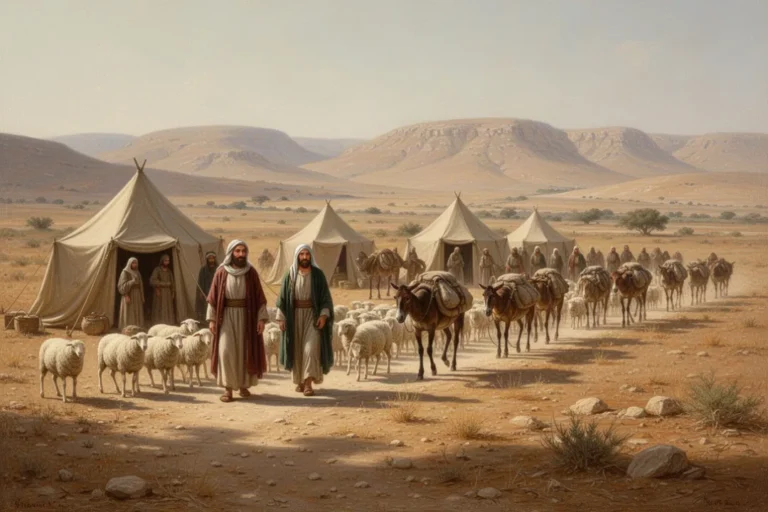
They leave their homeland. Abram travels from Mesopotamia toward Canaan, taking Sarai, his nephew Lot, and their household.
They receive a promise. God promises Abram land, descendants, and blessing that will extend beyond his immediate family.
They face famine and instability. A famine leads them to Egypt, where Abram fears for his safety and presents Sarai as his sister.
They separate from Lot. As their households grow, Abram and Lot part ways to prevent conflict over grazing land.
Sarai proposes a solution to childlessness. She gives her Egyptian servant Hagar to Abram, and Hagar bears Ishmael.
The covenant is renewed. God changes Abram’s name to Abraham, Sarai’s name to Sarah, and promises that Sarah will have a son, Isaac.
Sarah receives heavenly visitors. Visitors announce that she will give birth, and she reacts with disbelief because of her age.
Isaac is born. Sarah gives birth in her old age, and Abraham names the child Isaac according to the divine instruction.
Hagar and Ishmael leave the household. Conflict after Isaac’s birth leads Abraham to send Hagar and Ishmael away, though Genesis also describes God caring for them.
Sarah dies in Canaan. Abraham purchases the cave of Machpelah as a burial place for her, establishing an important family burial site.
This sequence matters because each event develops the same question: How will the promise survive real human circumstances? Abraham and Sarah are not removed from ordinary pressures. They deal with hunger, political danger, marriage tensions, inheritance concerns, and grief while carrying a promise that reaches far beyond their own lifetime.
Why God called Abraham to leave home
Genesis presents Abram’s call as a decisive break with his previous life. He is told to leave his country, relatives, and father’s household for a land that God will show him. The promise includes descendants, a great name, and blessing for others through him.
The call is not merely a change of address. It requires Abraham to trust a destination he has not yet seen and to build a future without the security of an established family line. Sarah makes that move with him, so her faithfulness is part of the journey even when the text often centers on Abraham.
Travel in the ancient world involved serious risks. A household depended on livestock, servants, water sources, alliances, and safe routes. Leaving familiar territory meant uncertainty about food, protection, and political authority. Abraham and Sarah’s migration therefore represents both spiritual obedience and a demanding practical decision.
When they arrive in Canaan, Abraham builds altars at several locations. These acts connect the land, worship, and promise. He does not immediately receive a settled kingdom or a large family; instead, he lives as a resident outsider while waiting for what God has said will come.
How famine tested Abraham and Sarah in Egypt
A famine forces Abraham and Sarah to travel to Egypt. There, Abraham worries that Sarah’s beauty will cause local rulers to kill him in order to take her. He asks her to identify herself as his sister. Genesis explains that she is his half-sister, but the arrangement still places Sarah in a vulnerable position and exposes Abraham’s fear.
The story raises difficult ethical questions. Abraham seeks personal safety, while Sarah bears the immediate consequences of the plan. Pharaoh takes Sarah into his household, but God intervenes through serious troubles affecting Pharaoh’s household. Pharaoh learns that Sarah is Abraham’s wife and sends them away with their possessions.
A similar episode later occurs with Abimelech, king of Gerar. Again, Abraham describes Sarah as his sister, and again the situation is exposed before the marriage is violated. These episodes show Abraham’s weakness without canceling his larger role in the story. Biblical narratives often preserve the failures of major figures rather than presenting them as consistently admirable.
For Sarah, the episodes show how limited her control could be within systems shaped by male authority and royal power. She is not simply a symbol of quiet patience. She survives dangerous circumstances, participates in major household decisions, and later speaks forcefully about the future of her family.
What happened between Abraham, Lot, and the promised land
Abraham and Lot become wealthy enough that their herders cannot use the same pasture without conflict. Abraham responds by offering Lot first choice of the land. Lot selects the well-watered Jordan Valley, while Abraham remains in Canaan. This separation protects family peace but also places Lot near the cities associated with Sodom.
Later, Abraham gathers a small force to rescue Lot after a regional conflict. The episode presents him as a capable leader, not only a wandering herdsman. He also refuses to make wealth from the king of Sodom, insisting that the king should not be able to claim credit for making Abraham rich.
Abraham’s relationship with Lot illustrates the tension between kinship and responsibility. Abraham allows separation when shared resources create conflict, but he does not abandon Lot in danger. His actions also show that the covenant promise does not make him passive; he still negotiates, travels, intervenes, and makes decisions in a volatile world.
Why Hagar and Ishmael are central to the story
Sarah’s inability to have children becomes increasingly painful as the promise of descendants continues. In Genesis, Sarah gives Hagar, her Egyptian servant, to Abraham so that Hagar may bear a child on Sarah’s behalf. Hagar becomes pregnant with Ishmael, but the arrangement creates tension between the two women.
The text describes Sarah treating Hagar harshly, leading Hagar to flee into the wilderness. There, an angel of the Lord encounters her and tells her to return, while also promising that her descendants will become numerous. Ishmael’s name and future are connected to God’s response to Hagar’s distress.
Hagar’s story should not be reduced to a plot device for Isaac’s birth. She is an enslaved or dependent woman whose body is used in a family strategy shaped by infertility and inheritance. Her encounter in the wilderness gives her a distinctive place in Genesis as someone seen and addressed by God while in distress.
After Isaac is born, Sarah sees Ishmael behaving in a way that threatens her son’s status and demands that Hagar and Ishmael be sent away. Abraham is distressed, but God tells him that Ishmael will also become a nation and assures him that Isaac will carry the covenant line. Abraham sends them away with food and water, and when those supplies run out, God provides for them in the wilderness.
Read the family conflict carefully: The covenant line through Isaac does not mean Ishmael is portrayed as worthless or abandoned by God. Genesis gives Ishmael a future, descendants, and divine care, even while describing the painful separation from Abraham’s household.
How the covenant promise changed Abraham and Sarah’s identity
Genesis 17 presents a major renewal of the covenant. Abram becomes Abraham, and Sarai becomes Sarah. God promises that Abraham will be the ancestor of many nations and that Sarah will become the mother of kings and peoples.
The covenant includes circumcision as a physical sign among Abraham’s household and descendants. It also clarifies that the promised son will come through Sarah, not through an alternative arrangement that merely solves the immediate problem of childlessness.
Abraham responds with both worship and astonishment. He falls facedown and laughs at the thought that a man of his age and a woman beyond normal childbearing years will have a son. The laughter carries a mixture of amazement, doubt, and the strangeness of the promise.
Sarah’s name change gives her a public role in the covenant. She is not only Abraham’s wife or the mother of the promised child; she is specifically included in the future of the people God promises to form. Her story demonstrates that the covenant depends on her participation and survival as much as on Abraham’s actions.
What Sarah’s laughter reveals about waiting
When visitors announce that Sarah will have a son, she listens from inside the tent and laughs because the promise seems physically impossible. The narrative does not hide her reaction. Her laughter reflects the distance between divine assurance and her lived experience of aging and infertility.
Abraham also laughs earlier when he hears that Sarah will bear a son. The child is eventually named Isaac, a name associated with laughter. This gives the story an emotional reversal: what first sounds absurd becomes the name attached to the family’s joy and future.
Sarah’s laughter can be read as disbelief, but it can also reveal how deeply disappointment has shaped her expectations. Years of waiting have made the promise difficult to imagine. The story does not treat faith as the absence of honest reaction; instead, it places doubt and fulfillment in the same narrative.
Hebrews 11 later remembers Sarah as someone who received power to conceive because she considered God faithful. That later interpretation emphasizes trust, while Genesis preserves the more complicated human response. Reading both passages together allows room for faith that includes confusion and gradual change.
Why Isaac’s birth matters
Isaac’s birth is the turning point of Abraham and Sarah’s story. Genesis says Abraham is one hundred years old when Isaac is born, and Sarah is ninety. These ages underline the extraordinary nature of the event within the biblical narrative.
Sarah responds by recognizing that God has brought her laughter and that others will share in that joy. The birth confirms that the promised family will begin through Sarah, not through a substitute heir. Isaac’s arrival also creates new tension because the household must now address the relationship between Isaac and Ishmael.
Isaac is not presented as the end of the promise but as its next stage. He becomes the son through whom the covenant continues to Isaac’s son Jacob and, later, the people of Israel. Abraham and Sarah do not see the full extent of the future associated with their family.
For Sarah: Isaac represents the reversal of long infertility and social vulnerability.
For Abraham: Isaac confirms that the covenant depends on God’s promise rather than ordinary inheritance plans.
For the family: Isaac creates joy but also sharpens questions about belonging, status, and succession.
For later biblical writers: Isaac becomes part of the chain connecting Abraham’s faith to Israel’s identity.
How Abraham’s test involving Isaac is understood
Genesis 22 describes God testing Abraham by commanding him to offer Isaac. Abraham travels with Isaac to the designated mountain, prepares an altar, and binds his son. Before Isaac is killed, an angel stops Abraham, and a ram becomes the offering instead.
This passage is among the most difficult in the Abraham cycle because it places a child’s life at the center of a divine test. The text does not report Sarah’s response, and readers should avoid inventing emotions or conversations that Genesis does not provide. Her absence from the scene is itself significant because the narrative focuses narrowly on Abraham and Isaac.
The episode concludes with a reaffirmation of the promise that Abraham’s descendants will become numerous and that blessing will reach other peoples through them. Jewish, Christian, and Muslim traditions have interpreted the story in different ways, including as a test of obedience, a rejection of child sacrifice, or a pattern later connected with sacrifice and faith.
Whatever interpretation a reader adopts, the story should not be used to excuse abuse or to suggest that people should obey harmful commands from anyone claiming divine authority. Genesis presents a unique narrative event within its own theological world, not a general instruction to endanger children or surrender moral judgment.
What Sarah’s death and burial tell us about her place
Genesis 23 records Sarah’s death at Hebron. Abraham mourns for her and negotiates with the local Hittites to purchase a burial place. He acquires the cave of Machpelah and the surrounding field from Ephron.
This is the first property Abraham is explicitly described as owning in the promised land. During his life, he travels through Canaan as a resident outsider, but Sarah’s burial place becomes a permanent family connection to the land. The purchase is carefully negotiated in public, giving Abraham legal possession of the site.
Sarah’s death also changes the emotional shape of the story. She is no longer present for Abraham’s later arrangements concerning Isaac’s marriage or for the next stage of the family line. Yet her role remains foundational: Isaac’s birth, the covenant through her, and the family burial site all connect the future to her life.
How Abraham and Sarah are remembered in Judaism, Christianity, and Islam
In Judaism, Abraham and Sarah are major ancestors of the Jewish people. Their stories appear in the Torah and are expanded through later Jewish interpretation. Sarah is remembered as one of the matriarchs, while Abraham is associated with covenant, hospitality, and devotion to God.
Christianity frequently presents Abraham as an example of faith. Paul refers to Abraham in Romans, Galatians, and elsewhere when discussing trust in God’s promise and the relationship between faith, law, and inheritance. First Peter also refers to Sarah as an example of a woman connected with hope and faithful conduct, though modern readers may debate how that passage applies to contemporary relationships.
Islam honors Abraham as Ibrahim and Sarah as Sarah. Ibrahim is a major prophet and model of submission to God. Islamic tradition also gives Hajar, the Arabic name commonly used for Hagar, an important place in the story of Ishmael and the origins associated with Mecca. Details and emphases differ among Islamic sources and between Islamic and biblical accounts.
Across these traditions, Abraham’s story is not separated from his family. Sarah, Hagar, Ishmael, and Isaac are essential to understanding how the promise, conflict, and legacy develop. Treating Abraham as the only important figure leaves out the women whose lives carry much of the story’s emotional and theological weight.
What Abraham and Sarah can teach readers today
One lesson is that faith and uncertainty can exist together. Abraham leaves without knowing the full route, and Sarah struggles to imagine the promised child. Their story gives readers language for waiting without pretending that waiting is easy or that every decision made during it is wise.
A second lesson concerns the consequences of trying to force a solution to a promise. Abraham and Sarah attempt to secure descendants through Hagar, but the plan produces lasting pain. The narrative does not erase the humanity of their choice, yet it shows that urgent attempts to control the future can harm people with less power.
A third lesson is that divine blessing should not be used to deny the dignity of people outside the main covenant line. Ishmael’s story remains important, and Hagar receives divine attention in the wilderness. The family’s chosen line and God’s care for others are presented together.
Readers can also see the value of honest moral reflection. Abraham protects himself at Sarah’s expense, Sarah mistreats Hagar, and the story of Isaac’s binding raises profound ethical questions. Admiring the larger faith journey does not require approving every action performed by its central characters.
When facing uncertainty: distinguish patient trust from passive inaction.
When making family decisions: consider how choices affect people with less authority.
When reading difficult passages: separate what the text reports from what it commands.
When studying biblical figures: include women, servants, children, and outsiders in the interpretation.
When thinking about legacy: remember that a person may shape a future they never live to see.
Where to read Abraham and Sarah’s story in the Bible
The main account runs through Genesis 11–23, with the most concentrated material in Genesis 12–23. Genesis 11 introduces the family background and Sarai’s infertility. Genesis 12 begins Abram’s call, while Genesis 15–17 develops the covenant and the promise of a son through Sarah.
Genesis 18–21 covers the visitors who announce Isaac’s birth, the destruction of Sodom, Isaac’s birth, and the departure of Hagar and Ishmael. Genesis 22 presents the test involving Isaac, and Genesis 23 records Sarah’s death and burial.
For later interpretations, read Romans 4, Galatians 3–4, Hebrews 11, and 1 Peter 3. These passages do not retell every event and should be read in their own contexts. They show how later biblical writers used Abraham and Sarah to discuss faith, promise, identity, and hope.
Frequently asked questions
Were Abraham and Sarah related before they married?
Genesis describes Sarah as Abraham’s half-sister, sharing the same father but not the same mother. The account comes from Abraham’s explanation to Abimelech in Genesis 20. Biblical family structures and marriage practices varied across the ancient world, so readers should interpret this detail within the social setting of Genesis rather than applying modern family categories without context.
Did Sarah have children besides Isaac?
The biblical narrative identifies Isaac as Sarah’s son and does not name any other children born to her. After Sarah’s death, Abraham has additional sons through Keturah, according to Genesis 25, but those sons are not described as Sarah’s children. Hagar’s son Ishmael is Abraham’s child, yet Hagar is the woman who gives birth to him.
What was the age difference between Abraham and Sarah?
Genesis gives enough information to infer that Abraham was ten years older than Sarah. When Abraham is one hundred and Sarah is ninety, Isaac is born. The text does not present their age difference as the main issue; it emphasizes their advanced ages and Sarah’s long infertility in relation to the promised birth.
Are Abraham and Sarah considered saints?
In Christianity, Abraham and Sarah are honored as biblical ancestors and examples associated with faith, but the way they are formally recognized differs among Christian traditions. Eastern Orthodox and Roman Catholic communities commemorate biblical figures within their calendars and worship practices, while many Protestant traditions emphasize their scriptural witness without using the same formal saint classifications.




Leave a Reply