Biblical Babylon refers both to the ancient city in Mesopotamia and to the broader empire that ruled much of the ancient Near East. In the Bible, Babylon is best known for its role in conquering Judah, destroying Jerusalem, carrying Judeans into exile, and later becoming a symbol of human arrogance and corrupt power.
The name also has a symbolic meaning that reaches beyond one ancient kingdom. In Genesis, Babylon appears as Babel, associated with humanity’s attempt to establish greatness apart from God. In Revelation, “Babylon” represents a wealthy and oppressive world power that seduces nations and stands against God’s purposes.
Babylon stood in southern Mesopotamia, near the Euphrates River in what is now Iraq. Its ruins lie roughly 50 miles south of modern Baghdad. The city was part of a region shaped by the Tigris and Euphrates rivers, where irrigation supported dense populations, agriculture, trade, writing, and urban government.
The city’s location gave it both economic and strategic importance. River routes connected Babylon with other Mesopotamian centers, while roads led toward Syria, the Levant, Anatolia, and the Persian Gulf. That position helped Babylon become more than a local city: it became the center of a major imperial system.
Babylon was not always the dominant power in the region. It rose and declined several times before becoming the capital of the Neo-Babylonian Empire. The Bible often focuses on this later period, especially under King Nebuchadnezzar II, whose reign shaped Judah’s history and the biblical accounts of exile.
How Babylon developed into an ancient superpower
Babylon had a long history before the events most familiar to Bible readers. It became especially prominent under Hammurabi, an early second-millennium BCE king known for expanding Babylonian control and for a famous collection of legal decisions. That earlier Babylon should be distinguished from the Neo-Babylonian Empire described in the books of Kings, Jeremiah, Ezekiel, and Daniel.
After periods of foreign rule and political weakness, Babylon rose again in the late seventh century BCE. Nabopolassar founded the Neo-Babylonian dynasty after breaking Assyria’s control. His son, Nebuchadnezzar II, expanded the empire and made Babylon one of the most impressive cities of the ancient world.
Nebuchadnezzar’s armies defeated Egyptian influence in the region and brought Judah under Babylonian control. The Babylonian Empire eventually fell to the forces of Cyrus the Great of Persia in 539 BCE. Babylon continued to exist after that conquest, but it no longer held the same imperial position.
Historical distinction: “Babylon” can mean the city, the Babylonian kingdom, the Neo-Babylonian Empire, or a symbolic power in biblical prophecy. Reading the surrounding passage helps determine which meaning is intended.
What Genesis says about Babel and Babylon
The first major biblical reference appears in Genesis 10–11, where the city is called Babel. The account describes people gathering in the land of Shinar and building a city with a tower intended to reach the heavens. Their goal is presented as making a name for themselves and preventing their scattering.
God confuses their language and disperses them. The narrative connects the city’s name with confusion, using a Hebrew wordplay that links Babel to the idea of confusing or mixing language. The story does not function as a detailed architectural report. Instead, it presents a theological explanation of human pride, centralized power, and resistance to God’s command that people fill the earth.
Some readers connect the tower with a Mesopotamian ziggurat, a large stepped temple structure common in the ancient region. That connection may help explain the cultural setting, but Genesis does not identify a specific archaeological building by name. The central point is the people’s attitude and ambition, not the engineering details of the tower.
Babel establishes themes that return throughout Scripture. The city seeks greatness through its own power, gathers people around a self-made identity, and treats heaven as something to be reached or controlled. Later biblical writers build on those themes when they describe Babylon as proud, violent, wealthy, and opposed to God.
How Babylon conquered Judah and Jerusalem
Babylon became central to biblical history when it defeated Judah. The process occurred through successive military campaigns rather than one single event. Babylon first brought Judah into submission during the reign of Jehoiakim, and later deportations removed additional groups from Jerusalem and the surrounding kingdom.
In 586 BCE, during the reign of Zedekiah, Babylonian forces captured Jerusalem after a long siege. They destroyed the city and the temple, broke down much of its defenses, and deported many survivors. This catastrophe is one of the defining events of the Hebrew Bible and shaped Jewish identity, worship, memory, and hope for generations.
The fall of Jerusalem was not described by the biblical writers as merely a military defeat. The prophets interpreted it as judgment for persistent idolatry, injustice, covenant unfaithfulness, and abuse of power. Babylon was the invading empire, but the Bible also presents the disaster within a larger moral and theological framework.
That framework does not make Babylon innocent. The prophets condemn Babylon’s cruelty and arrogance even while explaining Judah’s defeat as divine judgment. This creates an important biblical tension: a nation may be used as an instrument of judgment and still be held accountable for its violence, motives, and pride.
Why the Babylonian exile matters in the Bible
The exile was more than relocation. Judeans were separated from their land, temple, political independence, and familiar patterns of worship. Some were taken to Babylon, while others remained in the devastated land or fled to neighboring areas. The experience forced communities to ask how faith could continue far from Jerusalem.
Several biblical books address this crisis directly. Jeremiah warns of Babylon’s rise, interprets the coming disaster, and speaks of eventual restoration. Ezekiel prophesies from among the exiles and addresses the loss of the temple and national identity. Daniel portrays Judeans serving in the Babylonian and later Persian court while remaining faithful to God.
The exile also changed how worship and Scripture were practiced. Prayer, teaching, communal identity, and the preservation of sacred traditions became especially significant when sacrifices at the Jerusalem temple were no longer possible. The biblical record shows that exile did not mean God had abandoned his people or that his presence was limited to one location.
For many readers, Babylon therefore represents both judgment and the setting for faithfulness. The city is the place where Jerusalem’s defeat becomes visible, but it is also where exiles learn that loyalty to God can continue under foreign rule.
What Nebuchadnezzar represents in biblical accounts
Nebuchadnezzar II is the most prominent Babylonian ruler in the Bible. He is associated with the conquest of Jerusalem, the destruction of the temple, and the deportation of Judeans. The book of Daniel also presents him as a powerful king whose authority is tested by dreams, divine judgment, and encounters with God’s sovereignty.
Daniel’s portrayal emphasizes that imperial authority is limited. Nebuchadnezzar may command armies, build cities, and rule many peoples, but he cannot control the meaning of dreams or place himself above divine judgment. His humiliation in Daniel 4 is presented as a lesson about pride and dependence on God.
The famous image of the golden statue in Daniel 3 reflects another aspect of imperial pressure. The king demands public conformity, while Shadrach, Meshach, and Abednego refuse to worship the image. Their response illustrates that biblical faithfulness may require refusing a ruler’s demand when it conflicts with worship of God.
Readers should avoid treating every detail in Daniel as a simple modern political prediction. The narratives communicate theological claims through court stories, visions, symbolic images, and accounts of rulers. Their repeated message is that kingdoms rise and fall, while God’s authority is not finally threatened by any empire.
How the prophets describe Babylon’s pride and judgment
Prophetic passages in Isaiah, Jeremiah, and Habakkuk use Babylon to explore power, violence, and accountability. Babylon is portrayed as an agent that overwhelms other nations, yet its own triumph is temporary. Its military strength cannot protect it from judgment.
Isaiah 13–14 announces judgment against Babylon using elevated poetic language. The passage speaks of the city’s downfall and includes taunting imagery against the arrogance of its king. Some Christian traditions have connected the language about a fallen “morning star” with Satan, but the immediate context addresses the pride and downfall of a human ruler. The broader spiritual application should not erase the passage’s historical setting.
Jeremiah 50–51 contains an extended oracle against Babylon. It describes the empire’s violence, arrogance, treatment of God’s people, and eventual collapse. The language is both historical and theological: Babylon will fall, the exiles will find a path home, and the destruction of Jerusalem will not be the final word.
Habakkuk raises a difficult question about using a nation more wicked than Judah to bring judgment. The book does not offer a simplistic answer. Instead, it affirms that Babylon itself will face judgment for its greed, violence, and attempt to dominate peoples. This pattern matters because it prevents readers from equating military success with moral approval.
Babylon becomes a symbol through repeated biblical associations. It represents a civilization that concentrates wealth and power, glorifies itself, exploits other peoples, and treats human life as a resource. The symbol is not limited to one ethnic group or one political arrangement.
Several themes commonly belong to the biblical image of Babylon:
Pride: Babylon exalts its own greatness and assumes that its position cannot be challenged.
Oppression: The empire expands through conquest, forced labor, deportation, and political domination.
Idolatry: Babylon is associated with worship systems and values that compete with loyalty to God.
Luxury: Its wealth is connected with excess, unequal power, and the exploitation of others.
Exile: Babylon becomes the place where conquered people live under foreign rule.
Temporary glory: Its apparent permanence ends when God brings judgment.
These themes explain why the Bible can speak about Babylon long after the empire’s political collapse. The symbol remains useful for describing any system that combines self-glorification, injustice, coercion, and spiritual unfaithfulness.
Use the symbol carefully: Biblical Babylon should not be applied as a careless label for an entire modern nation, culture, religion, or ethnic group. The biblical critique targets pride, exploitation, idolatry, and oppressive power.
How Revelation uses the name Babylon
The book of Revelation presents “Babylon the Great” as a symbolic figure and city. Revelation 17–18 describes a power dressed in wealth and splendor that influences rulers, profits from trade, and participates in violence against God’s people. The imagery draws heavily from earlier biblical descriptions of Babylon, Tyre, Egypt, and other oppressive powers.
Many interpreters understand Revelation’s Babylon as an allusion to Rome, the empire that ruled the Mediterranean world when Revelation was written. Rome’s political authority, wealth, military force, and persecution provide a plausible historical background. The text’s symbolism also allows Babylon to represent more than Rome alone.
Revelation emphasizes the moral character of the system. Babylon is condemned for seducing nations, enriching merchants, glorifying luxury, and shedding innocent blood. Its fall produces grief among kings and merchants who benefited from it, while heaven celebrates the end of its oppression.
The command to “come out” of Babylon in Revelation 18 is best understood as a call to reject participation in its sins rather than simply an instruction to leave a geographic city. The message concerns spiritual allegiance and moral separation. God’s people are called not to depend on corrupt power or share in exploitation, even when such a system appears prosperous.
Is Babylon the same as Rome in the Bible?
Babylon and Rome are not the same historical empire. Babylon ruled Mesopotamia and destroyed Jerusalem in the sixth century BCE, while Rome rose to dominate the Mediterranean much later. However, biblical writers can use Babylon as a symbolic name for a later empire that resembles Babylon in its arrogance and oppression.
Revelation’s imagery strongly supports a connection between Babylon and Rome, but the symbol is not exhausted by that identification. The name points backward to the pattern established by Babylon: a dominant power becomes wealthy through conquest, demands loyalty, harms the vulnerable, and assumes that its rule will last forever.
First Peter 5:13 refers to a community in “Babylon.” Some readers take this as a literal reference to the Mesopotamian city, while many interpreters understand it as a coded reference to Rome. The verse is brief, and the text itself does not settle the question in a way that eliminates all debate.
What archaeology reveals about ancient Babylon
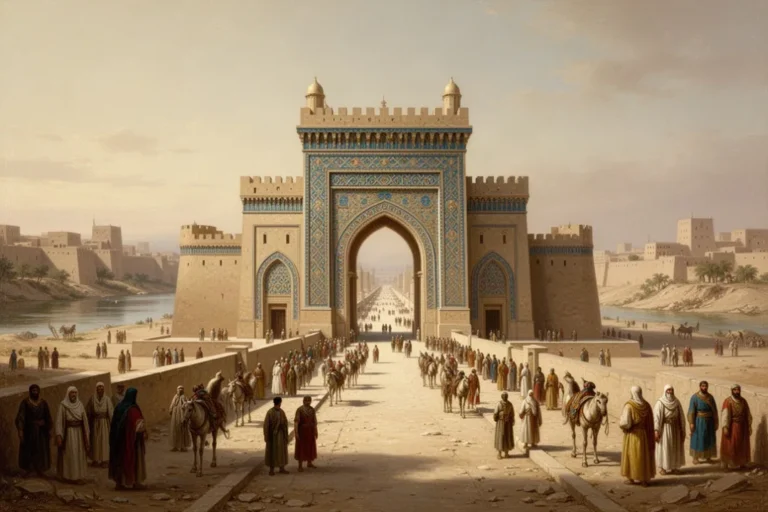
Archaeological remains confirm that Babylon was a large and influential city, though archaeology cannot prove every biblical interpretation. Excavations have uncovered remains associated with monumental walls, temples, processional areas, and royal construction. The city’s scale helps explain why biblical writers treated it as an image of imperial magnificence.
The Ishtar Gate, associated with the city’s ceremonial route, is especially famous. Its glazed brick decoration featured animals connected with Babylonian religious symbolism. Much of the gate now displayed in Berlin comes from reconstructed archaeological material, while the original site in Iraq contains additional remains and reconstructions.
The city also contained major temples, including the temple complex dedicated to Marduk, Babylon’s chief god. Babylonian kings used building projects to display religious devotion, political legitimacy, and royal power. Such monuments could serve worship, administration, ceremony, and imperial propaganda at the same time.
Archaeology also reminds readers that biblical Babylon was a real urban center, not merely an invented symbol. At the same time, the Bible’s purpose is not to provide a complete city guide. Its descriptions select details that serve historical memory, prophetic warning, and theological interpretation.
Confusing Babel with every later event in Babylon: Genesis 11, the Neo-Babylonian conquest, and Revelation use related imagery but belong to different contexts.
Assuming one king ruled the entire story: Nebuchadnezzar II is important, but Babylon’s history includes many rulers and several periods of strength and weakness.
Reading prophecy as a simple timeline: Prophetic texts often combine historical events, poetic imagery, future hope, and theological themes.
Calling Babylon purely evil without acknowledging Judah’s judgment: The Bible condemns Babylon while also explaining why Judah faced discipline.
Treating Revelation as a direct architectural description: Revelation uses symbols to portray an oppressive imperial order and its eventual collapse.
Applying “Babylon” to people rather than systems and practices: Biblical criticism focuses on idolatry, exploitation, pride, and violence.
Assuming archaeology can answer every theological question: Excavations can illuminate the city’s history and culture, but they do not replace careful reading of the biblical text.
Practical steps for reading Babylon passages well
A careful reading begins by identifying the passage’s setting. Ask whether the text refers to Babel in Genesis, the historical empire in Kings and Jeremiah, the exile in Daniel and Ezekiel, or the symbolic Babylon of Revelation. The same name does not guarantee the same immediate meaning.
Locate the passage historically. Determine whether the setting is before Jerusalem’s fall, during the exile, after Babylon’s defeat, or within an apocalyptic vision.
Identify the speaker and audience. A prophet addressing Judah may emphasize judgment, while an exilic prophet may stress hope and God’s presence away from Jerusalem.
Observe the moral accusations. Look for references to pride, violence, idolatry, greed, deception, or persecution.
Separate literal and symbolic language. A city may be historical in one verse and a symbol of imperial corruption in another literary setting.
Read the promised outcome. Babylon passages often move toward judgment, restoration, return from exile, or the triumph of God’s kingdom.
Compare related passages. Genesis, Isaiah, Jeremiah, Daniel, 1 Peter, and Revelation develop connected themes but should not be flattened into one account.
This method helps prevent two opposite errors. One error reduces Babylon to an ancient archaeological site and misses its theological significance. The other turns every reference into a prediction about a modern government without respecting the original passage.
What biblical Babylon teaches about power and hope
Babylon’s story presents political power as real but limited. Empires can destroy cities, move populations, and reshape history, yet they cannot establish permanent security through force. Biblical writers repeatedly challenge the belief that wealth, armies, walls, or imperial titles make a kingdom invulnerable.
The Bible also treats the vulnerable seriously. Deportation and conquest are not abstract events; they involve families, homes, worship, language, work, and identity. The judgment of Babylon therefore includes its treatment of conquered people, not only its opposition to Israel’s religion.
At the same time, biblical hope does not depend on pretending that Babylon’s damage was insignificant. Restoration includes return, rebuilding, renewed worship, and the vindication of people who suffered. The end of Babylon’s power is portrayed as good news because it opens space for justice and faithful worship.
For Christian readers, Revelation extends that hope toward the final defeat of every system that profits from oppression and demands ultimate loyalty. For Jewish readers, the exile and return remain central to the story of covenant, judgment, survival, and restoration. Across these contexts, Babylon warns against trusting human grandeur while affirming that injustice does not have the last word.
Why biblical Babylon still matters
Babylon remains significant because it joins history and symbolism without reducing either one. It was an actual Mesopotamian city and empire that changed the course of Judah’s history. It also became Scripture’s enduring image of a society that mistakes prosperity for righteousness and power for permanence.
Understanding Babylon requires attention to both dimensions. The historical Babylon explains the trauma of exile and the political world of the prophets. The symbolic Babylon exposes recurring patterns of pride, exploitation, idolatry, and imperial overreach wherever they appear.
Its message is therefore not simply “Babylon once fell.” It is also a warning that human systems built on domination will be judged, and a promise that God remains present with people who seek faithfulness in the shadow of powerful empires.
Frequently asked questions
Was Babylon a real city or only a biblical symbol?
Babylon was a real and influential city in ancient Mesopotamia, located in present-day Iraq. It became the capital of the Neo-Babylonian Empire and played a major role in the conquest and exile of Judah. Biblical writers later used Babylon symbolically to represent pride, oppression, idolatry, luxury, and corrupt imperial power.
Who destroyed Jerusalem and took the people into exile?
Babylonian forces under King Nebuchadnezzar II conquered Jerusalem in stages. The city and temple were destroyed in 586 BCE, during the reign of Zedekiah, and many Judeans were deported to Babylon. The biblical writers interpret this event as both a political catastrophe and judgment for Judah’s persistent unfaithfulness.
Does biblical Babylon refer to the United States or another modern country?
The Bible does not directly identify the United States or any other modern country as Babylon. Some people apply the symbol to present-day institutions, cultures, or empires, but such applications should be made cautiously. The biblical pattern concerns pride, exploitation, violence, idolatry, and unjust power rather than a simple national label.
Why is Rome sometimes called Babylon?
Revelation appears to use Babylon as a symbolic name for a powerful, wealthy, and oppressive empire, and many interpreters see Rome as its primary historical reference. First Peter also mentions Babylon, which some understand as a coded reference to Rome. The symbolism can point beyond one empire to recurring forms of corrupt imperial power.






Leave a Reply