Harlot in the Bible: meaning, context, and symbolism
Harlot in the Bible: meaning, context, and symbolism
The word “harlot” in the Bible can describe a person involved in prostitution, but it also serves as a metaphor for spiritual unfaithfulness and corrupt societies. The surrounding passage determines which meaning applies.
Modern readers may encounter “harlot” in older English Bible translations, while newer translations often use terms such as prostitute, sex worker, or wayward woman. The language can sound harsh today, so reading the original setting and the wider biblical message helps prevent shallow or unfair interpretations.
In the Old Testament, the English word “harlot” commonly translates the Hebrew term zonah. Its basic sense refers to a woman who engages in prostitution, although the precise meaning can depend on the narrative. In some passages, the term is connected with sexual commerce; in others, it becomes part of a symbolic accusation against a nation or city.
The New Testament was written mainly in Greek. Words related to porne and porneia are often translated with terms such as prostitute, sexual immorality, or fornication. These words belong to a broader family of language concerning illicit sexual behavior, but they do not automatically carry exactly the same meaning in every passage.
Older translations sometimes use “harlot” because it was a traditional English term for a prostitute. In contemporary English, however, the word may sound archaic, insulting, or broader than the original context requires. Comparing translations can reveal whether a passage is discussing a literal person, a figurative image, or a moral charge against a community.
Reading principle: Do not assign one meaning to every appearance of “harlot.” Ask whether the passage describes an individual, a city or nation, a religious community, or an apocalyptic symbol.
Where the Bible describes a literal prostitute
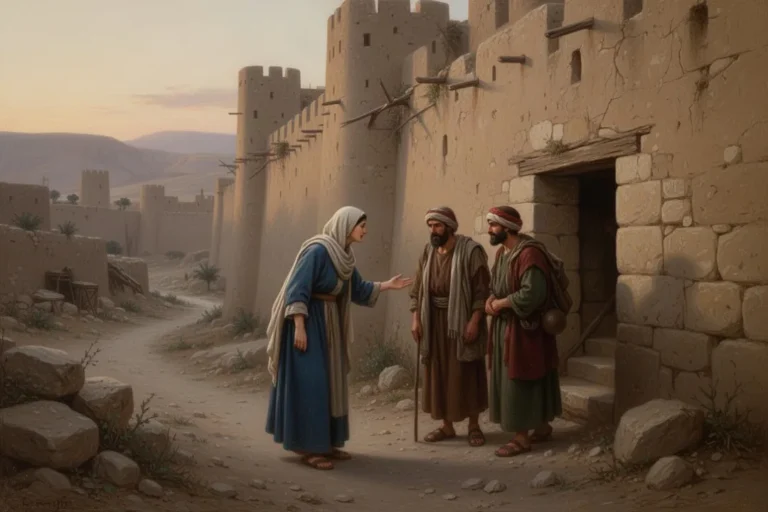
Several biblical narratives use the image in an ordinary, concrete sense. Rahab in Jericho is the best-known example. Joshua 2 identifies Rahab as a woman associated with prostitution who lived in a house on the city wall. She protected Israelite spies, misdirected those searching for them, and helped them escape.
Rahab’s story shows that the biblical narrative does not treat a person’s past as the only fact that defines them. Joshua presents her as a woman who recognized Israel’s God and acted courageously under pressure. The New Testament later remembers Rahab positively in Hebrews 11 and James 2, and Matthew 1 includes her in Jesus’ genealogy according to the Gospel’s account.
Those references do not erase the reality of her earlier circumstances, but they do show that Rahab is not portrayed as permanently disqualified. Her story is frequently used to emphasize faith expressed through action, hospitality, courage, and a changed relationship to God.
Another literal reference appears in Genesis 38, where Tamar disguises herself and Judah mistakes her for a prostitute. The episode is complicated and should not be reduced to a simple moral lesson. It involves family obligations, Judah’s failure to provide what was expected, deception, sexual relations, and his eventual recognition that he had acted unjustly.
Proverbs 7 describes a “seductive woman” in language that older translations may connect with a harlot or prostitute. The chapter is wisdom literature, using a vivid warning about sexual temptation, secrecy, self-deception, and consequences. Its purpose is not to provide a social description of all women who sell sex; it warns against destructive desire and the failure to exercise judgment.
Some legal and narrative passages mention prostitution alongside other social practices considered unacceptable within Israel’s covenant life. Deuteronomy 23, for example, addresses prostitution in a setting involving worship and community boundaries. The exact interpretation of difficult legal passages varies, so readers should avoid treating an isolated verse as a complete account of biblical views on sexuality, economics, or gender.
How Rahab complicates common assumptions
Rahab matters because she challenges the assumption that the Bible speaks about every person labeled a harlot in the same way. Her occupation is part of the story, but it is not the final word about her. The narrative gives significant attention to her discernment and protection of vulnerable people.
Joshua 2 portrays Rahab as recognizing that the God of Israel was acting in history. She understood the danger facing the spies and chose to hide them from the authorities. Her decision involved personal risk, since discovery could have brought punishment from the king of Jericho.
Hebrews 11 presents Rahab among people remembered for faith, while James 2 points to her actions as evidence that faith is not merely verbal. These passages do not praise prostitution. They highlight the possibility that a person can respond to God with trust and courageous action despite a stigmatized past.
Rahab’s inclusion in Matthew’s genealogy also deserves careful attention. The genealogy places her within the line leading to Jesus, along with other women whose stories involve complicated social and moral circumstances. The point is not that every detail of each story is identical. Rather, the genealogy shows that God’s purposes are not limited to people with socially uncomplicated backgrounds.
A responsible reading therefore avoids two opposite mistakes. One mistake is to ignore Rahab’s identity in the text and pretend the passage says nothing about prostitution. The other is to define her entirely by that label and overlook the transformation, faith, and agency emphasized by the biblical writers.
Why the prophets call Israel a harlot
The prophets frequently use sexual imagery to describe Israel’s covenant unfaithfulness. In these passages, “harlot” usually does not mean that the entire population literally practiced prostitution. It is a metaphor for abandoning the worship of Israel’s God and pursuing other gods or political loyalties.
Hosea is the most sustained example. Hosea’s marriage and family life become a living sign of Israel’s betrayal, although the book is difficult and emotionally intense. The prophet describes Israel as unfaithful because the nation has turned to idols and ignored the relationship established through the covenant.
Jeremiah uses similar language when accusing Jerusalem and Judah of pursuing foreign gods. The imagery includes adultery, prostitution, and betrayal because biblical covenant language often compares the relationship between God and Israel to a marriage. Idolatry is therefore portrayed not merely as an incorrect idea but as a profound breach of loyalty.
Ezekiel 16 develops an especially extended allegory. Jerusalem is depicted as a woman rescued, clothed, and honored, who later uses those gifts in unfaithful relationships with other nations and gods. The chapter is deliberately shocking, and its sexual language can be difficult to read. Its central accusation concerns abuse of privilege, spiritual betrayal, and social corruption.
Ezekiel 23 uses two sisters as symbols for Samaria and Jerusalem. The imagery is graphic and includes political alliances, idolatry, and violent consequences. Readers should recognize that these chapters are prophetic rhetoric, not neutral descriptions of women. They use culturally familiar marriage imagery to express the seriousness of covenant violation.
Isaiah also describes Jerusalem as faithful and later corrupt, using prostitution as an image of moral and civic decline. Isaiah 1 connects the city’s unfaithfulness with injustice, bribery, and oppression. That connection is significant: the prophetic accusation is not limited to private religious devotion. A society’s treatment of the poor and vulnerable is part of its faithfulness or unfaithfulness.
What spiritual prostitution means in the Old Testament
When the Bible uses prostitution as a metaphor for idolatry, the comparison rests on exclusive loyalty. Israel was expected to worship the Lord rather than combine covenant worship with devotion to other gods. The metaphor communicates that turning away is not a minor preference; it is a betrayal of a committed relationship.
Prophetic writers also connect spiritual unfaithfulness with national security and politics. Israel and Judah sometimes sought help through alliances with foreign powers instead of relying on God. Prophets could describe that behavior as prostitution because the nation was giving its trust and allegiance to powers outside the covenant relationship.
This imagery should not be used carelessly. It is a mistake to treat “harlot” as a general insult for anyone who disagrees with a religious group. In the prophetic books, the metaphor carries a specific theological charge: the people who belong to God have violated their relationship through idolatry, injustice, or dependence on rival powers.
The prophetic books also contain calls to return. Their accusations are severe, but judgment is not always the final note. Hosea, Jeremiah, and other prophets speak of repentance, restoration, renewed covenant relationship, or God’s continuing concern for the people. The metaphor of unfaithfulness therefore sits within a larger pattern of warning, judgment, mercy, and restoration.
Who is the “great harlot” in Revelation?
Revelation 17 and 18 present a symbolic figure called Babylon the Great, also described as a great harlot. She is pictured as a richly dressed woman associated with a beast, political power, wealth, and the corruption of nations. The vision is not a straightforward account of one individual involved in prostitution.
Babylon in Revelation draws on the Bible’s earlier use of Babylon as a symbol of arrogant empire and opposition to God. The city represents a system marked by luxury, exploitation, idolatry, political domination, and economic entanglement. Revelation 17 says that the woman’s immorality affects kings and peoples, showing that the image is communal and international rather than private.
Many interpreters understand Babylon as referring first to Rome or to the Roman imperial system familiar to the original audience. The description of a powerful city ruling over kings, enriched by commerce, and hostile to God fits the book’s ancient setting. Other readers see Babylon as a recurring symbol of any empire or culture that combines wealth, violence, false worship, and oppression.
Revelation 18 emphasizes merchants, cargoes, luxury goods, and the economic impact of Babylon’s fall. The passage mentions human beings among the commodities or victims of the system, which makes exploitation central to the judgment. The symbol therefore concerns more than sexual immorality. It exposes a civilization that treats people and resources as instruments of power and profit.
The figure’s appearance also matters. She looks attractive, wealthy, and influential, yet the vision reveals corruption beneath the surface. Revelation uses this contrast to warn that a society can appear successful while being morally diseased. The “harlot” image communicates seduction as well as unfaithfulness: power draws others into its values and practices.
Revelation 19 contrasts Babylon’s destruction with the imagery of a bride prepared for marriage. This contrast continues the Bible’s broader use of marriage language. Babylon represents corrupt loyalty and exploitative desire, while the bride represents a people prepared for faithful union with God’s purposes.
How Jesus and the New Testament treat people labeled sinners
The Gospels contain strong warnings about sexual sin, but they also repeatedly challenge the habit of reducing people to their reputations. In Matthew 21, Jesus says that tax collectors and prostitutes were responding to John the Baptist’s message while religious leaders were refusing to believe. The statement is intentionally confrontational: public sinners who repent may enter God’s kingdom before respectable people who reject the truth.
Jesus’ point is not that prostitution is harmless or that moral choices do not matter. The issue is repentance and response to God. The people criticized by the religious authorities were willing to change direction, while those who appeared righteous relied on status and refused correction.
Luke 7 describes a woman known publicly as a sinner who approaches Jesus in a Pharisee’s home. The passage does not explicitly call her a prostitute, although tradition has often identified her that way. Jesus receives her act of devotion and uses the encounter to teach about forgiveness, love, and self-righteous judgment.
John 8, in translations that include the story of the woman accused of adultery, is also often brought into discussions of sexual shame. The passage’s textual history is complex, and it should be handled carefully. Its central ethical movement is clear in the narrative as received by many Christian communities: Jesus neither treats sin as irrelevant nor permits a crowd to use condemnation as a weapon.
The wider New Testament calls Christian communities to sexual integrity, honesty, and care for one another. At the same time, it rejects boasting, exploitation, and contempt. A biblical approach must hold both truths together: sexual wrongdoing can cause real harm, and people who have sinned must not be treated as beyond mercy or dignity.
Common mistakes when interpreting “harlot” in the Bible
The most useful interpretive habit is to slow down before applying a loaded label. Several mistakes appear repeatedly in sermons, online discussions, and casual reading.
Treating every use as literal: In the prophets and Revelation, the term is usually symbolic. The passage may be condemning idolatry, political corruption, economic exploitation, or covenant betrayal rather than describing a person’s occupation.
Treating every use as symbolic: Rahab and the woman in Genesis 38 appear in narratives involving literal prostitution or an accusation of it. Symbolic meaning should not erase the plain narrative details.
Using “harlot” as a general insult: Biblical writers use the image within particular covenant, prophetic, or apocalyptic arguments. It should not become a casual label for women, churches, nations, or opponents.
Ignoring translation differences: Older English versions may say “harlot,” while newer versions may say “prostitute” or use a different phrase. Comparing translations helps identify what the underlying context is doing.
Defining Rahab only by her occupation: Joshua and the New Testament emphasize her faith, actions, and place in the story of redemption. Her past is part of the narrative, but it is not her entire identity.
Reading prophetic imagery as a statement about women: The prophets use female imagery to portray cities and nations. That rhetorical choice should be examined critically rather than used to justify contempt for women.
Overlooking injustice: Prophetic accusations often connect unfaithfulness with oppression, bribery, violence, and exploitation. The issue is broader than private sexual behavior.
Using one verse without its setting: Read the chapter, identify the speaker, notice the audience, and ask whether the passage is law, narrative, wisdom, prophecy, Gospel teaching, or apocalyptic vision.
How to study a difficult passage about a harlot
Start with the passage’s literary form. A narrative about Rahab should be read differently from a prophetic oracle in Hosea or a vision in Revelation. Genre affects how images function and whether a word should be understood directly, metaphorically, or in both ways at once.
Next, identify who is being addressed. Is the speaker confronting an individual, Israel, Jerusalem, foreign nations, an imperial power, or a religious community? The same image can carry a different force depending on the target of the accusation.
Then examine the surrounding actions and consequences. A passage about prostitution may focus on deception, exploitation, idolatry, adultery, poverty, military danger, or social injustice. The surrounding details reveal what the writer wants the reader to judge, understand, or hope for.
Translation comparison is useful, but it should not become a substitute for context. Look at several reputable translations and, if possible, a Bible dictionary or scholarly commentary that explains the Hebrew or Greek terms. A study Bible can also identify cross-references to Hosea, Jeremiah, Ezekiel, or Revelation.
Read the entire chapter rather than isolating one sentence.
Mark the type of passage: narrative, law, wisdom, prophecy, Gospel, letter, or apocalyptic vision.
Ask what “harlot” refers to: an individual, a city, a nation, a religious practice, or a symbolic power.
Notice related themes such as idolatry, covenant, exploitation, repentance, judgment, mercy, and restoration.
Compare translations to see whether “harlot” reflects an older English choice.
Apply the passage carefully without turning a prophetic metaphor into a personal insult.
Important warning: Biblical sexual language has often been used to shame women or stigmatize people in vulnerable situations. A careful interpretation preserves the passage’s moral seriousness without adding contempt that the text does not require.
What the Bible’s wider message says about dignity and restoration
The Bible’s references to prostitution and sexual unfaithfulness are serious, but they are not isolated from its broader teaching about human dignity. People are portrayed as morally responsible, socially vulnerable, capable of repentance, and never reducible to one public label.
Rahab demonstrates that a stigmatized past does not prevent a person from acting with faith and courage. The teachings of Jesus show that repentance matters more than religious reputation. The prophets remind communities that worship cannot be separated from justice, while Revelation warns that wealthy and powerful systems can seduce entire nations into complicity.
These themes also clarify what the Bible is not saying. It is not giving permission to harass sex workers, humiliate people who have experienced sexual exploitation, or call a religious opponent a “harlot” as a shortcut for disagreement. Biblical judgment is directed toward sin, betrayal, oppression, and corruption; it is not a license for cruelty.
A faithful reading also recognizes that prostitution can involve unequal power, poverty, coercion, trafficking, and abuse. Biblical passages do not all analyze those realities in modern terms, but readers should not assume that every person involved in commercial sex has identical freedom or responsibility. Moral reflection should include compassion for people who are vulnerable to exploitation.
The central biblical pattern is therefore more substantial than the word itself: unfaithfulness is exposed, injustice is judged, and restoration remains possible. The term “harlot” carries different meanings across Scripture, but its significance becomes clearer when each passage is read with attention to context, genre, power, and the possibility of redemption.
How “harlot” differs from related biblical terms
Readers may confuse “harlot” with several related terms, but they are not interchangeable in every passage. A prostitute generally refers to a person who has sex for payment or material benefit. An adulterer is someone who violates a marriage relationship through sexual relations with another person. A person can be described by one term without the other applying.
Fornication is an older English translation choice for several Greek terms and may refer broadly to sexual immorality, depending on the translation and context. It does not necessarily mean prostitution. Adultery specifically involves betrayal of a marriage bond, while “harlot” usually points toward prostitution or a metaphor built from that image.
Words such as “whore” and “harlot” can also appear in older translations as part of a prophetic metaphor. Modern readers should pay attention to whether the translation is preserving an ancient style or using language that communicates naturally today. The most accurate interpretation comes from the passage’s argument, not from the emotional force of one English word.
Questions to ask when applying these passages today
When a biblical text uses prostitution as a symbol, ask what kind of behavior the author is actually exposing. Is the target idolatry, hypocrisy, imperial violence, economic exploitation, betrayal, or a combination of these? Naming the specific issue prevents the metaphor from becoming vague moral condemnation.
When the passage concerns a real person, ask whether the narrative emphasizes vulnerability, agency, repentance, courage, or harm. Rahab’s story, for example, should lead readers to consider how God sees a person beyond a social label. A difficult passage about sexual sin should also lead to honesty about consequences and compassion toward those who have been harmed.
Finally, ask whether your interpretation reflects the full biblical pattern. Scripture confronts sin directly, but it also condemns self-righteousness, defends the vulnerable, welcomes repentance, and promises restoration. Those themes should shape how the word “harlot” is understood and how it is never used: not as a weapon against people, but as a carefully interpreted term within its ancient context.
Frequently asked questions
Is Rahab in the Bible the same person as a prostitute?
Yes. Joshua 2 describes Rahab as a woman associated with prostitution in Jericho. Later biblical references remember her for faith and courageous action, not only for her former occupation. Hebrews 11 and James 2 present her as an example of faith demonstrated through deeds, while Matthew 1 includes her in Jesus’ genealogy.
Does “harlot” always mean a prostitute in Scripture?
No. In some narratives, it refers to a literal prostitute or to someone accused of prostitution. In prophetic books, it often symbolizes Israel, Judah, Jerusalem, or another community’s unfaithfulness to God through idolatry and injustice. Revelation uses the image for Babylon the Great, a symbolic power associated with corruption and oppression.
Who is the harlot in Revelation 17?
Revelation 17 presents the harlot as Babylon the Great, a symbolic woman linked with political power, luxury, idolatry, and the corruption of nations. Many interpreters connect the first-century image with Rome and imperial rule, while others see Babylon as a recurring symbol of oppressive systems that combine wealth, violence, and false worship.
Is it appropriate to call someone a harlot today because of this biblical language?
No. “Harlot” is an archaic and often derogatory term in modern English. Biblical passages use it within specific narratives, prophetic accusations, or symbolic visions. Applying it casually to a person is demeaning and usually ignores context. Discussions about prostitution, sexual exploitation, or moral conduct should use precise, respectful language instead.








Leave a Reply