Ezekiel and the prophets: visions, message, and meaning
Ezekiel and the prophets: visions, message, and meaning
Ezekiel was a priest-prophet who spoke to Judeans living in exile in Babylon, explaining why Jerusalem had fallen while proclaiming that God could still restore his people and dwell among them.
His ministry belongs to one of the most disruptive periods in ancient Israel’s history. Babylon had taken control of Judah, deported many people from Jerusalem, and threatened the political, religious, and social structures that had shaped the nation for generations. Ezekiel addressed people who had lost their homeland, their king, and eventually the temple that stood at the center of their worship.
The book associated with him is famous for striking visions, symbolic actions, severe warnings, and expansive promises. Ezekiel saw heavenly beings, a radiant divine presence, a valley filled with dry bones, and a future temple described in extraordinary detail. These images can seem difficult at first, but they consistently address a central question: how can a displaced people understand God’s holiness, judgment, and continuing presence?
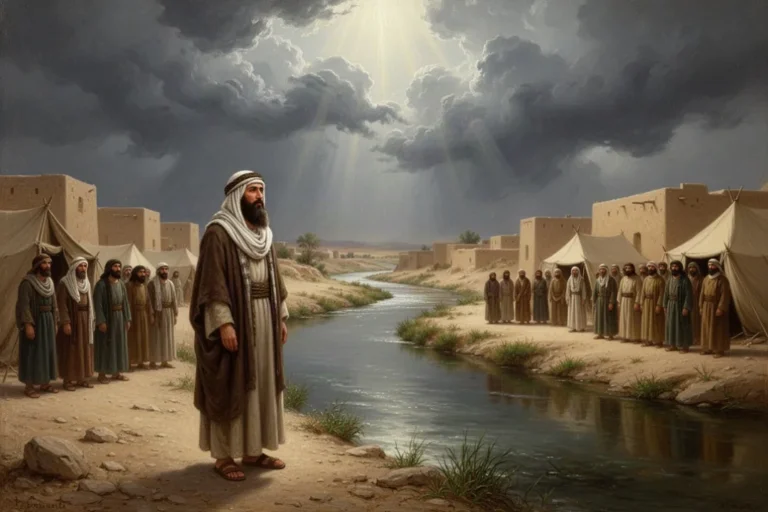
Ezekiel was both a priest and a prophet. The book identifies him as the son of Buzi and places his first recorded vision beside the Kebar River in Babylon. That setting matters because Ezekiel did not deliver his message from a secure religious center in Jerusalem. He prophesied among deported Judeans, far from the temple and the land associated with God’s covenant.
His prophetic calling began in the fifth year of King Jehoiachin’s exile, commonly dated to about 593 BCE. Jehoiachin had been taken to Babylon several years earlier, after Babylon defeated Jerusalem. Ezekiel’s ministry continued through the period leading to Jerusalem’s destruction and into the years when the exiles had to imagine life after national catastrophe.
The book records dates for many of Ezekiel’s messages, usually according to the exile of King Jehoiachin. This gives the material a strong sense of historical movement. Early messages warn that Jerusalem will face judgment; later messages address the aftermath and turn toward restoration, renewed identity, and a rebuilt sacred order.
Ezekiel’s priestly background helps explain his repeated attention to holiness, impurity, worship, the temple, and the divine presence. Yet he was not simply a temple official serving in ordinary circumstances. His prophetic vocation forced him to explain how God’s holiness could be encountered in a foreign land and why the temple itself could not protect a corrupt society from judgment.
Central idea: Ezekiel’s exile setting does not make his message less religious; it is the setting in which he asks how God remains present when familiar institutions and places have been lost.
Like other biblical prophets, Ezekiel challenged the idea that religious identity could be preserved through outward practices alone. He condemned violence, exploitation, idolatry, and injustice. His message was not merely that Judah had suffered bad luck or military defeat. He interpreted the crisis as a moral and spiritual reckoning, while also insisting that judgment would not be the final word.
How Ezekiel compares with other biblical prophets
Ezekiel stands within a broad prophetic tradition that includes Isaiah, Jeremiah, Hosea, Amos, Micah, and others. These prophets differ in historical setting and style, but they share several concerns: faithfulness to God, justice toward vulnerable people, rejection of idolatry, and hope beyond judgment.
Amos and Micah, for example, strongly emphasize social injustice and the abuse of the poor. Jeremiah speaks to Judah’s final decades before Jerusalem’s fall and also addresses the experience of exile. Isaiah contains messages of judgment and restoration across several historical settings. Ezekiel shares these concerns but presents them through especially elaborate visions, enacted signs, and priestly imagery.
Several features make Ezekiel distinctive among the prophets:
He uses visionary scenes to reveal divine glory, heavenly activity, judgment, and restoration.
He performs symbolic actions, such as lying on his side, preparing food under unusual restrictions, and acting out the coming siege of Jerusalem.
He describes the departure and return of God’s glory, connecting the destruction of the temple with the hope of a renewed sanctuary.
He develops the responsibility of the individual, stressing that people are accountable for their own conduct rather than relying only on ancestry or communal reputation.
He presents detailed future temple arrangements, including boundaries, priestly duties, land distribution, and the movement of sacred space.
Ezekiel and Jeremiah are especially connected because both address the final years of Judah and the Babylonian crisis. Jeremiah prophesied mainly in and around Jerusalem, while Ezekiel spoke to exiles in Babylon. Their audiences therefore experienced the catastrophe from different locations. Both warned against false confidence, but Ezekiel’s visions give unusual attention to what happens when the divine presence is no longer associated with Jerusalem’s temple.
The earlier prophets often use poetry, brief oracles, courtroom language, and memorable images. Ezekiel also uses poetry, but his book frequently unfolds through long symbolic narratives and visionary reports. His style can feel more dramatic and architectural. It asks readers to picture the movement of divine glory, the shape of a future sanctuary, or the reassembly of a people who appear beyond hope.
Ezekiel’s place among the major and minor prophets
In Christian Bibles, Ezekiel is one of the four Major Prophets, alongside Isaiah, Jeremiah, and Daniel. “Major” refers primarily to the length and scope of the books, not to greater spiritual importance. The “Minor Prophets,” such as Amos, Joel, and Zechariah, have shorter books but are not considered less significant because of that classification.
In the Hebrew Bible, Ezekiel belongs to the section known as the Latter Prophets, together with Isaiah, Jeremiah, and the Twelve. The arrangement and numbering of biblical books differ between Jewish and Christian traditions, but Ezekiel remains recognized as a central prophetic voice in both broad traditions.
Reading Ezekiel alongside other prophets prevents two common mistakes. First, his visions should not be separated from the ethical concerns shared by the prophetic tradition. Second, his promises of restoration should not be treated as vague optimism. They answer specific losses: a ruined city, a scattered population, a defiled land, broken leadership, and the apparent absence of God’s glory.
What Ezekiel’s visions and symbolic actions mean
The opening vision in Ezekiel 1 introduces a mobile throne-chariot associated with God’s glory. Ezekiel sees powerful living beings, wheels, and a radiant appearance above them. The description is difficult to visualize, but its theological force is clear: God’s presence is not trapped inside Jerusalem or limited to one building. The exiles are not outside God’s reach simply because they are in Babylon.
This vision also introduces one of Ezekiel’s recurring themes: divine holiness is overwhelming and cannot be controlled by human institutions. The prophet’s response is fear and submission, not casual familiarity. He receives a commission to speak to a resistant people, even though they may refuse to listen.
Ezekiel often communicates through actions rather than speeches alone. In Ezekiel 4, he creates a miniature representation of Jerusalem’s siege and lies in prescribed positions to symbolize the burden of Israel and Judah’s wrongdoing. He also prepares food in a way that reflects scarcity and ritual concern. These actions turn an invisible warning into something the community can see.
In Ezekiel 12, the prophet packs belongings and moves them in a way that represents forced departure. He also acts out the fate of Jerusalem’s ruler. In Ezekiel 24, the death of Ezekiel’s wife becomes a sign connected to the coming loss of the sanctuary, and the prophet is told not to perform ordinary public mourning. These actions are emotionally severe because Ezekiel’s prophetic ministry communicates the scale of collective trauma.
Not every unusual detail should be treated as a code with a separate hidden meaning. Prophetic symbolism works through accumulated images, public performance, and theological patterns. The actions show that judgment is approaching, that the temple cannot shield injustice, and that the people’s familiar world will be overturned.
The watchman image in Ezekiel 3 and 33 explains the prophet’s responsibility. A watchman must warn a city when danger comes. If people hear the warning and ignore it, they bear responsibility for their response; if the watchman refuses to warn them, the watchman is accountable. The image does not make Ezekiel responsible for forcing obedience. It defines his duty to speak clearly.
Ezekiel 18 develops this question through a sustained discussion of personal conduct. The chapter rejects the assumption that one generation’s wrongdoing automatically determines another generation’s moral standing. A person who turns away from evil and practices justice is treated differently from someone who persists in wrongdoing. Ezekiel also insists that repentance can change a person’s direction.
Reading tip: Ask what each vision or sign reveals about God, human responsibility, the consequences of injustice, or the possibility of restoration before searching for a prediction about modern events.
Why Ezekiel announces judgment on Jerusalem and the nations
The first major movement of Ezekiel’s book announces judgment against Jerusalem, Judah, and the surrounding nations. The warnings are severe because Ezekiel sees the crisis as the result of long-standing rebellion rather than a single political mistake. Idolatry, violence, corruption, and the abuse of power have damaged the community from within.
Chapters 8–11 describe a series of visions involving the temple in Jerusalem. Ezekiel sees practices that represent the people’s unfaithfulness and then witnesses the departure of God’s glory from the city. This is one of the book’s most unsettling ideas. The temple, though sacred, is not a guarantee that the city can avoid judgment while its leaders and people reject justice and loyalty to God.
The departure of the divine glory also answers the exiles’ location. If God’s glory leaves the temple and appears in a vision near the exiles, then Babylon cannot claim to have confined or defeated God. The temple’s destruction is a judgment on Judah, but it is not evidence that Babylon’s gods have become supreme.
Ezekiel also criticizes leaders through images of shepherds. In Ezekiel 34, Israel’s shepherds are condemned for feeding themselves instead of protecting the flock. The image addresses kings, officials, and other authorities who have benefited from the people while neglecting the weak. God promises to seek the scattered sheep, judge between them, and provide responsible care.
The judgment oracles against foreign nations in chapters 25–32 place Judah’s disaster within a larger international setting. Ammon, Moab, Edom, Philistia, Tyre, Sidon, and Egypt are addressed in different ways. Their pride, hostility, exploitation, or delight in Judah’s downfall will also face judgment.
These passages do not mean that every neighboring nation is condemned for the same reason. Each oracle has its own historical and rhetorical focus. Together, they communicate that God’s moral authority extends beyond Judah. No empire, trading power, military state, or proud ruler stands outside accountability.
The judgment sections can be difficult for modern readers because they use intense poetry and war imagery. They should be read as prophetic proclamations shaped by ancient conflict, not as permission for religious violence. Their central concern is the exposure of arrogance and injustice, especially when powerful societies treat human suffering as an opportunity for gain.
How Ezekiel describes restoration, new life, and God’s presence
After the fall of Jerusalem, Ezekiel’s message changes in tone. The prophet no longer needs to persuade his audience that disaster is coming. The city has fallen, the temple has been damaged, and the survivors must decide whether a future is possible. The book’s later chapters respond with promises of gathering, cleansing, renewed leadership, restored land, and divine presence.
Ezekiel 36 presents restoration as more than a return to familiar territory. The people will be gathered from the nations, cleansed from impurity, and given a new heart and a new spirit. The promise addresses both external circumstances and internal character. A repaired political community would not be enough if the people remained committed to the patterns that caused their ruin.
The famous vision of the dry bones in Ezekiel 37 dramatizes this hope. Ezekiel sees a valley filled with bones, representing a people who believe their hope has disappeared. The bones are joined, covered, and given breath. The image points to national renewal and the reconstitution of a devastated community, though its language has also influenced later Jewish and Christian reflection on resurrection.
The chapter continues with two pieces of wood brought together to symbolize the reunification of divided kingdoms. The image reaches beyond individual comfort toward communal healing and political unity. Restoration involves a people becoming one again under renewed leadership, not merely isolated individuals receiving private blessings.
Ezekiel 34 also contributes to this vision by promising a shepherd who will care for the flock. The chapter’s emphasis is not only on leadership in general but on protection, justice, and the recovery of those who have been scattered or injured. Later Jewish and Christian readers have interpreted this shepherd imagery in different ways, often connecting it with messianic hope.
The final section, Ezekiel 40–48, presents an extensive vision of a future temple and reordered land. The details include measurements, gates, courts, priestly responsibilities, offerings, land divisions, and a river flowing from the sanctuary. The vision is not simply a construction plan. It presents a world in which holiness is ordered, worship is regulated, and God’s presence again shapes communal life.
The book ends with a name for the restored city that means, in essence, that the Lord is there. This ending answers the anxiety created by the earlier departure of glory. The decisive hope is not only that walls will be rebuilt or land redistributed. It is that God’s presence will again be at the center of the community.
Gathering: scattered people are brought together from the nations.
Cleansing: impurity and idolatry are removed.
Renewed character: the people receive a new heart and spirit.
Responsible leadership: corrupt shepherds are replaced by faithful care.
Reordered worship: the sanctuary and priestly service are structured around holiness.
Restored presence: the city’s defining reality is that God is there.
How to read Ezekiel’s message today
Ezekiel rewards careful reading because its images operate on several levels. A vision may address the historical crisis of the Babylonian exile while also expressing lasting questions about leadership, communal responsibility, worship, and hope. Readers should resist reducing every symbol to a prediction chart or a direct reference to a modern country.
Begin by asking who is speaking, to whom, and at what point in the exile. A warning delivered before Jerusalem’s fall has a different function from a promise delivered after the city’s destruction. The dated notices throughout the book help readers follow this change.
Next, pay attention to repeated themes. Ezekiel returns to God’s glory, the knowledge of the Lord, the responsibility of leaders, the danger of idolatry, the restoration of the land, and the transformation of the people. Repetition is one of the main ways the book develops its argument.
It also helps to distinguish between a prophet’s message and later interpretations. Jewish and Christian communities have read Ezekiel in different ways, especially the visions of the dry bones, Gog of Magog, and the future temple. Responsible interpretation acknowledges those traditions without claiming that one modern reading is the only possible meaning.
Several practical questions can guide a close reading:
What crisis does this passage address? Identify whether the setting is before Jerusalem’s fall, immediately afterward, or within the vision of future restoration.
What behavior is condemned? Look for idolatry, oppression, false leadership, pride, violence, or betrayal.
What does the image reveal about God’s presence? Many passages challenge the assumption that God is limited by geography, buildings, or political power.
What kind of hope is offered? Ezekiel’s hope often includes changed conduct, repaired community, just leadership, and renewed worship.
Ezekiel’s message remains challenging because it refuses easy comfort. It says that religious symbols cannot excuse injustice, that leaders answer for how they treat vulnerable people, and that communities may need deep transformation rather than superficial repair. At the same time, it refuses to define a wounded people by their worst moment.
The prophet’s most enduring contribution may be the way he holds judgment and hope together. Jerusalem’s destruction is real; suffering is not minimized. Yet exile does not prove that God has abandoned the people, and ruin does not make renewal impossible. The final vision directs attention toward a restored community shaped by holiness and marked by God’s presence.
Frequently asked questions
Was Ezekiel a prophet before or after the destruction of Jerusalem?
Ezekiel began prophesying before Jerusalem was destroyed and continued afterward. His early messages warned that the city and temple would face judgment because of persistent unfaithfulness. After the fall, his emphasis shifted toward consolation and restoration. This change in focus helps explain why the book contains both severe warnings and detailed promises of renewed life.
What is the meaning of Ezekiel’s vision of dry bones?
The dry bones represent a people who believe their national life has ended. In the immediate context, the vision speaks of Israel’s restoration after exile and the re-creation of a defeated community. Later Jewish and Christian interpretations have also connected the image with resurrection, but its first setting is the hope of collective renewal after national catastrophe.
Why are Ezekiel’s temple measurements so detailed?
The detailed temple vision presents an ordered future in which holiness, worship, land, and community life are properly arranged. Its purpose is theological as well as architectural. After the temple’s destruction, Ezekiel describes a restored sacred center to show that God’s presence and Israel’s communal identity can be renewed, even after judgment and displacement.
How should readers understand Gog and Magog in Ezekiel?
Gog and Magog appear in Ezekiel 38–39 as symbolic enemies gathered against a restored people. The passage emphasizes God’s sovereignty over forces that appear overwhelming. Later religious traditions use these names in different ways, so readers should first consider Ezekiel’s own setting and themes rather than assuming the names identify a specific modern nation or event.




Leave a Reply