Who is Lucifer in the Bible? Meaning and biblical context
Who is Lucifer in the Bible? Meaning and biblical context
In the Bible, “Lucifer” is not originally presented as Satan’s personal name. The term comes from a Latin translation of Isaiah 14:12, where the prophet describes the downfall of the king of Babylon using vivid imagery about a fallen morning star.
The English word Lucifer comes from the Latin word lucifer, meaning “light-bearer” or “morning star.” In the Latin Vulgate, the word appears in Isaiah 14:12 as part of a poetic description of a ruler brought down from a position of apparent glory.
The underlying Hebrew expression is often transliterated as helel ben shachar, which can be understood as “shining one, son of the dawn.” It refers to a bright celestial image, not necessarily to a personal name. The language evokes the morning star, commonly associated with Venus, which appears brilliantly before sunrise and then disappears as daylight arrives.
Older English translations, including the King James Version, use “Lucifer” in Isaiah 14:12. Many modern translations instead use phrases such as “morning star”, “day star,” or “shining one.” These choices reflect the meaning of the Hebrew image rather than treating Lucifer as a proper name.
Key distinction: In Isaiah 14, “Lucifer” is connected directly to a taunt against the king of Babylon. The belief that Lucifer is Satan comes from how later Christian interpretation connects this passage with other biblical descriptions of evil and rebellion.
What Isaiah 14 says about the king of Babylon
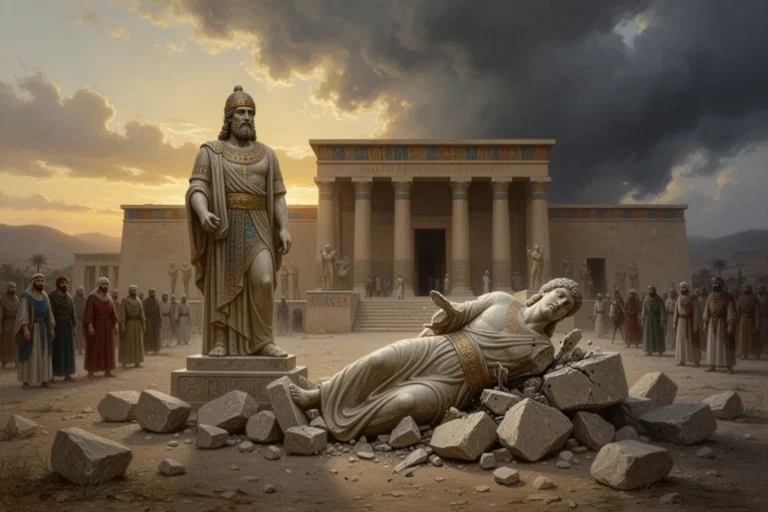
Isaiah 14 is a poetic oracle concerning the king of Babylon. The chapter describes a proud oppressor whose power collapses, bringing relief to people who had suffered under his rule. The surrounding passage repeatedly focuses on Babylon, its arrogance, and its eventual humiliation.
The prophet imagines the dead rulers of the nations rising from their resting places to mock the fallen king. They ask whether this once-powerful figure has become as weak as everyone else. The imagery is dramatic because the king had acted as though he were above ordinary human limits.
Isaiah 14:12-15 describes the ruler’s ambition through a series of upward-reaching claims. He wants to rise into the heavens, set his throne above the stars of God, and make himself like the Most High. The passage then reverses that ambition: instead of ascending, he is brought down to the depths.
The central message is the judgment of arrogant power. A ruler may appear untouchable, exalt himself above others, and claim extraordinary status, but God can bring him down. The morning-star image makes the fall especially striking because something that shines before dawn does not remain in the sky once the day appears.
Does Isaiah 14 describe Satan directly?
Isaiah 14 does not explicitly use the name Satan, nor does it plainly identify the king of Babylon as a fallen angel. Its immediate subject is a human ruler and the political empire he represents. Reading the chapter in its historical and literary setting helps prevent the passage from being separated from its original purpose.
Many Christians nevertheless understand Isaiah 14 as having a secondary or typological application to Satan. In this reading, the king’s pride reflects the deeper pattern of rebellion against God. The passage becomes a picture of the kind of self-exaltation associated with the devil, even if its first reference is the king of Babylon.
That interpretation developed alongside reflection on other passages. Jesus speaks of Satan falling from heaven in Luke 10:18. Revelation 12 portrays a dragon cast down from heaven and identifies that dragon with the devil and Satan. These texts do not quote Isaiah 14 as a direct explanation, but together they shaped Christian teaching about Satan’s fall.
The distinction matters because an interpretation can be theologically meaningful without being the passage’s only original reference. Isaiah 14 can address Babylon’s king in context while also reminding readers of the broader biblical theme that pride and rebellion against God end in judgment.
How the Bible describes Satan
The Bible uses several names and titles for the figure Christians commonly call the devil. “Satan” comes from a Hebrew term associated with an adversary or accuser. In the New Testament, the Greek word diabolos, usually translated “devil,” conveys the idea of a slanderer or false accuser.
These names emphasize what Satan does rather than offering a complete biography. He opposes God’s purposes, accuses people, deceives, tempts, and seeks to turn human beings away from faithful obedience. The Bible presents him as a real spiritual adversary, but never as God’s equal.
In Job 1-2, Satan appears as an accuser in a heavenly setting, while still operating under God’s authority. The passage raises difficult questions about suffering, but it clearly does not portray two independent gods fighting on equal terms. Satan’s activity is limited and accountable.
In Zechariah 3, Satan stands to accuse the high priest Joshua, while God rebukes the accusation and restores the priest. This scene connects Satan with condemnation and opposition. It also emphasizes that God—not Satan—has the final authority to judge and forgive.
The New Testament describes Satan as a tempter in Matthew 4, a deceiver in John 8:44, an enemy who seeks to devour in 1 Peter 5:8, and a force opposed to the spread of the gospel in passages such as 2 Corinthians 4:4. These descriptions give a consistent picture of spiritual opposition without presenting Satan as omniscient or omnipotent.
Why Christians connect Lucifer with Satan
The identification of Lucifer with Satan comes from a process of reading several passages together. Isaiah 14 depicts a proud figure falling from a high position. Ezekiel 28 describes the downfall of the king of Tyre with imagery of beauty, privilege, and expulsion from a garden-like setting. The Gospels and Revelation describe Satan’s defeat and fall.
Ezekiel 28, like Isaiah 14, directly addresses a human ruler. The “prince” or “king” of Tyre is condemned for pride, wealth, and self-exaltation. Some Christian interpreters have seen the language as reaching beyond the human king to describe the spiritual power behind such arrogance. Others retain the passage’s historical focus while recognizing its broader theological significance.
Over time, these passages were brought into a unified account of Satan’s origin: a glorious spiritual being became proud, rebelled against God, and was cast down. That account is common in Christian teaching, but the Bible does not present it in one continuous narrative with every detail explained.
The traditional story is therefore a theological synthesis, not a simple retelling of one chapter. It draws on biblical images of pride, accusation, temptation, cosmic conflict, and judgment. The name Lucifer became especially prominent in Christian and later Western tradition because of the Latin wording of Isaiah 14.
What “Lucifer” means in different Bible translations
Translation differences can create confusion. The King James Version uses “Lucifer” in Isaiah 14:12, which helped establish the word as a familiar label for Satan in English-speaking Christianity. In that translation, “Lucifer” appears as a capitalized term, making it look like a personal name.
Many contemporary translations translate the phrase according to its imagery. They may say “morning star,” “shining star,” or “day star.” This does not necessarily reject the traditional association with Satan; it simply shows what the Hebrew wording means in its immediate context.
The word also appears in 2 Peter 1:19 in the King James Version, where it refers to the rising morning star and is associated with the dawning of spiritual light. In that passage, it is not a name for the devil. Other translations use “morning star” or “day star” there as well.
This wider use shows that lucifer originally had a positive or neutral meaning: a light-bearing star that appears at dawn. The word itself does not mean “devil.” Its negative association comes from the traditional interpretation of Isaiah 14 and the later use of Lucifer as a name for Satan.
What Jesus and the New Testament say about Satan’s defeat
Jesus’ ministry presents Satan as an enemy whose influence is real but whose defeat is certain. During Jesus’ wilderness temptation, recorded in Matthew 4 and Luke 4, the devil tries to turn Jesus away from faithful obedience. Jesus responds by grounding his actions in Scripture and refusing worship that would compromise devotion to God.
In Luke 10:18, Jesus describes seeing Satan fall like lightning from heaven. Christians interpret this statement in different ways. It may refer to the collapse of Satan’s authority as Jesus’ representatives proclaim God’s kingdom, or it may point toward the devil’s ultimate defeat. Either way, the emphasis is on Satan’s loss of power before God’s reign.
Jesus also describes Satan as a thief and destroyer in John 10:10’s wider context, while other passages portray the devil as a liar and murderer. These descriptions are not meant to create a mythology of equal forces. They warn that evil can be active, intelligent, and destructive while remaining subject to God’s judgment.
Revelation 12 uses symbolic imagery of a dragon, war in heaven, and expulsion from heaven. The dragon is identified as the ancient serpent, the devil, and Satan. Revelation 20 then depicts Satan’s final judgment. The book’s symbolism communicates the certainty of evil’s defeat rather than supplying a chronological biography of Lucifer.
What the Bible does not say about Lucifer
The Bible does not say that Lucifer was originally the highest-ranking angel. It does not provide a complete list of his former duties, describe a specific angelic rebellion led by him, or state that one-third of the angels followed him in a single event. Those ideas are common in sermons, books, art, and popular Christian explanations.
Some of these ideas are associated with interpretations of Revelation 12:4, where the dragon’s tail sweeps away a third of the stars of heaven. The passage uses apocalyptic symbolism, and interpreters differ about what the stars represent. The text does not explicitly say that one-third of the angels became demons because of Lucifer’s rebellion.
Likewise, the Bible does not call Satan “Lucifer” in the original Hebrew or Greek manuscripts. Lucifer is a Latin-derived term that entered English through translation tradition. Calling Satan Lucifer can communicate a traditional Christian belief, but it should not be confused with a direct biblical statement that the devil has that name.
The Bible also does not describe Satan as ruling hell today. Popular images often portray the devil as a king governing an underground kingdom, but Scripture presents hell or final judgment as a punishment for evil, not Satan’s personal domain. Revelation 20 depicts Satan himself facing judgment.
Common mistakes when reading Lucifer passages
Treating Isaiah 14 as a biography: The chapter is a prophetic taunt against Babylon’s king, expressed through poetry and cosmic imagery. It does not offer a complete life story of an angel called Lucifer.
Ignoring the surrounding chapters: Isaiah 13-14 focuses on Babylon’s judgment. Removing the passage from that setting makes its original subject difficult to see.
Assuming “Lucifer” means “Satan” everywhere: In 2 Peter 1:19, the related word refers to the morning star and does not function as a title for the devil.
Confusing tradition with direct quotation: The idea of a beautiful angel named Lucifer becoming Satan is a theological synthesis built from several passages, not a single verse stated in those terms.
Making Satan equal to God: Biblical texts portray Satan as powerful and dangerous, but still created, limited, and subject to divine judgment.
Using symbolic passages as technical diagrams: Isaiah, Ezekiel, and Revelation use poetry, prophecy, and apocalyptic imagery. Their purpose is theological communication, not a detailed map of the unseen world.
A reliable reading habit: First ask who a passage addresses, what literary form it uses, and what its surrounding context says. Then compare it with other passages before forming a broader doctrine about Satan.
How to study passages about Lucifer and Satan responsibly
A careful study begins with the passage’s immediate context. Read the whole chapter and identify the person, nation, or group being addressed. In Isaiah 14, the repeated references to Babylon and its fallen ruler should guide the first interpretation.
Next, consider the passage’s literary form. Isaiah 14 is a poetic taunt, Ezekiel 28 is an oracle against a ruler, and Revelation uses apocalyptic symbolism. Poetry can communicate genuine truth through metaphor, exaggeration, and images drawn from the heavens without functioning like a literal report.
Then compare related texts without forcing them to say more than they do. Useful passages include Job 1-2, Zechariah 3, Matthew 4, Luke 4 and 10, John 8, 2 Corinthians 11, 1 Peter 5, Revelation 12, and Revelation 20. Each contributes something different to the biblical picture of Satan.
It also helps to distinguish three levels of interpretation:
Historical meaning: What did the passage say about its original audience, ruler, nation, or situation?
Canonical meaning: How does the passage fit with the Bible’s wider teaching about pride, evil, temptation, judgment, and redemption?
Traditional meaning: How have Jewish and Christian interpreters connected the passage with later beliefs about Satan and fallen angels?
This approach allows you to respect Christian tradition while remaining precise about what the biblical text explicitly states. It also prevents a common error: rejecting an entire doctrine merely because one proof text has been interpreted too narrowly or too confidently.
What Lucifer represents in Christian teaching
In Christian teaching, Lucifer commonly represents pride that seeks equality with God. The traditional reading of Isaiah 14 emphasizes a creature who wants to rise above the place assigned to him. His fall becomes a warning against ambition that turns into self-worship.
Lucifer also represents the deceptive appeal of evil. The image of a bright morning star suggests that what opposes God may appear attractive, impressive, or enlightened. The New Testament makes a related point in 2 Corinthians 11:14 by warning that Satan can disguise himself as an angel of light.
At the same time, biblical teaching does not encourage obsessive attention to Satan. The focus remains on God’s holiness, Christ’s authority, human responsibility, and the hope of final justice. Warnings about deception are intended to produce discernment rather than fear or speculation.
The broader biblical lesson is that created power cannot replace the Creator. Kings, spiritual beings, institutions, and individuals may exalt themselves, but no creature can become God. The downfall of Babylon’s ruler and the promised defeat of Satan both reinforce that message.
Is Lucifer a fallen angel according to the Bible?
The Bible clearly teaches that Satan is a spiritual adversary and that evil spiritual beings face God’s judgment. It does not, however, state in one direct passage that “Lucifer was an angel who fell and became Satan.” That formulation combines Isaiah 14 with other passages and with long-standing Christian interpretation.
For many Christians, calling Satan a fallen angel is a reasonable theological conclusion from the Bible’s wider picture of spiritual rebellion. Others emphasize that the key passages usually cited—especially Isaiah 14 and Ezekiel 28—directly address human rulers and should not be treated as explicit accounts of Satan’s origin.
The most accurate answer depends on the level of the question. If the question concerns the word “Lucifer,” it refers first to a Latin translation of the morning-star image in Isaiah 14. If it concerns Christian tradition, Lucifer is commonly identified with Satan before his fall. If it concerns the Bible’s explicit wording, Scripture does not provide that identification as a simple biographical statement.
What the name Lucifer means for readers today
Understanding Lucifer requires holding together historical context, translation, symbolism, and Christian theology. The word’s original sense is connected with light and dawn, while its familiar negative meaning comes from the interpretation of a proud figure brought down in Isaiah 14.
The passage warns against the arrogance of rulers who treat their power as permanent. The wider biblical witness applies that warning to every form of rebellion and deception, including Satan’s opposition to God. Yet it also insists that evil is neither ultimate nor equal to God.
When someone asks, “Who is Lucifer in the Bible?” the clearest answer is this: Lucifer is a Latin rendering of the morning-star image in Isaiah 14:12, originally used in a passage about Babylon’s king; Christian tradition later connected the image with Satan’s fall. That answer preserves both the biblical context and the tradition that has shaped Christian language.
Frequently asked questions
Is Lucifer actually named in the Bible?
The word “Lucifer” appears in some English translations of Isaiah 14:12, especially the King James Version, but it comes from Latin. The Hebrew text uses an expression meaning “shining one” or “morning star.” The passage addresses the king of Babylon. “Lucifer” became a personal name for Satan through later Christian interpretation rather than through a direct biblical naming statement.
Are Lucifer and Satan the same person?
In traditional Christian teaching, Lucifer and Satan are usually treated as the same figure: a proud spiritual being who rebelled against God and fell. However, the Bible does not explicitly say in one passage that a person named Lucifer became Satan. That identification comes from connecting Isaiah 14 with New Testament passages about Satan’s fall, deception, and final judgment.
Why does Isaiah call Lucifer a morning star?
The image describes brilliance, elevation, and sudden downfall. The king of Babylon appeared powerful and exalted, but his pride would end in humiliation. “Morning star” reflects the Hebrew poetic imagery and does not automatically mean the devil. In fact, related morning-star language can be used positively elsewhere in Scripture, depending on the context.
Was Lucifer the leader of one-third of the angels?
Scripture does not state this directly. The idea is often connected with Revelation 12:4, where a dragon’s tail sweeps away a third of heaven’s stars, but Revelation uses symbolic apocalyptic imagery and does not explicitly explain those stars as angels who followed Lucifer. The claim belongs to a common theological tradition rather than a clear biblical biography.










Leave a Reply