Jeconiah: King of Judah, exile, and biblical legacy
Jeconiah: King of Judah, exile, and biblical legacy
Jeconiah was the king of Judah whom Babylon deported after a reign of only three months. His story connects the final years of Judah’s monarchy with exile, royal judgment, restoration, and the genealogy of Jesus.
The Bible refers to him by several names, including Jehoiachin, Jeconiah, and the shorter form Coniah. These names identify the same person, the son of King Jehoiakim and grandson of the reforming King Josiah.
Jeconiah’s life raises several questions. Why did he surrender to Babylon? What did Jeremiah mean when he spoke of him as if he were childless? How could a king who experienced judgment later receive honor in Babylon? His account is found mainly in 2 Kings 24–25, 2 Chronicles 36, Jeremiah, and the genealogical record in Matthew.
Jeconiah belonged to the Davidic royal family, the dynasty that ruled Judah from Jerusalem. His father was Jehoiakim, who had succeeded Josiah after the brief reign of Jehoahaz. Jeconiah therefore inherited a throne already weakened by political pressure, military defeat, and spiritual failure.
The names used for him can seem confusing because different biblical books prefer different forms. Jehoiachin is common in 2 Kings and 2 Chronicles, while Jeremiah often uses Jeconiah or Coniah. They are not three separate kings.
Jehoiachin: the longer royal name used frequently in the historical narratives.
Jeconiah: a related form of the name that appears in Jeremiah and genealogical passages.
Coniah: a shortened form used in Jeremiah, especially in passages announcing judgment.
The names are related in meaning to the idea that the Lord establishes. That meaning creates a striking contrast with Jeconiah’s experience. Although he carried a name associated with stability and divine establishment, his reign ended quickly and his kingdom lost its independence.
Jeconiah became king after his father’s death. The historical books describe his reign as lasting about three months, a short period during which Judah faced the expanding power of Nebuchadnezzar, king of Babylon. Babylon had already defeated Judah under Jehoiakim, and the new king inherited the consequences of that earlier conflict.
The biblical accounts differ in some details, including the numerical age given for Jeconiah when he became king. The central point remains consistent: he was a young ruler whose reign was cut short by Babylonian conquest. His personal decisions mattered, but the larger crisis had developed over several generations.
Name clarification: Jeconiah, Jehoiachin, and Coniah refer to the same king of Judah. Reading them as different people can make the biblical accounts appear more complicated than they are.
Why Babylon removed Jeconiah from Jerusalem
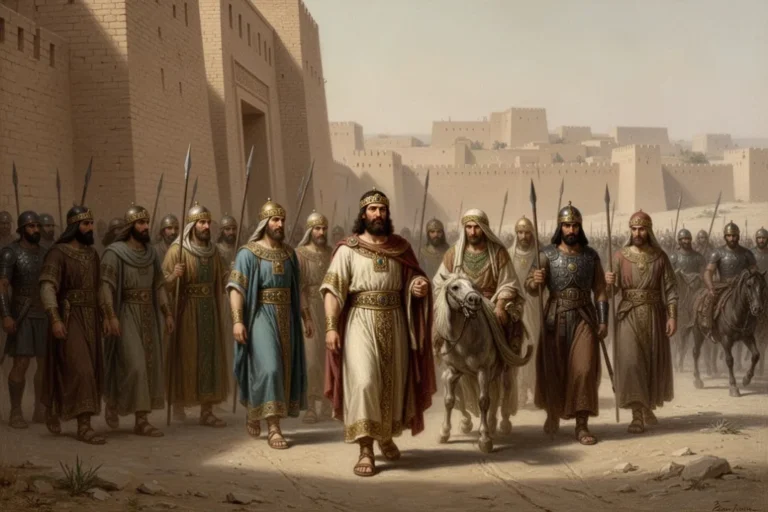
Jeconiah’s removal occurred during Babylon’s campaign against Judah. According to 2 Kings 24, Nebuchadnezzar’s forces surrounded Jerusalem, and Jeconiah went out to meet the Babylonian king. He, his mother, his officials, and his servants surrendered.
This surrender did not preserve the kingdom. Nebuchadnezzar carried Jeconiah away to Babylon and took valuable objects from the Jerusalem temple and royal palace. He also deported members of the ruling class, military leaders, skilled workers, and other people whose abilities could strengthen Babylon.
The event was more than a change of rulers. It was a major stage in the Babylonian exile, the forced displacement of Judah’s population that eventually led to the destruction of Jerusalem and the temple. Babylon placed Jeconiah’s uncle, Mattaniah, on the throne and changed his name to Zedekiah.
Jeconiah’s deportation fulfilled the pattern of judgment announced by Israel’s prophets. Jeremiah had repeatedly warned that Babylon would become the instrument of judgment against Judah. The political disaster was therefore interpreted by the biblical writers as both an international defeat and a consequence of covenant unfaithfulness.
Jeremiah’s messages concerning Jeconiah are especially severe. In Jeremiah 22, the prophet criticizes the royal house and portrays Coniah as a rejected vessel, someone whose claim to rule will not succeed. The passage emphasizes that no descendant of Jeconiah will sit successfully on David’s throne in the same way as earlier kings.
This language should be read in its historical setting. It addresses the continuation of royal rule, not a claim that Jeconiah had no children at all. Later biblical genealogies name his descendants, and 1 Chronicles 3 lists several sons associated with him.
The judgment also reflects the failures of Judah’s kings as a group. The biblical writers do not present Jeconiah’s exile as an isolated accident. His father Jehoiakim had resisted prophetic warnings, and the royal leadership had repeatedly failed to protect the vulnerable or remain faithful to God’s covenant.
Babylon defeated Judah and established political control.
Jeconiah surrendered and was taken from Jerusalem.
Members of the royal family and national leadership were deported.
Temple and palace treasures were removed.
Zedekiah was installed as a Babylonian-controlled king.
The account in 2 Chronicles 36 places Jeconiah’s removal within the wider collapse of Judah. It also presents the later destruction of Jerusalem as the result of persistent rebellion rather than one brief political mistake.
What happened to Jeconiah in Babylon
Jeconiah did not disappear from the biblical record after his deportation. For many years he lived in Babylon as a captive king, separated from Jerusalem and deprived of political authority. His situation represented the humiliation of Judah’s royal line.
Yet the final chapter of 2 Kings records an unexpected change. In the thirty-seventh year of Jeconiah’s exile, Evil-merodach, also known as Awel-Marduk, became king of Babylon and released him from prison. The Babylonian king treated him favorably, gave him a place at the royal table, and provided him with regular support.
This was not a restoration of Jeconiah to the throne in Jerusalem. Judah remained under foreign rule, and the Davidic monarchy did not immediately recover. Still, the change from imprisonment to royal favor is significant because it shows that Jeconiah’s story did not end with permanent disgrace.
The biblical account says that Jeconiah received a position above other captive kings who were in Babylon. He exchanged prison clothing for a place of honor and ate regularly in the presence of the Babylonian ruler. The details highlight a controlled but real restoration of dignity.
His release also creates a deliberate contrast with the judgment passages in Jeremiah. The prophetic warnings about the end of Jeconiah’s royal rule remained true: he did not resume the throne in Jerusalem. At the same time, his later treatment in Babylon shows that divine judgment did not mean he was erased from history or denied every form of mercy.
Ancient Babylonian administrative records are often discussed in connection with Jehoiachin. Some cuneiform ration lists mention a Judean king named Yaukin, commonly understood by historians to be Jehoiachin, along with members of his household. These records fit the biblical picture of a deposed Judean king living in Babylon and receiving provisions.
Such records do not tell the entire story of Jeconiah, and they do not replace the biblical accounts. They do, however, show that the setting of a royal Judean exile in Babylon is consistent with surviving ancient evidence.
Restoration does not mean coronation: Jeconiah was released and honored in Babylon, but he was not returned to the throne of Judah. His later favor was personal and royal in character, not a restoration of national independence.
How Jeremiah’s judgment on Jeconiah should be understood
Jeconiah is particularly important because Jeremiah uses him to express a difficult theological question: what happens to God’s promises to David when the royal line experiences judgment?
God’s covenant with David included the promise of a lasting royal line. Yet Jeremiah spoke of Jeconiah in terms that seemed to block his descendants from successful rule. Readers of the Bible have therefore asked whether the Davidic promise was canceled, transferred, or fulfilled in another way.
The language in Jeremiah 22 focuses on royal succession and political authority. The prophet’s statement that Jeconiah should be treated as childless does not require the conclusion that he had no biological children. The passage means that none of his offspring would prosper as the reigning king on David’s throne in Jerusalem under the conditions then being judged.
That interpretation fits the broader biblical record. First Chronicles names Jeconiah’s sons, including Shealtiel and others. Matthew also includes Jeconiah in the genealogy that traces the royal line from David through Solomon.
Another important descendant is Zerubbabel, who appears later as a leader of the returning Jewish community. The genealogies and historical passages connect him with Shealtiel, though the precise family relationship is presented differently in some biblical records. Zerubbabel did not become an independent king, but his leadership gave the Davidic line renewed public importance after the exile.
Haggai 2 uses royal imagery when addressing Zerubbabel, describing him as a signet ring in a message about God’s future purposes. Many readers see this as a deliberate contrast with the rejected signet-ring imagery associated with Jeconiah in Jeremiah. The biblical text does not simply erase the earlier judgment; it presents hope emerging after the period of exile.
The New Testament adds another layer. Matthew 1 includes Jeconiah in the genealogy of Jesus, placing him within the royal line that begins with David and Solomon. Matthew’s genealogy shows that the exile is a major turning point in Israel’s story, not a minor interruption.
Matthew divides the genealogy into major historical periods, including the era from the deportation to Babylon. Jeconiah stands near that transition. His name marks the point at which the royal family moves from ruling in Jerusalem to living under foreign power.
Christians interpret the genealogy in different ways when comparing it with Luke’s genealogy. Some understand Matthew as emphasizing the legal or royal succession through Solomon and Jeconiah, while Luke is often connected with a different branch of the family. The Gospel texts do not provide a detailed explanation of every genealogical difference, so confident claims about each relationship should be made carefully.
Jeconiah’s place in the Bible’s larger story
Jeconiah’s account illustrates how biblical history combines judgment, displacement, and hope. He was not portrayed as a heroic reformer, and his reign did not produce a military rescue or national renewal. Nevertheless, his life remains important because it stands at the center of Judah’s collapse.
Several themes become clearer when his story is read alongside the surrounding kings and prophets.
His reign shows the fragility of political power
Jeconiah inherited a throne that looked prestigious but had little practical security. Judah’s king still lived in Jerusalem and belonged to David’s house, yet Babylon controlled the regional balance of power. A royal title could not prevent surrender, deportation, or the removal of national treasures.
The account challenges the assumption that status guarantees safety. Jeconiah’s lineage gave him significance, but it did not shield him from the consequences of national rebellion or international defeat.
His exile shows that judgment can affect a whole society
The Bible describes the deportation of more than the king. Officials, soldiers, craftsmen, and other residents were taken to Babylon. The exile disrupted families, worship, government, land ownership, and the community’s understanding of its future.
Jeconiah therefore represents more than an individual prisoner. He embodies a nation whose institutions were dismantled and whose people had to live faithfully away from their homeland.
His release shows that judgment is not the last word
The final scene in 2 Kings is deliberately restrained. It does not describe a triumphant return to Jerusalem, but it does record a significant reversal in Jeconiah’s personal circumstances. He is no longer confined and forgotten; he receives food, clothing, and a place of respect.
That detail matters because biblical restoration often begins before every outward condition has changed. The kingdom was not yet rebuilt, but the royal line was not treated as permanently worthless.
His genealogy keeps the Davidic promise in view
Jeconiah appears in Matthew’s genealogy because the exile did not end the biblical interest in David’s house. His inclusion shows both the seriousness of judgment and the persistence of the family line.
For Christian readers, Jeconiah’s place in Matthew points toward the claim that Jesus fulfills the royal hope in a way that differs from ordinary kingship. The Gospel presents Jesus as the Messiah connected to David, while also showing that the story passes through periods of failure, exile, and apparent collapse.
What Jeconiah can teach readers today
Jeconiah’s story invites careful reading rather than simple labeling. He was a king under judgment, but the biblical record does not end by reducing him to his worst moment. His later release demonstrates that a person’s history can include both serious consequences and unexpected mercy.
The account also warns against separating private choices from public responsibility. A king’s conduct affects institutions, families, worship, and the security of an entire people. The prophetic criticism of Judah’s rulers repeatedly connects leadership with justice, faithfulness, and care for those with less power.
His story offers several practical interpretive lessons:
Compare names across books: Jeconiah, Jehoiachin, and Coniah are different forms of one name.
Read prophecy in context: Jeremiah’s language concerns the royal line and successful succession, not necessarily the absence of biological children.
Distinguish personal restoration from national restoration: Jeconiah received honor in Babylon without regaining Judah’s throne.
Notice turning points: His deportation marks the movement from monarchy to exile, while his release anticipates later hope.
Read genealogies as theology as well as ancestry: Matthew uses Jeconiah’s name to connect Jesus with David’s royal story and the exile.
Jeconiah’s life is brief in the historical narrative, but its significance is wide. He links the final kings of Judah with the Babylonian exile, Jeremiah’s warnings with later hope, and the Old Testament royal line with the genealogy presented in Matthew.
The most balanced picture holds these facts together: Jeconiah was judged, deported, and displaced, yet he was later treated with honor and remained part of the story of the Davidic line. His name stands as a reminder that biblical history includes failure without surrendering the possibility of restoration.
Frequently asked questions
Is Jeconiah the same person as Jehoiachin?
Yes. Jeconiah and Jehoiachin are variant forms of the same king’s name, while Coniah is a shorter form used in Jeremiah. He was the son of Jehoiakim and ruled Judah for about three months before Babylon deported him to Babylon.
Did Jeconiah have children?
Yes. Although Jeremiah uses language describing him as childless in relation to royal succession, other biblical passages name his sons. The prophetic statement is best understood as saying that his descendants would not successfully continue his reign on Judah’s throne under the circumstances being judged.
Was Jeconiah ever returned to Jerusalem?
No. Jeconiah was released from prison in Babylon and given a favored position at the Babylonian king’s table, but he was not restored as king of Judah. His release brought personal honor rather than national independence or a return to the Jerusalem throne.
Why does Jeconiah appear in Matthew’s genealogy?
Matthew includes Jeconiah to connect Jesus with David’s royal line and to mark the Babylonian exile as a major stage in Israel’s history. His inclusion shows that the genealogy passes through judgment and displacement while continuing the biblical story of Davidic hope.











Leave a Reply