The veil of Christ: meaning, symbolism, and biblical context
The veil of Christ: meaning, symbolism, and biblical context
Have you ever wondered why Christian teaching connects Jesus with a veil, especially when the New Testament says that the temple curtain was torn after his death? The phrase “the veil of Christ” is not a single formal biblical title, but it describes several closely related ideas: Christ’s human body, the temple curtain separating people from the holiest place, and the spiritual blindness that keeps people from recognizing God’s work.
The central meaning is access. In the Bible, Jesus’ death is presented as opening a way into God’s presence that was previously represented as restricted. The veil therefore points both to what hides God’s glory and to how Christ removes that barrier.
What “the veil of Christ” means in Christian teaching
The most direct reference appears in Hebrews 10:19–20. The passage describes believers as having confidence to enter God’s presence through Jesus and associates the “new and living way” with the veil, which it explains in relation to Christ’s flesh. In other words, Jesus’ humanity is portrayed as the veil through which God’s presence is encountered.
This language does not mean that Jesus’ body was a deceptive covering or that his humanity was unimportant. It emphasizes the mystery that God’s glory was present in a truly human life. During his earthly ministry, Jesus was seen as a man who could be tired, hungry, wounded, and killed, yet Christian faith identifies him as the Son of God.
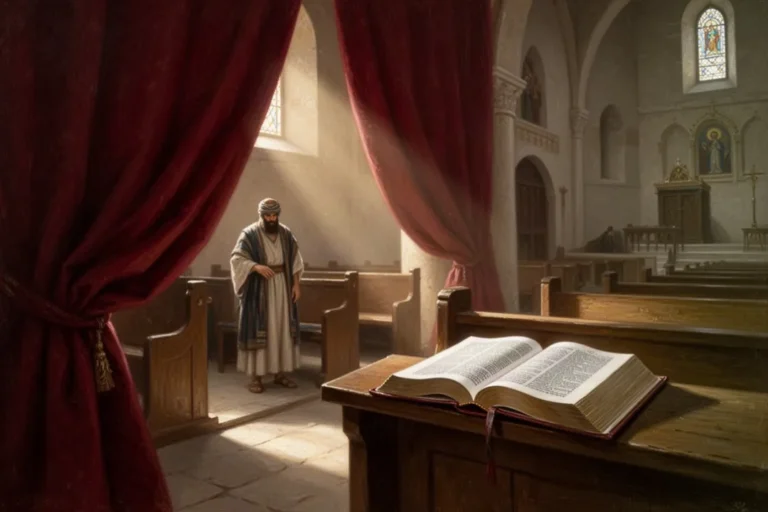
The expression also draws on the veil in the Jerusalem temple. According to the Gospel accounts, the curtain separating the sanctuary’s inner area from the Most Holy Place was torn when Jesus died. That event functions as a sign that the old barrier to God’s presence had been opened through Christ’s sacrifice.
A third connection comes from 2 Corinthians 3–4. Paul describes a veil over the hearts or understanding of some people who hear Scripture but do not perceive its fulfillment in Christ. In this setting, the veil represents spiritual misunderstanding, not a physical curtain. Turning to the Lord is associated with the veil being removed.
Put simply: the veil of Christ can refer to the temple curtain, Christ’s human flesh, or the spiritual blindness that prevents people from seeing God’s glory. The surrounding biblical passage determines which meaning is in view.
How to understand the veil of Christ step by step
Several passages contribute to the idea, so it helps to read the imagery in a deliberate order. The following sequence keeps the symbols connected without treating every use of “veil” as identical.
Begin with the temple veil. In the Old Testament, the tabernacle and later the temple included a curtain that marked off the Most Holy Place. This space represented the special presence of God and was not treated as an ordinary room.
Recognize the restricted access. The priestly system taught Israel that approaching God was holy and serious. The high priest entered the innermost sanctuary under specific covenant arrangements, as described in Leviticus 16.
Read the Gospel accounts of Jesus’ death. Matthew 27:51, Mark 15:38, and Luke 23:45 report that the temple curtain was torn when Jesus died. The accounts present this as a significant sign, not a minor detail.
Connect the sign with Hebrews. Hebrews 9–10 explains Christ’s death using sanctuary and priesthood imagery. Jesus is presented as the mediator of a new covenant and as the one who provides lasting access to God.
Consider the veil as Christ’s flesh. Hebrews 10:20 links the way into God’s presence with Jesus’ flesh. His embodied life and sacrificial death are not obstacles to salvation; they are the means through which salvation is revealed.
Examine the spiritual meaning. Second Corinthians uses veil imagery for a failure to understand or recognize God’s work. Through Christ, that obscurity is removed and people can turn toward the Lord.
This progression prevents a common mistake: assuming that the veil always means the same thing. In one passage it is a temple curtain; in another, it is an image for Christ’s body; elsewhere, it describes unrecognized spiritual truth.
Why the temple curtain matters to the meaning of Christ
The temple veil was connected with the innermost sanctuary, where the ark had been located in the earlier tabernacle tradition. The space symbolized the distinctive holiness and presence of God. The curtain communicated that God was near to Israel, while also showing that sinful humanity could not approach casually or on its own terms.
This was not a statement that God was absent from the rest of creation. Biblical worship involved God’s presence among his people in many ways. The veil instead taught that access to the holy God required mediation, cleansing, sacrifice, and obedience within the covenant system.
The tearing of the curtain at Jesus’ death is therefore rich with meaning. It signals a decisive change in how access to God is understood. The barrier is not removed because holiness no longer matters. It is removed because Christ fulfills the priestly and sacrificial pattern that the temple represented.
The Gospel writers do not give a long explanation immediately after mentioning the torn curtain. The symbolism becomes clearer when read alongside Hebrews. That book contrasts repeated temple sacrifices with Christ’s singular, complete offering and presents Jesus as both high priest and sacrifice.
Every boundary carries a message. A doorway can mark the difference between public and private space; a fence can show where one property ends and another begins. The temple veil worked symbolically as a boundary between ordinary human access and the sanctuary associated with God’s holiness.
Christian interpretation does not usually treat the curtain as magical fabric. Its significance came from what it represented within Israel’s worship. When the curtain is torn at the death of Jesus, the sign announces that the relationship between God and humanity has reached a decisive turning point.
Why Hebrews connects the veil with Jesus’ flesh
Hebrews uses language that can seem puzzling at first: the way through the veil is identified with Christ’s flesh. The point is not that Jesus’ body hid God in a negative sense. Rather, God was encountered through the humanity of Jesus, and the path to reconciliation passed through his embodied suffering and death.
Christian doctrine holds together two truths that can be difficult to express: Jesus is genuinely human, and Jesus reveals God uniquely. The veil image helps preserve that tension. His glory was not always obvious to those who saw him. He looked like a man from an ordinary town, lived among ordinary people, and endured an apparently shameful execution.
At the same time, the New Testament presents his human life as the place where God’s character becomes visible. His compassion, authority, obedience, forgiveness, and self-giving love are not distractions from God’s presence. They are central to how Christians understand God’s presence in Christ.
Hebrews also emphasizes that Jesus’ death was not an accidental tragedy detached from his mission. His suffering is interpreted as the priestly offering through which believers are brought near. This is why the veil imagery is tied to atonement, mediation, and confidence before God.
A helpful distinction: Christ’s humanity is a veil in the sense that divine glory is encountered through a real human life, not because Jesus’ humanity is a false or inferior covering. Christian faith treats his humanity as essential to his saving work.
How the torn veil relates to prayer and worship
One practical implication is that Christians do not need to approach God through a restricted earthly sanctuary or repeat the temple’s sacrificial system. Hebrews describes believers as able to draw near because of Jesus’ priestly work. The emphasis is on confidence grounded in Christ, not confidence based on personal worthiness.
This does not make prayer casual or careless. The same passages that speak about access also speak about reverence, sincerity, perseverance, and a cleansed conscience. Open access means that God invites people to come through Christ; it does not mean that the holiness of God has been reduced.
For personal prayer, the image can correct two opposite errors. You may feel that God is unreachable because of guilt, shame, or failure. Or you may assume that access to God depends on performing well enough. The veil imagery directs attention away from both extremes and toward Jesus as the mediator.
Many Christian traditions use the temple veil symbolically in worship spaces, art, preaching, or Holy Week services. Such uses can help people remember the Gospel accounts, but the physical decoration is not itself the spiritual reality. The central claim is that Christ opens access to God.
What the veil means in 2 Corinthians
Second Corinthians 3 uses a different but related image. Paul discusses Moses’ veil and the difficulty some hearers have in recognizing the meaning of Scripture. The veil represents a form of spiritual dullness or hardened perception: people can hear the words while failing to see what they reveal about God’s purposes.
Paul then connects the removal of the veil with turning to the Lord. The idea is not that all intellectual questions instantly disappear. It is that a person’s relationship to God changes the way Scripture is perceived. Christ becomes the interpretive center, and the reader can see the continuity between God’s earlier covenant work and the Gospel.
Later in the same letter, Paul describes the Gospel as veiled to those who are perishing because they do not perceive its truth. He also says that God shines light into human hearts to give knowledge of divine glory through Christ. This develops the image from a covered face to a darkened inner understanding.
That use of “veil” should not be confused with the temple curtain. Both images involve limited access or obscured understanding, but one is primarily a sanctuary symbol and the other concerns perception. Together, they show that the Gospel addresses both the barrier between humanity and God and the human inability to recognize God’s revelation.
Spiritual blindness is not the same as honest doubt
The biblical image of a veil should not be used to dismiss every person who has questions. Scripture includes people who ask difficult questions, express grief, or need time to understand. Honest doubt and spiritual blindness are not automatically identical.
In its context, the image concerns a failure to perceive the significance of God’s work, especially when pride, resistance, or hardened allegiance prevents recognition. Applying it carefully means avoiding quick judgments about another person’s motives. Christians can explain the symbol faithfully without labeling every disagreement as rebellion.
How the veil connects with the incarnation
The veil of Christ can also be understood through the Christian teaching of the incarnation: the Son of God took on human nature. This doctrine says that God’s self-revelation is not limited to ideas, laws, or visions. In Jesus, God’s character is disclosed through a human life.
That disclosure is both clear and hidden. Jesus teaches, heals, welcomes outsiders, confronts hypocrisy, and announces God’s kingdom. Yet many people in the Gospel narratives do not recognize who he is. His ordinary appearance and lowly circumstances form part of the “veiling” of glory.
The transfiguration accounts in Matthew 17, Mark 9, and Luke 9 provide a striking contrast. Jesus’ glory is briefly revealed to selected disciples, while his regular ministry continues in the conditions of ordinary human life. The event does not suggest that he becomes divine only at that moment. It shows, symbolically, what is usually concealed becoming visible.
The cross intensifies the paradox. If people expect divine glory to appear through power, triumph, and public honor, Jesus’ crucifixion seems to contradict those expectations. Christian theology instead sees the cross as the place where divine love, justice, obedience, and mercy are revealed through suffering.
What Christians can learn from the veil imagery
The first lesson is that access to God is a gift. The temple system taught that God is holy, while the torn curtain and Hebrews teach that Christ provides the way to approach. Prayer is not a performance intended to persuade a reluctant deity.
The second lesson is that God’s presence may not always be recognized by appearance. Jesus’ humanity concealed as much as it revealed to those who judged by social status, outward power, or expected religious forms. Christians therefore need humility when deciding where God is at work.
The third lesson concerns Scripture. A person can read biblical words without grasping their purpose. The veil image encourages readers to seek not merely information but transformation of understanding through Christ, prayer, repentance, and faithful practice.
The fourth lesson is that spiritual access does not eliminate reverence. The New Testament combines boldness with holy fear. Believers are invited to draw near, but they are not invited to remake God according to their preferences.
When you feel distant from God: remember that Christian access rests on Christ’s work rather than your emotional condition.
When you feel spiritually confused: read the relevant passage in context and ask how it points to God’s character and Christ’s mission.
When you judge appearances: remember that the veil image warns against assuming that glory always looks powerful or impressive.
When you approach prayer: combine confidence with reverence, honesty, and willingness to be changed.
When you explain the symbol: distinguish the temple curtain, Christ’s flesh, and spiritual blindness instead of blending them into one vague idea.
Common misunderstandings about the veil of Christ
It is not the name of a separate object in the Bible
Some readers search for a particular artifact called “the veil of Christ.” The Bible does not present a universally recognized object by that exact title. The phrase is a theological expression built from several passages, especially Hebrews and the Gospel accounts of the torn temple curtain.
It does not mean Jesus was only pretending to be human
The veil language in Hebrews does not support the idea that Jesus’ humanity was an illusion. The New Testament repeatedly presents him as genuinely born, physically vulnerable, capable of suffering, and truly dead. His humanity is central to Christian claims about redemption, not a temporary disguise.
It does not mean God was previously unwilling to hear anyone
The Old Testament includes prayers, forgiveness, covenant relationship, and many examples of people calling on God. The restricted temple access communicated holiness and mediation; it did not mean that God had no relationship with humanity. The New Testament describes Christ as bringing these themes to their fulfillment.
It does not mean every veil in Christian art has the same symbolism
Artists and churches may use veils to represent mystery, mourning, holiness, hidden glory, or the temple curtain. Those meanings can be appropriate in context, but an artistic symbol should not be treated as a direct biblical command. Scripture and tradition use imagery with more than one layer.
How to study the veil of Christ in the Bible
A careful study works best when you read passages in their literary and historical settings. Start with the temple instructions and priestly rituals, then compare the Gospel reports of Jesus’ death with Hebrews’ explanation of priesthood and sacrifice. Finally, read Paul’s discussion of veiling and unveiling in 2 Corinthians.
Read Exodus 26 and 36 for the tabernacle curtain and the structure of the sanctuary.
Read Leviticus 16 for the Day of Atonement and the high priest’s restricted approach to the Most Holy Place.
Read Matthew 27, Mark 15, and Luke 23 for the accounts of the temple curtain being torn at Jesus’ death.
Read Hebrews 8–10 for the new covenant, Christ’s priesthood, and access to God through his sacrifice.
Read 2 Corinthians 3–4 for the spiritual meaning of a veil over understanding and the revelation of God’s glory in Christ.
Compare the passages carefully and ask which kind of veil each writer is discussing.
As you study, pay attention to repeated ideas: holiness, mediation, sacrifice, access, revelation, and transformation. These themes explain why the veil image continues to matter even when Christians are not discussing a physical curtain.
What the veil of Christ means for Christian faith today
At its heart, the veil of Christ expresses the Christian claim that God is both holy and approachable through Jesus. The temple curtain represents the seriousness of the barrier between sinful humanity and divine holiness. Its tearing represents the new access established through Christ’s death and resurrection.
The image of Christ’s flesh adds a second dimension. God’s glory is not encountered by bypassing Jesus’ humanity but through it. The life, suffering, death, and risen identity of Jesus are the means by which Christians say that God has made himself known.
The veil over human understanding adds a third dimension. Even when revelation is present, people may fail to recognize it. Christian faith therefore includes an appeal for opened understanding: not merely seeing religious information, but recognizing God’s character and responding to Christ.
These meanings belong together without being identical. The temple veil shows restricted access; Christ’s flesh shows divine glory revealed through humanity; spiritual veiling shows the difficulty of recognizing that revelation. Taken together, they present Jesus as the one through whom the barrier is crossed, God is made known, and the heart is invited to see.
Frequently asked questions
Is “the veil of Christ” an exact phrase from the Bible?
Not usually as a single formal expression. The phrase is a theological shorthand drawn from Hebrews 10, where the way into God’s presence is associated with Christ’s flesh, and from the Gospel accounts of the temple curtain being torn at his death. It can also include Paul’s imagery of a veil covering spiritual understanding in 2 Corinthians 3–4.
Did the temple veil literally become Jesus?
No. The temple curtain and Jesus’ body are connected through symbolism and theological interpretation, not physical identity. The curtain represented restricted access to the sanctuary, while Hebrews uses the veil as an image for Christ’s flesh and his sacrificial death. The relationship is one of fulfillment: Jesus accomplishes what the sanctuary system represented.
Why was the temple curtain torn when Jesus died?
The Gospel accounts present the torn curtain as a sign connected with Jesus’ death. It signifies that the barrier represented by the sanctuary system has been overcome through Christ’s sacrifice. Hebrews develops this meaning by describing Jesus as the mediator who provides lasting access to God, while still affirming God’s holiness and the need for reverence.
Does the veil symbolize mystery in Christian art?
It can. Christian artists may use a veil to represent hidden glory, holiness, mourning, or the temple curtain. Those meanings depend on the setting and the artist’s purpose. The biblical symbolism most directly concerns restricted access to God, revelation through Christ’s humanity, and spiritual understanding that is opened through turning to the Lord.



Leave a Reply