Have you seen a bishop carrying a curved staff during a procession and wondered what it means? That staff is usually called a crosier, or crozier. It is a ceremonial pastoral staff used mainly by bishops and certain abbots as a visible sign of spiritual care, leadership, and responsibility.
The crosier is more than a formal accessory. Its shape recalls a shepherd’s staff, connecting Christian leadership with the image of a shepherd caring for a flock. The person who carries it is symbolically reminded to guide, protect, and serve the people entrusted to their care.
A crosier is a tall, decorated staff associated with a bishop’s pastoral office. It is commonly made from wood, metal, or a combination of materials, and many examples include a curved top that forms a spiral, hook, or other ornamental shape.
The word appears in two common spellings: crosier and crozier. Both refer to the same general object. In American English, “crosier” is widely used, while “crozier” is also familiar in religious, historical, and British contexts. The word is sometimes linked with the idea of a cross, although the object’s form developed primarily from a shepherd’s staff rather than from the shape of a simple cross.
In church settings, the crosier can be called a pastoral staff. That term emphasizes its purpose: it represents the bishop’s duty to teach, govern, and care for a local church. A crosier may be carried during a procession, held during a liturgical service, or displayed near the bishop’s seat.
Basic definition: A crosier is a ceremonial pastoral staff, usually carried by a bishop or certain abbot, that symbolizes spiritual guidance and shepherd-like care.
Why bishops carry a crosier
The central meaning of a crosier comes from the shepherd metaphor found throughout Christian tradition. Shepherds use a staff to steady themselves, guide animals, protect the flock, and retrieve an animal that has wandered. The crosier brings those responsibilities into the public symbolism of church leadership.
A bishop’s role is not limited to presiding over ceremonies. In many Christian traditions, a bishop is responsible for teaching the faith, overseeing congregations and clergy, administering church life, and offering pastoral care. The staff therefore represents a form of servant leadership, not personal status alone.
The curved end has often been understood as a reminder that a pastor should be ready to draw people back toward the community. Some explanations also associate the staff’s pointed or lower end with correction or discipline, while its curved upper end suggests compassion and guidance. These interpretations vary by tradition and period, so the crosier does not have one universally fixed symbolic code.
The staff also makes the bishop’s role visible to the congregation. During a procession, the crosier identifies the person who has pastoral authority. When the bishop sets it aside, the action can signal that the staff is a liturgical symbol rather than a personal possession or badge of rank.
How the crosier reflects the image of the shepherd
Christian writers have long described church leaders as shepherds and their communities as flocks. This imagery appears in biblical passages such as Psalm 23, John 10, and 1 Peter 5. Rather than reproducing those passages, their shared message can be summarized this way: genuine leadership involves care, protection, guidance, and willingness to serve.
The crosier makes that abstract idea tangible. A bishop holding a staff shaped like a shepherd’s tool is visually associated with watchfulness and responsibility. The symbol can also challenge leaders to remember that authority exists for the good of others.
Different viewers may notice different aspects of the image. One person may see the staff as a sign of protection; another may focus on the bishop’s teaching role. A congregation may also understand it through its own denomination’s traditions, local customs, and liturgical explanations.
The staff’s meaning is therefore best understood alongside the ceremony in which it appears. A crosier carried during an episcopal procession, held during a blessing, or placed beside a bishop’s chair communicates related ideas, but the surrounding actions give each use its particular emphasis.
How crosiers developed in Christian history
The crosier developed gradually rather than appearing in one universally agreed form at a single moment. Early Christian leaders drew on several existing symbols of authority and care, including the staff associated with a shepherd or traveler. Over time, church communities gave the staff a more specific ceremonial role.
In Western Christianity, the pastoral staff became especially associated with bishops and abbots. As church offices and liturgical ceremonies became more structured, the staff gained a recognized place in processions and public worship. Its design also became more elaborate, particularly when made for a cathedral, monastery, or prominent church leader.
Medieval craftsmen produced crosiers from precious metals, carved wood, ivory, and other valuable materials. Some included enamel work, gemstones, religious figures, animals, foliage, or scenes connected with the life of Christ and the saints. The decoration could express the identity of the person who used the staff or the institution that commissioned it.
Many Western crosiers developed a volute, a curled ornamental top resembling a spiral. The center of the curl might contain a cross, a small figure, a plant form, or another symbolic design. Some staffs were made in sections so that the upper portion could be detached, transported, or preserved separately.
The history of the crosier also reflects changing ideas about church authority. A richly decorated staff could communicate the importance of a bishop’s office, while its shepherd form continued to point toward humility and care. That combination of dignity and service remains one of the object’s defining tensions.
What the different parts of a crosier represent
Although designs vary widely, a traditional crosier can be understood as having several main parts. Each part contributes to the staff’s appearance and practical use, even when a church does not assign a formal meaning to every detail.
The shaft: The long central section gives the staff its height and makes it visible during a procession. It may be plain, carved, painted, or decorated with metal bands.
The crook or volute: The curved upper section recalls the hook of a shepherd’s staff. It is often the most recognizable feature of a Western crosier.
The finial: Some staffs end in a cross, figure, animal, plant, or other ornament at the top or center of the curve.
The ferrule: A metal fitting at the lower end can protect the shaft from wear and provide stability when the staff rests on the floor.
The joints: Large ceremonial staffs may separate into multiple pieces for storage or transport.
Not every crosier includes all these features. A modern pastoral staff may have a simple metal or wooden design, while a historic example may be highly detailed. The materials and decoration often depend on the church’s resources, artistic tradition, and intended use.
How a crosier differs from similar religious staffs
Several religious staffs can look similar, so names may be confusing when you are viewing a photograph, museum object, or worship service. The most useful clues are who carries the staff, what shape it has, and which tradition uses it.
Crosier or crozier: Usually a bishop’s or abbot’s pastoral staff, especially in Western Christian traditions. It often has a curved or spiral top.
Pastoral staff: A broader term for a staff symbolizing pastoral leadership. Many people use it interchangeably with crosier.
Papal ferula: The pope’s ceremonial staff, traditionally distinct from a bishop’s curved crosier. It often has a cross or cruciform design rather than a shepherd’s crook.
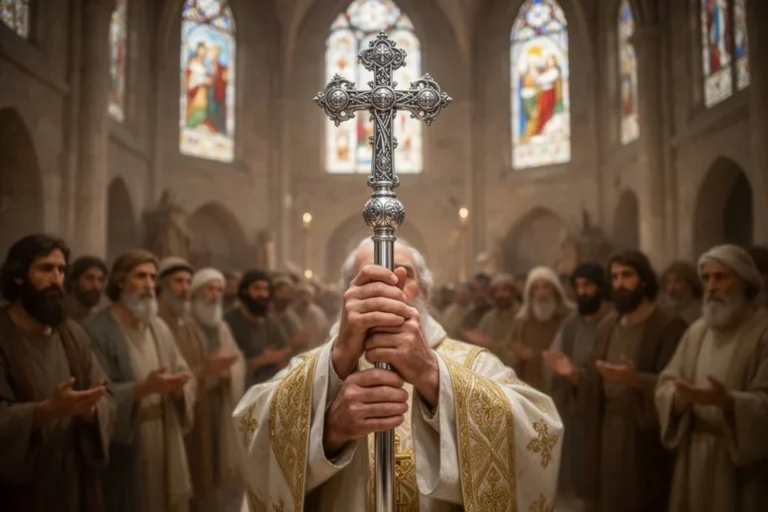
Processional cross: A cross mounted on a tall pole and carried at the head of a procession. Unlike a crosier, it is usually intended to display the cross prominently rather than represent a pastoral staff.
Orthodox pastoral staff: Eastern Christian bishops and other senior clergy may use a staff with distinctive forms, including designs influenced by the Greek letter tau or paired serpents.
Abbatial staff: An abbot or abbess may carry a pastoral staff in some traditions. Its design and the circumstances of its use can differ from those associated with a diocesan bishop.
These distinctions are helpful, but terminology is not perfectly consistent. A church may call its object a pastoral staff even when visitors would call it a crosier. Local custom, denominational practice, and translation also affect the words people choose.
How bishops use a crosier during worship
A crosier is commonly used in processions and formal worship. The bishop may carry it while entering or leaving a church, during a procession through the congregation, or at another point when the bishop’s pastoral role is being represented publicly.
In many Western liturgical settings, the bishop holds the crosier with the curved end facing outward. This convention is often explained as a sign that the bishop’s pastoral care is directed toward the people. Some traditions, however, have different customs or do not prescribe one fixed direction.
The staff may be held during a blessing or while the bishop addresses the congregation, although the exact practice depends on the denomination and service. It may also be handed to an assistant, placed beside the bishop’s chair, or set aside at certain moments.
Some churches limit the use of a crosier to particular liturgical occasions. Others use it regularly at major services, installations, confirmations, ordinations, funerals, or episcopal visits. A bishop may also use a simpler staff for travel or outdoor events instead of a large ceremonial example.
Context matters: A crosier’s meaning comes from both its design and its use. The same staff may represent pastoral care in one setting and the historical authority of an office in another.
How crosier designs vary across churches and regions
There is no single correct appearance for a crosier. One may be a restrained wooden staff with a modest curve, while another may be covered with silverwork and detailed religious imagery. Both can fulfill the same symbolic purpose.
Western European crosiers often feature the curled volute associated with a shepherd’s crook. Some historical examples have a small figure or scene inside the curve. Others use foliage, geometric patterns, or a cross. The shaft may be plain, fluted, jeweled, or decorated with panels.
In Eastern Christian traditions, episcopal staffs can have very different silhouettes. Some include a crossbar or a pair of serpent forms, drawing on long-standing symbolism and regional artistic practice. Calling every such staff a Western-style crosier can blur meaningful differences between traditions.
Modern churches often favor portability and durability. Lightweight metal, laminated wood, resin, and other contemporary materials can reduce the burden of carrying a tall staff. A simple design may also fit a church that prefers understated worship or wants to avoid an association between pastoral leadership and wealth.
Art historians and museum visitors should avoid identifying a staff from shape alone. The object’s date, maker, inscription, ownership history, and religious context can be just as important as its visible form.
What to look for when identifying a crosier
If you encounter an unfamiliar staff in a church, museum, painting, or photograph, begin with the surrounding context. The person carrying it and the ceremony taking place usually provide more information than decoration by itself.
Identify the person carrying it. A bishop, abbot, or senior Christian leader is more likely to hold a pastoral staff than a lay participant.
Check the top shape. A shepherd-like curve suggests a crosier, while a prominent cross on a pole may indicate a processional cross.
Look for a church setting. A cathedral, monastery, episcopal ceremony, or formal procession can help establish the object’s role.
Notice the materials and ornament. Silverwork, enamel, carving, and religious figures may reveal the staff’s age or institutional importance.
Read the label carefully. Museums may use “pastoral staff,” “crozier,” “crosier,” or a tradition-specific term for a similar object.
Use historical context. The same shape can carry different meanings in Western, Eastern, Anglican, Roman Catholic, or other Christian communities.
Paintings and sculptures can be especially difficult to interpret. Artists sometimes simplify a crosier, exaggerate its curve, or use a staff as a general sign of authority. A saint’s staff may be an attribute connected with that person’s story rather than a literal representation of a bishop’s liturgical crosier.
Common mistakes when discussing a crosier
People often use the word correctly but attach assumptions that do not apply everywhere. A few distinctions prevent the most common errors.
Do not assume every curved staff belongs to a bishop. Abbots, abbesses, and other religious leaders may also use pastoral staffs.
Do not treat “crosier” and “cross” as identical. A crosier can include a cross, but its basic form comes from a shepherd’s staff.
Do not assume the pope always carries a crosier. The papal ferula is traditionally a distinct object, even though casual descriptions may use broader language.
Do not assign one meaning to every ornament. A spiral, animal, saint, or plant may reflect a local artistic tradition rather than a universal symbol.
Do not describe the staff as merely decorative. Its primary significance is connected with pastoral office, leadership, and care.
Do not overlook Eastern Christian forms. Pastoral staffs outside Western traditions may look different and should be described in their own context.
Spelling can also cause confusion. “Crosier” and “crozier” are accepted variants, but a search for one form may produce more results than the other depending on the country, denomination, or collection catalog.
Use crosier when you mean the ceremonial pastoral staff associated with a bishop or certain abbot. For example, you might write that “the bishop carried a silver crosier during the procession” or that “the museum displays a medieval crosier with an enamelled volute.”
Use pastoral staff when you want a broader, less tradition-specific expression. This wording works well when the object’s exact denomination is unknown or when the staff has a modern design that does not resemble the classic curved form.
Use crozier if that spelling matches a source, institution, or regional style. The two spellings should not be treated as separate objects. If clarity matters, you can write “crosier, also spelled crozier” the first time the term appears.
When describing a historical object, be precise about what is known. “A late medieval pastoral staff” is safer than assigning a precise date or owner without documentation. Museum records, church archives, and specialist catalogs may provide details that are not visible from the object itself.
Why the crosier still matters
The crosier remains recognizable because it joins a simple physical image with a substantial idea. A staff can suggest guidance, protection, authority, and care without requiring a long explanation. Its meaning is immediately visible during a public ceremony.
At the same time, the object invites a more demanding understanding of leadership. The shepherd image is not only about having authority over a community; it is about accepting responsibility for its welfare. A crosier therefore symbolizes both the dignity of a bishop’s office and the obligations that accompany it.
Its continued use also preserves connections between present-day worship and centuries of Christian art, ceremony, and institutional history. Whether plain or ornate, wooden or metallic, traditional or modern, the crosier communicates that pastoral leadership is meant to be exercised in service of others.
Frequently asked questions
Is a crosier the same as a crozier?
Yes. “Crosier” and “crozier” are spelling variants for the same type of ceremonial pastoral staff. “Crosier” is common in American English, while “crozier” appears frequently in British usage and in historical or religious sources. Neither spelling refers to a different object.
Can an abbot or abbess carry a crosier?
Yes. In some Christian traditions, abbots and abbesses use pastoral staffs as symbols of their responsibility for a monastic community. The design and ceremonial rules may differ from those governing a diocesan bishop’s staff, so the office and tradition should be identified when describing it.
Why is a bishop’s staff curved at the top?
The curve recalls a shepherd’s crook. It represents the bishop’s responsibility to guide, protect, and care for the Christian community. The curve does not have exactly the same interpretation in every denomination, and some pastoral staffs use a cross, tau shape, or another design instead.
What is the difference between a crosier and a bishop’s mitre?
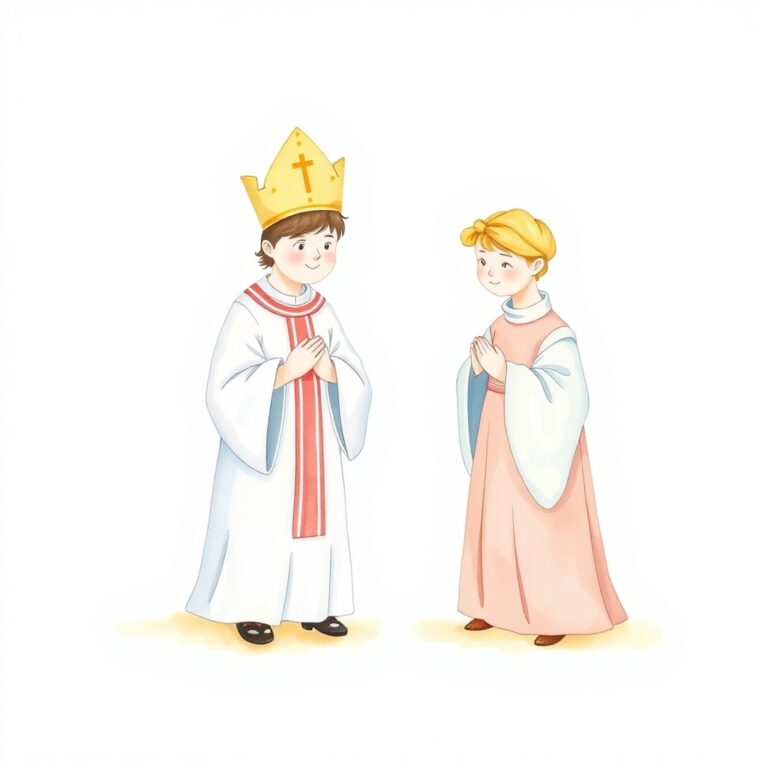
A crosier is a staff, while a mitre is a ceremonial head covering. Both can be associated with bishops and may appear together during formal worship, but they represent different parts of episcopal ceremonial dress and have separate histories and uses.



Leave a Reply