Leah was Jacob’s first wife and the mother of six of his sons, including Judah and Levi.
Her story appears mainly in Genesis 29–31, with important references in chapters 33, 35, and 49. Leah lived within a difficult family arrangement shaped by deception, competition, infertility, and unequal affection. Yet the biblical account does not reduce her to a rejected wife. It presents her as a mother whose family became central to Israel’s history and as a woman who gradually turned her attention from Jacob’s approval toward God.
Leah was the older daughter of Laban, who lived in Paddan-aram. Her younger sister was Rachel, and both women became wives of Jacob. Their father also had an unnamed wife or household matriarch, but Genesis gives very little information about Leah’s mother.
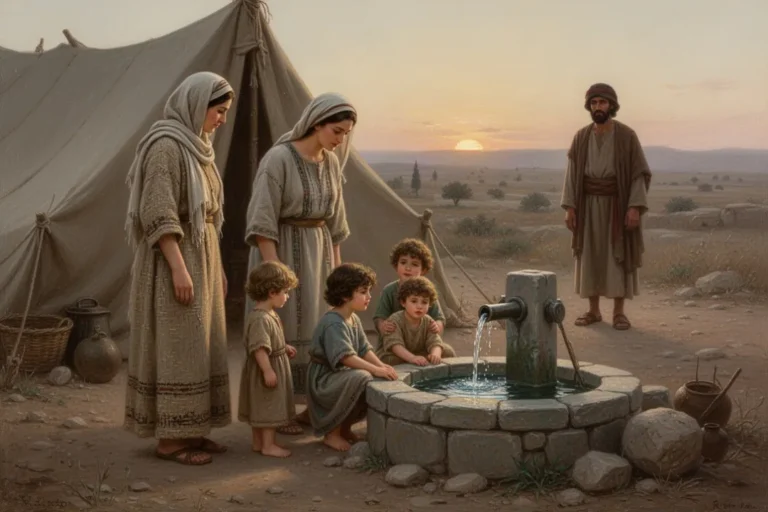
Jacob had traveled to Laban’s household after leaving Canaan. He had been sent away partly because of the danger created by his conflict with his brother Esau. At a well, Jacob met Rachel, Laban’s younger daughter, and fell in love with her. He agreed to work for Laban for seven years in exchange for Rachel’s hand in marriage.
Genesis presents Jacob’s love for Rachel clearly. The years of work seemed short to him because of his affection for her. Leah, by contrast, is introduced in relation to Rachel. The text says that Leah’s eyes were “tender,” a description that has been understood in different ways, including delicate, soft, or less striking than Rachel’s appearance. The passage does not give enough information to determine exactly what the description means.
The contrast between the sisters establishes one of the central tensions in Leah’s life: Rachel was desired by Jacob, while Leah became his wife through circumstances she did not control.
How Laban deceived Jacob with Leah
After Jacob completed the seven years of service, he asked Laban to give him Rachel. Laban held a wedding feast, but after nightfall he brought Leah to Jacob instead. Because of the clothing, darkness, customs, and veil associated with the wedding, Jacob did not realize the substitution until the next morning.
When Jacob confronted Laban, Laban defended his action by appealing to a local custom: the older daughter was not normally married before the younger one. Laban then offered Rachel to Jacob after another week of wedding celebrations, provided Jacob would work for him for another seven years.
Jacob therefore married both Leah and Rachel. Genesis does not portray the arrangement as peaceful or fair. Jacob loved Rachel more than Leah, and the household became a place of emotional rivalry. Laban’s deception echoed Jacob’s own earlier deception of Isaac and Esau, but the text does not present Leah as responsible for either deception.
A crucial distinction: Leah was not the person who tricked Jacob. Laban arranged the substitution, while Leah entered a marriage in which her husband openly preferred her sister.
The biblical narrative also shows that Leah’s position was complicated. She was legally married to Jacob and bore his children, but she did not receive the affection and security that Rachel received. Her pain was not simply about wanting attention; it involved belonging, dignity, and emotional safety within her own household.
What Leah’s first four sons reveal about her hopes
God saw that Leah was unloved, and Genesis says that he enabled her to conceive while Rachel remained childless. The births of Leah’s first four sons are accompanied by explanations of the names she gave them. These explanations offer a window into her changing hopes.
Reuben: Leah associated his name with the Lord seeing her affliction. She hoped that Jacob would love her because she had given him a son.
Simeon: His name is connected with hearing. Leah understood that God had heard that she was unloved.
Levi: His name is connected with being joined or attached. Leah hoped that Jacob would become more closely attached to her after the birth of three sons.
Judah: His name is connected with praise. With Judah’s birth, Leah says she will praise the Lord.
These names show a movement from longing for Jacob’s love toward recognition of God’s care. Leah’s first statement focuses on being seen and winning her husband’s affection. Her second emphasizes that God hears her. Her third still expresses hope for Jacob’s attachment. By the fourth son, her words center on praise rather than Jacob’s response.
This does not mean Leah’s sorrow instantly disappeared. The text does not say that she stopped wanting love or that her marriage became emotionally equal. Instead, her naming of Judah suggests a change in where she located her deepest source of hope.
Leah’s story moves from asking to be chosen by Jacob toward giving praise to God.
Judah’s name later becomes especially significant. The tribe of Judah produced Israel’s royal line, including David, and the New Testament traces Jesus’ family line through Judah. Leah could not have known the later significance of her son’s descendants, but the biblical story places her at the beginning of that line.
Why Leah continued having children while Rachel struggled
Rachel initially remained unable to have children. In the ancient world, infertility could carry social shame and could deeply affect a woman’s position within a household. Rachel responded with distress and asked Jacob for children. Jacob’s answer showed his own frustration, but it did not resolve the conflict.
Rachel then gave her servant Bilhah to Jacob so that Bilhah could bear children on Rachel’s behalf. Bilhah had two sons, Dan and Naphtali. Leah, who had stopped conceiving for a time, responded by giving her servant Zilpah to Jacob. Zilpah bore Gad and Asher.
These arrangements reflect the customs and power structures of the ancient Near Eastern household. They also intensify the competition between the sisters. The births are not described as a healthy solution to the family’s conflict; they become part of a contest over fertility, status, and Jacob’s attention.
Leah later conceived again and bore Issachar, followed by Zebulun. She also had a daughter named Dinah. Genesis does not provide a detailed explanation for each name in the same way it does for Leah’s first four sons, but the births establish Leah as the mother of a large portion of Jacob’s family.
Leah’s children and their place in Israel’s story
Leah had six sons directly: Reuben, Simeon, Levi, Judah, Issachar, and Zebulun. She also had Dinah, her daughter. Through Zilpah, Leah’s servant, Jacob had two additional sons, Gad and Asher, who were counted among the ancestors of the tribes of Israel.
Each of Leah’s sons became associated with a tribe. Their later histories differ, and the Bible does not treat every son as equally exemplary. Still, Leah’s children became foundational to the nation that emerged from Jacob’s family.
Reuben was Jacob’s firstborn son, though he later lost the privileges associated with firstborn status.
Simeon became the ancestor of the tribe of Simeon, which was eventually located within Judah’s territory.
Levi became the ancestor of the Levites, including the priestly family descended from Aaron.
Judah became the ancestor of the royal line associated with David and the tribe connected with Jesus’ human ancestry.
Issachar and Zebulun became ancestors of two additional tribes in Israel.
Leah’s importance, therefore, is not limited to the emotional drama of her marriage. She is also the mother of the sons whose descendants shaped Israel’s worship, leadership, geography, and later biblical expectations about the Messiah.
Levi’s descendants served in the tabernacle and later in the temple, while Judah became associated with kingship. These two lines came from the same woman who had experienced rejection inside her own family. The narrative places spiritual service and royal authority within Leah’s family line.
What the Bible says about Leah’s relationship with Jacob
Genesis uses painful language to describe Jacob’s unequal love. In Genesis 29:30, Jacob loved Rachel more than Leah. In the following verse, the Lord’s concern for Leah is shown through her ability to conceive while Rachel remained childless.
Some translations use language such as “hated” in the next description of Jacob’s relationship with Leah. This wording should be read in context. Biblical language can use comparative terms to describe a strong difference in love or preference, not necessarily a claim that Jacob felt constant personal hostility toward Leah. The central point is that Leah was significantly less loved than Rachel.
Later events show that Jacob did not abandon Leah. She traveled with the household when Jacob left Laban’s land, and she was included in the family as they returned toward Canaan. However, the narrative continues to show Jacob arranging Rachel and her children differently from Leah and her children when he feared an encounter with Esau.
That scene reveals the unequal protection within the household. Jacob placed the servant women and their children first, Leah and her children next, and Rachel and Joseph last. His arrangement may have reflected his desire to protect Rachel most carefully, although the text does not state every motive. Leah’s lower position remained visible.
Leah, Rachel, and the family’s pattern of conflict
The conflict between Leah and Rachel was not created by either sister alone. Laban’s deception, Jacob’s unequal love, cultural expectations about marriage and children, and the importance of fertility all contributed to the rivalry. Each woman acted within a system in which her security depended heavily on childbirth and her husband’s favor.
Genesis 30 describes a tense exchange involving mandrakes, plants that were associated in the ancient world with fertility or desire. Reuben found mandrakes and brought them to Leah. Rachel wanted them, and Leah responded bitterly that Rachel had already taken her husband. Rachel offered Leah a night with Jacob in exchange for the mandrakes, and Leah later conceived Issachar.
The episode is uncomfortable because it shows how far the rivalry had spread. The sisters negotiated access to Jacob, and Jacob participated without resolving the deeper injustice between them. The story does not present the mandrakes as a magical answer or as a model for healthy family life. Instead, it reinforces the atmosphere of competition and emotional scarcity.
At the same time, the Bible gives both women significant places in the formation of Israel. Rachel became the mother of Joseph and Benjamin, while Leah became the mother of six sons and Dinah. Their lives cannot be reduced to a simple contest in which one woman wins and the other loses.
Leah’s place in the return to Canaan
After Jacob had worked for Laban for many years, God instructed him to return to the land of his ancestors. Leah and Rachel both recognized that their father had treated them unfairly. They joined Jacob and the children in leaving Laban’s household.
Leah’s participation matters because it shows that she was not merely a passive figure left behind in Aram. She moved with Jacob’s household and faced the dangers of travel and uncertainty. Her life was tied to the larger promise given to Abraham, Isaac, and Jacob concerning descendants and land.
During the journey, Rachel secretly took her father’s household gods. Leah is not involved in that act. When Laban pursued the family, he searched the tents, but Rachel concealed the objects. The episode creates another contrast between the sisters, while also showing that their relationship existed within the larger conflict between Jacob and Laban.
When Jacob prepared to meet Esau, Leah was included among the family members he arranged. The reunion with Esau was less violent than Jacob feared. The family eventually settled in the land of Canaan, although later events brought further grief and disruption.
Where Leah was buried
Leah died sometime before Jacob’s final words about his family. Genesis 49:31 records that Jacob buried Leah in the cave of Machpelah, the burial place associated with Abraham, Sarah, Isaac, Rebekah, and later Jacob himself.
Jacob’s burial instruction is significant. He specifically identified the cave where Abraham and Sarah were buried, where Isaac and Rebekah were buried, and where he had buried Leah. Rachel, who was dearly loved by Jacob, had been buried near Bethlehem after dying while giving birth to Benjamin. Leah, however, was buried in the ancestral family tomb.
The text does not explain Jacob’s emotions or motives in choosing that burial place. It does establish Leah’s permanent connection to the family’s ancestral land. In death, she rested beside the matriarchs and patriarchs of the covenant family.
Her final biblical setting matters: Leah is remembered not only as Jacob’s less-loved wife but as a matriarch buried in the family tomb and mother of the tribes that shaped Israel.
What Leah’s story can teach about rejection and identity
Leah’s experience speaks to people who feel overlooked, compared with someone else, or valued mainly for what they can provide. Her marriage did not give her the affection she wanted, and her first responses show how deeply she hoped childbirth might change Jacob’s attitude.
The narrative does not shame Leah for wanting to be loved. Her desire for affection was human and understandable. At the same time, the names of her sons show that her identity gradually became less dependent on whether Jacob responded as she hoped.
Leah’s story also cautions against measuring a person’s significance by social visibility. Rachel received Jacob’s stronger affection, but Leah became the mother of more of his sons and the ancestor of Judah and Levi. Being overlooked by one person did not make Leah insignificant.
Her story does not promise that every painful relationship will become fair. Jacob and Leah’s marriage is never described as fully healed. The more careful lesson is that human rejection does not have the authority to define a person’s entire life, family legacy, or relationship with God.
Common mistakes when reading Leah’s story
Blaming Leah for the wedding deception: Genesis identifies Laban as the person who arranged the substitution. Leah was not the architect of Jacob’s mistaken marriage.
Calling Leah unloved by everyone: Jacob loved Rachel more, but the text specifically says that God saw Leah’s affliction. Her human rejection was not divine indifference.
Assuming “tender eyes” means a definite physical disability: The Hebrew description is interpreted in different ways, and the passage does not establish a specific medical condition.
Confusing Leah’s children with Zilpah’s: Leah directly bore six sons and Dinah. Gad and Asher were born to Zilpah, Leah’s servant, though they became part of Jacob’s family and tribal ancestry.
Turning the sisters into simple rivals: Their conflict was intensified by Jacob, Laban, cultural customs, and the pressure surrounding fertility.
Assuming praise erased Leah’s pain: Judah’s naming marks an important shift, but the Bible does not claim that Leah no longer desired love or felt grief.
Practical ways to study Leah in Genesis
Reading Leah’s story carefully requires attention to both the events and the words attached to them. A useful study does not isolate one verse from the family history around it.
Read Genesis 29–30 together. Notice the order of the marriages, the births, the name explanations, and the rivalry between Leah and Rachel.
Track Leah’s spoken hopes. Compare her comments about Reuben, Simeon, Levi, and Judah. They show how her focus changes over time.
Separate actions from motives. The text tells you what Laban, Jacob, Leah, and Rachel did, but it does not explain every inner motive. Avoid treating guesses as facts.
Follow Leah’s sons through the rest of Scripture. Judah and Levi become especially important, while the other tribes also contribute to Israel’s history.
Read the burial references. Genesis 49:29–32 gives Leah a place in the ancestral burial story that should not be overlooked.
Consider the social setting. Marriage customs, fertility, servants, inheritance, and family honor help explain the pressures surrounding the household without excusing its injustices.
It can also help to compare Leah with other biblical women who experienced social vulnerability. The comparison should not erase their differences, but it can show recurring themes: God seeing the overlooked, family conflict producing lasting consequences, and a person’s value exceeding the judgment of a household.
Why Leah remains important in the Bible
Leah matters because her story brings together personal suffering and large-scale biblical history. She was a woman caught in a marriage she did not arrange, competing for affection in a household shaped by deception. Yet she became the mother of a major part of Israel’s tribal family.
Her son Judah connects her to the royal line, and her son Levi connects her to Israel’s priestly and worship traditions. Her descendants included people who carried national leadership, religious service, and the hopes associated with God’s promises.
Leah’s story is also important because the Bible does not hide the emotional costs of polygamous family structures. It shows jealousy, unequal affection, bargaining, grief, and the long consequences of favoritism. Rather than presenting the household as an ideal, Genesis records its wounds honestly.
At the center of Leah’s story is the conviction that God saw the woman whom Jacob overlooked. Her worth was not created by Jacob’s preference, and her legacy was not canceled by the pain of her marriage. Leah’s life became part of the covenant story, and her name remains attached to the family through which Israel emerged.
Frequently asked questions
Was Leah Jacob’s first wife?
Yes. Laban gave Leah to Jacob first, even though Jacob had worked seven years intending to marry Rachel. After the wedding week, Jacob also married Rachel and worked another seven years for Laban. Leah was therefore Jacob’s first wife in the order of marriage, although Rachel was the woman Jacob had originally chosen and loved more.
How many children did Leah have in the Bible?
Leah directly had seven named children: six sons—Reuben, Simeon, Levi, Judah, Issachar, and Zebulun—and one daughter, Dinah. Her servant Zilpah also bore Jacob two sons, Gad and Asher. Those boys were connected with Leah’s household and later with tribes of Israel, but they were not Leah’s biological children.
Was Leah older than Rachel?
Yes. Genesis presents Leah as Laban’s older daughter and Rachel as the younger daughter. Laban used the local custom concerning the older daughter to justify giving Leah to Jacob first. The passage does not give Leah’s age or describe the sisters’ childhood, so details beyond their order in the family should not be assumed.
What is the spiritual meaning of Leah’s name?
The exact meaning and origin of the name Leah are not completely certain. Her biblical significance comes less from the name itself than from her story. Genesis shows God seeing her distress, hearing her pain, and giving her children. Her naming of Judah also associates her experience with praise directed toward God.







Leave a Reply