Judah was Jacob’s fourth son and Leah’s child, but his importance in the Bible reaches far beyond his place in the family line. His descendants became the tribe of Judah, the southern kingdom of Judah, and the people associated with the Jewish identity. The biblical story also connects Judah’s family line with King David and, in the New Testament, with Jesus.
Judah’s life includes serious moral failure, painful family conflict, courageous responsibility, and meaningful change. He first appears as one of Joseph’s brothers, yet he later becomes the brother who offers himself to protect Benjamin. That transformation helps explain why Judah receives such a prominent place in Israel’s story.
The name Judah comes from the Hebrew name Yehudah, commonly connected with the idea of praise or thanksgiving. Leah gave him this name after his birth, as recorded in Genesis 29:35. She had already given birth to Reuben, Simeon, and Levi, and Judah was her fourth son by Jacob.
Leah’s naming of Judah reflects the complicated family situation surrounding Jacob. Jacob loved Rachel, Leah’s sister, more deeply, while Leah experienced rejection within the household. After Judah’s birth, Leah expressed gratitude to God. His name therefore carries both a personal meaning in Leah’s story and a larger theological association with praise.
Judah was the grandson of Isaac and Rebekah and the great-grandson of Abraham and Sarah. His father, Jacob, was later renamed Israel. Judah’s brothers included Joseph and Benjamin, the two sons of Rachel, as well as several other sons born to Leah and the household servants Bilhah and Zilpah.
The central fact: Judah was not the oldest son, but his descendants eventually became Israel’s leading royal tribe, producing David’s dynasty and forming the family line associated with Jesus.
Judah’s part in the conflict over Joseph
Judah is first shown in a morally troubled family story. Joseph, Jacob’s favorite son, received special attention and reported dreams that suggested his family would one day bow before him. His brothers resented him, and their anger grew into a plan to get rid of him.
When the brothers found Joseph in a pit, Reuben tried to prevent his death. Judah then proposed selling Joseph to passing traders rather than killing him. In Genesis 37:26-27, Judah argues that the brothers should profit from Joseph because he was still their brother. The proposal saved Joseph from immediate murder, but it was still a cruel act of betrayal.
Judah’s decision also shows the limits of his early character. He did not rescue Joseph or openly confess the brothers’ actions to Jacob. Instead, the brothers sold Joseph and deceived their father by presenting Joseph’s bloodstained garment. Jacob concluded that a wild animal had killed his son and mourned for many years.
The story does not treat Judah’s compromise as harmless. Joseph was carried to Egypt, separated from his family, and eventually imprisoned before rising to power under Pharaoh. Although God later used the events to preserve many lives during famine, the brothers remained responsible for the harm they had caused.
What happened between Judah and Tamar
Genesis 38 presents one of the most difficult and significant episodes in Judah’s life: his relationship with Tamar. Judah married and had three sons. His oldest son, Er, died, and Tamar was then connected to the family through the ancient practice in which a widow could be given to a deceased husband’s brother so that the family line might continue.
Judah’s second son, Onan, also died. Judah then told Tamar to remain a widow until his youngest son, Shelah, was old enough. However, Judah did not fulfill his promise. Tamar recognized that she had been denied the family protection and future she had been promised.
Tamar later disguised herself and encountered Judah without his recognizing her. She became pregnant by him. When Judah learned that Tamar was pregnant, he initially demanded that she be punished. Tamar then produced the personal items Judah had left with her and identified him as the father.
Judah responded by admitting that Tamar was more righteous than he was. His confession in Genesis 38:26 is important because he acknowledged his own failure rather than continuing to blame Tamar. The chapter also records that Tamar gave birth to twins, Perez and Zerah. Perez became especially important in the later genealogy of David and Jesus.
This story does not excuse the actions of Judah or Tamar. It shows a family system marked by widowhood, unequal power, broken promises, and concern for inheritance. It also highlights Judah’s first clearly recorded movement toward honest self-recognition. His admission becomes a small but important sign of the change that appears later.
How Judah changed when Benjamin was threatened
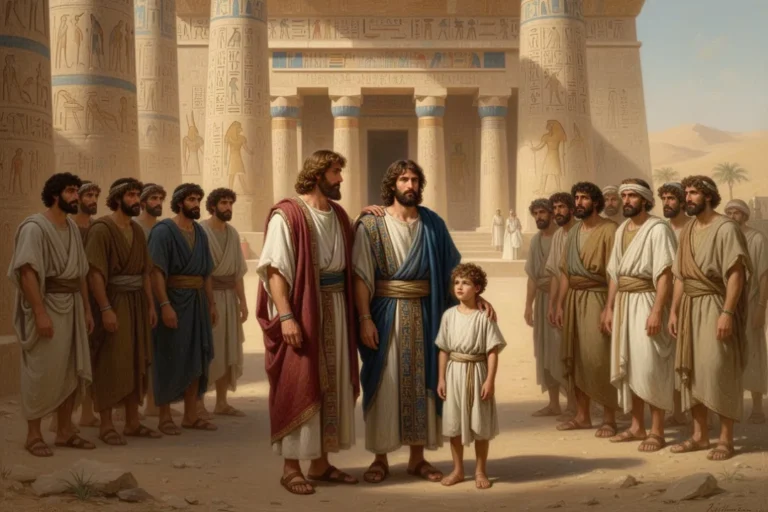
Years after Joseph was sold, a famine affected Canaan and Egypt. Joseph had risen to authority in Egypt, although his brothers did not recognize him. When Jacob’s family needed food, Joseph required them to bring Benjamin, the only other son of Rachel still living with Jacob.
Jacob feared losing Benjamin as he had lost Joseph. Judah personally accepted responsibility for Benjamin’s safety. In Genesis 43:8-9, he urges Jacob to let Benjamin go and promises that he will be accountable for the young man’s return. This is a striking contrast with his earlier role in Joseph’s disappearance.
When Joseph arranged for a silver cup to be found in Benjamin’s sack, Benjamin was threatened with slavery. The brothers could have returned home without him, just as they had once abandoned Joseph. Instead, Judah delivered a long appeal on Benjamin’s behalf, recorded in Genesis 44:18-34.
Judah explained Jacob’s grief and the special place Benjamin held in his father’s life. He then offered himself as a slave in Benjamin’s place. His words and actions show that he now understood the cost of causing his father another loss. He was willing to sacrifice his own freedom rather than repeat the betrayal of Joseph.
This act moves the story toward its emotional turning point. Joseph could no longer conceal his identity and revealed himself to his brothers. The family was eventually reunited, and Jacob’s household moved to Egypt. Judah’s willingness to stand in Benjamin’s place demonstrates the kind of leadership that his earlier behavior lacked.
What Jacob’s blessing says about Judah
Near the end of his life, Jacob gathered his sons and spoke about their future. His words concerning Judah appear in Genesis 49:8-12. Jacob describes Judah as one whom his brothers would praise, and he uses images of a lion, royal authority, prosperity, and obedience from the nations.
The lion imagery became a lasting symbol of Judah. Jacob’s blessing presents Judah as a strong leader among the tribes. It does not mean that every individual from Judah would be virtuous, but it identifies Judah’s family line as one that would receive unusual authority within Israel.
The passage also contains the phrase often translated with terms such as scepter and ruler’s staff. Interpreters have debated the precise meaning of the Hebrew wording and how the passage relates to Israel’s kingship and the Messiah. The broad biblical pattern is clear: Judah becomes associated with royal rule.
Jacob’s blessing also refers to abundance, including wine and fertile land. These images portray Judah as a tribe with strength, stability, and blessing. The blessing builds on Judah’s changed behavior in Egypt and anticipates the later prominence of his descendants.
How Judah became one of Israel’s tribes
After the Israelites left Egypt, the descendants of Judah formed one of the twelve tribes of Israel. The tribe occupied a large area in the southern part of the land. Its territory included the region around Jerusalem, although Jerusalem itself was originally a Jebusite stronghold before David captured it.
Judah’s territory included important places such as Bethlehem and Hebron. Bethlehem became known as David’s hometown, while Hebron was one of the places associated with David’s early reign. The tribe’s location and population gave it considerable influence among the Israelites.
Judah’s tribal identity connected many families to Jacob’s son and to the land assigned to his descendants.
Judah’s territory lay in the southern part of the land of Israel and included several historically important towns.
Judah’s royal connection developed through David and the dynasty that followed him.
Judah’s religious importance grew because Jerusalem and the temple became central to Israel’s worship.
The tribe of Judah was not the only tribe to live in the southern region. Benjamin occupied land near Judah, and members of Levi lived in towns distributed throughout Israel. Still, Judah became the dominant southern tribe and gave its name to the larger political kingdom that emerged later.
David was a descendant of Judah through Perez, the son born to Tamar. The genealogy in Ruth 4 traces the line from Perez to David. This connection is significant because it links the complicated story of Judah and Tamar with Israel’s most famous king.
David began as a shepherd from Bethlehem. He later became king over Judah and eventually over all Israel. Under David, Jerusalem became the political center of the kingdom, and the promise of a lasting royal line became closely associated with his family.
The books of Samuel and Kings often measure later kings against David. Most of those kings came from Judah’s line, even when their reigns were morally or politically weak. The phrase house of David therefore became an important way to describe Judah’s royal dynasty.
Judah’s connection with David also shapes later biblical hope. Prophets looked forward to a future ruler connected with David who would bring justice, restoration, and faithful leadership. Christians understand these expectations as pointing to Jesus, while Jewish interpretation approaches these prophetic passages through its own traditions and expectations.
What the kingdom of Judah was
After Solomon’s reign, the united kingdom divided. The northern tribes formed the kingdom of Israel, while the southern kingdom was generally known as Judah. Judah included the tribes of Judah and Benjamin, along with priests, Levites, and others who moved south because of loyalty to Jerusalem’s temple.
Jerusalem served as Judah’s capital and religious center. The kingdom continued for more than three centuries after the division, though it experienced repeated political crises, foreign pressure, and spiritual reform movements. Kings such as Hezekiah and Josiah are remembered for efforts to return the nation to faithful worship.
Judah was eventually conquered by Babylon. Jerusalem was destroyed, the temple was burned, and many people were taken into exile. The Babylonian exile was a defining catastrophe in the Old Testament, but it did not end the identity of Judah’s people.
After Persia conquered Babylon, some exiles returned and rebuilt the temple and Jerusalem’s walls. The postexilic community was often associated with Judah or the province of Yehud. Over time, terms derived from Judah became connected with the people known in English as Jews.
Do not confuse the terms: Judah can mean Jacob’s son, the tribe descended from him, the southern kingdom, the land or province associated with that kingdom, or the broader people whose identity developed from Judah’s history.
How Judah relates to Jesus in the New Testament
The New Testament presents Jesus as belonging to the tribe of Judah and the line of David. Matthew 1 traces Jesus’ genealogy through David and the kings of Judah, while Luke 3 gives another genealogy connected with David’s family. The two genealogies differ in their arrangement and details, and readers have proposed several explanations for those differences.
The main point is consistent: Jesus is presented as the promised Davidic ruler connected with Judah. Hebrews 7:14 explicitly identifies Jesus with the tribe of Judah. This matters because the New Testament describes his kingship as fulfilling the biblical hope associated with David’s line.
Revelation 5:5 calls Jesus the Lion of the tribe of Judah. Rather than reproducing the full biblical wording, the image can be understood as a title portraying Jesus as the victorious royal descendant promised through Judah. It echoes Jacob’s blessing in Genesis 49 and connects Judah’s ancient symbolism with Christian claims about Jesus.
Judah’s family history also appears in Jesus’ genealogy through Perez and Tamar. Their story shows that the biblical line leading to Jesus includes people whose lives involved shame, irregular family circumstances, moral failure, and repentance. The genealogy emphasizes that God’s purposes move through a complicated human history rather than through a flawless family.
Other people and uses of the name Judah
The Bible contains more than one person named Judah. The best-known Judah is Jacob’s son, but the name appears in later genealogies and family records. Context is necessary before deciding which Judah a passage means.
Judah, Jacob’s son: the central figure in Genesis and ancestor of the tribe of Judah.
Judah, the tribe: the descendants and tribal community associated with Jacob’s son.
Judah, the southern kingdom: the political kingdom centered on Jerusalem after Israel divided.
Judah, the postexilic province or people: the community connected with the land and identity of Judah after the exile.
Judah or Judas in the New Testament: several individuals have names related to the same Hebrew tradition, including Judas Iscariot and Jude, but they are not the same person as Jacob’s son.
The New Testament form of the name may appear as Judas or Jude, depending on the person and English translation. Judas Iscariot was one of Jesus’ twelve disciples who betrayed him, while Jude is traditionally associated with the short New Testament letter bearing that name. Neither should be confused with Judah, the son of Jacob.
In books included in some Christian biblical traditions, Judah Maccabee is another important figure. He led a Jewish revolt against Seleucid rule in the second century BC and is described in 1 and 2 Maccabees. Those books are accepted as Scripture in Catholic and Orthodox traditions but are not included in the Jewish Bible or most Protestant Bibles.
Practical ways to read Judah’s story accurately
Judah’s story can be misunderstood when readers focus on only one scene. Genesis gives a longer portrait: Judah begins with compromise and deception, but later accepts responsibility and acts sacrificially. The following habits help keep the interpretation grounded in the biblical text.
Separate Judah the person from Judah the kingdom. Genesis 37 concerns Jacob’s son, while later historical books may refer to the southern kingdom.
Read Genesis 37, 38, 43, and 44 together. These chapters show Judah’s behavior before and after his major change.
Do not call Judah the oldest brother. Reuben was the firstborn. Judah became prominent through later leadership and the royal line, not birth order.
Do not describe Judah as the brother who rescued Joseph. Judah prevented Joseph’s immediate killing but promoted his sale. His later offer to replace Benjamin is a different and more sacrificial action.
Recognize Tamar’s role. Judah’s story cannot be understood fairly if Tamar is treated only as a source of scandal. Genesis also exposes Judah’s broken promise and records his admission of guilt.
Use the right genealogy references. Ruth 4 connects Perez to David, while Matthew 1 and Luke 3 connect Jesus with David’s line in different genealogical presentations.
Distinguish Judah from Judas. Similar names can refer to different people, especially in English translations of the New Testament.
These distinctions also prevent a common theological mistake: treating Judah’s later prominence as proof that he was always the most faithful brother. The biblical account is more demanding and more realistic. Judah’s status emerges alongside a record of wrongdoing, responsibility, confession, and changed conduct.
What Judah teaches about responsibility and redemption
Judah’s significance is not based only on ancestry. His story gives a vivid example of how a person’s later choices can differ from earlier failures. He once participated in Joseph’s abandonment, then later stood between Benjamin and slavery at the cost of his own freedom.
His confession before Tamar matters because he admits that he judged her while ignoring his own conduct. His speech before Joseph matters because he accepts responsibility for Benjamin and recognizes the effect another loss would have on Jacob. In both scenes, Judah moves closer to truthful accountability.
The Bible does not erase Judah’s earlier wrongdoing. Joseph’s suffering remains real, and Tamar’s vulnerability remains part of the story. Yet the narrative shows that guilt does not have to be the final description of a person’s life. Judah becomes a leader through actions that protect another person rather than through claims of power.
His legacy combines family history, tribal identity, kingship, exile, and hope. From Judah came the tribe that produced David, the kingdom that preserved Jerusalem’s central role, and the line that the New Testament identifies with Jesus. The man whose name began as Leah’s expression of praise became the ancestor behind one of the Bible’s most influential symbols: the Lion of Judah.
Frequently asked questions
Was Judah the oldest son of Jacob?
No. Reuben was Jacob’s oldest son, followed by Simeon and Levi. Judah was Jacob’s fourth son and the fourth son born to Leah. Even though he was not firstborn, Judah eventually became prominent because his descendants formed the royal tribe and because he showed leadership during the crisis involving Benjamin.
Did Judah sell Joseph into slavery?
Judah proposed selling Joseph to passing traders instead of allowing the brothers to kill him. The other brothers accepted the plan, and Joseph was taken to Egypt. Judah’s action spared Joseph’s life but still involved betrayal. Later, Judah demonstrated significant change by offering himself as a substitute when Benjamin was threatened.
Why is Judah called the Lion of Judah?
The expression comes from imagery in Jacob’s blessing of Judah in Genesis 49, where Judah is associated with a lion and royal authority. Revelation 5 applies the title to Jesus, presenting him as the victorious ruler connected with Judah and David’s line. It is a symbolic title, not a claim that Judah himself was literally a lion.
Are Judah and Judas the same name?
They are related forms of a Hebrew name, but they refer to different people in the Bible. Judah was Jacob’s son in Genesis. Judas Iscariot was the disciple who betrayed Jesus, and other New Testament individuals are also called Judas or Jude. The surrounding passage is needed to identify which person is meant.







Leave a Reply