Machpelah Cave: history, faith, and visiting Hebron
Machpelah Cave: history, faith, and visiting Hebron
Machpelah Cave in Hebron is traditionally regarded as the burial place of Abraham, Sarah, Isaac, Rebekah, Jacob, and Leah.
The site is one of the most important places shared by the religious histories of Judaism, Christianity, and Islam. It is also a historic monument shaped by many centuries of construction, worship, political change, and religious devotion. Although the cave itself is not ordinarily open for archaeological inspection, the monumental enclosure built above and around it remains a prominent landmark in Hebron.
Machpelah Cave stands in the center of Hebron, a historic city in the southern West Bank, roughly south of Jerusalem. In Jewish tradition, the site is called Me'arat HaMachpelah, meaning the Cave of the Double or Doubled Caves. Muslims commonly know the sanctuary as the Haram al-Ibrahimi, or the Ibrahimi Mosque, honoring Abraham, who is known in Islam as Ibrahim.
The name refers to the biblical description of the property Abraham purchased for a burial place. Genesis 23 recounts that Abraham bought the cave and adjoining field from Ephron the Hittite after the death of Sarah. The narrative presents the transaction as a formal purchase, witnessed publicly and connected with a defined parcel of land.
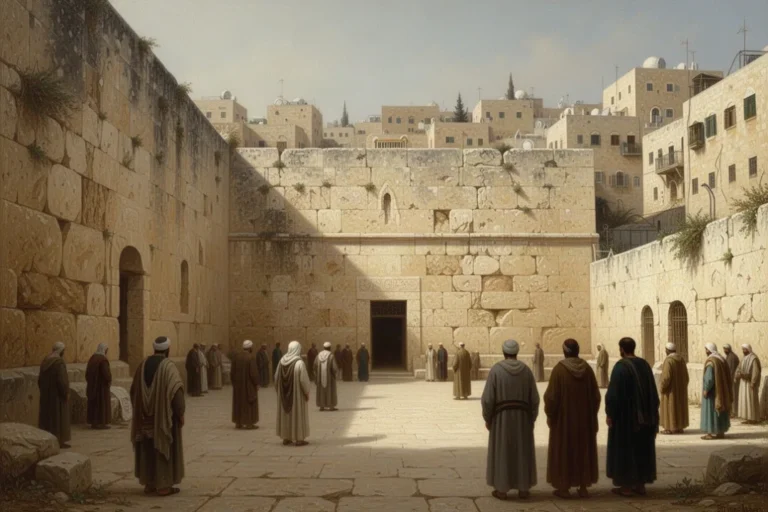
The site is not simply a natural cave visible in an open landscape. Its central feature today is a large, rectangular stone enclosure surrounding the traditional burial area. The structure has massive ashlar masonry, carefully fitted stones, and a design commonly associated with the building program of Herod the Great in the late first century BCE.
The central distinction: The enclosure and its architectural history can be studied directly, while the precise condition, layout, and contents of the underground cave remain largely inaccessible and are described mainly through tradition and historical reports.
Why the cave matters in the Hebrew Bible
Machpelah first becomes central in Genesis 23, when Abraham seeks a permanent burial place for Sarah. Rather than accepting the land as a gift, Abraham insists on purchasing the field, the cave, and the trees within the property. The account emphasizes the public nature of the sale and the legal transfer of the land.
This story gives the cave a special role in biblical memory. It is described as the family burial place of the patriarchal household, not merely as a location associated with one individual. Genesis later identifies the cave as the place where Abraham, Sarah, Isaac, Rebekah, Jacob, and Leah were buried or would be buried.
Jacob’s final instructions in Genesis 49 direct his sons to bury him in the same cave in Canaan. Genesis 50 then describes the burial journey from Egypt to the field near Mamre, another ancient name associated with the Hebron area. These passages connect the site with the family’s ancestral identity and with the biblical idea of return to the land of Canaan.
The biblical account also gives the location several names. Hebron is linked with Mamre, and the surrounding area appears in different forms across biblical narratives. This can make the geography confusing for modern readers, but the traditional identification of Machpelah with the Hebron sanctuary has been maintained for centuries.
Who is traditionally buried at Machpelah Cave
Jewish tradition generally associates the cave with the burial of the following patriarchs and matriarchs:
Abraham, regarded in the Bible as the ancestor of the Israelite people and a foundational figure in Judaism, Christianity, and Islam.
Sarah, Abraham’s wife and the first person whose burial at the cave is described in Genesis.
Isaac, the son of Abraham and Sarah.
Rebekah, Isaac’s wife and the mother of Jacob and Esau.
Jacob, also called Israel, whose twelve sons become ancestors of the tribes of Israel.
Leah, Jacob’s wife and the mother of several of his sons.
Rachel, another wife of Jacob, is traditionally associated with a separate site near Bethlehem rather than Machpelah. The biblical text itself distinguishes her burial place from the cave at Hebron. This is one reason a careful description should say that the cave is connected with six major biblical figures, rather than with every member of the patriarchal family.
The identity of the people buried there is a matter of religious tradition, not a conclusion established by modern excavation. The cave has not been excavated in the manner of an ordinary archaeological tomb, and visitors should distinguish between scriptural accounts, later traditions, historical reports, and independently verified physical evidence.
How Judaism, Christianity, and Islam understand the site
Jewish significance
For Jews, Machpelah is one of the four traditional holy cities or sacred centers associated with the Land of Israel, alongside Jerusalem, Safed, and Tiberias in later Jewish tradition. The site represents the burial place of the patriarchs and matriarchs and therefore has a direct connection with the origins of the Jewish people.
Jewish visitors may come to pray, recite psalms, remember deceased relatives, or connect with the biblical figures associated with the cave. The sanctuary’s rooms and prayer areas include places identified by tradition with Abraham, Sarah, Isaac, Rebekah, Jacob, and Leah. Customs can vary by community, religious calendar, and the area accessible to visitors at a given time.
The cave’s importance also relates to the biblical purchase described in Genesis 23. For many Jews, that account makes Hebron significant not only as a place of burial but also as an early biblical example of a legally acquired ancestral property.
Christian significance
Christianity reads the stories of Abraham, Sarah, Isaac, Rebekah, Jacob, and Leah as part of the history of salvation recorded in the Hebrew Bible, which Christians call the Old Testament. Christian visitors may therefore view the site as a place connected with the patriarchs who occupy a major position in biblical theology.
The New Testament frequently refers to Abraham as an important example of faith, and Christian interpretation often places the patriarchal stories within a longer history leading to Israel, the prophets, and the life of Jesus. The sanctuary itself is not a principal Christian pilgrimage destination in the same way as some churches in Jerusalem or Bethlehem, but its biblical associations give it clear importance for many Christians.
Christian travelers should remember that the building is an active Muslim and Jewish holy place with changing access arrangements. A respectful visit focuses on the site’s religious meaning and architectural history rather than treating it as a neutral tourist attraction.
Islamic significance
In Islam, Abraham is known as Ibrahim, a major prophet and an ancestor connected with the prophetic traditions of the Qur’an. The sanctuary is therefore known as the Ibrahimi Mosque and is an important Islamic religious site. Muslim tradition also associates the area with Abraham and members of his family.
The present complex includes a mosque and Islamic prayer spaces, along with architectural elements that reflect the building’s long and layered history. The term Haram al-Ibrahimi emphasizes the sanctuary’s sacred status rather than only the physical cave below it.
Because the site is shared across religious traditions, its meaning cannot be reduced to one community’s interpretation. Its continuing importance is one reason that visitors need to follow local rules, observe prayer practices, and avoid assuming that every room or feature has the same meaning for all worshippers.
What the stone enclosure reveals about the site’s history
The most visible part of Machpelah is the Herodian enclosure. Its long walls are built from large, finely dressed stones arranged in courses. The architectural style resembles other monumental projects associated with Herod the Great, including the retaining walls of the Temple Mount in Jerusalem. The enclosure is commonly dated to the late first century BCE, although the site’s full building history includes later modifications.
The enclosure does not prove the precise location of the biblical cave by itself. It does, however, show that the location had major religious importance by the Herodian period. A monumental structure on this scale required planning, labor, and resources, suggesting that the site was already treated as an important sacred place.
After the Roman and Byzantine periods, the complex underwent further changes. A church was established at the site during the Byzantine era, reflecting its place in Christian sacred geography. Following the Muslim conquest, the building was adapted for Islamic worship. Later rulers added, changed, or repurposed architectural features as religious and political control shifted.
During the medieval period, the sanctuary became associated with Islamic worship and pilgrimage. The building’s interior contains features from different eras, including prayer spaces, inscriptions, architectural screens, and burial markers connected with local tradition. These layers are part of what makes the complex historically significant.
The site changed again under different political authorities, including the Mamluks and the Ottoman Empire. Ottoman-era elements remain visible in parts of the complex. The building should therefore be understood as a historical palimpsest: a sacred place repeatedly adapted while retaining its central association with the biblical patriarchs.
Accounts of underground chambers beneath the enclosure have circulated for centuries, but direct modern knowledge of the cave is limited. The lower spaces have not been opened and excavated as a normal archaeological site, and access has been restricted at different times by religious and political authorities.
Historical sources describe underground features in varying ways. Some accounts refer to passages, chambers, or openings, while others focus on memorial structures above ground. These reports do not always agree, and later writers sometimes repeated earlier claims without independent verification.
It is reasonable to say that the sanctuary was built around a location identified by tradition as a cave or group of caves. It is not reasonable to claim that archaeology has conclusively confirmed the identity of every burial or revealed a fully documented underground tomb complex. The distinction between traditional identification and archaeological proof is essential.
Stories about secret entrances or dramatic discoveries often appear in popular accounts. Treat them cautiously unless they are supported by reliable historical or archaeological documentation. The mystery surrounding the lower cave is part of the site’s enduring character, but mystery should not be presented as evidence.
How access to Machpelah Cave works today
Machpelah Cave is located in a politically sensitive part of Hebron, where access, security procedures, and movement between areas can change. The sanctuary is used for Jewish and Muslim worship, and particular spaces may be available to one community, the other community, or visitors at different times.
Public access may be affected by religious holidays, prayer schedules, security restrictions, local events, or official decisions. Travelers should confirm current information before going, preferably through a reputable local guide, an official tourism or religious authority, or current local travel guidance.
Visitors may encounter checkpoints or controlled entrances in and around the site. Identification and security screening can be required. Conditions in Hebron can change quickly, so a plan made several days earlier may no longer reflect the situation on the day of a visit.
The sanctuary is not an ordinary museum. Worshippers may be praying, studying, or mourning, and some areas may have strict rules about photography, clothing, noise, and movement. Even when photography is allowed in one section, it may be prohibited in another.
Practical visiting tips and common mistakes
A thoughtful visit begins with preparation rather than improvisation. These practices can help you avoid confusion and show respect for the people who use the sanctuary for worship:
Check access in advance. Confirm opening arrangements, holiday restrictions, security requirements, and which areas are available to visitors.
Carry identification if local guidance advises it, and allow extra time for checkpoints or entry procedures.
Dress modestly. Clothing covering shoulders and knees is a sensible standard for a shared religious sanctuary, though particular prayer areas may have additional expectations.
Follow instructions immediately. Security staff, religious attendants, and local guides may direct visitors to specific entrances or rooms.
Ask before taking photographs. Do not photograph worshippers, prayer services, guards, or restricted areas without permission.
Keep voices low and avoid blocking doorways, memorial markers, prayer spaces, or people moving through the building.
Use a knowledgeable local guide if you want help understanding the architecture, access arrangements, and political geography of Hebron.
Do not touch or climb on historic stonework. The enclosure is a protected religious and historic structure, not an interactive exhibit.
Leave political arguments outside the prayer areas. The site has deep political significance, but confrontational behavior can endanger you and others.
Do not assume that every “tomb” is a verified burial. Many visible markers identify places through longstanding religious tradition.
Common mistakes include arriving without checking whether the desired section is open, treating the cave as a tourist curiosity, and relying on old online descriptions of access. Another mistake is assuming that one community’s name for the site is the only correct name. Using both Machpelah Cave and the Ibrahimi Mosque accurately reflects the sanctuary’s shared religious history.
Respectful planning: Build flexibility into your schedule, wear conservative clothing, and treat changing access rules as part of visiting an active sacred site rather than as an inconvenience to overcome.
How to interpret the site without confusing faith and archaeology
Machpelah Cave is best understood through several kinds of evidence at once. The Hebrew Bible supplies the foundational account of Abraham’s purchase and the family burials. Jewish, Christian, and Muslim traditions preserve and interpret the site’s religious meaning. The enclosure provides substantial architectural evidence for the importance of the location in the Herodian period and afterward.
These forms of knowledge answer different questions. A biblical text can explain why the cave matters to a faith community, while architectural study can help date and analyze the enclosure. Neither automatically proves every later claim about underground chambers or individual burials.
That does not make the site less important. Religious places are often valued because of a combination of sacred narrative, communal memory, ritual practice, and physical continuity. Machpelah’s significance has endured precisely because generations have continued to identify the place with the patriarchs and matriarchs.
For travelers, the most accurate approach is to describe the cave as traditionally identified with the biblical burial place and to distinguish that tradition from what can be directly observed. This wording respects religious belief while maintaining historical precision.
What a visit can teach about Hebron’s wider history
Machpelah Cave cannot be separated completely from Hebron. The city has a long history reaching across biblical, Roman, Byzantine, Islamic, Mamluk, Ottoman, British, Jordanian, Israeli, and Palestinian periods. Its streets and buildings reflect overlapping communities, changing administrations, and contested claims to land and sacred space.
The sanctuary’s architecture shows this layering in physical form. Herodian stonework, later religious adaptations, Islamic furnishings, Christian associations, and modern security arrangements all occupy the same complex. Looking carefully at those layers helps explain why the site is both an archaeological landmark and a living place of worship.
Hebron’s present political circumstances also shape the experience of visiting. Travelers may see barriers, controlled roads, checkpoints, and sharply different patterns of daily life within a relatively compact area. These conditions are not simply background scenery; they influence how residents worship, work, travel, and receive visitors.
A responsible visit therefore combines curiosity with restraint. Learn the site’s biblical and architectural history, listen to more than one community’s account, obey local rules, and avoid reducing a complex city to a single political slogan or a single dramatic story.
Why Machpelah Cave remains significant
Machpelah Cave has survived as a powerful religious landmark because it joins a specific place with the memory of an ancestral family. For Jews, it is associated with the patriarchs and matriarchs of Israel. For Christians, it belongs to the biblical history of Abraham and his descendants. For Muslims, the Ibrahimi Mosque honors Ibrahim and reflects the sanctuary’s place in Islamic tradition.
The visible enclosure also preserves evidence of ancient monumental construction and centuries of religious adaptation. Even without direct access to the cave below, visitors can encounter the powerful connection between scripture, architecture, pilgrimage, and living worship.
The most careful description holds two ideas together: the site is profoundly sacred to millions of people, and many details about the underground cave remain matters of tradition rather than modern archaeological confirmation. That balance offers a clearer understanding of why Machpelah is both historically important and deeply sensitive.
Frequently asked questions
Is Machpelah Cave the same place as the Ibrahimi Mosque?
They refer to the same sacred complex in Hebron, but the names emphasize different traditions. “Machpelah Cave” is common in Jewish and biblical contexts, while “Ibrahimi Mosque” and “Haram al-Ibrahimi” are common Islamic names. The complex includes the traditional burial site below or within the enclosure, along with Jewish and Muslim prayer areas.
Can visitors enter the actual cave?
Ordinary visitors generally cannot explore the underground cave as they would an archaeological site. Access has historically been restricted, and the visible sanctuary is built around the location traditionally identified with the cave. Visitors typically see the enclosure, prayer spaces, memorial features, and architectural details rather than the cave chambers themselves.
Is there archaeological proof that the patriarchs are buried there?
The site’s identification rests primarily on biblical tradition, religious memory, and long historical continuity. The monumental enclosure confirms the location’s ancient importance, but the underground area has not been fully excavated or independently documented. Claims about individual burials should therefore be described as traditional rather than archaeologically proven.
When is the best time to visit Machpelah Cave?
There is no universally reliable date because access can change with Jewish and Muslim holidays, prayer schedules, security conditions, and local events. Check current information shortly before traveling and allow extra time for entry procedures. A knowledgeable local guide can also help you understand which areas are open during your visit.



Leave a Reply