Ur of the Chaldees: Location, history, and biblical meaning
Ur of the Chaldees: Location, history, and biblical meaning
If you have come across “Ur of the Chaldees” in the Bible, you may be wondering whether it was a real place, where it was located, and what happened there. Ur was an important ancient city in southern Mesopotamia, in present-day Iraq, and it is traditionally associated with the early life of Abraham.
The archaeological site is generally identified with Tell el-Muqayyar, near the modern city of Nasiriyah. It stood close to the Euphrates in antiquity and became one of the most influential urban centers of the ancient Near East. Its remains include a famous ziggurat, royal tombs, temples, houses, and evidence of a sophisticated literate society.
Short answer: Ur of the Chaldees was an ancient Mesopotamian city, most likely the city now called Tell el-Muqayyar in southern Iraq. In biblical tradition, Abraham’s family left Ur and traveled toward Canaan, stopping first at Haran.
Ur was located in the broad region known as southern Mesopotamia, the low-lying plain between the Tigris and Euphrates rivers. The site lies in modern Iraq, south of Baghdad and not far from Nasiriyah. In the ancient landscape, waterways connected the city with the Euphrates and with the Persian Gulf, giving Ur access to regional trade.
The city was not situated on the Gulf coast in exactly the same way it would be today. Rivers shifted course, and the coastline changed over thousands of years because of sediment carried downstream. In Ur’s most prosperous periods, however, the city was close enough to major waterways to benefit from maritime and river commerce.
Most archaeologists identify biblical Ur with the ruins at Tell el-Muqayyar. The Arabic name means something like “the mound of pitch,” referring to the dark, hardened material visible in parts of the site. The identification became especially persuasive when excavations revealed a major city dedicated to Nanna, the Mesopotamian moon god, along with royal inscriptions and monumental architecture.
Ur should not be confused with the city of Uruk, another major Mesopotamian center. The names look similar in English, but they refer to different ancient cities. Uruk is associated with the biblical name Erech and with the legendary king Gilgamesh, while Ur was a separate city farther south in the alluvial plain.
Modern location: Near Nasiriyah in southern Iraq.
Ancient region: Sumer, in the southern part of Mesopotamia.
Likely archaeological site: Tell el-Muqayyar.
Important nearby feature: The Euphrates and its ancient channels.
Major religious focus: Worship of Nanna, the moon god.
The phrase “of the Chaldees” comes from the biblical wording rather than from the city’s earliest known name. The Chaldeans became a prominent people in southern Mesopotamia much later than the period usually associated with Abraham. That difference in chronology has led scholars to discuss how the place-name was preserved and transmitted in the biblical text.
What the Bible says about Ur and Abraham
The Bible mentions Ur of the Chaldees in the family history of Abraham. Genesis presents Terah, Abraham’s father, as leaving Ur with Abraham, Sarai, and Lot. The family travels toward the land of Canaan but settles in Haran, where Terah later dies. Abraham then continues his journey after receiving God’s call.
Genesis 11:27–32 gives the family setting, while Genesis 12 describes Abraham’s departure from Haran. Later references, including Genesis 15:7 and Nehemiah 9:7, connect Abraham with Ur. These passages treat Ur as a meaningful point of origin rather than as a minor village.
The biblical narrative does not provide a detailed description of the city. It does not explain Ur’s streets, temples, political system, or industries. Its focus is genealogy, migration, covenant, and faith. Ur matters because leaving it begins a major movement in the story of Abraham and his descendants.
According to the biblical account, Abraham’s family first traveled northward to Haran. That route makes geographical sense if Ur refers to the southern Mesopotamian city identified with Tell el-Muqayyar. A journey from southern Iraq toward northern Syria and then toward Canaan would follow the general pattern of movement along the Fertile Crescent rather than crossing the most difficult desert areas directly.
The Bible also describes Abraham’s family as living among people with different religious practices. Archaeology shows that Ur was a major cult center for Nanna, and religious life shaped nearly every part of the city. The text does not say that Abraham’s personal beliefs were formed in a specific temple, nor does archaeology prove the details of his individual life. It does show that the setting was a complex urban society with powerful religious institutions.
Genesis presents Ur as the place from which Abraham’s family began its movement toward the land of Canaan, while archaeology reveals the wealthy and religiously important city behind the name.
Readers sometimes ask whether the Bible means that Abraham personally lived in Ur for his entire childhood. The text gives only limited information. It places his family there before their migration, but it does not describe how long they stayed, what Abraham did there, or what the city looked like during his lifetime.
The biblical story also does not require every feature of later Ur to have existed during Abraham’s lifetime. The city was occupied for many centuries, and its buildings, rulers, waterways, and population changed repeatedly. Archaeological discoveries help explain the setting, but they should not be used to fill gaps in the narrative with invented details.
How old Ur was and why it became powerful
Ur was inhabited for a very long period, with roots reaching back into prehistoric southern Mesopotamia. It became especially powerful during the Early Dynastic period and reached one of its greatest peaks during the Third Dynasty of Ur, often called Ur III. This dynasty ruled near the end of the third millennium BCE.
Ur III kings controlled a large territory and developed a highly organized state. Administrative tablets record deliveries of grain, livestock, textiles, labor, and other goods. These records show that the government depended on extensive bookkeeping and on institutions capable of managing workers and resources across a broad region.
The city’s success depended partly on its position among waterways and partly on the agricultural potential of southern Mesopotamia. Farmers used irrigation to grow crops in an otherwise hot, dry environment. Canals required maintenance, coordination, and labor, so agriculture was closely tied to government authority and temple administration.
Ur also benefited from long-distance trade. Mesopotamian cities sought materials that were scarce in the southern plain, including stone, timber, and metals. Merchants and officials exchanged local agricultural and manufactured goods for imports from neighboring regions. The evidence does not mean that every resident was wealthy; it shows that Ur was connected to a wide economic network.
Writing played a central role in this system. Most surviving texts are written in cuneiform, a script made by pressing a shaped reed into wet clay. Many tablets are administrative rather than literary. They list rations, workers, animals, fields, contracts, and payments, offering a practical view of how the city operated.
Ur’s history included periods of prosperity, conquest, decline, and rebuilding. The city was not simply “the city of Abraham” frozen at one moment in time. It was a living urban center that changed under Sumerian, Akkadian, Babylonian, and later imperial powers.
Early settlement: Communities occupied the area long before Ur became a major kingdom.
Early Dynastic growth: Ur emerged as a powerful city-state in southern Mesopotamia.
Ur III prominence: The city became the center of a strongly administered kingdom.
Later rebuilding: Babylonian and other rulers restored or altered major parts of the city.
Gradual abandonment: Changing waterways, political shifts, and economic pressures reduced its importance over time.
The dates often assigned to Abraham are debated, and the Bible does not give a universally accepted absolute date for his life. For that reason, it is safer to distinguish between the city’s long archaeological history and the particular period in which Abraham may have lived. The existence of an ancient Ur is firmly established, while the exact relationship between Abraham’s lifetime and specific archaeological layers remains uncertain.
What archaeologists discovered at the site of Ur
The ruins of Ur became widely known through major excavations conducted in the early twentieth century, especially under the direction of Leonard Woolley. The work uncovered monumental buildings, domestic neighborhoods, graves, temples, inscriptions, and thousands of objects. The discoveries demonstrated that Ur had been a wealthy, carefully planned city rather than an isolated settlement.
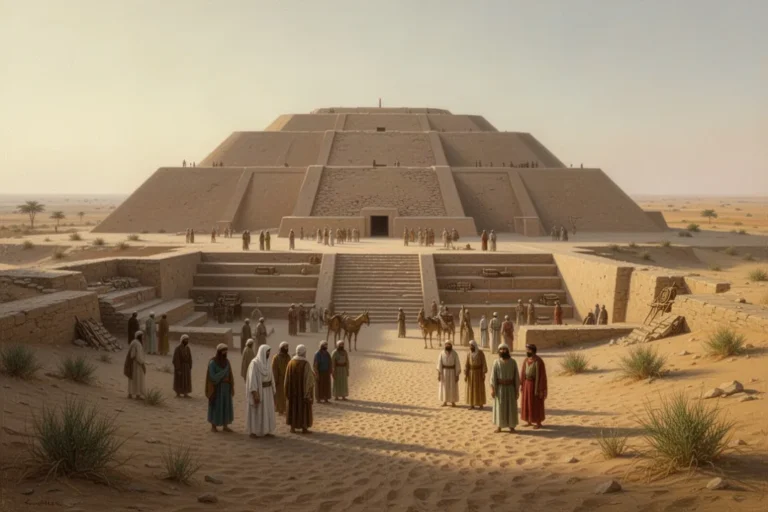
The most recognizable structure is the Great Ziggurat of Ur. A ziggurat was a massive stepped platform associated with a temple complex. The structure at Ur was dedicated to Nanna and was repeatedly repaired and expanded by different rulers. Its surviving lower levels give visitors an impression of the scale of the original monument, although the upper temple and ancient surface have not survived intact.
A ziggurat was not simply a pyramid-shaped tomb. Its purpose was religious and ceremonial, and it formed part of a larger temple precinct. The temple administration could own land, employ workers, distribute food, and participate in the political life of the city. Religious and economic institutions were closely connected in Mesopotamian urban society.
Excavations also revealed the Royal Cemetery, which contained richly furnished graves dating to the third millennium BCE. Objects included gold jewelry, vessels, weapons, musical instruments, beads, and decorated materials. Some graves were associated with evidence of multiple deaths, a disturbing indication of retainer sacrifice or related funerary practices in that period.
The cemetery should not be treated as a picture of ordinary life. Royal burials represent an elite section of society and preserve unusual wealth. Everyday residents lived in houses, worked in fields and workshops, transported goods, served institutions, and raised families. Their lives are visible through less dramatic evidence, including domestic architecture, tools, pottery, and administrative records.
One important discovery was the layout of residential areas. Some houses were built around interior courtyards, with rooms opening onto a central space. Streets and drains reveal attempts to manage movement, waste, and water within a dense urban environment. These remains help explain that ancient cities had practical infrastructure as well as temples and palaces.
Archaeologists have also found evidence of literacy and education. Cuneiform tablets record economic transactions, legal arrangements, school exercises, hymns, and stories. Most people were not scribes, but the number and variety of texts show that writing was essential to administration and that trained specialists had a recognized role.
Archaeology can and cannot do: Excavations can establish Ur’s location, age, buildings, economy, and religious setting. They cannot independently confirm every detail of Abraham’s biography or identify one specific house as his family home.
The site’s preservation is uneven. Mud-brick buildings erode more easily than stone monuments, and ancient builders often reused bricks from earlier structures. Later construction, looting, weather, and changes in groundwater also affected the remains. What visitors see today is therefore a partial record, not the complete ancient city.
Who the Chaldeans were and why the name causes debate
The word Chaldees refers to the Chaldeans, a people known from first-millennium BCE sources in southern Mesopotamia. Chaldean leaders eventually became prominent in the Neo-Babylonian period, including the dynasty associated with Nebuchadnezzar II. This is much later than the time traditionally linked with Abraham.
That chronological gap raises a natural question: if Abraham lived centuries before the Chaldeans became prominent, why does the Bible call the city “Ur of the Chaldees”? Several explanations have been proposed, and no single explanation is accepted by everyone.
Later geographic terminology: A later writer or editor may have used the name familiar to their own audience to identify an older city.
Preserved traditional wording: The phrase may have become part of the received tradition even as political and ethnic names changed.
Different location proposal: Some interpreters have searched for a northern site that would fit the chronological problem differently.
Textual complexity: The wording may reflect the history of how ancient traditions were transmitted and written down.
The presence of the phrase does not prove that the city itself was founded by the Chaldeans. Ur existed long before the Chaldeans appear prominently in historical records. In the same way, a modern place-name can preserve a later label for a location with a much older history.
The traditional southern identification remains strong because the site at Tell el-Muqayyar was unquestionably a major city named Ur and fits the wider Mesopotamian context. It also lies in the region where later Chaldean groups were active. Still, the chronological issue means that careful explanations should distinguish between the ancient city and the later ethnic label.
Some scholars have proposed northern alternatives, including sites whose names may resemble Ur or whose location might fit a different interpretation of the biblical route. These suggestions have not displaced the southern site in mainstream archaeological discussion. The debate continues because the Bible gives no detailed coordinates and because ancient place-names can be difficult to match across languages and periods.
This issue also illustrates a broader principle in historical study: a name in a later text may describe an older place using terminology familiar at the time the text was written or copied. That does not automatically make the tradition false, but it does require attention to language, chronology, and the movement of traditions across generations.
Why Ur of the Chaldees still matters
Ur matters to biblical readers because it is connected with Abraham’s departure, a turning point in the story of Israel and the biblical patriarchs. The city also matters to historians because it provides unusually rich evidence for the development of cities, writing, administration, religion, trade, and social hierarchy in ancient Mesopotamia.
Its significance is not limited to one religious tradition. Ur belongs to the history of Sumer and to the broader heritage of Iraq. The city’s remains preserve the achievements and inequalities of an early urban society: monumental construction beside ordinary housing, sophisticated accounting beside forced labor, and artistic wealth beside evidence of strict social divisions.
Ur also helps explain why biblical references to Mesopotamia are meaningful. The ancient Near East was not a blank backdrop of scattered tents. It contained large cities, temples, irrigation networks, professional scribes, commercial routes, and powerful states. A migration from such a city would have involved family decisions, economic realities, political conditions, and difficult travel across a connected region.
For visitors, researchers, and readers of Genesis, several questions are worth keeping separate:
Was Ur a real city? Yes. Its ruins and written records establish its existence beyond reasonable doubt.
Is Tell el-Muqayyar the biblical Ur? It is the leading identification, although alternative proposals exist.
Was Ur founded by the Chaldeans? No. The city is far older than the Chaldeans’ known prominence.
Does archaeology prove Abraham lived there? No direct archaeological evidence identifies Abraham personally.
Does archaeology illuminate the biblical setting? Yes. It reveals the urban, religious, economic, and geographic world in which the story is placed.
The remains are also part of Iraq’s cultural heritage. The site has suffered from the normal dangers facing ancient monuments, including erosion and human damage, but conservation work has helped protect important structures. Its value comes from the whole landscape, not only from the ziggurat that appears in photographs.
When you read “Ur of the Chaldees,” the most responsible picture is therefore both specific and cautious: a major city in southern Mesopotamia, most likely Tell el-Muqayyar; a place with deep roots in Sumerian history; a city associated in the Bible with Abraham’s family origins; and a name that preserves a later ethnic designation whose chronology remains debated.
Frequently asked questions
Is Ur of the Chaldees the same place as modern Urfa in Turkey?
No. Some historical and religious discussions have proposed northern locations, but the leading archaeological identification is Tell el-Muqayyar in southern Iraq. Modern Urfa, also called Şanlıurfa, is a different city in southeastern Turkey. The two places can become confused because both have associations in later traditions and because ancient place-names were recorded in several languages.
Did Abraham live in the Great Ziggurat of Ur?
No evidence suggests that Abraham lived in the ziggurat. The structure was a monumental religious platform connected with the worship of Nanna, the moon god. It was not a normal residence. The Bible does not identify Abraham’s house or describe his daily life in Ur, so claims linking him personally to a particular building go beyond the available evidence.
What god did people worship at Ur?
Ur’s principal deity was Nanna, the Mesopotamian moon god, also known by the name Sin in later traditions. The city’s major temple complex and ziggurat were dedicated to him. Residents also honored other gods, as was common in Mesopotamian cities. Religious institutions controlled land, labor, food distribution, and ceremonies as well as worship.
Can tourists visit Ur of the Chaldees today?
The archaeological site is in modern Iraq and has been visited by researchers, officials, and travelers, but access can depend on current security conditions, permits, local regulations, and conservation work. Anyone planning a visit should check official Iraqi guidance and reliable travel advisories rather than assuming that routes, opening arrangements, or site services will remain unchanged.




Leave a Reply