Jesus and the woman in the well: Meaning of John 4
Jesus and the woman in the well: Meaning of John 4
Jesus and the woman in the well refers to the meeting recorded in John 4, where Jesus speaks with a Samaritan woman at Jacob’s well. He asks her for a drink, offers her “living water” as a picture of eternal life, and reveals that he is the Messiah. The woman then tells people in her town about Jesus, and many come to believe.
The scene matters because Jesus crosses several boundaries at once: he speaks publicly with a woman, engages a Samaritan, knows the truth about her relationships without rejecting her, and treats her as someone capable of understanding and sharing spiritual truth. The story is not mainly about a well or a mysterious woman’s past. It is about grace meeting a person honestly and turning an ordinary conversation into an encounter with God.
Where the meeting between Jesus and the woman took place
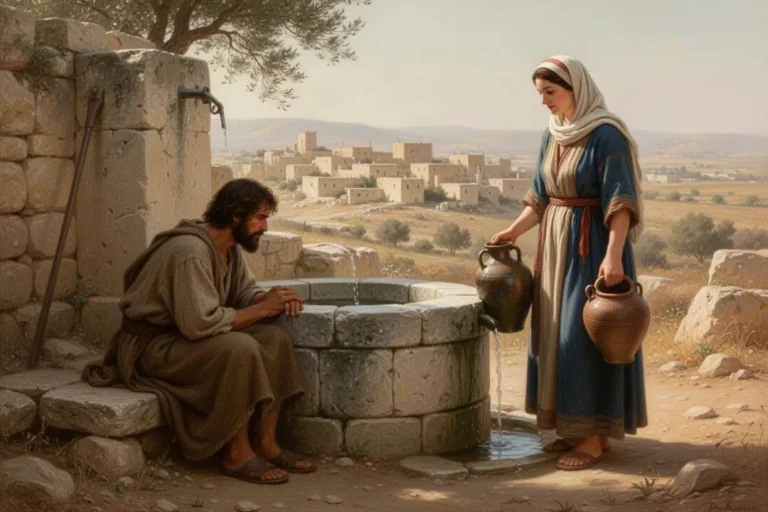
John places the conversation in Samaria, a region between Judea and Galilee. Jesus is traveling through the area and stops near Jacob’s well, associated with the patriarch Jacob. The woman arrives to draw water, while Jesus sits nearby because he is tired from the journey.
John identifies the time as about the sixth hour, commonly understood as around midday. The passage does not explain why she comes at that time or whether she is avoiding other people. Later traditions often portray her as a social outcast, but the text itself does not directly say that. Her marital history is complicated, yet the reason for her water-drawing schedule remains unstated.
Jesus’ disciples have gone into the nearby town to buy food. This leaves Jesus alone with the woman for the central part of the conversation. The setting is simple, but the exchange challenges assumptions about religion, ethnicity, gender, morality, and who may recognize the Messiah.
A careful reading: The Bible never gives the woman’s name, never says she was a prostitute, and never states that she came to the well at noon to avoid the town. Those details should not be presented as if John explicitly reported them.
What happens between Jesus and the woman at the well
The conversation develops in clear stages. Each question and answer moves from a practical subject toward a deeper revelation about Jesus and the kind of worship God seeks.
Jesus asks for a drink. This begins a normal human exchange and shows that Jesus is physically tired and willing to receive help.
The woman questions the request. She is surprised that a Jewish man would ask a Samaritan woman for water, since Jews and Samaritans had longstanding religious and social tensions.
Jesus offers living water. He shifts the conversation from ordinary water to the life God gives through him.
The woman thinks about physical water. She asks how Jesus could obtain this water without a bucket and recognizes that the promise sounds greater than the well itself.
Jesus addresses her personal life. He tells her to call her husband, leading to a conversation about her five former husbands and her current relationship.
The woman raises the question of worship. She asks whether worship should take place on Mount Gerizim, important to Samaritans, or in Jerusalem, central to Jewish worship.
Jesus describes true worship. He teaches that worshipers will honor the Father in spirit and truth rather than treating one sacred location as the entire center of access to God.
Jesus identifies himself. When she speaks of the coming Messiah, Jesus makes clear that he is the one she is expecting.
The woman tells the town. She leaves her water jar, returns to the people, and invites them to meet the man who knew her life and might be the Christ.
The Samaritans come to Jesus. Many believe first because of the woman’s testimony and then because they hear Jesus themselves.
This progression shows how Jesus teaches. He begins with something the woman understands, listens to her response, and then leads the discussion toward spiritual reality. He does not force a speech onto her. He engages her questions and allows the truth to unfold through conversation.
Why Jesus asking a Samaritan woman for water was significant
The request seems ordinary, but it carries social meaning. Jews and Samaritans shared some ancestral and scriptural connections, yet they disagreed about religious history, worship, and communal identity. Their relationship was marked by distrust, and John explicitly highlights the divide.
The woman also points out that Jesus is Jewish and she is a Samaritan. Her surprise may involve both the ethnic divide and the fact that a Jewish man is initiating a public conversation with a woman. The passage does not reduce her to one category. She is a Samaritan, a woman, a person with a complicated relational history, a thoughtful questioner, and eventually a witness.
Jesus does not pretend the division does not exist. He acknowledges the difference between Jewish and Samaritan understanding of salvation, while still speaking to her with respect. His actions show that truth does not require contempt and that a person’s background does not disqualify them from receiving God’s grace.
The request for water also reveals Jesus’ humanity. He is not acting as if physical needs are beneath him. He is tired, thirsty, and dependent on another person’s access to the well. The one who later speaks about living water first meets the woman as someone who needs a drink.
What “living water” means in Jesus’ conversation
In ordinary language, “living water” could refer to moving or flowing water, as opposed to stagnant water in a cistern. The woman initially hears Jesus’ words at that practical level. She notices that he has no bucket and that the well is deep, so she wonders where this water will come from.
Jesus is speaking symbolically about the life God gives. He contrasts water that satisfies thirst temporarily with a spiritual gift that becomes an enduring source within the person who receives it. The image points to renewal, spiritual life, and lasting fellowship with God.
The woman’s question about the well is not foolish. It exposes the gap between physical and spiritual ways of hearing. John’s Gospel often presents people who understand Jesus’ words literally at first, while Jesus is speaking on a deeper level. Her confusion becomes the opening for further explanation.
The living water does not mean that believers will never experience physical thirst, grief, temptation, or hardship. It means that relationship with God is not limited to temporary relief or external religious activity. Jesus offers a life rooted in God that continues to sustain a person beyond changing circumstances.
Practical meaning: The image of living water invites you to ask what you are treating as a permanent source of security when it can only provide temporary relief. Jesus directs the woman from a physical need toward the deeper life God offers.
What Jesus meant when he spoke about the woman’s husbands
After discussing living water, Jesus tells the woman to call her husband. She replies that she has no husband, and Jesus confirms that her answer is accurate while describing her history of five husbands and her present relationship. This is the point at which the conversation becomes deeply personal.
The passage does not give enough information to reconstruct every detail of her life. The five relationships could have involved death, divorce, abandonment, or other circumstances. Jesus identifies the truth of her situation, but John does not explain how each relationship ended. It is therefore unwise to label her simply as immoral or to assume that every failed relationship resulted from her choices.
At the same time, Jesus is not avoiding moral reality. He knows her life and speaks about it directly. His knowledge does not lead to public humiliation or rejection. Instead, it becomes part of the woman’s recognition that Jesus is a prophet and part of her growing understanding of who he is.
This encounter holds together two truths that are often separated. Jesus offers compassion without pretending sin and brokenness do not exist. He offers truth without using a person’s past as a weapon. The woman is neither excused by vague kindness nor condemned to her history.
Her response is also revealing. Rather than ending the conversation, she turns to a theological question about worship. Some readers see this as an attempt to change the subject, but the text does not require that interpretation. She may be moving from Jesus’ knowledge of her personal life to the larger religious question that has shaped her community for generations.
Why the woman asks about Mount Gerizim and Jerusalem
The woman asks Jesus to address the central dispute between Samaritan and Jewish worship. Samaritans associated worship with Mount Gerizim, while Jews regarded Jerusalem as the appointed center. This was not a minor disagreement. It involved sacred history, community identity, and competing claims about how people should approach God.
Jesus answers by saying that the hour is coming when worship will not be defined by access to one mountain. He explains that salvation is connected with the Jewish story, yet he also announces a change in how worship will be understood. The question is no longer simply, “Which location is correct?”
Jesus describes worshipers as those who worship the Father in spirit and truth. This does not mean that physical gatherings, places, or traditions are meaningless. It means that genuine worship is not secured by geography alone. It must arise from a real relationship with God and agree with what God has revealed.
“In spirit” can point to worship empowered by God’s Spirit and offered from the inner person rather than performed as empty ritual. “In truth” can point to sincerity, reality, and worship shaped by the truth revealed in Jesus. Together, the words reject both superficial emotion and merely external religious performance.
The exchange also shows that the woman is capable of serious theological thought. Jesus does not give her a shallow answer because she is a Samaritan or because her personal life is complicated. He discusses one of the central questions of biblical faith with her directly.
How Jesus reveals that he is the Messiah
The woman mentions the coming Messiah, or Christ, who will explain all things. Jesus then makes one of the clearest self-revelations in the Gospel of John. He identifies himself as the expected one she has just mentioned.
This disclosure is striking because it happens in Samaria and in a private conversation with a woman whose community might not have been expected to receive such a revelation first. John presents the moment as deliberate, not accidental. Jesus is not merely allowing the woman to reach her own conclusion. He tells her who he is.
His identity explains the earlier parts of the conversation. The living water comes from the one who gives eternal life. True worship is centered on the revelation of God in Christ. The woman’s personal history is known by the one who offers mercy and truth.
Jesus’ self-revelation also prevents the story from becoming only a lesson about social inclusion. Inclusion matters, but the central claim is theological: the person who meets the woman is the Messiah. The transformation begins with who Jesus is, not merely with the fact that he treats her kindly.
What the woman’s water jar may communicate
When the disciples return, the woman leaves her water jar and goes into the town. John does not explain the action, so the meaning should be stated carefully. On a narrative level, she leaves behind the object she came to use because she is now eager to tell others about Jesus.
The jar can also function as a literary contrast. She came seeking ordinary water and leaves with a message about a different kind of life. The text does not say that she permanently abandoned the jar or that physical water no longer mattered. The image instead emphasizes the urgency of her testimony.
Her words to the townspeople are framed as an invitation to investigate. She refers to a man who told her what she had done and asks whether he might be the Christ. She does not claim to know everything or demand that the people accept her conclusion without meeting Jesus.
That approach gives her testimony credibility within the story. She speaks from personal experience, but she points beyond herself. Her role is not to replace Jesus as the source of truth. It is to bring others into contact with him.
How the Samaritan woman becomes a witness
The woman’s testimony has three noticeable qualities. First, it is personal: Jesus knew facts about her life. Second, it is open-ended: she invites others to consider what those facts mean. Third, it is communal: she returns to the town rather than keeping the encounter private.
John then shows the limits and strength of personal testimony. Many Samaritans believe because of what the woman says. They later ask Jesus to stay with them, listen to him, and tell the woman that their faith now rests on hearing Jesus for themselves.
This does not diminish her role. Her words begin the movement toward belief, while Jesus’ own teaching deepens it. The passage presents a healthy pattern for sharing faith:
Tell what you have genuinely encountered rather than exaggerating your experience.
Point people toward Jesus instead of making yourself the center of attention.
Allow people to examine the claims rather than pressuring them to perform agreement.
Accept that spiritual understanding may develop over time, through listening and continued reflection.
The woman is therefore more than an example of someone rescued from a troubled past. She is also a person Jesus teaches, trusts with revelation, and uses to reach others. Her credibility does not come from having a flawless history. It comes from encountering Jesus and speaking truthfully about that encounter.
What Jesus means by the harvest in Samaria
While the disciples are focused on food, Jesus speaks about food they do not understand. He explains that his nourishment is doing the will of the Father and completing the work he was sent to do. The conversation then turns toward fields ready for harvest.
Within the immediate setting, the harvest language points to people coming from the Samaritan town to meet Jesus. The disciples may have been thinking about crops and ordinary timing, while Jesus directs their attention to people who are ready to hear the good news.
The image communicates urgency without requiring panic. A harvest is a time to recognize that something has become ready and to act appropriately. Jesus is showing the disciples that ministry is already happening in a place they might have overlooked because of ethnic and religious tension.
The Samaritan response challenges narrow expectations about where faith will appear. The disciples went into town to buy food, but the story’s spiritual opportunity is not measured by their shopping task. God is already at work in the conversation between Jesus and a woman beside a well.
Major themes in Jesus’ meeting with the woman
Grace crosses social boundaries
Jesus does not allow ethnic hostility, gender expectations, or religious disagreement to prevent a meaningful conversation. He treats the woman as a serious person before God. His conduct shows that the call to love one’s neighbor cannot be limited to people who share one’s community or reputation.
Truth and compassion belong together
Jesus knows the woman’s history and speaks about it, but he does not reduce her to it. The story rejects both harsh exposure and dishonest reassurance. He brings truth into the open so that grace can address the real person rather than an edited version of her life.
Worship is more than location
The debate about Mount Gerizim and Jerusalem is answered by a broader vision of worship. God is not confined to a single geographic site, and worship cannot be reduced to a public label. It must be grounded in truth and animated by genuine spiritual devotion.
Jesus offers more than temporary relief
The woman arrives with a physical need, but Jesus speaks of a life that reaches deeper than thirst. His promise does not deny ordinary needs. It places them within a larger hope: God can give an enduring source of life that circumstances cannot create or control.
The woman is not introduced as a respected religious leader. Yet Jesus speaks with her, reveals himself to her, and allows her testimony to lead others toward him. Her past is part of the story, but it is not the boundary of what God can do through her.
How to apply the story without misusing it
The encounter invites personal reflection, but application should remain faithful to what John actually says. It is not a license to speculate about another person’s private life or to assume that everyone who comes to church alone is hiding shame. The story calls for humility when interpreting both Scripture and people.
Bring honest questions to Jesus. The woman asks about water, worship, and the Messiah. Her questions do not prevent the conversation; they become part of it.
Do not let a painful past define your entire identity. Jesus knows the truth about the woman, but he does not treat her as permanently disqualified.
Speak with people across real disagreements. Jesus does not erase the differences between Jews and Samaritans, but he refuses to let hostility make conversation impossible.
Practice worship that is sincere and truthful. External habits matter, but they cannot substitute for a heart turned toward God.
Share your testimony without exaggeration. The woman reports what Jesus did and invites others to see for themselves.
Expect God to work in overlooked places. Jesus finds a spiritually significant opportunity in an ordinary stop beside a well.
The story also offers guidance for churches and Christian communities. People should not have to hide their history before they are treated with dignity. At the same time, welcome should not mean avoiding the truth. A community shaped by Jesus makes room for honest conversation, responsible repentance, restored dignity, and meaningful participation.
Common misunderstandings about the woman at the well
One common misunderstanding is that the woman was certainly a prostitute. John does not say this. Jesus’ reference to five husbands and a current man who is not her husband tells readers that her relational situation is unusual or morally complicated, but it does not provide enough evidence to assign a specific occupation or explain every event.
Another misunderstanding is that she was certainly shunned by everyone in her town. The fact that she speaks to people later does not prove either total rejection or complete social acceptance. The text shows that people listen to her and come to Jesus; it does not offer a full biography of her reputation.
A third misunderstanding is that “living water” is merely a promise of material prosperity or constant emotional happiness. Jesus is speaking about life from God, not guaranteeing freedom from hardship. The promise concerns an enduring spiritual source, not a life without physical needs or sorrow.
Some readers also treat the woman’s question about worship as a distraction. Yet John includes it because it reveals the importance of the conflict between Jewish and Samaritan communities and gives Jesus an opportunity to explain true worship. Her theology is not incidental to the meeting.
Finally, the story should not be used to suggest that women can serve only through informal testimony. In this passage, the woman’s public witness is central to the Samaritans’ encounter with Jesus. The text gives her a meaningful role in communicating what she has learned.
Questions to consider when reading John 4
Several questions can help you read the passage carefully and personally:
Where do I see Jesus meeting an ordinary physical need before discussing a spiritual one?
Which assumptions about the woman come from the text, and which come from later tradition?
How does Jesus correct the woman without humiliating her?
What does worship in spirit and truth look like in my daily life?
Am I willing to listen to people whose background or community differs from mine?
Do I point people toward Jesus, or do I expect them to depend on my experience alone?
Read as a whole, the passage moves from thirst to eternal life, from social division to welcome, from personal history to honest truth, and from a private conversation to a community response. Jesus does not ignore the woman’s real life. He meets her there and opens a future larger than the labels attached to her past.
How to explain Jesus and the woman in the well in one sentence
Jesus’ meeting with the Samaritan woman teaches that he offers life from God to people across social and religious boundaries, knows their full story without rejecting them, and calls them to worship in spirit and truth.
Frequently asked questions
Was the woman at the well a prostitute?
The Bible does not say that she was a prostitute. John 4 records that she had five husbands and was living with a man who was not her husband, but it does not explain how those relationships ended or identify her occupation. Calling her a prostitute goes beyond the information in the passage and can obscure the dignity and complexity of her encounter with Jesus.
Why did Jesus speak with a Samaritan woman?
Jesus spoke with her because he was willing to cross social, ethnic, and religious boundaries to bring truth and grace. The conversation also fits John’s presentation of Jesus as the Messiah whose mission reaches beyond one community. Her identity as a Samaritan woman makes the encounter especially significant, but Jesus treats her as a thoughtful person capable of understanding and bearing witness.
What does living water represent?
Living water represents the life God gives through Jesus. The image points to spiritual renewal, lasting fellowship with God, and an inner source that does not depend on temporary circumstances. It is not a promise that believers will never experience physical thirst or hardship. Instead, it describes a deeper kind of life that reaches beyond immediate relief.
What can Christians learn from the woman’s testimony?
Her testimony shows that you can speak honestly about what Jesus has done without pretending to know everything. She invites others to investigate rather than making herself the center of faith. Her story also shows that a complicated past does not automatically disqualify someone from serving God. Personal testimony can open a door, while people continue growing by listening to Jesus themselves.










Leave a Reply