Maon was a town in the hill country of Judah, south of Hebron, and the name also describes the surrounding wilderness in several biblical passages. It is best known from 1 Samuel 23–25, where David hides from Saul near Maon and later encounters Nabal and Abigail.
The Hebrew name is often connected with the idea of a dwelling place or habitation. In the Bible, however, Maon matters less as a word study than as a real location: a high, dry settlement surrounded by rough country, grazing land, ridges and caves. Understanding that setting makes David’s movements and the events involving Nabal much easier to follow.
Maon belonged to the territory assigned to the tribe of Judah. Joshua 15:55 places it among several towns in the hill country, naming Maon alongside Carmel, Ziph and Juttah. These settlements lay south of Hebron in a landscape that rises sharply from the Judean wilderness.
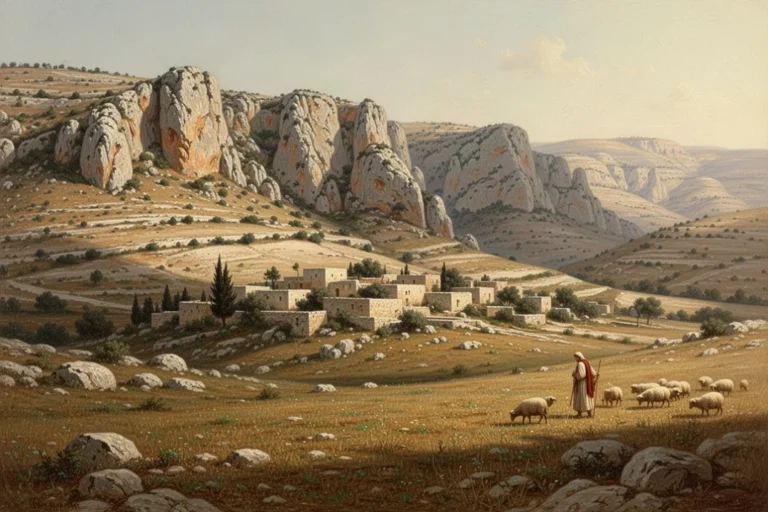
The exact site is not established with complete certainty, but Maon is commonly associated with a location near the modern village of Ma'in, roughly south of Hebron. Archaeologists and geographers have proposed sites in this area because the biblical descriptions fit the region’s position, terrain and relationship to nearby places such as Carmel and Ziph.
Maon should not be imagined as a large urban center. It was more likely a small highland settlement whose residents depended on sheep raising, farming and trade. The surrounding land could support flocks in suitable seasons, while the nearby wilderness offered concealment for people moving through the region.
Location matters: Maon was not simply an abstract “wilderness” in the story of David. It was a settled place in Judah, with a nearby desert region that provided both pasture and hiding places.
How Maon appears in the biblical record
The main references to Maon are concentrated in the historical books of the Old Testament. Each passage contributes something different: Joshua identifies it as a Judahite town, 1 Samuel connects it with David’s flight from Saul, and the account of Nabal and Abigail shows how the area functioned as grazing country.
Joshua 15:55: Maon appears in the list of towns belonging to the hill country of Judah.
1 Samuel 23:24–25: David hides in the wilderness of Maon while Saul pursues him.
1 Samuel 25:1–3: Nabal is described as a wealthy man from Maon whose livestock business was centered at Carmel.
1 Samuel 25: Abigail travels from the Maon-Carmel area to meet David and prevent bloodshed.
These references show that “Maon” can mean the town itself or the broader area around it. Biblical place names often work this way. A town may lend its name to a wilderness, district or group of people connected with that area.
What the name Maon may mean
Maon is related to a Hebrew word associated with a dwelling, habitation or settled abode. The same broader word family can refer to a place where someone lives or takes refuge. That association is especially interesting because David’s story near Maon involves hiding, movement and temporary shelter.
The name’s possible meaning should not be treated as a complete interpretation of every event there. Biblical place names sometimes preserve older descriptions, local traditions or geographical features, and the original significance may not have been obvious to later readers.
A careful reading therefore holds two ideas together. Maon was a physical location with a particular place in Judah, and its name may suggest dwelling or habitation. The geography provides the historical setting; the name offers a possible linguistic connection, but it does not replace the narrative details.
How to trace Maon through the Bible step by step
You can understand the references to Maon by reading them in a simple sequence. Start with the town list in Joshua, then move to David’s flight from Saul, and finally read the account of Nabal and Abigail.
Begin with Joshua 15:55. Notice Maon’s position among towns in the hill country of Judah. This establishes its tribal and geographical setting.
Read 1 Samuel 23:14–29. Follow David’s movement through the wilderness, including Ziph and Maon, as Saul searches for him.
Compare “Maon” and “Carmel” in 1 Samuel 25:2–3. Nabal lives in Maon, but his sheep-shearing operation is at Carmel. The two places are close enough to belong to the same local story without being the same town.
Read Abigail’s response in 1 Samuel 25. Her journey shows how people, livestock and resources were connected across this hill-country landscape.
Return to the map. Picture the route between Hebron, Ziph, Maon and Carmel as rugged upland country rather than flat, open terrain.
This approach prevents a common mistake: treating every mention of Maon as though it refers to one identical spot or event. The town, the wilderness and the wider local area are related, but the text uses them in different ways.
Maon in David’s escape from Saul
Maon becomes especially important in 1 Samuel 23, during the period when David is living as a fugitive. Saul is trying to capture him, while David moves through remote parts of Judah with his followers. The text describes David as being in the wilderness of Maon when Saul learns where he is.
The scene is shaped by the area’s terrain. David is not hiding in a royal palace or a fortified city. He is moving through open wilderness, steep ridges and difficult approaches. Saul’s forces close in from one side, creating a serious threat, but the surrounding landscape also gives David routes of escape and places to conceal himself.
The narrative says that David moves toward a rock or crag while Saul’s men approach from another direction. Just as Saul appears ready to surround him, a messenger reports a Philistine attack, forcing Saul to break off the pursuit. The place is then given a name associated with division or escape, commonly translated as Sela-hammahlekoth.
In 1 Samuel 23, the wilderness of Maon becomes the setting for a narrow escape when Saul must abandon his pursuit of David.
The text does not claim that Maon itself performs a miracle. Instead, the location creates the conditions for a tense pursuit, and the sudden change in Saul’s priorities alters the outcome. The geography and the political circumstances work together within the story.
Why the wilderness of Maon mattered to David
The wilderness around Maon was not necessarily a completely empty desert. In biblical geography, “wilderness” can describe uncultivated or sparsely settled land, including pasture areas and rugged zones between towns. Such places could support animals and travelers while still offering limited access and concealment.
For David, this kind of landscape had several advantages. It was difficult for a large force to search quickly, local knowledge mattered, and caves or rocky slopes could provide cover. At the same time, living there was demanding because food, water and reliable information were not guaranteed.
The wilderness also placed David near communities that might help or threaten him. People who owned flocks, managed estates or controlled routes could provide supplies, while Saul’s supporters could report David’s movements. Maon therefore represents both refuge and exposure: it offers space to hide, but it does not make David safe.
Maon, Carmel and Ziph are different places
Readers sometimes confuse Maon with nearby biblical locations. The stories in 1 Samuel mention Ziph, Maon and Carmel close together, but they are not interchangeable names for one settlement.
Ziph was a town and surrounding wilderness in Judah. David hides in the wilderness of Ziph before moving toward Maon.
Maon was a town in the hill country, with a wilderness named after it.
Carmel was another settlement nearby. Nabal’s sheep-shearing activity took place there, although he is identified as a man from Maon.
The name Carmel in this story should also be distinguished from Mount Carmel in northern Israel, the setting of Elijah’s confrontation with the prophets of Baal in 1 Kings 18. The southern Carmel associated with Nabal is a different place in Judah.
Keeping these locations separate clarifies the travel narrative. David may move through a region containing several settlements and wilderness areas, while Nabal’s household uses more than one place for residence and livestock management.
What Nabal’s connection with Maon reveals
In 1 Samuel 25, Nabal is introduced as a wealthy man from Maon. He owns a large number of sheep and goats, and he is at Carmel during sheep shearing. The description gives a practical picture of the local economy: a man could live in one settlement while conducting seasonal work at another nearby location.
Sheep shearing was more than a routine agricultural task. It was a significant social and economic occasion, involving food, workers, guests and celebration. David’s men had protected or at least coexisted with Nabal’s shepherds in the area, and David sends a request for provisions at this time.
Nabal refuses in a dismissive manner. Abigail, his wife, recognizes that the situation is becoming dangerous and quickly prepares food and supplies for David. She meets him on the road, appeals to his conscience and persuades him not to take revenge.
Maon’s role in this account is therefore connected to wealth, livestock and regional relationships. The story is not about an isolated household disconnected from its surroundings. Nabal’s prosperity depends on pastureland, seasonal activity and the movement of people and animals between nearby places.
How Abigail’s actions fit the geography of Maon
Abigail’s response makes more sense when you picture the setting as a working pastoral district. She has access to food and provisions because Nabal’s household is prepared for a large sheep-shearing event. She also understands the urgency of reaching David before his armed group arrives.
Her journey demonstrates that the roads around Maon and Carmel were usable, even though the region was rugged. The landscape could slow an army, but it did not prevent local people from traveling between settlements. Abigail’s knowledge of the area becomes one of the practical strengths she uses to avert violence.
Her speech to David also changes the moral direction of the story. David has been wronged and is preparing to retaliate, but Abigail urges him to avoid carrying out personal vengeance. The setting near Maon provides the immediate stage, while the larger issue is how power should be exercised when a leader feels insulted.
Reading tip: When studying 1 Samuel 25, track both the place names and the people moving between them. Maon explains Nabal’s home, Carmel explains the sheep-shearing event, and the road between them frames Abigail’s intervention.
Maon’s place in the hill country of Judah
The hill country south of Hebron was well suited to small settlements, terraced cultivation and livestock. Its elevation created a cooler environment than the lowlands, while the slopes and valleys produced many different microenvironments. Rainfall was seasonal, so people had to manage water and pasture carefully.
Maon’s location near the edge of the Judean wilderness would have placed it between settled and unsettled zones. That position helped make it useful for herding, but it also exposed residents to travelers, raiders and political conflict. A town in such a location needed local knowledge of springs, paths, grazing areas and defensible ground.
This background explains why the biblical stories connect Maon with both pastoral wealth and military pursuit. The same countryside that supported Nabal’s flocks gave David room to evade Saul. The geography did not determine every event, but it shaped what was possible.
Maon and the meaning of refuge
Because Maon’s name may be related to dwelling or habitation, some readers connect it with the biblical theme of refuge. That connection can be meaningful, especially when David is concealed in the wilderness, but it should be expressed carefully.
The Bible does not present Maon as a formal sanctuary or protected city. It is not one of the designated cities of refuge described in the law. David’s safety there is temporary and uncertain, depending on movement, terrain, loyal companions and circumstances beyond his control.
Maon can still illustrate the difference between a permanent home and a temporary refuge. David has no secure throne or settled residence during this period. He moves through places that offer short-term protection, while his future remains unresolved.
The broader biblical theme is clear without forcing the place name to carry too much meaning. People may find shelter in physical locations, but those places can be fragile. The account in 1 Samuel emphasizes providence, wise action and restraint more directly than it offers a symbolic explanation of Maon’s name.
Maon compared with other biblical place names
Many biblical locations are known through a single event, while Maon appears in several connected references. Comparing it with nearby places helps identify what makes it distinctive.
Maon and Hebron: Hebron was a major and much older center in Judah; Maon was a smaller settlement farther south in the hill country.
Maon and Ziph: Both are associated with David’s wilderness years, but the text treats them as separate locations.
Maon and Carmel: Nabal lives in Maon and has his flocks at Carmel, showing that the names refer to different places within the same region.
Maon and the Negev: Maon lies in the southern hill country near wilderness zones, but it should not automatically be identified with the broader Negev.
These distinctions are useful when reading maps or commentaries. A place can be geographically close to another without being identical to it, and biblical narratives often assume that readers will follow those local relationships.
Several biblical passages mention groups called the Meunites or names that resemble Maon. Their identity and relationship to the town of Maon are not always certain. Similar spellings in English translations can create the impression that every reference describes the same group.
Some passages associate the Meunites with conflicts involving Judah or neighboring regions. Other references may preserve a tradition about people from a place called Maon or a related area. Because the ancient terms and textual traditions are not identical in every passage, the connection should not be stated as settled fact.
For most readers studying Maon, the clearest references remain the ones in Joshua 15 and 1 Samuel 23–25. Those passages clearly treat Maon as a location in Judah. The references to Meunites require separate attention and should be interpreted from their own contexts.
How to study Maon without missing the main point
A productive study of Maon combines a Bible map, the surrounding passages and basic attention to the Hebrew place name. You do not need to resolve every archaeological question to understand the biblical narratives.
Mark the main locations. Find Hebron, Ziph, Maon and Carmel in relation to one another.
Read the full scenes. Do not isolate the place name from David’s movements or Abigail’s conversation with him.
Separate certain facts from proposals. The Bible clearly places Maon in Judah; the exact modern identification remains a matter of scholarly discussion.
Observe the landscape. Notice how hills, wilderness, pasture and narrow routes affect the action.
Compare translations carefully. Spellings such as Maon, Ma'on, Meunites and Maonites may reflect different Hebrew forms or translation choices.
This method keeps the study grounded. It respects the historical setting while avoiding claims that go beyond what the biblical text and available evidence can establish.
What Maon teaches about reading biblical geography
Maon shows why geographical details deserve attention. A short place name can explain why a character is traveling, how livestock are managed, why an army struggles to capture someone and how quickly a warning can reach another person.
It also shows that biblical geography is often relational. Maon is not meaningful only because of its coordinates. Its significance comes from its connection with Judah, Ziph, Carmel, David, Saul, Nabal and Abigail. Place names become easier to remember when you see the network of people and events attached to them.
Most of all, Maon is a setting where danger and ordinary life overlap. David is trying to survive political persecution, while nearby households are managing animals and holding seasonal celebrations. That contrast gives the narrative its human scale and makes the location more than a dot on a map.
Frequently asked questions
Is Maon the same place as Carmel in 1 Samuel 25?
No. Maon and Carmel were separate places in the southern hill country of Judah. Nabal is described as a man from Maon, but his sheep-shearing activity takes place at Carmel. Their close relationship reflects the movement of people and livestock within the same local region, not two names for one settlement.
Did David live permanently in Maon?
No. David was temporarily moving through the wilderness of Maon while fleeing Saul. The area offered rugged terrain and hiding places, but it was not his permanent residence or a designated city of refuge. His life during this period involved repeated movement through several wilderness areas and settlements.
Is Maon mentioned in the New Testament?
Maon is not a prominent New Testament location. Its main biblical references are in the Old Testament, especially Joshua 15 and 1 Samuel 23–25. The New Testament does not develop a separate teaching centered on Maon, so its significance comes primarily from Israel’s history and David’s narratives.
Can you visit the biblical site of Maon today?
The exact location has not been established beyond dispute. A site near modern Ma'in, south of Hebron, is commonly proposed because it fits the biblical geography, but identification remains cautious. Visiting conditions in the area can also change, so travelers should consult current local guidance and reputable archaeological resources.







Leave a Reply