Holy Sepulchre Jerusalem: history and visiting guide
Holy Sepulchre Jerusalem: history and visiting guide
The Church of the Holy Sepulchre in Jerusalem stands at the traditional site of Jesus’ crucifixion, burial, and resurrection. For Christians, it is the most significant pilgrimage destination in the Holy Land, even though its weathered chapels and crowded courtyards may look less grand than many expect.
The church is in Jerusalem’s Christian Quarter, at the western end of the Via Dolorosa. Inside one complex, visitors can approach Calvary, the stone associated with Jesus’ burial preparation, and the tomb traditionally identified as the place where he was laid.
Why the Church of the Holy Sepulchre matters to Christians
The name combines two central Christian ideas: the Holy Sepulchre is the tomb, or burial place, and the church also preserves the traditional location of Golgotha, the hill where Jesus was crucified. These events form the center of Christian belief about Jesus’ death and resurrection.
The site does not present a single open landscape. Jerusalem has developed around it for centuries, and the original rocky terrain is now enclosed by a layered building containing chapels, stairways, altars, columns, mosaics, and small devotional spaces.
Christian tradition places Jesus’ crucifixion and burial outside the walls of Jerusalem in the first century. The area later became part of the city. Supporters of the traditional location point to the fact that the site was associated with an ancient quarry and contained rock-cut tombs, features that fit the general description of a place used for execution and burial outside an earlier city boundary.
That evidence does not provide a modern, conclusive identification of Jesus’ tomb. Other locations have also been proposed, including the Garden Tomb. The Church of the Holy Sepulchre remains the site with the strongest continuous Christian tradition, supported by centuries of worship and pilgrimage.
What visitors should understand: The church is a place of prayer before it is a museum or archaeological attraction. Even when crowds are heavy, people may be keeping vigil, celebrating Mass, lighting candles, or quietly venerating a sacred place.
The building is especially important during Holy Week, when Christians remember Jesus’ final days, crucifixion, and resurrection. Jerusalem’s Easter celebrations follow different calendars among Christian traditions, so services and crowds can vary considerably from one year to another.
How the Holy Sepulchre developed through history
The present church occupies a site that has been reshaped repeatedly. According to early Christian tradition, the Roman emperor Constantine supported the construction of a church at the place identified with Jesus’ death and burial after Christianity gained legal recognition in the Roman Empire.
Construction began in the fourth century after the removal of a Roman sanctuary that had occupied the area. The complex included a large basilica, an open courtyard, and a shrine built around the tomb. The church was dedicated in the fourth century, and pilgrims soon began arriving from across the Christian world.
The original complex was damaged during the Persian capture of Jerusalem in the seventh century. It was repaired, but later suffered further destruction under the Fatimid ruler al-Hakim in the early eleventh century. The damage was extensive, and reconstruction took place in stages rather than restoring every part of Constantine’s original design.
The Crusader conquest of Jerusalem in 1099 led to another major phase of building. In the twelfth century, the separate areas associated with Calvary and the tomb were brought into a more unified church structure. Much of the building’s recognizable medieval character comes from this period, although later fires, earthquakes, repairs, and alterations changed its appearance.
Ottoman authorities governed Jerusalem for centuries, while different Christian communities maintained claims to particular chapels, altars, and ceremonies. The arrangement of rights eventually became known as the Status Quo, a complex system governing access, repairs, processions, and worship in several shared holy places.
Responsibility for the church is divided among several Christian communities rather than held by one denomination. The principal custodians are the Greek Orthodox Church, the Roman Catholic Church through the Franciscan Custody of the Holy Land, and the Armenian Apostolic Church. The Coptic Orthodox, Syriac Orthodox, and Ethiopian Orthodox communities also hold rights and maintain spaces connected with the church.
Because the arrangements are so carefully balanced, even repairs can require agreement among several parties. A ladder leaning beneath a second-story window became a familiar symbol of this situation because it remained in place for generations under the Status Quo. Its presence illustrates how small physical details can carry legal and historical significance within the building.
What you can see inside the church
The Church of the Holy Sepulchre is easier to appreciate when you know what the main areas represent. Signs can be limited, and the interior may feel confusing at first. Allow time to look around rather than treating the church as a quick stop on a walking route.
Calvary and the chapels of the crucifixion
A staircase leads upward from the main entrance to the area traditionally identified as Calvary, also called Golgotha. The space is divided into chapels associated chiefly with Greek Orthodox and Roman Catholic worship, with ornate lamps, icons, mosaics, and polished stone surfaces.
Under the Greek Orthodox altar, a small opening in the floor marks the traditional place of the cross. Pilgrims may kneel and touch the stone or place their hands near it. Depending on the time of day, a line may form quickly, particularly when organized pilgrimage groups arrive.
The Catholic chapel nearby commemorates the nailing of Jesus to the cross according to the traditional Stations of the Cross. The exact arrangement of objects and chapels reflects centuries of devotional practice rather than a modern reconstruction of the crucifixion scene.
The Stone of Anointing
Just inside the entrance, visitors encounter a flat stone commonly known as the Stone of Anointing. Christian tradition associates it with the preparation of Jesus’ body for burial. People often pause here to pray, touch the stone, or place cloth and religious objects upon it.
The present stone and its setting belong to the church’s later history; it should not be treated as a securely identified first-century artifact. Its importance comes from the devotional tradition attached to the location and from the role it plays in the experience of pilgrims.
The Aedicule and the tomb
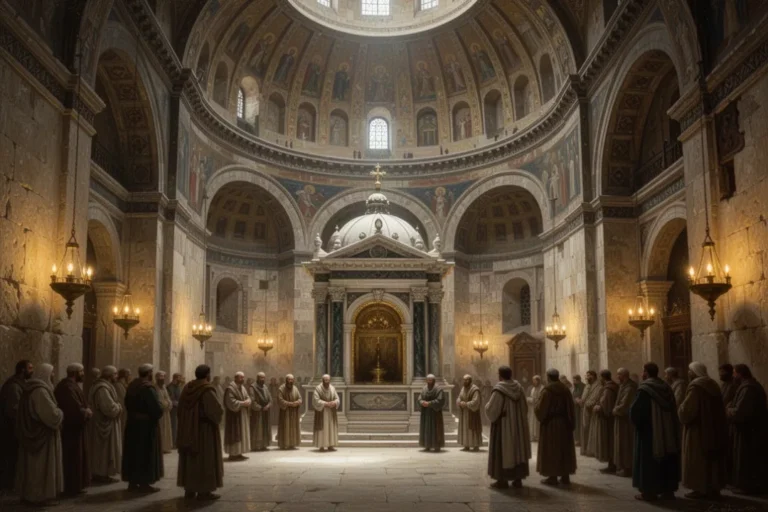
At the center of the Rotunda stands the Aedicule, a small shrine enclosing the traditional tomb of Jesus. The word means a small shrine or structure. Its exterior has been repaired and rebuilt over time, while the interior contains a narrow chamber where visitors may briefly pray.
A marble slab known as the Angel’s Stone is associated with the entrance area of the tomb. A second inner room, often called the Tomb Chamber, marks the place traditionally identified as Jesus’ burial bench. The space is small, so attendants may keep visits moving when many people are waiting.
The shrine underwent major conservation work in the twenty-first century. That work helped stabilize the structure and allowed specialists to examine parts of the tomb area that had long been covered. Conservation does not prove the identity of the tomb, but it has helped preserve one of Christianity’s most important sacred spaces.
Other chapels and devotional spaces
The church contains many additional spaces, including the large Greek Orthodox area known as the katholikon, or central church, and a dome above the Rotunda. Lower chapels and side passages preserve traditions connected with the discovery of the cross, imprisonment, and other events in the Passion narrative.
The Chapel of Saint Helena is traditionally associated with Helena, the mother of Constantine, and the search for the cross. The exact historical details of that tradition developed over time, but the chapel remains an important part of the church’s devotional geography.
Rotunda: the domed area surrounding the Aedicule.
Calvary: the elevated area linked with Jesus’ crucifixion.
Stone of Anointing: the entrance-area stone associated with burial preparation.
Chapel of Saint Helena: a lower chapel connected with the tradition of finding the cross.
Katholikon: the principal Greek Orthodox worship space inside the complex.
How different Christian communities share the church
The Holy Sepulchre is unusual because several ancient Christian communities worship in one building while preserving their own liturgies, chapels, languages, calendars, and customs. The result is sometimes solemn and harmonious, and at other times visibly complicated.
The Greek Orthodox community has a major presence around the central church and the Aedicule. The Roman Catholic presence is represented by the Franciscans, who conduct services and care for designated chapels and devotional traditions. The Armenian Apostolic community maintains important spaces and celebrates its own liturgical schedule.
The Coptic Orthodox, Syriac Orthodox, and Ethiopian Orthodox communities also have established rights in or around the church. Their worship may include distinctive music, incense, vestments, processions, and languages. The Ethiopian community’s most visible spaces are associated with the roof area and adjoining structures, though access arrangements can change.
These communities do not simply share the building informally. The Status Quo regulates matters such as the timing of processions, the use of particular spaces, and responsibility for repairs. A service may begin in one chapel while another tradition is preparing for worship nearby.
The keys to the main door have traditionally been entrusted to a Muslim family, while another Muslim family has historically carried out the opening and closing. This arrangement reflects Jerusalem’s long history of practical cooperation across religious communities. The door-opening ritual is also a reminder that the church’s daily operation has depended on relationships beyond its Christian custodians.
For visitors, shared custody means that the atmosphere can change within minutes. A quiet prayer space may become part of a procession, bells may sound, or clergy may pass through with incense. These activities are not performances arranged for tourists; they are continuing religious practices.
When and how to visit the Holy Sepulchre
The church is in the Old City, near the end of the Via Dolorosa. You can approach it through several narrow streets, but the entrance is easy to miss because it is set within the dense urban fabric rather than facing a broad modern plaza.
Opening hours vary by season and can be affected by religious services, special observances, security measures, or the schedules of the communities that share the building. Check current information locally before setting out, especially if you are traveling for a particular service or hoping to enter the tomb.
Early morning is often a better time for a quieter visit, although services may already be taking place. Late afternoon can also be calmer than the busiest middle hours, but closing times and evening worship schedules differ. During Easter, major feast days, and peak pilgrimage periods, expect lines and limited room inside the principal chapels.
Wear clothing that is respectful for a major place of worship. Covered shoulders and knees are a sensible choice, and comfortable shoes are useful because the Old City streets are uneven. The church contains stairs, narrow passages, and polished stone surfaces that may be difficult for visitors with limited mobility.
Photography rules can differ by area and may be restricted during worship. Ask before taking pictures, turn off flash when permitted, and never photograph people who are praying without their consent. Keep voices low, silence your phone, and avoid blocking a doorway or altar while viewing the architecture.
Check current access information before visiting, particularly on Sundays and major feast days.
Enter quietly and observe what is happening before taking photographs or approaching a chapel.
Visit the main areas in sequence: the Stone of Anointing, Calvary, the Rotunda, and the Aedicule.
Allow extra time for lines at Calvary and the tomb shrine.
Leave space for worshippers and follow instructions from clergy, attendants, or signs.
If you want to attend a service, find out which tradition celebrates it and whether visitors may enter. Some liturgies welcome pilgrims quietly at the edges, while others require more careful observance. A guided tour can provide historical context, but it should not interrupt worship or reduce active religious ceremonies to sightseeing.
Practical tip: Do not plan the church as a short photo stop between other Old City attractions. Crowds, services, queues, and the number of chapels make a meaningful visit take longer than the map suggests.
What the church can and cannot establish historically
The Holy Sepulchre combines archaeology, tradition, and living faith. Archaeological evidence can reveal the character of the land, quarrying, tombs, walls, and later construction. It cannot independently confirm every event preserved in Christian tradition.
The location’s strongest historical argument is continuity. Early Christian writers described a sacred site in Jerusalem associated with Jesus’ tomb, and a major church was built there in the fourth century. The site’s location outside an earlier city wall and its ancient tomb features are also consistent with the general setting described in the Gospels.
At the same time, Jerusalem has experienced destruction, rebuilding, and changes in its street plan. The church has been altered repeatedly, and most visible surfaces are not from the first century. Visitors should resist two opposite assumptions: the building is not a perfectly preserved archaeological scene, but neither is its significance merely the result of a recent invention.
For Christians, the central claim is not that the tomb itself is an object of proof. The tomb is important because it is the place where the resurrection is proclaimed and remembered. The empty tomb tradition appears in the New Testament accounts, including Matthew 28, Mark 16, Luke 24, and John 20; those passages are best read as religious testimony rather than as a modern archaeological report.
That distinction allows visitors with different beliefs to approach the church honestly. A pilgrim may come to worship, a historian may study the building’s development, and a traveler may be interested in Jerusalem’s shared religious heritage. Each perspective can recognize the church’s extraordinary importance without claiming more certainty than the evidence supports.
The Holy Sepulchre’s power also comes from continuity of use. Generations of Christians have prayed at the same traditional locations, maintained lamps and altars, carried out processions, and passed the site’s care from one community to another. Its worn stones, crowded chapels, and layered history are part of what makes the place distinctive.
Frequently asked questions
Is the Church of the Holy Sepulchre the actual tomb of Jesus?
No archaeological evidence can conclusively prove that Jesus was buried there. The church preserves the oldest and most influential Christian tradition identifying the location, and its setting is consistent with an ancient quarry and rock-cut tombs outside an earlier city wall. The site’s importance rests on the combination of historical continuity, religious tradition, and ongoing Christian worship.
How long should I allow for visiting the Holy Sepulchre?
Allow at least one to two hours for a basic visit, and longer if you want to wait for the Aedicule, attend a service, or study the chapels. Lines, processions, and restricted access can change your timing. During Easter and other major feasts, the church may require substantially more time and patience.
Can non-Christians enter the Church of the Holy Sepulchre?
Yes. Visitors of all faiths, as well as those with no religious affiliation, can generally enter when the church is open. Everyone is expected to dress respectfully, speak quietly, and follow instructions during services. Some areas may be temporarily unavailable because of worship or community-specific ceremonies, regardless of a visitor’s religion.
What is the best time of day to visit the Holy Sepulchre?
Early morning is often the best choice for a less crowded visit, although services may already be underway. Late afternoon can also work outside major feast periods. Opening hours and access change with religious calendars, local conditions, and ceremonies, so confirm the schedule shortly before you go rather than relying on an old guidebook.





Leave a Reply