Scala Santa in Rome: History, meaning, and visiting tips
Scala Santa in Rome: History, meaning, and visiting tips
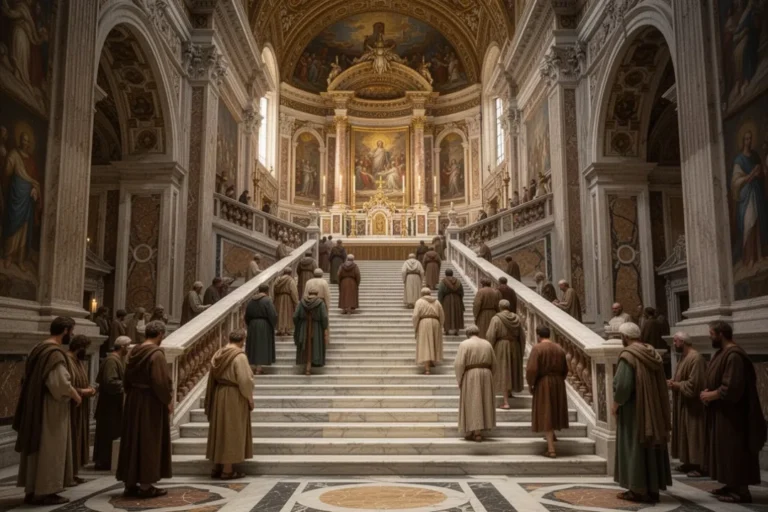
The Scala Santa, or Holy Stairs, is a flight of 28 marble steps in Rome that Christian tradition identifies with the staircase Jesus climbed before his trial by Pontius Pilate.
Located across from the Archbasilica of Saint John Lateran, the Scala Santa is one of Rome’s most significant pilgrimage sites. Visitors come to pray, study its history, see the chapel at the top, or experience a place where architecture, relic tradition, and Catholic devotion meet.
The stairs are not an ordinary museum monument. For many Catholics, climbing them on one’s knees is an act of penitence and prayer. Others visit as travelers interested in Rome’s layered history, ancient Christian worship, and the ways sacred traditions have shaped the city.
The Scala Santa stands in the San Giovanni neighborhood, directly across from the Archbasilica of Saint John Lateran. Its formal address is Piazza di San Giovanni in Laterano 14, although the complex is usually easy to recognize because of its distinctive white marble façade and prominent staircase entrance.
Saint John Lateran is Rome’s cathedral and the cathedral church of the Bishop of Rome, the pope. The Holy Stairs are not inside the basilica itself. They are housed in a separate building called the Sanctum Scalae, which also contains the Chapel of the Holy of Holies, known in Latin as the Sancta Sanctorum.
The site is accessible by Rome’s public transportation network. The San Giovanni metro station is nearby, and several buses stop in the surrounding streets. Because the Scala Santa is an active place of worship, visitors should allow time for security procedures, religious services, and possible lines rather than treating it as a quick monument stop.
Essential distinction: The Scala Santa is traditionally associated with Jesus’ Passion, but the historical chain of custody for the stairs cannot be independently proven. The site’s importance rests on both its long religious tradition and its physical role in Rome’s Christian history.
What the name Scala Santa means
Scala Santa is Italian for Holy Stairs. You may also see the Latin form Scalae Sanctae or the English expression Holy Stairs. All three names refer to the same staircase and, by extension, the building that contains it.
The word “holy” describes the stairs’ sacred association rather than their material composition. The marble is treated with reverence because tradition connects it with the Passion of Christ. Small metal or brass coverings protect portions of the steps, while some openings allow pilgrims to see the original surface below.
The staircase leads upward to the Chapel of the Holy of Holies. This name reflects the chapel’s traditional status as a place containing exceptionally important relics. In medieval and early modern Rome, the chapel was connected with the papal residence at the Lateran and with the ceremonial life of the popes.
Why tradition connects the stairs with Jesus and Pontius Pilate
According to Christian tradition, the staircase originally stood in the praetorium of Pontius Pilate in Jerusalem. Jesus is believed to have climbed it during the events leading to his condemnation and crucifixion. The tradition connects the stairs with the Passion narratives in the Gospels, although the Gospel accounts do not identify a surviving staircase by this name.
The traditional story says that Saint Helena, the mother of the Roman emperor Constantine, brought the stairs from Jerusalem to Rome in the fourth century. Saint Helena is strongly associated with the discovery and preservation of sites and objects connected to Jesus’ life, particularly in Jerusalem.
That account became part of the devotional memory of Rome. Pilgrims did not come only to inspect an ancient object. They came to place themselves imaginatively and spiritually near the suffering of Christ, using the physical climb as a form of prayerful remembrance.
It is useful to separate religious tradition from modern historical verification. There is no conclusive archaeological evidence proving that these marble steps were the staircase in Pilate’s residence. The traditional identification has shaped the site’s meaning for centuries, even as historians recognize that the surviving evidence does not establish every stage of its early history.
How the Holy Stairs arrived in Rome according to tradition
The traditional translation of the stairs to Rome is associated with the fourth century, after Constantine legalized Christianity within the Roman Empire. Saint Helena’s pilgrimage to the Holy Land is generally placed during the early fourth century, and later Christian accounts credit her with bringing important relics to Rome.
According to the tradition surrounding the Scala Santa, the stairs were transported to Rome and installed near the Lateran. The Lateran was an important center of Christian authority, and the area developed into a major papal complex long before the Vatican became the best-known papal residence.
Some accounts connect the staircase with the old Lateran palace. Over time, the stairs became part of a larger sacred setting that included the private papal chapel known as the Sancta Sanctorum. Medieval pilgrims regarded the chapel as especially holy because of the relics believed to be kept there.
The precise details of the transfer are difficult to reconstruct from contemporary evidence. Documents and traditions developed over different periods, and medieval descriptions often combined historical memory, liturgical purpose, and devotional storytelling. The result is a site whose identity is inseparable from both its physical presence and the story attached to it.
What you see inside the Scala Santa complex
The most recognizable feature is the central flight of 28 marble steps. The staircase is enclosed within a structure designed to direct attention upward toward the chapel. Two additional staircases on either side allow visitors to reach the upper level without climbing the Holy Stairs themselves.
At the top is the Chapel of the Holy of Holies. Its interior contains sacred images, relic traditions, and decorative elements developed over many centuries. Visitors may not always be able to enter every area or view every object closely, since access can change according to conservation work, liturgical use, and crowd control.
The chapel is associated with the Acheropita, a revered image of Christ traditionally described as “not made by human hands.” The image is linked to a long tradition of sacred icons and has been treated with exceptional devotion. As with the staircase, the historical development of the object and the claims made about its origin should be distinguished from the devotional role it has played.
The building also preserves paintings, inscriptions, architectural details, and decorative work connected with the history of the Lateran. Even visitors who do not share the religious beliefs associated with the site can observe how the complex expresses medieval and early modern ideas about relics, sacred space, and access to the holy.
Why pilgrims climb the Scala Santa on their knees
Many Catholic pilgrims climb the stairs on their knees while reciting prayers or meditating on scenes from the Passion of Christ. The gesture is intended to express humility, repentance, gratitude, or sorrow for sin. It is not a requirement for everyone who visits, and many people use the side staircases instead.
Prayer practices vary. Some pilgrims stop at each step, while others move slowly and quietly through the entire ascent. Many pray the Lord’s Prayer, the Hail Mary, or a sequence of prayers connected with the Passion. Others remain silent and focus on the physical act of climbing.
The meaning of the practice comes from the combination of movement and meditation. A person who climbs on the knees accepts discomfort and slows the pace of the visit. The staircase becomes a setting for remembrance rather than simply an object to photograph.
The practice should be approached respectfully, without assuming that every person on the stairs is following the same intention. Some visitors are making a formal pilgrimage, some are fulfilling a personal promise, and others are observing a religious custom that has been preserved for generations.
How to visit the Scala Santa respectfully
Because the Scala Santa remains a functioning devotional site, your behavior matters as much as your sightseeing plan. Quiet conversation, modest clothing, and attention to posted instructions help protect the atmosphere for people who have come to pray.
Dress appropriately: Cover your shoulders and knees, especially if you plan to enter the chapel or continue to Saint John Lateran.
Keep your voice low: Avoid conversations, phone calls, and unnecessary noise on the staircase and near the chapel.
Follow the designated route: Use the Holy Stairs only if you wish to participate in the devotional practice; the side staircases are available for ordinary access.
Do not touch protected surfaces: Barriers and coverings exist to preserve the marble, artwork, and relic-related features.
Ask before taking photographs: Photography rules may differ between the staircase, chapel, and other parts of the complex.
Respect worship: Pause or wait if a service, prayer, or procession is taking place.
Visitors with mobility limitations should use the side stairs and ask staff for assistance if necessary. The devotional significance of the main staircase does not make it appropriate to attempt a physically unsafe climb. A quiet visit and sincere attention are more important than reproducing a particular posture.
Common mistakes visitors make at the Holy Stairs
The Scala Santa can be easy to misunderstand if you approach it like a conventional archaeological attraction. A few practical distinctions will make the visit more comfortable and more respectful.
Assuming the stairs are inside Saint John Lateran: The two sites are close but separate. Plan to visit the basilica independently.
Expecting a standard museum experience: The building is primarily a place of worship, so access, silence, and photography rules may be stricter than at nearby monuments.
Believing you must climb on your knees: Kneeling is a devotional choice, not a condition of entry. The side staircases provide an alternative.
Touching or kissing the marble: Longstanding devotional gestures do not override conservation rules or barriers.
Relying on old opening information: Hours and access arrangements can change because of liturgical schedules, restoration, or special events.
Visiting without considering the physical demands: The kneeling ascent can be painful or unsafe. Wear suitable clothing and choose the ordinary stairs if needed.
Expecting every tradition to be historically proven: The site’s religious importance and its documentary certainty are not the same thing.
Practical tip: Check current opening information through an official Vatican or Rome church source before traveling. Religious sites may close or limit access for ceremonies even when nearby tourist attractions remain open.
The 2019 restoration and the marble stairs
For many years, the Holy Stairs were covered by wooden boards installed to protect the marble. This covering also shaped what visitors could see and how they experienced the staircase. During a major restoration, the boards were removed so the marble could be examined and conserved.
The restoration attracted wide attention because it offered visitors a rare view of the exposed steps. The marble showed wear consistent with centuries of use, including marks and surface changes that reflected the staircase’s long devotional history. The work also allowed specialists to address the condition of the steps and surrounding decorative elements.
The restoration did not prove the traditional connection with Pilate’s praetorium. Conservation can reveal the age, material, and condition of an object, but it cannot by itself confirm every story attached to that object. It did, however, make the physical reality of the Scala Santa more visible and helped preserve the site for future visitors.
Protective coverings may again be used or adjusted as conservation needs change. The appearance of the stairs on your visit may therefore differ from photographs taken during the restoration period or from older travel guides.
How the Scala Santa fits into Rome’s Christian history
The Holy Stairs are part of a larger group of sites that make the Lateran area central to the history of Christianity in Rome. The nearby archbasilica, baptistery, medieval buildings, and ancient Roman remains show how the neighborhood developed as a religious and political center.
Before the papacy’s long association with the Vatican, the Lateran served as the principal papal complex. The Scala Santa’s proximity to the old papal residence explains why its chapel held such importance. The site was not isolated from the church’s institutional history; it was woven into the ceremonial and devotional life of the papal court.
The complex also shows how Christian Rome preserved and reinterpreted earlier sacred traditions. Relics, images, chapels, processions, and pilgrim routes gave meaning to spaces across the city. The Holy Stairs became one point in a larger network that included Saint Peter’s Basilica, the Basilica of the Holy Cross in Jerusalem, and other pilgrimage churches.
For that reason, a visit is especially rewarding when paired with Saint John Lateran. The basilica demonstrates the scale and public authority of the Lateran, while the Scala Santa offers a more concentrated setting for personal devotion and relic veneration.
What the Scala Santa means to different visitors
For a practicing Catholic, the stairs may be a place of prayer connected with Christ’s suffering. The climb can represent repentance, an act of thanksgiving, or a pilgrimage undertaken for a personal intention. The physical effort is meaningful because it supports a deliberate spiritual focus.
For a historian, the site raises questions about relic traditions, the movement of sacred objects, medieval pilgrimage, and the relationship between material evidence and belief. The Scala Santa demonstrates how a tradition can influence architecture, ritual, conservation, and urban identity over many centuries.
For an art and architecture visitor, the complex offers a concentrated study of sacred design. The stairs, chapel, paintings, protective elements, and upper-level spaces are arranged to shape movement and attention. The building is not just a container for relics; it guides the body through a carefully constructed religious experience.
For a traveler with no religious affiliation, the site can still be approached thoughtfully. Its value lies in seeing how communities preserve memory through place, how repeated gestures create meaning, and how Rome’s Christian history remains present in the city’s buildings and daily routines.
Planning a visit around nearby landmarks
The Scala Santa works well as part of a walking route through the Lateran district. Begin with the Holy Stairs if you want a quieter visit, then continue to Saint John Lateran and the nearby Lateran Baptistery. The exact order depends on opening times and religious services.
Other nearby landmarks include the Basilica of the Holy Cross in Jerusalem, which is associated with relics of the Passion, and the Roman remains along the ancient roads leading toward the Colosseum. Allow extra time for the basilica rather than assuming the Scala Santa and cathedral can be completed in a few minutes.
A practical visit might include:
The Scala Santa: Reserve time for the staircase, chapel, security procedures, and quiet reflection.
Saint John Lateran: Examine the basilica’s monumental interior and its role as Rome’s cathedral.
The Lateran Baptistery: Consider the importance of baptism and early Christian architecture.
Nearby churches and museums: Add one or two sites according to your interests rather than rushing through all of them.
Comfortable shoes are useful for the surrounding walk, although they do not replace the need for modest clothing inside the churches. Early or later visits may feel less crowded, but access can change with the liturgical calendar, so flexibility is helpful.
Questions to consider before you go
Decide whether your visit is primarily devotional, historical, architectural, or a combination of these. That choice will affect how much time you need and whether you want to climb the central staircase or use the side stairs.
If you are traveling with children, explain beforehand that the building is a quiet place of worship rather than a typical attraction. If you are visiting with someone who has knee, balance, or mobility problems, plan to use the ordinary staircases and avoid pressure to imitate another visitor’s practice.
Finally, approach the tradition with appropriate care. You do not have to accept the historical claim in order to understand why it matters, and you do not have to share a pilgrim’s beliefs to behave respectfully. The Scala Santa has endured because its stones, stories, rituals, and setting continue to carry meaning for different kinds of visitors.
What makes the Scala Santa worth seeing
The Scala Santa brings together several parts of Rome that are often separated elsewhere: a relic tradition, a functioning place of prayer, a historic papal setting, a carefully preserved architectural complex, and a physical ritual that visitors can still witness.
Its significance does not depend on a single question about whether the stairs can be conclusively traced to Pilate’s headquarters. The site matters because generations of Christians treated it as a connection to the Passion, built a sacred environment around it, and kept its devotional use alive.
Standing before the 28 steps, you can see both the limits and the power of historical evidence. The marble cannot answer every question about its origin, but the building clearly records centuries of faith, pilgrimage, conservation, and memory. That combination makes the Scala Santa one of Rome’s most distinctive sacred landmarks.
Frequently asked questions
Can anyone visit the Scala Santa?
Yes. Visitors of any faith or no faith may enter, provided they follow the site’s rules for dress, silence, photography, and movement. You do not have to climb the central staircase on your knees. Side staircases are available, and they are the appropriate option for people who prefer ordinary access or cannot kneel safely.
How many steps are in the Scala Santa?
The Holy Stairs have 28 marble steps. The staircase is protected and used for devotional climbing, while side staircases provide regular access to the upper level. The number of steps is part of the site’s familiar identity, but the religious meaning comes from the tradition attached to them rather than from the number alone.
Is the Scala Santa the same as Saint John Lateran?
No. The Scala Santa is in a separate building directly across from the Archbasilica of Saint John Lateran. Both sites are closely connected to the history of the Lateran area, but they have different entrances, interiors, and functions. Visiting one does not automatically mean you have visited the other.
Is the Scala Santa really the staircase Jesus climbed?
Catholic tradition identifies it with the staircase from Pontius Pilate’s praetorium in Jerusalem, brought to Rome by Saint Helena. However, historical and archaeological evidence cannot conclusively verify that identification. The site’s religious importance comes from the enduring tradition and devotional practice, while the exact ancient origin remains a matter of historical uncertainty.










Leave a Reply