An acolyte is a person appointed or trained to assist during Christian worship, especially by serving at the altar and supporting the clergy. The word is commonly associated with Catholic Mass, but its meaning and responsibilities vary among Catholic, Anglican, Episcopal, and other Christian traditions.
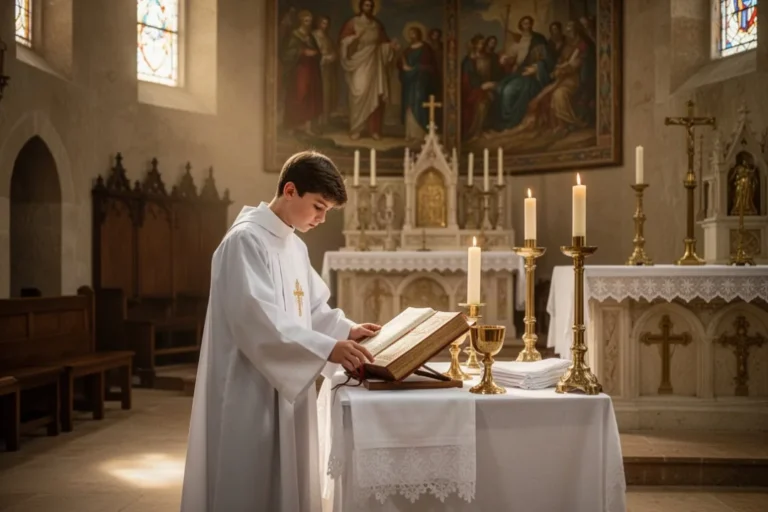
In everyday parish language, “acolyte” often means an altar server who carries candles, helps prepare the altar, and assists the priest or bishop. In the Catholic Church, however, an acolyte can also mean someone who has received the instituted ministry of acolyte, a formal lay ministry with responsibilities that extend beyond ordinary altar serving.
The English word acolyte comes through Latin from a Greek term meaning “attendant” or “follower.” That origin reflects the basic role: an acolyte accompanies and assists the minister who presides at worship.
An acolyte is not a priest, deacon, or ordained minister. The role is one of service rather than ordination. An acolyte helps worship take place in an orderly and prayerful way, but does not replace the priest or deacon in duties reserved to them.
The exact role depends on the church. A Catholic parish may use “acolyte” for a person who serves at the altar during Mass. In the Episcopal Church and some Anglican communities, an acolyte may carry a processional cross, handle candles, assist with communion, or help the clergy prepare the sanctuary.
Spelling note: “Accolyte” is a common misspelling. The standard spelling is acolyte, with one “c” after the initial “a.”
How an acolyte differs from an altar server
An altar server is usually a person who has been trained by a parish to assist at Mass or another service. Children, teenagers, and adults may serve in this role, depending on the local church’s policies. The position is often voluntary and does not require a formal appointment by a bishop or pastor.
An instituted acolyte is different. In the Catholic Church, this person receives a formal institution through a prescribed liturgical rite. The ministry is connected with service at the altar and assistance to priests, deacons, and, in particular circumstances, the distribution of Holy Communion.
The two terms can overlap in casual conversation. Someone who regularly serves at the altar may be called an acolyte even if that person has not received the instituted ministry. The distinction matters most in official Catholic documents and liturgical settings.
Altar server: a trained parish volunteer who assists during worship.
Instituted acolyte: a lay person formally admitted to a recognized Catholic ministry.
Deacon: an ordained minister with sacramental and liturgical responsibilities that differ from those of an acolyte.
Priest: an ordained minister who presides at the Eucharist and performs duties that an acolyte cannot perform.
A parish may call all altar assistants “acolytes” for practical reasons, but the formal status of an instituted acolyte should not be assumed from the title alone.
What an acolyte does during Catholic Mass
The tasks of an acolyte are designed to support the celebration of the Eucharist and other liturgical services. The person serves the worshiping community by preparing what is needed, assisting the ministers, and helping the rite proceed without unnecessary interruptions.
Specific duties vary according to the parish, the bishop’s guidelines, and the number of other ministers present. A typical acolyte may perform several of the following responsibilities:
Carry a cross, processional item, or candles during the entrance and closing processions.
Prepare the altar, corporal, purificator, chalice, missal, and other items required for Mass.
Bring the gifts of bread and wine to the priest or deacon.
Assist the priest or deacon during the preparation of the altar.
Hold the missal or help the priest find the correct prayers.
Handle incense, when the person has been trained and the parish uses it.
Ring bells or perform other local ceremonial duties when directed.
Assist with the orderly distribution of Holy Communion.
Help purify and store sacred vessels according to the parish’s approved practice.
Assist at other liturgies, such as Good Friday services, Eucharistic adoration, or processions.
These actions may look simple, but timing and attention matter. An acolyte must know when to move, where to stand, and whom to assist without drawing attention away from the liturgy.
What instituted acolytes are authorized to do
In the Catholic Church, the instituted ministry of acolyte is a stable form of lay service. It is not merely a temporary assignment for one Mass. An instituted acolyte is expected to grow in understanding of the liturgy and to serve the Church faithfully over time.
The acolyte’s principal responsibility is to assist the deacon and priest at the altar. The acolyte may also help prepare other ministers and support the congregation’s participation. This ministry can be especially valuable when a parish has several liturgical celebrations or needs trained leaders for Eucharistic service.
When ordained ministers are unavailable, an instituted acolyte may be entrusted with certain responsibilities under the rules of the Church. These can include distributing Holy Communion as an extraordinary minister and, in some circumstances, exposing the Eucharist for adoration without giving a blessing. The exact permission and procedure depend on Church law and local direction.
An instituted acolyte does not consecrate the bread and wine, hear confessions, preach as a priest, or give a priestly blessing. The ministry supports the Eucharistic celebration but does not confer the power of ordination.
Important distinction: Serving at the altar does not make someone clergy. An acolyte remains a lay minister unless that person has separately received Holy Orders.
How an acolyte serves at the altar step by step
Acolytes usually serve according to a predictable sequence. Learning the order of the Mass allows them to act calmly and avoid distracting movements. Local customs may differ, so the parish’s training should always take priority.
Prepare before the liturgy. The acolyte arrives early, checks the sanctuary, and confirms that the altar, credence table, candles, processional cross, and other needed items are ready.
Join the entrance procession. Depending on the assignment, the acolyte may carry the cross or candles and take a designated place near the sanctuary.
Support the Liturgy of the Word. During the readings and homily, the acolyte sits or stands in the assigned location and remains attentive to directions.
Prepare the altar. At the appropriate time, the acolyte brings the corporal, missal, chalice, and other items to the altar, usually with help from the deacon or another server.
Assist with the gifts. The acolyte may help receive or carry the bread and wine and may assist the priest or deacon as they prepare the altar.
Support the Eucharistic Prayer. The acolyte follows the prescribed posture and actions, assists with bells or incense when assigned, and avoids unnecessary movement.
Help during Holy Communion. The acolyte may assist ministers, guide the flow of communicants, or distribute Communion when properly authorized.
Clear and care for the altar. After Communion, the acolyte helps return vessels and books according to local practice.
Participate in the closing procession. The acolyte leaves the sanctuary in the correct order and helps secure liturgical items after the service.
The goal is not to perform as many visible tasks as possible. The best acolyte knows that quiet preparation and discreet service are often more valuable than constant movement.
What an acolyte wears
Clothing differs by denomination and parish. Catholic altar servers commonly wear an alb, a long white garment, sometimes with a rope belt called a cincture. Some parishes use a cassock and surplice instead. An instituted acolyte may wear the same vesture as other servers or may follow additional local norms.
Anglican and Episcopal acolytes may wear an alb, cassock and surplice, or another garment established by the congregation. The clothing identifies the person’s liturgical function and supports a consistent appearance during worship.
Comfort and modesty are practical concerns. Shoes should be quiet, secure, and appropriate for walking and kneeling. Jewelry, loose clothing, strong fragrances, and anything that could catch on vessels or furnishings are best avoided.
Who can become an acolyte
For ordinary altar serving, each parish sets its own requirements. Many churches welcome children once they can follow directions reliably, while others train only older children, teenagers, or adults. Some congregations require a period of preparation before a person serves publicly.
For the formal Catholic ministry of instituted acolyte, candidates must meet the requirements established by the Church and their diocese. The ministry is open to qualified lay men and women. In many places, it is connected with preparation for the permanent diaconate or priesthood, but it can also be entrusted to lay people whose service is not directed toward ordination.
Typical qualities expected of an acolyte include:
Reliability and willingness to arrive early.
Respect for the Eucharist, sanctuary, and other sacred spaces.
Ability to follow directions without constant supervision.
Calmness when something unexpected happens.
Physical ability to stand, walk, kneel, carry light objects, or adapt to the needs of the service.
Commitment to learning the order of worship and the meaning of the actions.
Cooperation with priests, deacons, readers, musicians, ushers, and other ministers.
Perfection is not required. Training exists because new servers need time to learn the movements, terminology, and expectations of the role.
How to become an altar server or acolyte
If you want to serve, begin by contacting the parish office, pastor, deacon, or liturgy coordinator. Ask whether the parish uses the title “acolyte” for altar servers and whether it offers regular training.
A practical path usually looks like this:
Learn the local requirements. Ask about age, scheduling, dress, background checks, and any required participation in parish formation.
Attend training sessions. Study the layout of the sanctuary, the names of liturgical objects, and the basic sequence of Mass.
Observe an experienced server. Watching a full service helps you understand timing better than memorizing isolated instructions.
Practice the movements. Rehearse processions, carrying candles, setting the altar, kneeling, bowing, and moving around other ministers.
Serve with a partner. A new server often begins alongside someone experienced rather than serving alone.
Accept feedback. Corrections are part of learning, especially when local customs differ from what you have seen elsewhere.
Build a dependable schedule. Communicate promptly when you cannot serve and arrive with enough time to prepare.
Someone seeking the formal instituted ministry should speak with the diocesan office or the person responsible for liturgical formation. The process may include discernment, spiritual preparation, theological study, practical training, and a formal institution by the bishop or another authorized minister.
How acolytes should behave in the sanctuary
Reverence is shown through both attention and restraint. An acolyte should move deliberately, keep conversations for appropriate places, and remain aware that the congregation is praying.
Posture matters, but it should never become theatrical. Stand upright when standing, sit attentively when seated, kneel when the liturgy calls for it, and make bows or other gestures according to the parish’s instructions. If you make a mistake, correct it quietly and continue rather than showing embarrassment.
An acolyte should also respect sacred objects. The chalice, ciborium, paten, missal, candles, and other items should be handled only as trained. Never improvise a solution involving the Eucharist or sacred vessels; ask the priest, deacon, or sacristan for guidance.
Personal prayer is part of the role. Although the acolyte has practical tasks, the person is also participating in worship. Listening to the readings, joining the responses, and maintaining an attentive interior posture keep the ministry from becoming merely ceremonial work.
Common mistakes acolytes should avoid
Most problems come from rushing, guessing, or failing to communicate. Even experienced servers benefit from a short review before an unfamiliar liturgy.
Arriving at the last minute: There may not be enough time to locate vestments or clarify assignments.
Moving before the cue: The next action should happen at the proper point in the rite, not simply when the server remembers it.
Walking too quickly: A steady pace looks more reverent and reduces the risk of spilling or dropping something.
Turning your back carelessly: Follow the posture and movement customs taught by the parish.
Whispering during the service: Communicate only when necessary and as quietly as possible.
Touching sacred vessels without instruction: Ask before handling objects you have not been trained to use.
Trying to fix every mistake publicly: Let the priest, deacon, or lead server direct the response.
Assuming every church follows the same custom: Liturgical practices vary, even between nearby parishes.
When two instructions seem to conflict, follow the direction of the priest or deacon presiding at the service. The person responsible for the liturgy can adapt assignments when circumstances change.
The history of the acolyte ministry
The role of assisting ministers developed as Christian worship became more organized. In the early Church, people served in practical and pastoral positions that supported bishops, priests, deacons, and the worshiping community.
In the Western Catholic tradition, acolyte became associated with one of the minor orders that prepared men for major orders. The structure and terminology changed over time. After reforms in the twentieth century, the formal instituted ministries of lector and acolyte were understood as stable lay ministries rather than simply steps within a clerical system.
Modern Catholic practice recognizes that lay people have important responsibilities in the liturgy. The formal ministry of acolyte remains distinct from ordination, while the everyday work of altar servers allows many parishioners to participate in this form of service.
Other traditions developed their own patterns. In Anglican and Episcopal worship, acolytes have long assisted with candles, processions, the altar, and communion. Some communities use the term for a formal ministry; others use it for a volunteer liturgical role.
Why the acolyte’s service matters
An acolyte contributes to worship in ways that may be easy to overlook. A well-prepared server helps the congregation remain focused on prayer instead of wondering whether a book, vessel, or procession is in the right place.
The role also teaches the meaning of shared ministry. The priest or bishop presides, the deacon serves the Word and assists at the altar, readers proclaim Scripture, musicians lead song, ushers welcome people, and acolytes support the liturgical action. Each ministry has a distinct purpose.
For children and young people, altar serving can provide an early experience of responsibility within the Church. For adults, it can become a disciplined form of prayer and a practical way to support the parish. For instituted acolytes, the ministry represents a deeper and more stable commitment to the Church’s public worship.
The most effective acolyte combines technical competence, reverence, and humility. The service is successful when the congregation can pray freely and the liturgy unfolds with dignity.
Questions to ask before serving in a new church
If you are visiting another parish or beginning to serve in a different congregation, do not assume that familiar habits apply. A few questions can prevent confusion and show respect for local practice.
Who is responsible for assigning acolytes at this service?
Where should servers vest and wait before the procession?
Which items should be placed on the credence table?
Who handles the processional cross and candles?
What gestures, bows, and postures does this parish use?
May an acolyte assist with Holy Communion, and what authorization is required?
Who should be contacted if a server is unable to attend?
These questions are especially useful when visiting a parish in another denomination or country. The word “acolyte” may be familiar, but the responsibilities attached to it may not be identical.
An acolyte is not automatically a priest, deacon, seminarian, or candidate for ordination. Some seminarians serve as instituted acolytes, but many acolytes are lay people whose ministry does not lead to Holy Orders.
An acolyte is also not a performer whose purpose is to attract attention. The vesture, processions, candles, and movements have a liturgical purpose. They should serve the worship rather than become a display of the individual’s skill.
Finally, an acolyte is not expected to make independent decisions about matters that belong to the celebrant or the parish’s liturgical leadership. The role involves responsible service within clear limits.
How families and parishes can support young acolytes
Young servers do best when expectations are clear and adults provide patient supervision. A parish should give them written schedules, dependable trainers, suitable vestments, and a simple way to report absences.
Parents can help by ensuring that children arrive on time, wear appropriate clothing, and understand that serving is a form of worship rather than a social activity. Encouragement should focus on reliability, attentiveness, and growth rather than flawless performance.
Training should include more than memorizing movements. Young acolytes benefit from learning the names of the liturgical seasons, the purpose of the altar, the meaning of the vessels, and the reasons behind the gestures they make. Understanding produces better service than repetition alone.
A parish should also maintain appropriate safeguarding practices for minors. Adult leaders need to follow diocesan or congregational policies for supervision, communication, transportation, and conduct.
How to prepare before each assignment
A short preparation routine can make serving less stressful. Review the schedule, check whether the liturgy includes incense or a procession, and ask about any special arrangements for baptisms, funerals, weddings, or feast days.
Before the service begins, confirm who is leading the servers and identify where each person will sit or stand. Check candles, matches or lighting equipment, books, vessels, and processional items without rearranging anything that belongs to the sacristan or clergy.
Take a moment for quiet prayer. The purpose is not to create anxiety about performing perfectly, but to remember that the work is directed toward worship and service. If an unexpected problem occurs, listen to the lead minister and respond calmly.
Frequently asked questions
Is an acolyte the same as an altar server?
Not always. “Altar server” usually describes a trained volunteer who assists at worship, while “instituted acolyte” refers to a formal Catholic lay ministry. Many parishes use “acolyte” informally for altar servers, so the local church’s terminology matters. The duties may overlap, but formal institution carries a distinct ecclesial status and additional responsibilities.
Can women serve as Catholic acolytes?
Yes. Qualified lay women may be admitted to the instituted ministry of acolyte in the Catholic Church, subject to the applicable diocesan process and requirements. Women and girls may also serve as altar servers where the parish permits it. Local policies determine scheduling, training, and the specific tasks assigned during Mass.
Does an acolyte distribute Holy Communion?
An instituted acolyte may distribute Holy Communion as permitted by Church law and local authorization. Other altar servers generally do not distribute Communion simply because they serve at the altar. A parish may appoint properly prepared extraordinary ministers for this responsibility when sufficient ordinary ministers are unavailable.
Do acolytes receive a salary?
Most acolytes serve voluntarily and receive no salary. Some churches may provide modest compensation for particular recurring liturgical or sacristan duties, but that is a local employment arrangement rather than a normal feature of the ministry. Payment, scheduling, and responsibilities should be discussed directly with the congregation or parish office.







Leave a Reply