What are the seven sacraments? A clear Catholic guide
What are the seven sacraments? A clear Catholic guide
The seven sacraments are visible signs instituted by Christ through which Catholics believe God gives grace to his people.
They are not simply religious ceremonies or symbolic reminders. In Catholic teaching, each sacrament uses a visible sign, such as water, bread, wine, oil, or the laying on of hands, to communicate an invisible spiritual reality. The sacraments belong to the life of the Church and are ordinarily celebrated by ministers acting in the name of Christ.
The seven are Baptism, Confirmation, the Eucharist, Reconciliation, Anointing of the Sick, Holy Orders, and Matrimony. They are commonly grouped into three categories: sacraments of Christian initiation, sacraments of healing, and sacraments at the service of communion and mission.
What the seven sacraments are and what each one does
Each sacrament has its own purpose, celebration, and place in a Christian’s life. Some are received once, while others may be received repeatedly. Together, they address the major spiritual stages and needs of the Catholic life.
1. Baptism begins Christian life
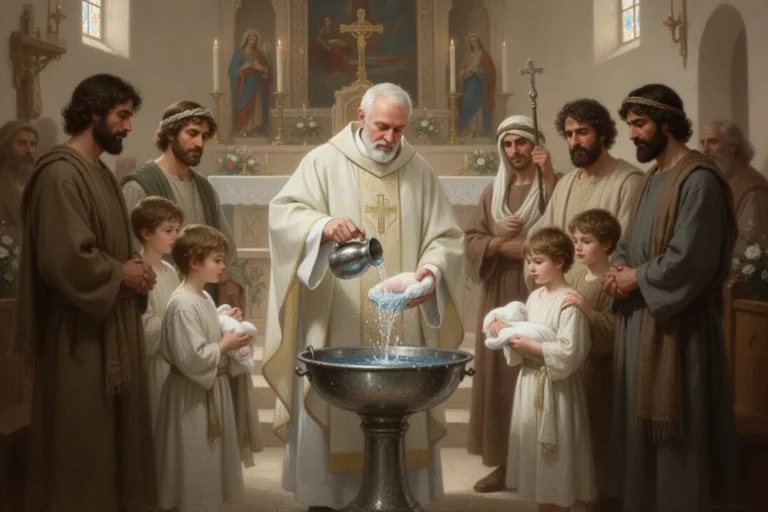
Baptism is the first sacrament and the foundation of the Christian life. Through baptism, a person is welcomed into the Church, receives forgiveness of sin, and begins a new relationship with God. Catholics understand baptism as the ordinary beginning of life in Christ.
The visible sign is the pouring of water over the person’s head or immersion in water, accompanied by the Trinitarian baptismal formula. Water represents cleansing, death to an old way of life, and new birth. Baptism also marks a person permanently as belonging to Christ, which is why it is not repeated.
Infants, children, and adults may be baptized. When an infant is baptized, parents and godparents promise to help the child grow in faith. Adults normally prepare through a period of instruction and prayer before receiving the sacrament, often through the process known as the Order of Christian Initiation of Adults.
2. Confirmation strengthens baptismal faith
Confirmation completes and strengthens the grace received in baptism. Catholics believe that the baptized person receives a special outpouring of the Holy Spirit, enabling them to live more firmly as a Christian and participate more fully in the Church’s mission.
The bishop or priest lays hands on the candidate and anoints the forehead with sacred chrism, a perfumed oil consecrated by a bishop. The minister says the sacramental words asking the Holy Spirit to seal the person with his gift. This anointing gives Confirmation its visible and physical character.
Confirmation is associated with the gifts of the Holy Spirit, traditionally described as wisdom, understanding, counsel, fortitude, knowledge, piety, and fear of the Lord. These gifts are not a guarantee that a person will never doubt or make mistakes. Rather, they point to the help Christians need to grow in holiness and bear witness to their faith.
3. The Eucharist nourishes Christians with Christ’s presence
The Eucharist is the sacrament in which Catholics receive the Body and Blood of Christ under the appearances of bread and wine. It is celebrated during the Mass, which includes readings from Scripture, prayers, the preparation of the gifts, the Eucharistic Prayer, and Holy Communion.
Catholic teaching holds that, through the consecration, the bread and wine truly become Christ’s Body and Blood, even though their outward appearance remains bread and wine. This change is traditionally called transubstantiation. The Eucharist is therefore more than a memorial meal, although it does include remembrance: it makes present sacramentally the one sacrifice of Christ.
Receiving Communion unites the person more deeply with Christ and with the Church. It also strengthens charity, nourishes spiritual life, and calls the recipient to live in a way consistent with the Gospel. Catholics generally receive the Eucharist at Mass after appropriate preparation and with respect for the sacrament.
4. Reconciliation restores communion after sin
Reconciliation, also called Penance or Confession, is the sacrament through which a person receives God’s forgiveness for sins committed after baptism. It includes conversion of heart, honest confession, absolution by a priest, and an act of penance intended to help repair the harm caused by sin.
The person seeking the sacrament examines their conscience, expresses genuine sorrow, confesses sins to a priest, and resolves to avoid sin. The priest listens, offers guidance, assigns a penance, and gives absolution in the name of Christ. Absolution is the sacramental declaration that God forgives the person’s sins.
Catholics distinguish between mortal sin, which seriously damages a person’s relationship with God, and venial sin, which weakens that relationship without destroying it. The Church encourages regular confession, including confession of venial sins, because the sacrament can form the conscience and strengthen a person’s resistance to temptation.
5. Anointing of the Sick brings spiritual strength in illness
Anointing of the Sick is offered to people whose health is seriously affected by illness, advanced age, or an important medical procedure. It is not reserved only for someone who is dying. The sacrament asks God to give the sick person strength, peace, courage, and, if it serves the person’s spiritual good, bodily healing.
A priest anoints the person’s forehead and hands with blessed oil while praying the sacramental prayer. The celebration may also include Scripture, a brief liturgy of the word, confession, and Holy Communion. When a person is near death, the Eucharist may be received as Viaticum, meaning spiritual food for the final passage from this life.
Anointing of the Sick does not promise that every physical illness will disappear. Its central purpose is to unite the sick person with Christ, who suffered and died, while strengthening the person against fear, discouragement, and spiritual distress. It can also bring forgiveness when the person is unable to receive the Sacrament of Reconciliation.
6. Holy Orders equips ministers for service
Holy Orders is the sacrament through which the Church’s ordained ministry is conferred. It has three degrees: the episcopate for bishops, the presbyterate for priests, and the diaconate for deacons. Each degree has distinct responsibilities, but all are ordered toward serving God’s people.
Through ordination, a bishop, priest, or deacon receives a permanent sacramental character. The central visible sign is the laying on of hands by the bishop, followed by the consecratory prayer. The ordained minister is entrusted with responsibilities such as preaching, leading worship, serving the community, and caring for the Church according to the particular order received.
Bishops possess the fullness of Holy Orders and teach, govern, and sanctify the local churches entrusted to them. Priests cooperate with bishops in preaching, pastoral leadership, and the celebration of the Eucharist and other sacraments. Deacons are ordained especially for service, including proclaiming the Gospel, assisting at the altar, preaching when permitted, and serving people in need.
7. Matrimony joins spouses in a covenant of life and love
Matrimony is the sacrament in which a baptized man and baptized woman freely enter a lifelong covenant of marriage. Catholic marriage is directed toward the good of the spouses and the procreation and education of children. The spouses themselves are the ministers of the sacrament when they exchange valid consent.
The essential sign is the couple’s free, faithful, and lifelong consent. A priest or deacon normally receives that consent on behalf of the Church, while witnesses attest to the marriage. The couple’s promises express a permanent partnership that Catholic teaching compares with Christ’s faithful love for the Church.
A sacramental marriage is understood as exclusive and indissoluble. This does not mean that every marriage is easy or that a person must remain in an unsafe situation. The Church recognizes the need for protection from abuse and provides pastoral and legal processes for examining whether a marriage was validly established. Separation may sometimes be necessary, even though the marriage bond is viewed as continuing.
The three groups: Baptism, Confirmation, and the Eucharist are sacraments of initiation; Reconciliation and Anointing of the Sick are sacraments of healing; Holy Orders and Matrimony are sacraments at the service of communion and mission.
Why Catholics call them sacraments
The word sacrament refers to a sacred sign that makes spiritual grace present and active. Catholic theology sees the sacraments as actions of Christ, not merely actions performed by the community. The priest or bishop celebrates them, but Christ is understood to be the primary source of the grace they give.
That does not mean the recipient’s attitude is irrelevant. The sacraments are not magic actions that work independently of faith, freedom, or proper preparation. A person should approach them with an openness to God and, where the sacrament requires it, the right intention and conditions.
At the same time, Catholics do not believe that the sacrament depends entirely on the personal holiness of the minister. The Church teaches that Christ acts through a validly celebrated sacrament, even when the minister is personally imperfect. This teaching is often expressed by the Latin phrase ex opere operato, which means that the sacrament’s effectiveness comes from Christ’s action rather than the minister’s spiritual excellence.
Every sacrament includes a visible sign and a sacramental action. For example, water is used in Baptism, oil in Confirmation and Anointing of the Sick, bread and wine in the Eucharist, and the exchange of consent in Matrimony. The words and actions together identify what is being celebrated and communicate its meaning.
The sacraments also connect individual believers with the whole Church. A baptism is not a private graduation into religion, and a wedding is not only a family celebration. Each sacrament places the person within a larger communion of worship, responsibility, service, and shared faith.
How the sacraments are grouped in Catholic life
Sacraments of initiation
Baptism, Confirmation, and the Eucharist are called the sacraments of Christian initiation. They establish and deepen a person’s relationship with Christ and the Church. In the usual order for adults, Baptism comes first, followed by Confirmation and the Eucharist. In many Catholic communities, children are baptized as infants, receive First Communion later, and celebrate Confirmation after additional formation.
These sacraments should not be treated as unrelated milestones. Baptism begins new life, Confirmation strengthens that life, and the Eucharist continually nourishes it. The order and timing can vary by tradition or local practice, but the three together form the basic sacramental pattern of becoming and living as a Catholic Christian.
Sacraments of healing
Reconciliation and Anointing of the Sick address wounds that affect human life and communion with God. Reconciliation responds primarily to spiritual injury caused by sin. Anointing responds to serious physical or psychological weakness associated with illness and age, while also strengthening the whole person spiritually.
These sacraments do not suggest that Christians should expect a life free from suffering. Instead, they show that the Church accompanies people in failure, illness, fear, and vulnerability. Both direct attention to God’s mercy and to the hope of restoration.
Sacraments at the service of communion
Holy Orders and Matrimony are directed toward the service of others and the building up of the Church. A married couple serves through faithful love, family life, hospitality, and care for others. Ordained ministers serve through preaching, worship, pastoral leadership, and works of charity.
The phrase “at the service of communion” does not mean these sacraments are less personal than the others. It means their grace is especially connected with a mission beyond the individual. Both call people to make a lasting commitment that benefits the wider Christian community and the world.
Which sacraments can be received more than once
Some sacraments leave what Catholic teaching calls an indelible spiritual mark. Baptism, Confirmation, and Holy Orders are received only once, or in the case of Holy Orders, once at each degree. They permanently configure the recipient in a particular way for Christian life or ministry, so repeating them would not be appropriate.
The other four sacraments may be received repeatedly when the proper circumstances are present. The Eucharist may be received regularly, Reconciliation whenever a person seeks forgiveness under the Church’s conditions, Anointing of the Sick when serious illness or a significant change in health warrants it, and Matrimony each time a person validly enters a new marriage after the previous bond has ended according to Church teaching.
Received once: Baptism, Confirmation, and each degree of Holy Orders.
Received repeatedly: the Eucharist, Reconciliation, Anointing of the Sick, and, under the appropriate circumstances, Matrimony.
Received according to need: Reconciliation and Anointing of the Sick are connected to a person’s spiritual or physical condition, not to a fixed schedule.
Frequency alone does not determine whether a sacrament is fruitful. A person’s preparation, faith, honesty, and willingness to live its consequences matter. For example, receiving Communion regularly should be connected with charity and a life turned toward Christ, while confession should include sincere repentance rather than a routine performance without intention to change.
How Catholics prepare to receive the sacraments
Preparation differs according to the sacrament, the person’s age, and the local parish. It may involve prayer, Scripture, formal classes, conversations with a priest or catechist, and participation in Sunday worship. The purpose is not merely to memorize information but to understand the sacrament and approach it freely and responsibly.
Learning the meaning: the person studies what the sacrament is, what it signifies, and what it asks of the recipient.
Examining readiness: the person considers faith, intention, freedom, and any conditions required by Church law or pastoral practice.
Taking part in prayer: participation in Mass and personal prayer helps connect the sacrament with an ongoing relationship with God.
Making the necessary commitments: parents, spouses, candidates, and godparents may accept specific responsibilities connected with the sacrament.
Celebrating with the community: the sacrament is ordinarily received in a public liturgy rather than as a purely private act.
For children, parents and godparents have an especially important role. They promise to support the child’s growth in faith and to help the child participate in the life of the Church. For adults, preparation usually includes a more direct profession of faith and an assessment of whether the person freely desires to become Catholic or receive a particular sacrament.
People who are not Catholic may attend Catholic sacramental celebrations respectfully, but receiving Communion or another sacrament can depend on specific Church rules. Anyone with questions about eligibility should speak with a parish priest rather than assume that attendance automatically gives permission to receive.
Practical guidance: If you are unsure whether you or a family member may receive a sacrament, contact a Catholic parish. The priest or parish staff can explain preparation, documentation, age requirements, and any circumstances that need pastoral attention.
How the sacraments relate to everyday Christian life
The sacraments are meant to shape ordinary decisions, relationships, and responsibilities. Baptism calls a person to live as a member of Christ’s body. Confirmation calls for mature witness. The Eucharist sends people from worship into lives of charity, justice, and service.
Reconciliation encourages people to face wrongdoing honestly and repair relationships where possible. Anointing of the Sick reminds the Church to care for people who are vulnerable, elderly, or seriously ill. Matrimony asks spouses to practice faithful love over time, while Holy Orders places ministers at the service of teaching, worship, and pastoral care.
The sacraments therefore combine personal grace and communal responsibility. They are encounters with God, but they also change how Christians belong to one another. Their purpose is not to provide isolated religious experiences; it is to form people who worship God and serve their neighbors.
Catholic belief about the sacraments is rooted in the life and ministry of Jesus, the practice of the early Church, and the Church’s continuing teaching. The New Testament presents baptism, the breaking of bread, the laying on of hands, forgiveness, anointing, marriage, and ordained ministry in different contexts. Catholics understand these practices as developing into the seven sacramental celebrations recognized by the Church.
The seven sacraments can be remembered as a pattern of Christian life: birth into faith, strengthening, nourishment, forgiveness, healing, vocation, and faithful service. They accompany people from the beginning of Christian life through its daily growth, its struggles, and its call to love others.
Frequently asked questions
Are the seven sacraments found by name in one Bible passage?
No single Bible passage lists all seven together. Catholics understand them through the combined witness of Scripture, the practices of the early Christian community, and the Church’s teaching over time. Biblical passages support the foundations of the sacraments, while the Church identifies and defines the seven-part sacramental structure.
Can a non-Catholic receive the Catholic sacraments?
The answer depends on the sacrament and the person’s circumstances. Some sacraments may be recognized across Christian communities, while reception of the Eucharist and certain other sacraments is normally reserved for Catholics who meet the Church’s requirements. A parish priest can give an accurate answer for a particular situation.
Why do Catholics baptize babies who cannot choose for themselves?
Catholic parents request infant Baptism because they want their children welcomed into the life of grace and the Church from the beginning. Parents and godparents promise to raise the child in the faith. As the child grows, personal instruction and free acceptance are expected to develop.
Is Confirmation required to become a Catholic?
Baptism is the sacrament that initiates a person into the Catholic Church. Confirmation completes and strengthens Baptism, and Catholics normally receive it as part of full Christian initiation. Someone who was baptized Catholic but has not yet been confirmed remains Catholic, although they are encouraged to complete their initiation through preparation and reception of Confirmation.



Leave a Reply