If you are checking the church calendar before making plans for Mass, the answer depends on your location and the date shown on your calendar. As of Friday, October 2, 2026, the next Sunday in the Catholic Church is October 4, 2026. It is the Twenty-Seventh Sunday in Ordinary Time, celebrated in Liturgical Year A.
October 4 is also the optional memorial of Saint Francis of Assisi. Because the Sunday celebration has priority, most parishes will celebrate the Sunday liturgy rather than the memorial. Some churches may give special attention to Saint Francis, especially through a blessing of animals or another parish devotion, but those customs do not replace the Sunday Mass.
Quick answer: The next Catholic Sunday is October 4, 2026: the Twenty-Seventh Sunday in Ordinary Time, Year A. Its Gospel is Luke 17:5-10.
What Sunday is it in the Catholic Church on October 4, 2026?
The Catholic Church will celebrate the Twenty-Seventh Sunday in Ordinary Time on October 4, 2026. “Ordinary Time” does not mean an unimportant or routine season. The term refers to the ordered numbering of the Sundays that fall outside Advent, Christmas Time, Lent, and Easter Time.
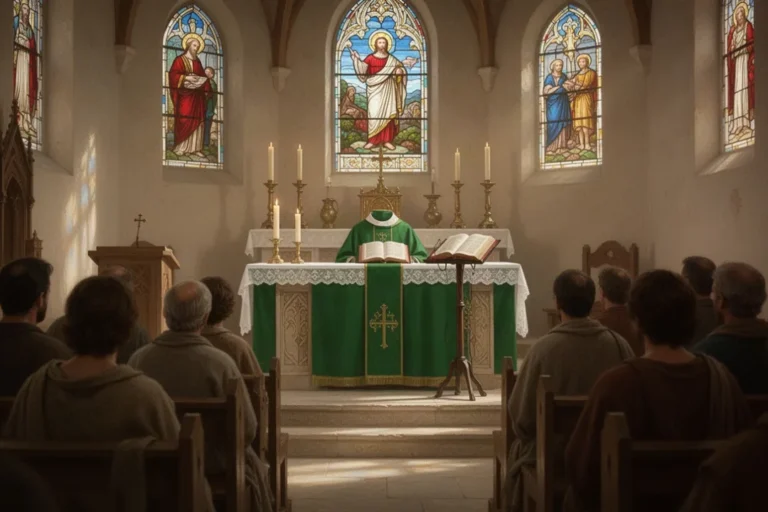
The color used at Mass will normally be green, the liturgical color associated with Ordinary Time. Green points to steady growth in Christian faith and discipleship. It is used for many Sundays that do not have a separate solemnity or feast with its own proper color.
The Sunday begins liturgically with the Saturday evening vigil Mass. In the Catholic Church, a Sunday obligation may ordinarily be fulfilled at a Mass celebrated on Saturday evening or at any time on Sunday, subject to the applicable rules and pastoral guidance in your diocese.
If your local parish follows a different national or diocesan calendar, you may see a particular observance included in the bulletin. The central Sunday celebration, however, remains the Twenty-Seventh Sunday in Ordinary Time unless a higher-ranking feast or solemnity is assigned locally.
What liturgical year is used on this Sunday?
October 4, 2026, falls in Liturgical Year A. The Catholic Sunday lectionary follows a three-year cycle:
Year A usually gives special prominence to the Gospel of Matthew.
Year B usually gives special prominence to the Gospel of Mark.
Year C usually gives special prominence to the Gospel of Luke.
The cycle is not limited to one Gospel book. The Sunday readings include passages from all four Gospels, and the Gospel of John appears especially during important seasons and on certain major celebrations. Still, the three-year pattern helps Catholics identify the general arrangement of the Sunday lectionary.
Because this Sunday is in Year A, the Gospel reading for October 4 is taken from Luke 17:5-10. The first reading is from Habakkuk 1:2-3 and 2:2-4, followed by a passage from Psalm 95. The second reading is 2 Timothy 1:6-8 and 13-14.
What are the readings for the Twenty-Seventh Sunday in Ordinary Time?
The readings connect honest questions about suffering with a call to faithful endurance. They also challenge the idea that faith is mainly about receiving recognition or rewards.
Habakkuk 1:2-3 and 2:2-4 asks how faith responds to injustice
The first reading presents the prophet Habakkuk crying out to God about violence, destruction, conflict, and apparent injustice. The passage does not hide the pain of waiting for an answer. Instead, it shows prayer as a place where a person can bring serious questions before God.
God tells the prophet to record the vision and wait for its appointed fulfillment. The reading contrasts the proud person, whose inner life is not upright, with the person who lives by faith. Its central concern is trust that remains faithful even when the outcome is not immediate.
Psalm 95 is a call to worship and attentive listening. The community is invited to rejoice in God while also hearing the warning not to harden its heart. In the Sunday liturgy, the responsorial psalm gives the congregation a way to respond prayerfully to the first reading.
The psalm’s message is practical: hearing God’s word requires more than listening to sounds. It involves humility, openness, and a willingness to let God’s instruction shape daily decisions.
2 Timothy 1:6-8 and 13-14 encourages courage and perseverance
In the second reading, Paul reminds Timothy to strengthen the gift he has received and not to be ashamed of witnessing to Christ. He urges Timothy to remain faithful to the teaching entrusted to him and to rely on the Holy Spirit.
The passage is especially relevant when Christian commitment brings difficulty, misunderstanding, or pressure. It does not promise an easy path. Instead, it points to spiritual courage, sound teaching, and faithful endurance as responsibilities that must be renewed rather than assumed.
Luke 17:5-10 connects faith with humble service
In the Gospel, the apostles ask Jesus to increase their faith. Jesus responds by teaching that even faith as small as a mustard seed can accomplish what seems impossible. He then uses the example of a servant who does what has been commanded without demanding special praise.
The passage is not a mathematical formula for obtaining whatever you want. Its emphasis is on trust in God and humble obedience. The final image reminds disciples that serving God is not a transaction in which good actions purchase status or special treatment.
For personal prayer, you might consider these questions:
Where am I asking God for stronger faith?
How do I respond when justice seems delayed?
Which responsibility has God placed before me today?
Do I serve mainly to be noticed, or because love calls me to serve?
What feast or memorial falls on October 4, 2026?
October 4 is associated with Saint Francis of Assisi, one of the best-known saints in the Catholic tradition. Francis lived in Italy during the late twelfth and early thirteenth centuries and founded the Order of Friars Minor, commonly known as the Franciscans. He is remembered for evangelical poverty, care for creation, love of the poor, and devotion to Christ.
Because October 4, 2026, is a Sunday in Ordinary Time, the Sunday liturgy normally takes precedence over the optional memorial of Saint Francis. A parish may still mention him in the homily, prayers, announcements, or a separate devotional service.
Many parishes connected with Franciscan spirituality observe the day in distinctive ways. A blessing of animals is common in some communities because of Saint Francis’s traditional association with creation and the creatures of the earth. These services are usually arranged separately from the Sunday Mass.
Saint Francis is also the patron saint of ecology. Catholics who mark his feast may use the day to examine how their household, parish, or community treats the natural world. That reflection can fit naturally with Christian responsibility without changing the official Sunday liturgy.
Remember: A saint’s memorial can be spiritually meaningful even when the Sunday liturgy takes precedence. Check your parish schedule to see whether a separate service or devotion is planned.
How do you know which Sunday Mass readings apply?
Start with the date of the Mass, not merely the date on which you open a missal or website. A Saturday evening vigil Mass uses the Sunday readings, while a Saturday morning Mass normally belongs to the Saturday of that week. The same principle applies to special evening Masses for solemnities.
Next, check whether the celebration is a Sunday, a solemnity, or another feast that has priority. The liturgical calendar ranks celebrations so that the Church knows which readings and prayers should be used when several observances fall on the same date.
For October 4, 2026, the ordinary parish Sunday schedule points to the following sequence:
First reading: Habakkuk 1:2-3; 2:2-4.
Responsorial psalm: Psalm 95.
Second reading: 2 Timothy 1:6-8, 13-14.
Gospel: Luke 17:5-10.
Some liturgical resources display slightly different punctuation or verse numbering. That does not necessarily mean the readings are different. Bible editions and lectionary formats can present references in different ways, while the assigned passages remain the same.
What should you check if your parish lists a different celebration?
Parish calendars can include local observances, patronal feasts, dedications, confirmations, first communions, and special Masses. These events may affect the music, prayers, or schedule without changing the underlying Sunday date. A parish may also publish a vigil Mass under Saturday’s calendar date even though it celebrates Sunday.
If the bulletin appears to conflict with a general Catholic calendar, check these details:
Look at the Mass time: Saturday evening usually indicates a Sunday vigil.
Check the diocese: diocesan calendars can include approved local celebrations.
Read the full name of the celebration: “Twenty-Seventh Sunday in Ordinary Time” is different from a weekday memorial.
Ask the parish office: staff can clarify whether a special event changes the readings or only supplements the Sunday schedule.
Use an official or well-established liturgical source: random calendar pages may contain errors or use a different country’s calendar.
National calendars can differ because bishops’ conferences may approve proper celebrations for their countries. A feast that appears on a calendar in one country may be an optional memorial, a weekday observance, or absent from the calendar in another.
Common mistakes when checking what Sunday it is
People often find conflicting answers because they are using different definitions of “today.” The following mistakes are easy to avoid.
Using the civil date after Saturday evening: The Church celebrates Sunday liturgically at the Saturday vigil, even though the civil calendar still says Saturday.
Confusing the feast of a saint with the Sunday celebration: Saint Francis of Assisi is remembered on October 4, but the Sunday liturgy normally takes precedence in 2026.
Assuming Ordinary Time means an unimportant Sunday: Every Sunday is a celebration of Christ’s Resurrection, including Sundays in Ordinary Time.
Reading the wrong lectionary year: The readings differ among Years A, B, and C, so the year matters.
Relying on a calendar from another country: local observances may change the way a date is labeled.
Checking a weekday reading by mistake: Daily Mass readings are not the same as Sunday readings.
Assuming every online calendar is current: confirm the year, date, country, and diocese before sharing the information.
A reliable habit is to confirm three items together: the civil date, the liturgical title, and the lectionary year. If all three agree, you are unlikely to be looking at the wrong Sunday.
Why does the Church call this season Ordinary Time?
Ordinary Time is the longest season in the Catholic liturgical year. Its weeks are numbered rather than given names connected to a single event in Christ’s life. The season begins after the Christmas season, pauses for Lent and Easter, and resumes after Pentecost.
The word “ordinary” comes from the idea of counting or ordering the weeks. It does not mean dull, second-rate, or spiritually empty. The Sundays of Ordinary Time focus on the public ministry of Jesus and the gradual formation of Christian disciples.
That focus makes the season especially practical. Instead of concentrating only on preparation for a major feast or the remembrance of a particular event, the Church spends many weeks hearing Jesus teach, heal, call disciples, confront sin, and reveal the kingdom of God.
The Twenty-Seventh Sunday in Ordinary Time fits that pattern. The readings ask how faith is lived through waiting, responsibility, courage, and service. They address ordinary decisions while pointing toward a deeper relationship with God.
How can you prepare for this Sunday’s Mass?
You do not need extensive study to prepare well. Reading the passages ahead of time can help you recognize the connection between the readings and listen more attentively during the proclamation of the Word.
A simple preparation routine could include these steps:
Read the four assigned references: begin with Habakkuk, Psalm 95, 2 Timothy, and Luke.
Notice the repeated themes: look for faith, waiting, courage, listening, and service.
Name one personal concern: bring a situation involving uncertainty, suffering, or responsibility to prayer.
Arrive with time to settle: a few quiet minutes can help you move from daily distractions into worship.
Choose one response: decide how you might practice humble service or patient faith during the coming week.
During the homily, the priest or deacon may emphasize a different aspect of the readings from the one that stood out to you. That is normal. The lectionary offers several connected themes, and the homily applies them to the particular community gathered for worship.
Families can prepare together by asking children what they think it means to have faith when they cannot see the outcome. Adults might discuss the difference between serving from love and serving mainly for praise. A short conversation is enough; preparation does not need to become another demanding task.
Does this Sunday fulfill the Catholic Sunday obligation?
Yes. The Twenty-Seventh Sunday in Ordinary Time is a Sunday celebration, so attending Mass at the Saturday evening vigil or on Sunday ordinarily fulfills the Catholic obligation to participate in Sunday Mass. The obligation is subject to individual circumstances and the pastoral law of the Church.
A person who is sick, caring for someone who is ill, unable to travel safely, or facing another serious obstacle should not place health or safety at risk. When you are unsure how the obligation applies to your circumstances, ask a priest or contact your parish for pastoral guidance.
Watching a televised or streamed Mass can be spiritually helpful when attendance is impossible, but it is not automatically the same as physically participating in Mass. The appropriate response depends on the reason attendance is not possible and on the guidance of your diocese or parish.
What if you are checking a different date?
The answer above is tied to October 2, 2026, the date used for this response. If you are reading it on another day, “today” may refer to a different Sunday or weekday. The Catholic liturgical calendar changes from week to week, and the date shown on your device may also differ because of time zone.
To find the correct celebration for another date, identify the location first, then check the diocesan calendar or a trusted Catholic liturgical calendar. Look for the complete liturgical title, the color, the readings, and the lectionary year. These details provide a stronger answer than a simple number such as “the 27th Sunday.”
For the date currently being considered, the essential information is clear: Sunday, October 4, 2026, is the Twenty-Seventh Sunday in Ordinary Time, Year A. The readings invite the Church to trust God amid difficulty, listen with an open heart, preserve the faith received, and serve without seeking special recognition.
Frequently asked questions
Is October 4, 2026, the feast day of Saint Francis of Assisi?
Yes. October 4 is associated with Saint Francis of Assisi. In 2026, however, it falls on a Sunday in Ordinary Time, and the Sunday celebration normally takes precedence over his optional memorial. A parish may still hold a separate blessing of animals or another devotion connected with Saint Francis.
What color will Catholic priests wear on October 4, 2026?
The usual liturgical color will be green because October 4 is the Twenty-Seventh Sunday in Ordinary Time. Green is used during Ordinary Time and represents ongoing growth in Christian life. A local celebration or special rite may affect parts of the parish schedule, but the standard Sunday color is green.
Can I attend Mass on Saturday evening instead of Sunday?
A Saturday evening vigil Mass normally celebrates the following Sunday and ordinarily fulfills the Sunday Mass obligation. Confirm the parish’s posted time and description, since not every Saturday Mass is a Sunday vigil. If your circumstances create uncertainty about the obligation, speak with a priest or parish office.
Where can I verify the readings for this Sunday?
Check your parish bulletin, diocesan website, approved daily or Sunday missal, or a reliable Catholic liturgical calendar. Verify that the source uses the correct country, date, and lectionary year. For October 4, 2026, the Gospel reference is Luke 17:5-10.





Leave a Reply