What is a Uniate church? Meaning, history and practice
What is a Uniate church? Meaning, history and practice
A Uniate church is an Eastern Christian church that is in full communion with the pope while retaining its own Eastern liturgy, spirituality, canon law, and ecclesiastical traditions. The term usually refers to churches now more formally called Eastern Catholic churches, such as the Ukrainian Greek Catholic Church, the Maronite Church, and the Syro-Malabar Church.
“Uniate” is a historical label, not the preferred official name in many communities. Some people use it neutrally to describe Eastern churches united with Rome, but others consider it outdated or dismissive because it has often been used in arguments between Catholics and Orthodox Christians. Eastern Catholic church is generally the clearer and more respectful term.
The word “Uniate” comes from a term meaning “united.” It was applied to Eastern Christians who entered or restored communion with the Roman Catholic Church while continuing to worship according to Eastern traditions. In practice, these communities did not simply become Latin Catholics using a different language. They usually kept their own bishops, liturgical books, sacramental customs, fasting practices, and forms of church governance.
That distinction matters. Catholicism is not limited to the familiar Roman, or Latin, tradition. The Catholic Church includes the Latin Church and a group of autonomous Eastern Catholic churches. Each Eastern Catholic church has its own historical identity and may belong to a particular liturgical tradition, including Byzantine, Alexandrian, Antiochian, Armenian, Chaldean, or East Syriac Christianity.
An Eastern Catholic church therefore has two defining features: it maintains an Eastern Christian heritage, and it recognizes communion with the bishop of Rome. Its members are Catholic, but their worship may look and sound very different from a typical Roman Catholic Mass.
Terminology tip: Use “Eastern Catholic church” when speaking about a living community today. “Uniate” is most useful when discussing the historical process or the debates surrounding union with Rome.
How Eastern Catholic churches developed
The history behind these churches is complicated because Christianity in the East was shaped by ancient divisions, changing empires, missionary movements, and political pressure. Some Eastern Christian communities separated from Rome many centuries ago. In later periods, groups within those traditions sought communion with Rome while attempting to preserve their inherited identity.
These unions did not all happen at the same time or under the same conditions. Some resulted from local negotiations between bishops and Rome. Others were connected to political changes, the Reformation, the weakening of older Christian institutions, or the policies of Catholic and Orthodox rulers. The word “union” can therefore describe a theological agreement, a pastoral reorganization, or a process influenced by civil authorities.
The phrase churches in communion with Rome is more accurate than the idea that one side simply absorbed the other. Eastern Catholic churches are legally and ecclesially distinct from the Latin Church. They are self-governing churches, although the pope has a universal role within the Catholic communion and some matters are regulated through Roman Catholic institutions.
How to identify an Eastern Catholic church
You can usually recognize a church described historically as Uniate by looking at several connected features. No single custom defines every community, because Eastern Catholic churches come from different regions and traditions.
Communion with the pope: The church accepts full communion with the bishop of Rome and shares Catholic sacramental communion.
An Eastern liturgical tradition: Worship follows a tradition inherited from Eastern Christianity rather than the standard Roman rite.
Its own hierarchy: The church has its own bishops, patriarch, major archbishop, or other governing structure.
Distinctive spiritual practices: Prayer, fasting, iconography, hymnody, vestments, and sacramental customs may differ significantly from Latin Catholic practice.
A historical community: Its identity is rooted in a particular people, region, apostolic tradition, or Christian heritage.
For example, a Ukrainian Greek Catholic parish may celebrate the Divine Liturgy of Saint John Chrysostom, use icons prominently, and follow Byzantine fasting customs. A Maronite parish may use the West Syriac tradition, while a Syro-Malabar parish reflects the East Syriac tradition and the Christian heritage of India.
What Eastern Catholic worship looks like
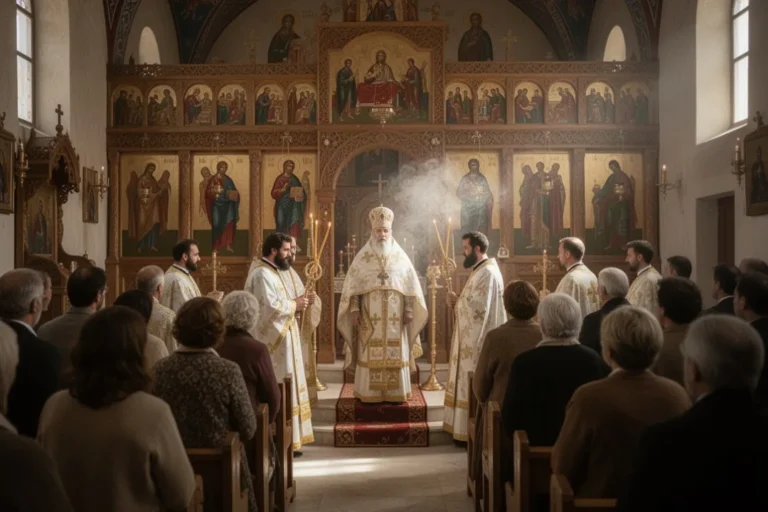
Many Eastern Catholic churches celebrate a Divine Liturgy rather than calling their principal service Mass. The service may include long sung prayers, incense, processions, repeated responses, and extensive use of icons. Congregations may stand for much of the liturgy, and the sanctuary may be separated from the nave by an icon screen or iconostasis.
The physical setting can feel very different from a Latin Catholic church. Icons are not merely religious decoration; they are part of the church’s prayer and teaching. The liturgy often presents worship as participation in the heavenly celebration, with biblical imagery, chant, and sacramental action woven together.
Eastern Catholic worship is not one uniform style. A Byzantine Divine Liturgy, a Maronite liturgy, an Armenian Divine Liturgy, and a Chaldean liturgy each have their own language, music, gestures, and theological vocabulary. Some parishes use ancient liturgical languages alongside English, Spanish, Arabic, Ukrainian, Malayalam, or other modern languages.
Common features may include:
Icons and sacred images placed throughout the church and used in personal prayer.
Incense and chanting as integral parts of the service rather than occasional additions.
Frequent standing, bows, or prostrations as expressions of prayer.
Communion under both kinds, often given through a spoon or another Eastern custom.
Infant initiation, with baptism, chrismation, and Eucharist celebrated together in many traditions.
A liturgical calendar that may differ from the calendar familiar in Roman Catholic parishes.
How Eastern Catholic and Roman Catholic practices differ
Eastern Catholic churches and the Latin Church share core Catholic beliefs, including the sacraments, the authority of the pope, and communion with one another. Their differences are primarily expressed through tradition, discipline, worship, and church organization, not through a separate Christian faith.
One visible difference concerns the Eucharistic liturgy. Roman Catholics ordinarily celebrate the Roman Rite, while Eastern Catholics celebrate the liturgy proper to their church. The prayers, calendar, vestments, music, and arrangement of the sanctuary may all be different.
Another difference concerns the clergy. In many Eastern Catholic churches, married men may be ordained priests under the church’s own discipline, although bishops are normally chosen from celibate clergy or monastics. The rules can vary by church and by location. In the Latin Church, priestly celibacy is the usual discipline, with particular exceptions.
Eastern Catholic churches also commonly administer chrismation and Eucharist to infants after baptism. Latin Catholics usually receive confirmation and first Communion later, after a period of preparation. These practices reflect different ways of organizing Christian initiation rather than disagreement about the value of the sacraments.
Fasting rules, feast days, prayer books, holy days, and terminology can also vary. A person visiting an Eastern Catholic parish should not assume that every familiar Roman Catholic custom applies in exactly the same form.
How Eastern Catholic churches differ from Eastern Orthodox churches
Eastern Catholic and Eastern Orthodox churches share much of the same ancient Christian heritage. Both may use Byzantine or other Eastern liturgies, honor icons, celebrate the sacraments or sacred mysteries, and maintain traditions shaped by the early Christian churches of the East.
The central institutional difference is communion with Rome. Eastern Catholic churches recognize the pope as holding a universal role in the Catholic Church. Eastern Orthodox churches do not accept papal authority in that form and are organized as a communion of self-governing churches led by patriarchs, metropolitans, and bishops.
The relationship between these communities is also shaped by history. Some Eastern Catholic churches emerged when portions of Orthodox or other Eastern Christian communities entered communion with Rome. Orthodox critics have sometimes viewed these unions as attempts to weaken Orthodox communities or as products of political pressure. Eastern Catholics generally describe their history as a legitimate restoration or preservation of communion with Rome.
That disagreement explains why the word “Uniate” can be sensitive. It may sound as though Eastern Catholics are defined only by leaving or departing from Orthodoxy. Many Eastern Catholics instead understand themselves as members of churches with their own apostolic identity, not as Roman Catholics who happen to use an Eastern style of worship.
Major Eastern Catholic traditions and examples
There is no single “Uniate church.” The Catholic Church recognizes multiple sui iuris churches, meaning self-governing churches with their own hierarchy, law, liturgical tradition, and history. Their names and structures differ, and some are organized around a patriarch, major archbishop, metropolitan, or other head.
Examples include the following:
Ukrainian Greek Catholic Church: A Byzantine church with deep roots in Ukrainian Christian life and a large worldwide diaspora.
Ruthenian Byzantine Catholic Church: A Byzantine Catholic tradition historically associated with Carpathian Rusyn communities and present in North America and elsewhere.
Maronite Church: An Antiochian church with a strong Lebanese heritage and a distinct liturgical tradition.
Melkite Greek Catholic Church: A Byzantine church rooted historically in the Arabic-speaking Christian communities of the Middle East.
Chaldean Catholic Church: An East Syriac church with historic connections to Mesopotamian Christianity.
Syro-Malabar Church: An East Syriac Catholic church in India with a long-standing Indian Christian identity.
Syro-Malankara Catholic Church: An Indian church using the West Syriac tradition.
Armenian Catholic Church: A Catholic church that preserves the Armenian liturgical and cultural tradition.
Coptic, Ethiopian, and Eritrean Catholic churches: Churches that preserve Alexandrian traditions within Catholic communion.
These communities are not interchangeable. A person attending a Ukrainian Greek Catholic parish is encountering a different ecclesial tradition from someone attending a Maronite or Chaldean parish, even though all are Catholic.
The expression sui iuris is Latin for “of its own law.” In Catholic usage, it describes a church that has its own legitimate governance and legal tradition within the worldwide Catholic communion. This does not mean complete independence from Rome, nor does it mean that the church has no relationship with other Catholic churches.
A self-governing Eastern Catholic church may have its own code of canon law, liturgical calendar, hierarchy, and rules for ordination or fasting. Its bishops govern the church according to its tradition, while the pope exercises his responsibilities for the universal Catholic communion.
This structure is intended to preserve legitimate diversity. Catholic unity does not require every community to use the same liturgy, follow identical clerical disciplines, or express prayer through the same cultural forms. The Eastern Catholic churches demonstrate that unity and uniformity are not identical.
Why the term “Uniate” remains controversial
The term became especially controversial because it was often used in polemical writing about relations between Catholics and Orthodox Christians. It can reduce a complex community to the fact that it is united with Rome and can suggest that the community lacks an authentic identity of its own.
Some historians still use “Uniate” when describing specific union movements, treaties, or periods of church history. Within some communities, people may also use the word informally or reclaim it. Even so, the safest general choice is Eastern Catholic, followed by the church’s actual name when possible.
Language matters most when discussing communities that have experienced conflict, displacement, or pressure to change their religious identity. A precise description should acknowledge both parts of the picture: these churches have a genuine Eastern heritage, and they are in full communion with the Catholic Church.
Respectful wording: Say “the Ukrainian Greek Catholic Church” or “an Eastern Catholic church” rather than treating “Uniate” as the community’s preferred modern name.
Can Roman Catholics attend a Uniate church?
Roman Catholics are generally welcome to attend an Eastern Catholic liturgy. Because Eastern Catholic churches are in full communion with the Catholic Church, a Catholic may normally fulfill the Sunday or holy day obligation by participating in an approved Eastern Catholic Divine Liturgy, provided the person participates in the liturgy as a Catholic rather than merely observing it.
Local customs can differ, especially concerning seating, processions, fasting, and receiving Communion. A visitor should follow the congregation’s directions and ask the priest or a parish member if the practice is unclear. Some communities invite all properly prepared Catholics to receive Communion; others may provide particular instructions for visitors.
Eastern Catholic parishes may also welcome non-Catholic visitors for prayer and worship, but reception of Communion is governed by Catholic discipline and, in some cases, by additional rules concerning Christians from other churches. Visitors should not assume that attending the service automatically means they should approach for Communion.
What to expect at your first Eastern Catholic liturgy
A first visit can be easier when you know that the service may be longer, more sung, and more physically expressive than a typical Roman Catholic Mass. The congregation may stand, bow, make the sign of the cross in a different direction, or respond with repeated prayers.
Arrive a little early so you can observe the church layout and pick up a service book if one is available.
Follow the congregation’s posture when you feel comfortable, but do not worry about getting every gesture right.
Listen for the tradition’s language, which may include English alongside Greek, Arabic, Slavonic, Syriac, Armenian, or another heritage language.
Watch the Communion procession and follow local instructions rather than assuming the Roman Catholic procedure applies.
Remain afterward if invited, since many Eastern Catholic communities share food, coffee, or conversation after the liturgy.
The service may include prayers for the pope and the local bishop, showing the church’s communion with Rome. At the same time, its music, vestments, iconography, and sacramental gestures may look unmistakably Eastern.
How Eastern Catholic churches preserve their identity
Preserving an Eastern Catholic identity involves more than retaining a particular liturgy. Churches pass on their identity through family life, feast-day customs, religious education, parish foods, music, saints, languages, pilgrimage sites, and relationships with communities in their historic homelands.
For immigrant communities, a parish may serve both as a place of worship and as a cultural center. Ukrainian, Lebanese, Indian, Romanian, Slovak, Hungarian, Armenian, and other communities have used parish life to pass traditions between generations. At the same time, many Eastern Catholic parishes are now multilingual and include members without the church’s original ethnic background.
Eastern Catholic identity can therefore be both heritage-based and open to newcomers. A person does not necessarily need to be born into the community to participate in its worship or learn its spirituality. The parish’s particular customs, however, deserve respect because they are part of a living church rather than decorative additions to a generic Catholic service.
What beliefs Eastern Catholics share with other Catholics
Eastern Catholics share the Catholic Church’s sacramental life and core doctrines. They recognize baptism, chrismation or confirmation, the Eucharist, reconciliation, anointing of the sick, marriage, and ordination, although the names, order, and ritual forms can differ by tradition.
They also share communion with the pope and with other Catholic bishops. An Eastern Catholic does not belong to a halfway category between Catholic and Orthodox Christianity. The church is fully Catholic, even when its worship and discipline are not modeled on the Latin tradition.
At the same time, an Eastern Catholic church may explain theological ideas using categories inherited from Greek, Syriac, Armenian, Alexandrian, or other Eastern traditions. This diversity is part of Catholic Christianity’s historical breadth and does not automatically indicate a doctrinal disagreement.
Why “Eastern Catholic” is usually the clearest answer
If someone asks what a Uniate church is, the simplest accurate answer is that it is an Eastern Catholic church in communion with Rome. That definition gives the essential information without implying that every such church has the same history or worship.
For a specific community, use its proper name. “Ukrainian Greek Catholic,” “Maronite,” “Melkite Greek Catholic,” or “Syro-Malabar” tells the reader much more than the broad historical label. It identifies the church’s tradition while recognizing that Eastern Catholic communities are distinct, self-governing churches rather than one standardized group.
The term can still be useful in historical discussions, especially when examining the formation of Catholic-Orthodox relationships. In contemporary conversation, however, Eastern Catholic church is usually the most precise, current, and respectful wording.
Frequently asked questions
Is a Uniate church Roman Catholic?
A Uniate church is Catholic, but it is not part of the Latin Church in the narrow sense. It belongs to one of the self-governing Eastern Catholic churches, each with its own liturgy, hierarchy, law, and spiritual tradition. Its members are in full communion with the pope while preserving an Eastern Christian heritage.
Are Eastern Catholics Orthodox?
Eastern Catholics share many traditions with Eastern Orthodox Christians, including icons, ancient liturgies, and similar spiritual practices. They differ institutionally because Eastern Catholics are in communion with the pope, while Eastern Orthodox churches are not. “Eastern Catholic” and “Eastern Orthodox” therefore describe distinct church memberships, even where worship may look similar.
Can a married man become a priest in an Eastern Catholic church?
In many Eastern Catholic traditions, married men may be ordained priests, following the discipline of their particular church. Bishops are ordinarily selected from celibate clergy or monastics. Rules may also vary by country and circumstance, so a specific parish or Eastern Catholic eparchy can provide the most accurate answer.
Do Eastern Catholic churches use the same Bible and sacraments?
Eastern Catholic churches share the Catholic sacramental life and accept the Bible as sacred Scripture. Their liturgical readings, biblical translations, prayer language, and sacramental ceremonies may differ from those commonly used in the Latin Church. The order of initiation can also vary, with baptism, chrismation, and Eucharist often administered together to infants.



Leave a Reply