What is consecration? Meaning, purpose, and practice
What is consecration? Meaning, purpose, and practice
Consecration means setting someone or something apart for God or a sacred purpose. It involves dedication, belonging, and a deliberate commitment to use a life, place, object, or time according to that purpose.
The word can describe several related practices in Christianity. A person may consecrate themselves to God through prayer and obedience. A church building may be consecrated for worship. In some traditions, people speak of consecrating themselves to Christ through Mary or another particular devotion. The exact ceremony differs, but the central idea remains the same: something ordinary is dedicated to a holy purpose.
To consecrate something is to set it apart and dedicate it. The word is closely associated with holiness, but holiness here does not mean merely being morally perfect. It includes belonging to God and being used in a way that reflects that belonging.
For example, a person might decide that their work, relationships, possessions, and daily decisions should be offered to God. A church might reserve a building for prayer, preaching, sacraments, and congregational worship. A chalice or altar may be dedicated for a particular religious use rather than ordinary household use.
Consecration therefore has both an inner dimension and an outward dimension. The inner dimension is the intention of dedication. The outward dimension includes practices, promises, ceremonies, and changes in conduct that express that intention.
Dedication: giving yourself or something you have to a sacred purpose.
Separation: treating the person, place, or object as distinct from ordinary use.
Belonging: recognizing that what has been consecrated is offered to God.
Service: directing it toward worship, love, obedience, or ministry.
Consecration is not simply making a wish while holding a religious object. It is not a guarantee that every future event will go as planned. At its heart, it is a serious act of offering and orientation: the person or thing is directed toward God.
How consecration appears in the Bible
The Bible presents consecration in several forms. People are set apart for particular work, priests are dedicated for service, sacred objects are prepared for worship, and the people of Israel are called to belong to God. These examples show that consecration can involve an individual, a community, a role, or a physical thing.
In the Old Testament, priests and worship objects are set apart through instructions involving washing, clothing, anointing, sacrifice, and ceremony. The details vary by situation, but the purpose is consistent: those who serve at the sanctuary and the objects used there are devoted to worship rather than ordinary use. Exodus 28–29 and Leviticus 8 describe priestly dedication in this setting.
Israel as a people is also described as belonging to God in a special way. This calling is connected with worship, justice, obedience, and faithful community life, not merely with possessing a religious label. The people’s consecration carries ethical responsibilities toward God and neighbor.
The New Testament places strong emphasis on the consecration of the whole person. Romans 12:1 presents Christian self-offering as a response to God’s mercy. The passage uses the language of presenting the body to God, which points to a life expressed through choices, habits, relationships, and service rather than a one-time emotional experience.
Jesus also speaks of sanctifying himself for the sake of his followers in John 17:19. The context connects his dedication with his mission and with the formation of a people who are sent into the world. First Corinthians 6:19–20 links belonging to God with honoring God through the body, making consecration practical and embodied.
These passages help prevent a narrow definition. Biblical consecration is not limited to priests, monasteries, special objects, or dramatic vows. A Christian’s ordinary life can become an offering to God through faithfulness, love, truthfulness, repentance, and service.
How consecration differs from holiness and sanctification
Consecration, holiness, and sanctification overlap, but they are not identical in every context. Their meanings depend partly on whether a person is discussing biblical theology, church practice, or everyday Christian devotion.
Consecration means being set apart
Consecration focuses on dedication and purpose. A person or object is designated for God or sacred service. The emphasis is often on a decisive act, ceremony, promise, or intentional offering.
Holiness can refer to being set apart for God, but it also describes a life that reflects God’s character. A holy life is marked by love, integrity, mercy, humility, and resistance to sin. Holiness is not merely religious separation from certain activities; it includes positive faithfulness.
Sanctification emphasizes ongoing transformation
Sanctification commonly refers to the process by which a person is made holy or grows in holiness. Christian traditions explain this process differently, but most connect it with God’s grace and a person’s continuing response through faith and obedience.
A useful distinction is this: consecration can describe the act of offering, while sanctification describes the continuing work of becoming more holy. Consecration may happen at a clearly remembered moment, but its meaning is tested over time by the life that follows.
Key distinction: Consecration is not a way to earn God’s love. It is a response to God, expressed by offering yourself for faithful relationship and service.
What personal consecration involves
Personal consecration is a deliberate commitment to place your life under God’s direction. Some people make this commitment privately in prayer. Others do so publicly through baptism, confirmation, a profession of faith, religious vows, membership promises, or a special devotional act.
The form matters less than the substance. A meaningful act of consecration should involve honest intention, not pressure or performance. You are not trying to persuade God to care about you. You are acknowledging that your life already depends on God and choosing to respond with greater trust and obedience.
Personal consecration may include several areas of life:
Your body: treating your physical life with dignity and avoiding choices that deliberately harm yourself or others.
Your mind: pursuing truth, rejecting patterns that corrupt your judgment, and allowing your beliefs to be examined honestly.
Your relationships: practicing fidelity, forgiveness, patience, and appropriate boundaries.
Your work: carrying out responsibilities with honesty and treating coworkers, customers, and clients as people rather than tools.
Your resources: using money, possessions, and time in ways consistent with worship, generosity, and responsibility.
Your future: holding plans with humility instead of assuming that control over every outcome is possible.
This does not mean that every decision becomes easy or that a consecrated person never fails. Consecration includes repentance when you fall short. The commitment is renewed through returning to God, receiving forgiveness, repairing harm where possible, and choosing faithfulness again.
How churches and religious traditions use the word
Different Christian traditions use “consecration” in distinct but related ways. Understanding the setting helps you know what someone means when they use the term.
Consecration of churches and sacred spaces
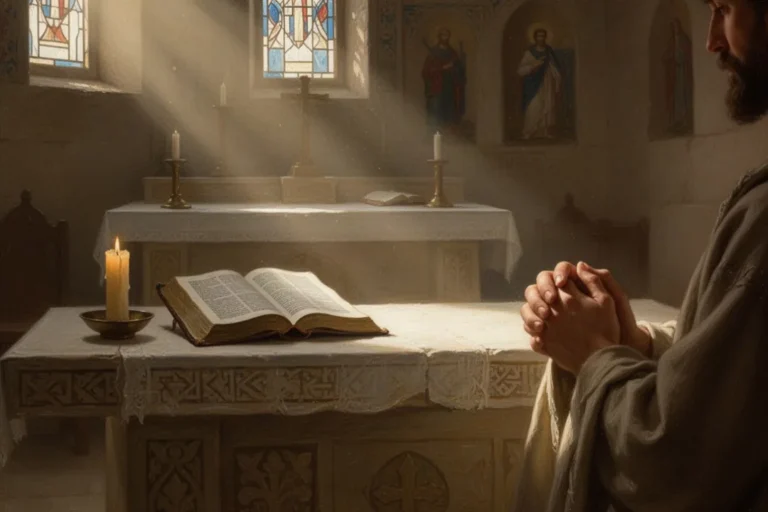
In many historic churches, a bishop or other authorized leader may consecrate a church building. The service dedicates the space to worship and may include prayers, Scripture readings, anointing, an altar dedication, and the celebration of Communion or the Eucharist, depending on the tradition.
A consecrated building is not believed to be valuable because the walls possess independent magical power. Its significance comes from being reserved for worship and gathered prayer. The ceremony gives public expression to the community’s purpose and responsibility.
Consecration of religious objects
Objects such as altars, vessels, crosses, icons, oils, or church bells may be blessed or consecrated for religious use. The distinction between “blessed” and “consecrated” varies among denominations. In some settings, consecration indicates a more formal and permanent dedication; in others, the words are used more broadly.
The object does not replace worship, faith, or moral action. Its role is to support the practices of a community and remind people of what they have dedicated themselves to.
In Catholic, Orthodox, Anglican, and other traditions, “consecrated life” often refers to people who make formal commitments to God within a recognized religious community or vocation. Monks, nuns, friars, and members of religious institutes may follow a rule of life involving prayer, community, service, and vows.
Common vows include poverty, chastity, and obedience, though their expression differs among communities. A vocation to consecrated life is not simply a stronger version of ordinary Christianity. It is a particular calling with communal structures, formation, accountability, and responsibilities.
Personal devotional consecration
Some Christians use the word for a personal dedication to Jesus Christ, the Sacred Heart, the Virgin Mary, or a particular spiritual mission. Marian consecration, for example, is understood in different ways across Catholic devotional movements. In general, it is intended to draw a person more deeply toward Christ, not to place Mary on the same level as God.
Because practices vary, read the prayers and commitments carefully, ask a trusted leader about their meaning, and avoid treating one group’s devotional language as universal to all Christians.
How to consecrate yourself in a thoughtful way
There is no single wording required for personal consecration. A simple and sincere prayer can be enough. What matters is that you understand what you are offering and are willing to let the commitment shape your conduct.
A practical process might look like this:
Clarify your intention. Decide whether you are dedicating your whole life to God, a specific season, a vocation, a ministry, or a particular area that needs renewed faithfulness.
Review your life honestly. Consider habits, relationships, ambitions, fears, and responsibilities. Identify where your stated beliefs and actual choices do not match.
Confess and release what needs to change. Bring sin, resentment, pride, and misplaced control to God. Where another person has been harmed, consider a wise and safe form of repair.
Offer yourself in prayer. Name your body, mind, work, relationships, possessions, and future as areas you want to place under God’s direction.
Choose concrete practices. Set a manageable rhythm of prayer, worship, Scripture, generosity, service, rest, and accountability.
Seek wise support. A pastor, priest, spiritual director, or mature believer can help you interpret the commitment without unnecessary fear or exaggeration.
Review the commitment over time. Notice where you are growing, where you are resisting, and what needs adjustment. Renewal should lead to deeper faithfulness rather than repeated emotional pressure.
A personal prayer might express these ideas in your own words: “God, I offer myself to you. Direct my desires, decisions, work, relationships, and resources. Help me live with faithfulness, humility, and love. Correct me when I turn away, and make my life useful for what is good.” The wording is less important than truthful surrender and practical obedience.
Practical tips and common mistakes to avoid
Consecration can be deeply meaningful, but confusion about it can create anxiety or unrealistic expectations. The following guidelines help keep the practice grounded.
Do not treat consecration as a transaction. You are not giving something to God in exchange for guaranteed health, wealth, protection, or a specific outcome.
Do not confuse intensity with sincerity. Strong emotion can accompany a genuine commitment, but a quiet decision can be equally sincere.
Do not make promises you cannot understand or keep. Ask what a vow or devotional commitment requires before making it publicly or permanently.
Do not use consecration to avoid ordinary responsibilities. Serving God does not excuse neglecting family duties, work obligations, financial commitments, or personal safety.
Do not assume one ceremony changes every habit instantly. A dedicated life still requires learning, discipline, repentance, and help.
Do not let another person control your conscience. Religious leaders can offer guidance, but coercion, threats, financial exploitation, and demands for secrecy are warning signs.
Do not use sacred language to justify harm. No spiritual commitment gives permission for abuse, manipulation, discrimination, or illegal behavior.
Do connect devotion with love of neighbor. If a practice makes you proud, cruel, dishonest, or contemptuous, its effect needs serious examination.
Practical test: A genuine consecration should make your life more truthful, loving, responsible, and available for service—not more fearful, controlling, or self-important.
What consecration does and does not change
Consecration changes the direction and meaning of a person’s life. Work can become an arena for integrity and service rather than only income or status. Possessions can become resources for hospitality and generosity. Time can be arranged around worship, relationships, rest, and responsibility rather than constant distraction.
It does not automatically change your circumstances. You may still experience illness, financial pressure, grief, temptation, conflict, or uncertainty. A consecrated life is not a promise that suffering will disappear. It is a commitment to face life with God, to seek wisdom, and to act faithfully within circumstances you cannot fully control.
Consecration also does not erase personality or legitimate desires. The goal is not to become passive or emotionally blank. Instead, desires are examined and ordered toward what is good. Ambition may become responsible leadership. Creativity may become service. A desire for security may be balanced by trust and generosity.
For many Christians, the deepest change is a shift from self-ownership to grateful stewardship. This does not mean that you have no agency. It means you understand your agency as accountable to God and connected to the well-being of others.
How consecration relates to baptism and church membership
In many Christian traditions, baptism is a foundational act of belonging to Christ and entering the Christian community. It can therefore be understood as a profound form of dedication, although churches explain its meaning in different ways. A later personal consecration should not be treated as a replacement for baptism where baptism is central to the tradition.
Church membership, confirmation, profession of faith, and communion may also express belonging and commitment. Personal consecration can renew or deepen these commitments, but it should not become a way to compete with the church or claim superior spiritual status.
The connection between private devotion and community matters. A person who dedicates themselves to God still needs teaching, correction, fellowship, worship, and opportunities to serve. Consecration is personal without being isolated.
How to know whether a consecration commitment is healthy
A healthy commitment is clear enough to understand, freely chosen, and consistent with the central demands of love, truth, and responsibility. It leaves room for questions and does not depend on fear of punishment from a person or group.
Before making a formal vow or joining a devotional program, ask yourself:
What exactly am I promising?
Who has authority to interpret or enforce this commitment?
Can I ask questions without being shamed?
What practical changes will this require?
Does the commitment respect my health, freedom, relationships, and legal responsibilities?
How will I receive guidance and accountability?
What happens if I fail or later need to reconsider?
A trustworthy religious community will take these questions seriously. It will not claim that a ceremony makes you spiritually superior or that questioning the practice proves disloyalty. Mature guidance recognizes that freely given devotion is more meaningful than pressured compliance.
Why consecration remains meaningful
Consecration gives a person a language for saying, “My life is not only mine to consume.” It connects beliefs with decisions and turns worship into a pattern of living. In a culture where commitments can feel temporary, a deliberate act of dedication can provide clarity and direction.
Its value is not measured by how dramatic the ceremony sounds. It is seen in ordinary choices: telling the truth when dishonesty would be easier, keeping a promise, treating someone with dignity, accepting correction, using resources generously, and returning to God after failure.
In that sense, consecration is both a moment and a practice. The moment establishes an intention; the practice gives that intention substance. A life consecrated to God is continually being offered through faith, obedience, repentance, love, and service.
Frequently asked questions
Is consecration the same as salvation?
No. In most Christian teaching, salvation is understood as God’s saving work received through faith and grace, while consecration is a person’s dedication to God. Consecration may be a response to salvation, a renewal of faith, or a commitment to a particular vocation. It should not be treated as a ritual that earns forgiveness or guarantees a place with God.
Can anyone consecrate themselves to God?
A person can make a sincere personal dedication to God through prayer and a changed pattern of life. Formal consecrations involving vows, religious communities, churches, or sacred objects may require an authorized minister or follow denominational rules. If the commitment is public or permanent, seek guidance first so you understand its promises and responsibilities.
Do I need a special prayer or ceremony to consecrate myself?
No universal wording is required for a private act of dedication. You can pray honestly, confess what needs to change, offer your life to God, and choose practical habits that support the commitment. A church ceremony can provide structure and accountability, but the sincerity of the offering matters more than elaborate language.
What should I do if I regret a consecration vow?
Do not respond by panicking or making additional promises. Review the wording and circumstances, then speak with a trustworthy pastor, priest, or spiritual director who understands your tradition. If coercion, abuse, financial pressure, or threats were involved, prioritize safety and seek appropriate support. Many commitments can be clarified, amended, or formally released according to church practice.


Leave a Reply