Catholic Protestant difference: beliefs and practices
Catholic Protestant difference: beliefs and practices
The central Catholic Protestant difference is that Catholicism recognizes the Church’s teaching authority alongside Scripture, while Protestant traditions generally treat Scripture as the highest or sole infallible authority.
Both Catholics and Protestants are Christian traditions centered on Jesus Christ. They share core beliefs such as the Trinity, Jesus’ death and resurrection, the importance of baptism, and the authority of the Bible. The differences developed through centuries of theological debate, church reform, and varied interpretations of Christian teaching.
“Protestant” does not describe one single church. It includes many traditions, such as Lutheran, Baptist, Methodist, Presbyterian, Anglican, Pentecostal, and Reformed churches. As a result, a belief that is typical of one Protestant denomination may not apply to another.
Keep the categories separate: Catholicism is one worldwide church with a defined teaching structure, while Protestantism is a broad family of independent traditions. General comparisons are useful, but local churches and individual believers may differ.
The Protestant Reformation began in the early 16th century in Western Europe. Reformers criticized aspects of late medieval church life and argued for changes involving church authority, salvation, worship, and the use of Scripture. Martin Luther, John Calvin, Huldrych Zwingli, and other reformers helped shape different Protestant movements.
The Catholic Church responded through internal reforms and the Council of Trent, which clarified Catholic teaching and addressed serious problems in church administration. The divisions that followed were not caused by one disagreement alone. They involved theology, politics, church power, language, education, and disputes over money and practice.
Before the Reformation, Western Christianity was organized primarily around the Catholic Church, although it already included different local customs and theological schools. The Reformation produced separate church bodies, while the Catholic Church retained its own structures and renewed its discipline and teaching.
Today, Catholic and Protestant Christians often cooperate in community service, Bible study, charitable work, and efforts toward Christian unity. Still, the historical separation remains visible in their teachings and worship.
How Catholics and Protestants understand authority
Authority is one of the deepest Catholic Protestant differences. Catholics look to Scripture, Sacred Tradition, and the teaching office of the Church, often called the Magisterium. In Catholic understanding, the Church has a continuing responsibility to interpret Scripture faithfully and preserve the apostolic faith.
Catholic teaching does not treat tradition as a collection of human opinions that can replace the Bible. Instead, it understands Scripture and apostolic Tradition as closely connected sources of Christian revelation. The pope and bishops have a role in formally teaching doctrine, especially when speaking through recognized church authority.
Most Protestant traditions emphasize sola Scriptura, a Latin phrase meaning “Scripture alone.” This usually means that the Bible is the final infallible authority for Christian faith and practice. It does not necessarily mean that Protestants reject all tradition, historical theology, or church teachers. Many Protestant churches value creeds, confessions, commentaries, and historic Christian statements, but they place them under biblical authority.
Protestants differ among themselves in how they interpret the Bible. Some follow detailed confessions, while others give more room to individual or congregational interpretation. Some churches have bishops and formal statements of belief; others are governed mainly by pastors, elders, or local congregations.
Catholic approach: Scripture is interpreted within the living Tradition of the Church and under the teaching authority of the bishops in union with the pope.
Protestant approach: Scripture is the final standard, with interpretation shaped by the Holy Spirit, Christian tradition, denominational teaching, pastors, and the local church.
Shared conviction: Both traditions treat the Bible as essential to Christian faith and worship.
What Catholics and Protestants teach about salvation
Both Catholics and Protestants teach that salvation comes through God’s grace and depends on Jesus Christ, not on human achievement alone. Both also affirm that faith matters deeply and that Christians are called to live in obedience, love, and holiness.
The difference often appears in how each tradition explains the relationship among grace, faith, justification, good works, and the sacraments. Many Protestant traditions emphasize justification by faith alone, or sola fide. In this framework, sinners are declared righteous before God through faith in Christ, not because they have earned acceptance through religious works.
Protestant churches generally teach that good works are the fruit or evidence of genuine faith rather than the basis on which a person earns salvation. The exact explanation varies. Lutheran and Reformed traditions, for example, discuss justification in somewhat different ways, while Wesleyan traditions often emphasize the transforming effects of grace and the believer’s growth in holiness.
Catholic teaching also insists that salvation begins with God’s grace and cannot be earned as a human accomplishment. Catholics describe justification as both forgiveness and inner renewal. Faith must be active through love, and a Christian cooperates with grace through a life of discipleship, including prayer, moral action, and participation in the sacraments.
This means the familiar contrast “Protestants believe in faith, while Catholics believe in works” is inaccurate. Catholics believe faith is necessary, and Protestants generally believe that living faith produces good works. The more precise disagreement concerns how justification occurs, how grace changes the believer, and how faith and obedience relate to final salvation.
Helpful distinction: Neither side teaches that Christians can save themselves by being morally impressive. The disagreement is about the biblical and theological explanation of how God’s grace, faith, works, and church life fit together.
Why the sacraments differ between Catholic and Protestant churches
The Catholic Church recognizes seven sacraments: Baptism, Confirmation, the Eucharist, Penance or Reconciliation, Anointing of the Sick, Holy Orders, and Matrimony. Catholics understand these as effective signs of grace instituted by Christ and entrusted to the Church.
Most Protestant churches recognize two ordinances or sacraments: baptism and the Lord’s Supper. They identify these as practices directly commanded by Jesus. Some Protestant traditions call them sacraments, while others prefer “ordinances” to stress that these practices symbolize or publicly express God’s grace rather than operate as channels of grace in the Catholic sense.
There are also important differences within Protestantism. Lutherans and Anglicans generally have a stronger sacramental understanding of baptism and Communion than many Baptists or non-denominational churches. Some Protestant groups baptize infants, while others baptize only people who personally profess faith in Christ.
Catholic baptism is commonly administered to infants or adults and is understood to remove original sin and begin the person’s life in the Church. Many Protestant churches that practice infant baptism understand it as a sign of God’s covenant or the child’s welcome into the Christian community, followed later by personal profession of faith.
The Catholic sacraments of Confirmation, Reconciliation, and Anointing of the Sick do not have direct equivalents in every Protestant tradition. Some Protestants practice confession, prayer for healing, anointing, or confirmation-like ceremonies, but their meaning and status differ.
How Catholics and Protestants understand Communion
The Eucharist, also called Holy Communion or the Lord’s Supper, is central to both traditions, but its meaning differs significantly. Catholics believe that the bread and wine truly become the Body and Blood of Christ while retaining the appearances of bread and wine. Catholic theology calls this change transubstantiation.
In the Catholic Mass, the Eucharist is not viewed as a simple reminder. It is a sacred participation in Christ’s one sacrifice, made present sacramentally. Catholics receive Communion as an act of worship and unity with Christ and the Church.
Protestant beliefs about Communion range widely. Lutherans generally affirm Christ’s real presence in the sacrament, although they explain it differently from Catholic transubstantiation. Anglicans and some other traditions also use language of real or spiritual presence.
Many Reformed, Baptist, and non-denominational churches emphasize Communion as a memorial meal and a public expression of faith. They may believe that Christ is present spiritually with believers without accepting the Catholic doctrine of a substantial change in the elements.
The frequency also varies. Catholics usually celebrate the Eucharist at every Mass, while Protestant churches may observe Communion weekly, monthly, quarterly, or according to local practice.
What Catholics and Protestants believe about Mary and the saints
Catholics give Mary a distinctive place as the Mother of Jesus and a model of faithful discipleship. Catholic doctrine includes teachings about her perpetual virginity, Immaculate Conception, and Assumption. The Immaculate Conception refers to Mary’s conception without original sin; it does not refer to Jesus’ conception.
Catholics honor Mary but do not consider her divine. They distinguish veneration, an honor given to saints, from worship, which belongs to God alone. Catholic prayer asking Mary or another saint to intercede is understood as requesting the prayers of fellow members of Christ’s body, not treating the saint as a rival to God.
Protestant views of Mary vary, but most Protestants honor her as the mother of Jesus and a faithful servant of God. They typically do not accept all Catholic Marian doctrines and usually do not ask Mary or the saints for intercession. Many Protestants stress that Jesus Christ is the unique mediator between God and humanity.
Most Protestant churches also reject the Catholic practice of formally invoking saints. Some Anglicans and Lutherans retain calendars of saints and honor historical Christian figures, but this does not always include praying to them. The differences involve both theology and the practical shape of private devotion and public worship.
How church leadership differs between Catholics and Protestants
The Catholic Church has a global hierarchical structure. The pope serves as the bishop of Rome and the visible leader of the worldwide Catholic Church. Bishops oversee dioceses, priests ordinarily lead local parishes, and deacons assist in liturgy and ministry.
Catholic teaching describes the bishops as successors of the apostles. The pope and bishops share responsibility for teaching, governing, and sanctifying the Church. Catholic clergy are normally ordained through a sacramental ministry, and the priesthood is central to celebrating the Eucharist and administering several sacraments.
Protestant church structures are much more varied. Some denominations, including Episcopal and Methodist bodies, have bishops or comparable regional leaders. Presbyterian churches are governed through councils of elders, while many Baptist and non-denominational churches give substantial authority to the local congregation.
Protestant pastors, ministers, elders, and priests may lead worship, preach, administer baptism and Communion, and provide pastoral care. Their ordination and responsibilities depend on the denomination. Many Protestant traditions permit women to serve as pastors or ministers, while others restrict ordained leadership to men.
The Catholic Church does not ordain women to the priesthood. Catholic priests ordinarily promise celibacy in the Latin Church, although married priests exist in some Eastern Catholic communities and certain other circumstances. Protestant rules regarding marriage and clergy vary widely, and many Protestant ministers are married.
How Catholic and Protestant worship services compare
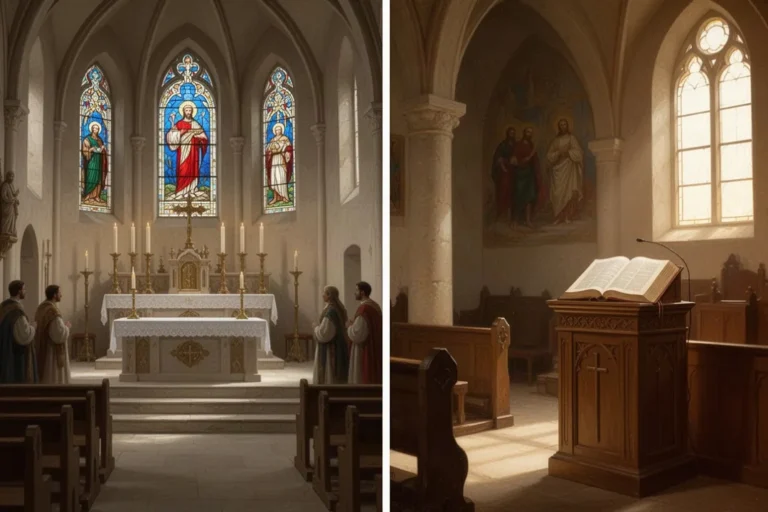
A Catholic worship service is called the Mass. Its structure includes readings from Scripture, a homily, prayers, the creed on many Sundays, and the Eucharistic liturgy. The altar, vestments, sacred calendar, and sacramental actions give Catholic worship a formal and consistent shape across the world, although local music and customs differ.
Protestant worship may include Scripture readings, preaching, prayer, singing, baptism, and Communion. In many Protestant churches, the sermon has a particularly prominent place. Worship styles can range from highly traditional liturgy with robes and set prayers to informal services with contemporary music and extended teaching.
Both traditions use music, prayer, Scripture, and preaching, but they often assign them different emphasis. Catholic worship is organized around the Mass and the Eucharist, while many Protestant services are organized around the proclamation of Scripture and the congregation’s response in faith.
Neither category is completely uniform. Anglican and Lutheran services may look very similar to Catholic worship in their use of liturgy, while a non-denominational Protestant service may have a very different atmosphere and structure.
How the Bible differs in Catholic and Protestant Bibles
Catholic and Protestant Bibles share the same central books, including the four Gospels and the letters of the New Testament. The main difference concerns several books in the Old Testament, which Catholics call deuterocanonical books and Protestants generally call the Apocrypha or do not include in their Old Testament.
Catholic Bibles include books such as Tobit, Judith, Wisdom, Sirach, Baruch, and First and Second Maccabees, along with additional passages in Esther and Daniel. Protestant editions generally follow the shorter Old Testament collection associated with the Hebrew Bible. Some Protestant Bibles print the additional books in a separate Apocrypha section, while others omit them.
The New Testament collection is the same in standard Catholic and Protestant Bibles. Differences in translation, notes, study features, and ordering can still affect how readers encounter the text.
For both traditions, reading the Bible is more than a private exercise. Catholics read it within the Church’s liturgy and teaching tradition. Protestants often emphasize personal Bible study, preaching, small groups, and the responsibility of believers to test teaching against Scripture.
Common mistakes when comparing Catholics and Protestants
Calling Protestantism a single denomination: Compare specific traditions when possible, such as Catholic and Lutheran or Catholic and Baptist.
Assuming Catholics do not believe in grace: Catholic teaching places divine grace at the beginning and throughout the process of salvation.
Assuming Protestants reject all tradition: Many Protestant churches rely on creeds, confessions, historic prayers, and established forms of worship.
Confusing Mary’s Immaculate Conception with Jesus’ virgin birth: The first concerns Mary’s conception; the second concerns the conception and birth of Jesus.
Describing Catholic prayer to saints as worship: Catholics distinguish worship of God from requests for a saint’s intercession.
Assuming every Protestant church teaches symbolic Communion: Some Protestant traditions affirm Christ’s real presence in the Lord’s Supper.
Using “born again” as a simple Catholic-Protestant dividing line: Catholics also speak about conversion, new life, and rebirth through baptism and faith.
Judging beliefs only by outward style: A quiet service may still express deep conviction, and a contemporary service may still contain historic Christian theology.
Practical ways to compare a Catholic and Protestant church fairly
If you are deciding where to worship or trying to understand someone else’s beliefs, begin with the church’s own official teaching. A local congregation may use a label broadly, and its actual practices may not represent every church with the same name.
Ask what the church recognizes as authoritative. Find out how it relates Scripture to tradition, creeds, pastors, councils, and denominational statements.
Ask what happens in baptism and Communion. These practices reveal how the church understands grace, belonging, Christ’s presence, and the life of the congregation.
Listen for its explanation of salvation. Pay attention to how the church describes faith, repentance, good works, assurance, perseverance, and the role of the sacraments.
Observe who leads the church. Learn whether authority belongs to a pope and bishops, denominational officers, elders, pastors, or the local congregation.
Ask how the church views Mary and the saints. This can clarify differences in prayer, intercession, Christian history, and devotion.
Compare actual worship rather than stereotypes. Consider the place of preaching, Eucharist or Communion, music, confession, silence, Scripture reading, and congregational participation.
Use specific terms carefully. “Catholic” usually refers to the Roman Catholic Church in everyday American speech, while “Protestant” requires further clarification.
Respectful comparison does not require pretending that the differences are minor. The questions of authority, salvation, sacraments, and church leadership affect how Christians worship and understand their relationship with God. At the same time, accurate comparison recognizes the substantial Christian beliefs Catholics and Protestants share.
Where Catholics and Protestants agree
Despite their divisions, Catholics and Protestants share a large foundation of Christian belief. Both affirm one God in three persons, the full significance of Jesus Christ, his death and resurrection, the need for repentance, and the hope of eternal life.
Both traditions also affirm the value of baptism, prayer, Scripture, Christian community, and moral living. They teach that Christians should love God and neighbor, care for people in need, resist sin, and grow in holiness.
The shared center is not enough to erase real theological disagreements, but it helps explain why Catholics and Protestants often recognize one another as fellow Christians. Discussions are most productive when they preserve both parts of the picture: shared faith in Christ and significant differences in doctrine and practice.
Frequently asked questions
Are Catholics and Protestants both Christians?
Yes. Catholics and Protestants are both Christian traditions that confess faith in Jesus Christ, his death and resurrection, and the Triune God. They differ over authority, salvation, sacraments, church leadership, Mary, the saints, and some biblical books. “Protestant” covers many denominations, so the beliefs of a Baptist church may differ considerably from those of a Lutheran or Anglican church.
Do Catholics believe they can earn salvation through good works?
No. Catholic teaching says salvation begins with God’s grace and depends on Jesus Christ. Catholics do believe that faith must become active through love and that Christians cooperate with grace through obedience, sacraments, and a transformed life. Many Protestants instead describe justification as a declaration received through faith alone, while also teaching that genuine faith produces good works.
Why do Catholics pray to Mary and the saints?
Catholics ask Mary and the saints to pray for them, much as a Christian might ask another believer for prayer. They do not consider Mary or the saints to be gods, and Catholic teaching reserves worship for God. Most Protestant churches honor biblical figures and historical saints but generally direct all prayer to God and do not seek the intercession of departed saints.
Can a Protestant receive Communion at a Catholic Mass?
Ordinarily, Catholic Communion is reserved for Catholics who share Catholic faith in the Eucharist and are properly prepared to receive it. Limited exceptions may apply in particular circumstances under Catholic rules, especially for certain Eastern Christians. Practices differ among Protestant churches, so a visitor should ask the local congregation about its Communion policy rather than assume all churches follow the same approach.


Leave a Reply