Litanies are structured prayers made of repeated invocations and responses. Usually, one person or a leader names titles, virtues, needs, or saints, and everyone answers with a short prayer such as “pray for us” or “have mercy on us.” You can pray a litany alone, with a family, or with a congregation.
The repetition is not meant to add empty words. It gives prayer a steady rhythm, gathers attention, and helps you return to a central request. Different litanies focus on God’s mercy, the life of Christ, the Virgin Mary, the saints, or a particular spiritual need.
The word litany refers to a form of supplication, or humble petition. Its usual pattern is simple: a series of short invocations followed by a repeated response. This form appears especially often in Catholic worship, although Christians in other traditions also use responsive prayers with similar structures.
A litany may begin with direct prayers to God, continue with requests for forgiveness or protection, and end with a concluding prayer. Some are addressed to the Holy Trinity; others ask Christ for mercy, honor Mary through biblical titles, or seek the intercession of saints.
The person praying does not need to analyze every line while saying it. A litany works through its cumulative movement. One invocation may ask for wisdom, another for courage, and another for peace. Together, the petitions express a fuller desire to live faithfully and to receive help for real circumstances.
“Lord, have mercy” is one of the simplest examples of a repeated Christian response.
Repeated prayer can also shape the heart over time. When you say the same response after many different petitions, you acknowledge that different concerns can be brought before the same God. The form encourages humility, persistence, and attention rather than hurried, improvised speech.
How the call-and-response structure works
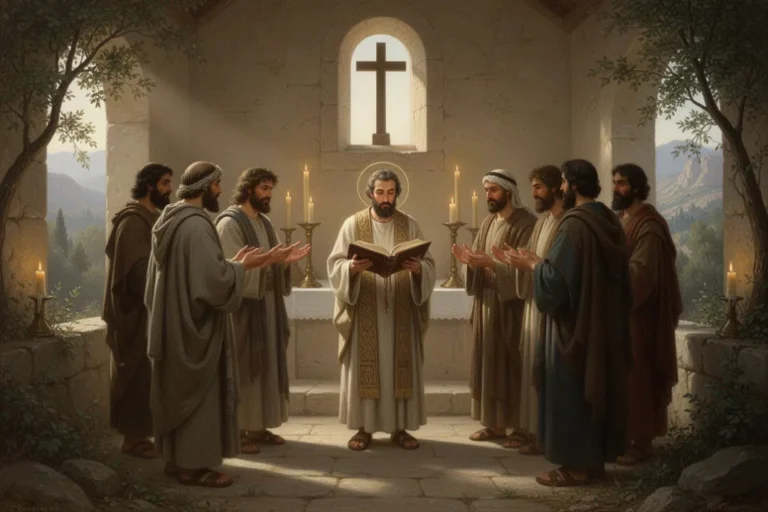
Most litanies divide the prayer into two parts. The invocations are short addresses or requests, while the responses are repeated answers from the congregation or from the person praying alone. A leader may say, “For peace in our homes,” and the group may respond with a line asking God to hear the prayer.
The response varies according to the litany. Common responses ask God to have mercy, ask Christ to hear the prayer, or ask a saint to pray for those making the request. These words should not be treated as a magic formula. Their purpose is to express dependence on God and to keep the community praying together.
In a group setting, the leader should leave enough space for the response to be heard clearly. The congregation does not need to speak loudly or dramatically. Steady pacing helps people listen to the invocations and participate rather than merely follow a printed page.
When praying alone, you can read both parts aloud, alternate them silently, or use the response after each invocation. Some people pause briefly after each line to consider its meaning. Others use a slow pace and let the repetition become a form of recollection.
Leader: reads the invocation or petition.
People: answer with the prescribed response.
Leader: continues through the list of requests or titles.
Everyone: prays the concluding prayer, when the litany includes one.
Helpful principle: Repetition should support attention, not replace it. If your mind wanders, return gently to the meaning of the current invocation and the response.
Why litanies use repetition
Repetition gives a litany its recognizable character, but it also serves several practical purposes. First, it makes participation easier. Once the response is known, people can join the prayer without having to read every line or prepare a personal speech.
Second, repetition creates continuity between different needs. A litany may move from personal concerns to family life, the Church, public leaders, the sick, the poor, and those who have died. The same response links these concerns in one act of prayer.
Third, repeated language can slow the pace of prayer. Many people arrive at prayer with scattered attention. A familiar response gives the mind something stable to return to while the invocations broaden the focus.
Repetition does not guarantee a particular emotional experience. You may feel comforted, distracted, peaceful, or unchanged. The value of a litany does not depend on strong feelings. Faithful prayer can remain worthwhile when it feels ordinary, provided you are making a sincere effort to attend.
The form also teaches that prayer is not limited to polished personal language. You do not have to find original words for every need. A traditional litany gives you a shared vocabulary of faith that can carry you when you are tired, grieving, or unsure how to pray.
Major kinds of litanies and their purposes
Litanies differ in subject and tone. Some are used in the liturgy or during special services, while others are prayed privately or in devotional gatherings. The title of a litany usually indicates its main focus, but the same prayer may serve more than one purpose.
Litanies addressed to God
These prayers focus directly on God’s nature and saving work. The Litany of the Holy Name of Jesus, for example, invokes the name and titles of Christ while asking for mercy and help. Other prayers emphasize the Trinity, divine providence, repentance, or trust.
These litanies are useful when your prayer needs to remain centered on God rather than on a particular saint or personal problem. They can help you praise, repent, and ask for grace within a single pattern.
Litanies focused on Christ
Christ-centered litanies often reflect on the identity, ministry, suffering, resurrection, or mercy of Jesus. The Litany of the Sacred Heart of Jesus uses titles associated with Christ’s love and compassion. It is often prayed as an expression of trust, reparation, and devotion.
A Christian who prays such a litany is not treating titles as unrelated descriptions. The invocations point toward the one person of Christ and invite the person praying to consider how his love meets human weakness.
Marian litanies
Marian litanies honor Mary through titles drawn from Scripture, Christian tradition, and the Church’s devotional language. The Litany of Loreto is the best-known example in Catholic practice. Its invocations include titles such as Mother, Virgin, and Queen, followed by a request for her prayer.
These prayers do not place Mary on the same level as God. Their purpose is to honor her role in the story of salvation and to ask for her intercession. The closing petitions direct the person praying toward Christ, whose mercy remains the foundation of Christian prayer.
Litanies of the saints
The Litany of the Saints calls on a broad range of holy men and women, beginning with prayer to God and continuing through requests for the saints’ intercession. It may be used in significant worship services, processions, vigils, or other communal settings.
This form expresses the belief that the Church includes believers on earth and those already with God. It can also remind the congregation that holiness has appeared in many times, cultures, vocations, and circumstances.
Litanies for mercy, healing, or protection
Some litanies emphasize a particular spiritual concern. A prayer for mercy may help a person face sin honestly. A prayer connected with the sick may give a family words for fear, hope, and endurance. A prayer for protection may be used during uncertainty or danger.
These litanies should not be treated as guarantees that a desired outcome will occur. Their purpose is to place a need before God, ask for grace, and strengthen trust. Prayer can accompany medical care, practical action, pastoral support, and responsible decisions; it should not be used as a substitute for them.
How to pray a litany by yourself
You can pray a litany at any time, but a simple setting often makes it easier to remain attentive. Choose a quiet place, silence unnecessary notifications, and decide whether you will pray aloud or silently. A printed text or trusted prayer resource can help you keep your place.
Choose the purpose. Decide whether you are praying for repentance, gratitude, a person in need, a feast day, or a general intention.
Begin slowly. Read the opening prayer and notice who is being addressed.
Pray each invocation distinctly. Avoid racing through the list simply because the responses repeat.
Bring a specific intention to mind. Connect broad petitions with an actual person, situation, or virtue.
Use silence when helpful. Pause after a group of invocations or before the concluding prayer.
End without rushing away. Remain quiet for a moment and consider one request you want to carry into the day.
If you are new to litanies, begin with a short prayer rather than choosing the longest text available. Learn what the repeated response means, then pray at a pace that allows you to hear each line. Over time, you may find that a familiar litany can be prayed from memory without losing its meaning.
Some people keep a small list of intentions beside the prayer book. This can prevent the litany from becoming vague. For example, when praying for the sick, you might remember a relative awaiting treatment, a neighbor recovering at home, and people who lack access to care.
A group litany needs clear leadership more than elaborate preparation. The leader should select an appropriate text, tell participants when to respond, and make sure everyone has access to the words. If the response is printed separately or repeated aloud first, people can participate with confidence.
The leader’s voice should be calm and distinct. Invocations are usually easier to follow when they are read at a measured pace with a brief pause before the response. A microphone may be useful in a large room, but amplification should preserve the prayer’s natural character rather than make it sound theatrical.
Groups may add intentions connected with a local event, season, or pastoral need, but additions should fit the form and theology of the prayer. If the litany belongs to an official service, follow the directions of the parish, congregation, or worship leader rather than changing the text independently.
Children and newcomers can participate when the structure is explained simply. You might say that the leader names a person, quality, or need and that everyone answers together. Giving the group time to learn the response is more effective than assuming everyone already knows it.
Practical tips and common mistakes when praying litanies
A litany is simple to use, but a few habits can make the prayer either more attentive or more mechanical. The goal is not perfect performance. It is to let the form serve honest prayer.
Do not rush the responses. Repeated words still deserve clear pronunciation and attention.
Do not treat the prayer as a spell. A litany expresses faith and petition; it does not control God or guarantee a result.
Do not choose a text solely because it is familiar. Select a litany whose theme fits the need you are bringing to prayer.
Do not force emotional intensity. A quiet, distracted prayer can still be sincere and faithful.
Do not change approved wording casually. If the litany is part of a formal service, use the authorized version provided by your tradition.
Do not ignore the meaning of titles. If an expression is unfamiliar, learn its basic meaning instead of repeating it without understanding.
Do not make every petition personal. Include other people, the wider community, and those who are suffering.
Do not let a long list replace silence. A short pause can help the petitions reach the heart.
Another common mistake is expecting a litany to solve a problem immediately. Prayer can change your perspective, strengthen patience, and open you to wise action, but it does not remove the need for conversations, medical attention, reconciliation, or practical help.
For a group: Give participants the response in advance, announce any unfamiliar pronunciation, and pause long enough for everyone to answer together. Clear guidance makes the prayer more welcoming.
How litanies relate to Scripture and tradition
Litanies are not usually a series of Bible verses quoted line by line. Still, many of their themes come from Scripture. Biblical prayer repeatedly asks for mercy, praises God’s holiness, seeks wisdom, remembers the poor, and calls people to trust God.
The Gospel of Luke presents Mary as blessed among generations, and the Gospel of John presents Jesus as the source of life and the shepherd of his people. These themes help explain why Christian tradition uses titles for Mary and Christ in devotional prayer. The titles are meant to direct attention to the biblical story, not replace it.
The Psalms also provide a strong background for responsive prayer. They move between praise, confession, lament, thanksgiving, and petition. A litany can gather these same movements into a repeated structure that is easier for a group to pray together.
Tradition contributes the particular wording and order of many litanies. Because texts can differ by denomination, language, edition, or liturgical approval, use a reliable prayer book or the version provided by your church. When a prayer is connected to public worship, local instructions take priority.
Choosing the right litany for a specific need
Your choice can begin with the kind of prayer you need rather than with the most famous title. If you want to ask for forgiveness, choose a penitential or mercy-focused litany. If you are preparing for a feast or devotional observance, a litany associated with that season may be fitting.
For repentance: choose a prayer that names sin, mercy, conversion, and renewed obedience.
For grief: choose a prayer that allows lament, hope, comfort, and remembrance.
For the sick: use a prayer that asks for healing, strength, wise care, and peace.
For family prayer: choose a text with a response that children and adults can learn easily.
For a parish or community: select petitions that include justice, peace, leaders, neighbors, and people in need.
For personal spiritual growth: use a litany focused on virtues such as humility, courage, patience, or charity.
You can also choose according to the time available. A short litany may fit into a morning routine, while a longer one may suit a retreat, vigil, or dedicated prayer period. Length alone does not determine depth; a few attentive petitions can be more fruitful than many words spoken without awareness.
Using litanies in daily and seasonal prayer
A litany can become part of a regular routine without turning into a checklist. You might pray one on a particular weekday, during a season of preparation, or whenever a recurring need calls for steady intercession. Keeping the practice modest makes it more sustainable.
Many communities use responsive prayers during seasons such as Advent, Lent, or times of public crisis. The choice of petitions may reflect the season’s themes: waiting, repentance, hope, compassion, or renewed commitment. In a household, one person can lead while others take turns naming intentions before the response.
Personal prayer can include a litany after another devotion, before a difficult conversation, or at the end of the day. You do not need to add several prayers simply to make the routine longer. A single litany prayed attentively can be enough for that moment.
When a litany becomes familiar, let that familiarity deepen rather than flatten the prayer. A phrase you once passed over may speak differently after illness, loss, parenthood, service, or a major decision. The words remain the same, but your understanding of the need behind them may change.
What litanies can teach about intercession
Intercession means praying on behalf of others. Litanies make this practice visible because they move beyond the private “I” and give names to many kinds of people: the sick, the poor, those who govern, families under strain, travelers, the persecuted, and those who have died.
This broad movement can correct a narrow view of prayer. Your immediate concerns matter, but they do not exhaust the needs of the world. A litany trains you to hold several concerns together without pretending that you can solve them all yourself.
When a litany asks a saint to pray, it expresses a belief in the communion of saints and in the unity of the Church. When it asks God directly for mercy, guidance, or healing, it expresses dependence on God as the source of grace. The exact language depends on the tradition, but the central purpose is prayerful reliance rather than spiritual control.
Intercession should also lead to responsible compassion. If you pray for the hungry, consider how you can respond to hunger. If you pray for reconciliation, examine the words or actions that may be required of you. The litany does not replace service; it can prepare and direct it.
When a litany may not be the best choice
A litany is not the only valid form of prayer. You may need silence, a psalm, personal confession, conversation with a pastor, or a direct request in your own words. Choosing a different form is not a failure to pray correctly.
A litany may be less suitable when a group does not understand the language, when the text is too long for the setting, or when repeated responses make participation difficult. In those cases, a shorter responsive prayer or a few carefully chosen petitions may serve the community better.
If you are facing a mental health crisis, abuse, medical emergency, or immediate danger, prayer should be joined with appropriate professional, pastoral, or emergency support. A litany can accompany help, but it should never be presented as a replacement for safety measures or qualified care.
The strength of litanies lies in their balance of structure and openness. The words give you a path, while the intentions allow the prayer to meet a real person and a real situation. Used attentively, they turn repeated responses into a disciplined way of asking, praising, remembering, and trusting.
Frequently asked questions
Can I pray a litany alone?
Yes. Read the leader’s lines and pray the response yourself, either aloud or silently. You can also alternate between the two parts or pause after each invocation. Solitary prayer does not require you to imitate a group perfectly; the responsive format simply provides structure and helps you remain focused.
Do I need a rosary to pray a litany?
No. A rosary is not required because litanies follow their own sequence of invocations and responses. You generally need only the prayer text and enough time to pray it attentively. Some people use beads or another quiet aid to stay focused, but that is optional and not part of every litany.
Are litanies only Catholic prayers?
Litanies are especially associated with Catholic worship and devotion, but responsive prayer exists in several Christian traditions. The wording, use of saints, and place in worship vary by denomination. If you are praying in a particular church, choose a text that fits that community’s beliefs and approved worship practices.
How long does it take to pray a litany?
The length depends on the number of invocations, the pace, and whether pauses or additional intentions are included. A short litany may take only a few minutes, while a longer communal version can take considerably more time. Praying slowly enough to understand the petitions matters more than finishing quickly.




Leave a Reply