First Communion and the Eucharist: What Families Should Know
First Communion and the Eucharist: What Families Should Know
Are you preparing for a child’s First Communion and wondering what will happen, what the Eucharist means, or how your family should get ready? In the Catholic Church, First Communion is the first time a baptized and prepared person receives the Eucharist, the sacrament Catholics believe makes Christ truly present under the forms of bread and wine.
The celebration is more than a milestone, a formal photograph, or a family gathering. It is a child’s fuller participation in the life of the Church. Preparation usually includes learning about Jesus, the Mass, prayer, sin and forgiveness, and the meaning of receiving Communion with faith and reverence.
First Communion is the first reception of Holy Communion after a person has been baptized and prepared according to the practice of their parish or Catholic community. It normally takes place during Mass, because the Eucharist is not a private ceremony separate from the Church’s worship.
The Eucharist is also called the Blessed Sacrament, Holy Communion, and the Lord’s Supper. Catholics believe that, through the Eucharistic prayer and the action of the Holy Spirit, the bread and wine become the Body and Blood of Christ, even though their outward appearance remains bread and wine.
This belief is connected to Jesus’ actions at the Last Supper and to the Church’s understanding of passages such as Matthew 26, Mark 14, Luke 22, and 1 Corinthians 11. Those passages describe Jesus giving bread and wine to his disciples and telling them to do this in remembrance of him. In Catholic teaching, “remembrance” means more than recalling a past event; the Church sacramentally participates in Christ’s one saving sacrifice.
Core idea: First Communion is not simply a graduation from religious education. It is a child’s first reception of a sacrament Catholics understand as spiritual nourishment and a profound meeting with Christ.
How First Communion fits into the sacraments
First Communion is part of the process of Christian initiation. In the Latin Catholic tradition, the sacraments of Baptism, Confirmation, and Eucharist form this process, although children often receive them at different ages and in a different order than adults or Christians in some Eastern Catholic traditions.
Baptism begins a person’s sacramental life and welcomes them into the Church. It is also the basis for receiving the other sacraments. Before First Communion, a child who was baptized as an infant usually renews an age-appropriate understanding of what baptism means.
Reconciliation, or Confession, is generally celebrated before First Communion. This helps a child understand repentance, God’s mercy, and the importance of approaching the Eucharist with a properly prepared heart. A child is not expected to have adult theological knowledge, but should have enough understanding to recognize sin, ask forgiveness, and know that the Eucharist is sacred.
Confirmation strengthens a baptized person with the gifts of the Holy Spirit. In many U.S. parishes, Confirmation happens several years after First Communion. The timing depends on the diocese, parish policies, and the person’s circumstances.
What happens before a child receives First Communion
Although parish programs differ, families can usually expect several stages of preparation. The parish may provide classes, parent meetings, take-home materials, Mass attendance guidance, and opportunities for prayer. The pastor, religious education director, or sacramental preparation coordinator can explain the local requirements.
Enrollment and eligibility: The family contacts the parish and confirms the child’s baptism, age or grade requirements, and readiness for preparation.
Faith formation: The child learns about Jesus, the Mass, the Eucharist, prayer, the Ten Commandments, forgiveness, and Christian living.
Participation in Mass: The child practices listening to the readings, responding to prayers, standing, sitting, kneeling where appropriate, and joining the community respectfully.
First Reconciliation: The child usually receives the sacrament of Penance before receiving the Eucharist for the first time.
Rehearsal: The parish explains where children will sit, how they will join the Communion procession, and how to receive the host and, where offered, the chalice.
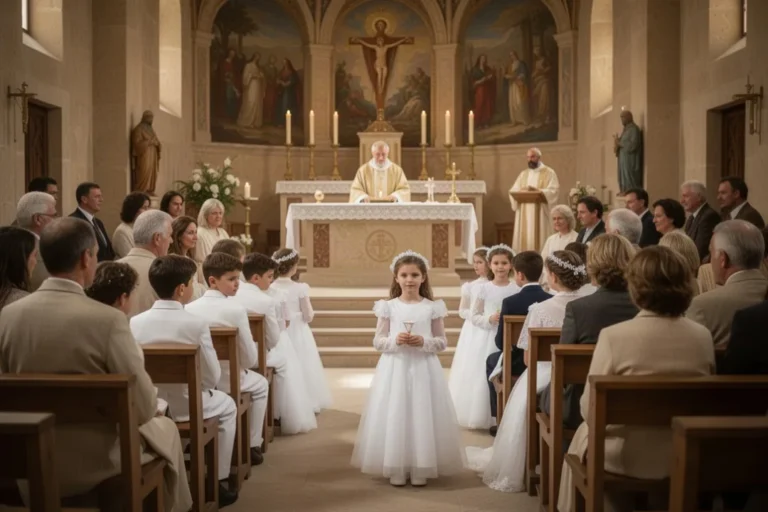
First Communion Mass: The child receives the Eucharist during a scheduled parish Mass with family and the wider faith community present.
Some parishes invite children to receive Communion during a regular Sunday Mass. Others schedule a special liturgy for several children from the parish. Both approaches place the child’s celebration within the community’s Eucharistic worship.
What children learn about the Eucharist
Preparation should give children a clear and age-appropriate understanding rather than asking them to memorize complicated explanations. They learn that the Eucharist is Jesus’ gift to the Church, that the Mass includes listening to God’s word and offering prayer, and that Holy Communion unites believers with Christ and with one another.
Children also learn the difference between ordinary bread and the consecrated host. The host may look and taste like bread, but Catholic faith teaches that its deepest reality has changed. This teaching is often called the Real Presence.
The Eucharist is not treated as a reward for being perfect. Catholics receive Communion as people who need God’s grace, while also taking seriously the need for sincere faith, a rightly disposed heart, and freedom from serious unconfessed sin. Children should hear both parts: God welcomes them with mercy, and the sacrament deserves reverence.
The Eucharist also points beyond the individual. Receiving Communion calls Catholics to become more attentive to people who are hungry, lonely, excluded, or in need. A child can understand this through ordinary acts such as sharing, forgiving, welcoming a classmate, and helping at home.
How to prepare a child at home
Parish classes are essential, but daily family life gives a child the most familiar setting for learning faith. Short conversations are often more effective than one long lecture. Ask what the child remembers from Mass, what part seems confusing, and what they think it means to receive Jesus.
Attend Mass together and arrive early enough to settle without rushing.
Practice simple prayers, including the Our Father, Hail Mary, Glory Be, and an act of contrition if these are part of the parish program.
Read Gospel accounts of the Last Supper using a child-friendly Bible or the parish’s recommended materials.
Talk about reverence as attentive love, not merely perfect posture or silence.
Explain the Communion procession so the child knows where to stand and what to do.
Connect the Eucharist with service by involving the child in a practical act of kindness.
Parents should avoid making the day seem like a performance that can be spoiled by a small mistake. Children may forget a response, walk too quickly, become nervous, or need a quiet reminder. A calm adult presence can protect the spiritual meaning of the celebration better than repeated corrections.
It also helps to avoid promising that the child will feel something extraordinary when receiving Communion. Some children feel joyful, peaceful, curious, or nervous; others feel very little emotionally. Sacramental faith does not depend on a dramatic feeling. The child can receive with trust even when the experience seems ordinary.
Practical tip: Ask the parish whether the child will receive the host in the hand or on the tongue, whether the chalice will be offered, and whether there are local customs about clothing, photographs, or fasting.
What to expect during the First Communion Mass
The First Communion Mass follows the basic structure of the Catholic Mass. It includes the Liturgy of the Word, in which Scripture is proclaimed and explained, and the Liturgy of the Eucharist, in which the gifts are presented, the Eucharistic Prayer is offered, and Holy Communion is distributed.
Children may have assigned seats near the front, process into the church, read a passage, carry gifts, or participate in another parish-approved role. These details vary, so the rehearsal should answer practical questions before the day arrives.
During the Eucharistic Prayer, the priest invokes the Holy Spirit and recounts Christ’s actions at the Last Supper. Catholics respond with prayer and worship. The congregation then prays the Lord’s Prayer, exchanges a sign of peace, and prepares to receive Communion.
When it is time for Communion, children usually walk in an orderly procession. If receiving the host in the hand, a communicant generally places one hand over the other, receives the host, and consumes it immediately in the presence of the minister. If receiving on the tongue, the person opens their mouth and allows the minister to place the host carefully.
Local instructions should always take priority because customs can differ. The child should not chew gum or bring food into the Communion procession, should respond clearly when the minister says “The Body of Christ,” and should answer “Amen” as an expression of faith.
After receiving, the child returns to their place and spends a moment in personal prayer and thanksgiving. The congregation normally continues with the remaining prayers of the Mass. The closing blessing sends everyone back into daily life with a responsibility to live as Christ’s disciples.
Fasting and other practical rules before Communion
The Catholic Church generally asks communicants to observe a one-hour fast from food and drink before receiving Communion, with exceptions for water and medicine. The fast is not meant to create anxiety or hardship. Parish or diocesan guidance should be followed, particularly for young children, people with medical needs, and anyone who has difficulty fasting.
Children should eat a sensible meal before the fasting period begins. Parents can explain that the fast helps set aside a short period of attention and preparation, not that food is bad or that the Eucharist is a prize earned through hunger.
Good practical preparation also includes getting enough rest, leaving home early, and choosing clothing that allows the child to sit, stand, kneel, and walk comfortably. The child may wear formal clothing, but the central requirement is respectful and modest dress, not a costly outfit.
Families should ask the parish about photography. Some churches allow a professional photographer to take pictures during the Mass; others restrict photography to protect prayer and the privacy of worshippers. A designated time after the liturgy may be available for family photographs.
Choosing First Communion clothing and accessories
Many Catholic communities use white clothing to symbolize Baptism, purity, and new life in Christ. Girls may wear a white dress or another modest outfit, while boys may wear a suit, dress shirt, or the clothing specified by the parish. Some parishes ask every child to wear a simple robe or coordinated garment.
Accessories should support the solemnity of the day without distracting from it. A veil, tie, cross, medal, shawl, or small Bible may be appropriate if the parish permits it. Families should check whether the church has rules about head coverings, jewelry, shoes, or matching attire.
Comfort matters. New shoes that hurt, a dress that is difficult to manage, or clothing that needs constant adjustment can make a child tense during the liturgy. Try on the full outfit in advance, practice sitting and walking, and keep a small emergency kit available for spills, loose buttons, or unexpected weather.
What guests should know about receiving Communion
Not every person at a First Communion Mass will be Catholic or prepared to receive the Eucharist. Catholic practice generally invites Catholics who meet the Church’s requirements to receive Communion. Guests who are not receiving can remain seated or approach the minister with arms crossed over the chest if the local parish offers a blessing to non-communicants.
Visitors should not feel embarrassed about remaining in their seat. Prayerful presence is a respectful form of participation, and the parish may print instructions in the worship aid. If you are unsure, ask an usher quietly before the Communion procession begins.
People who receive Communion should not carry the host away, keep it in a pocket, or leave it unattended. The host is consumed immediately, and any accidental concern should be brought calmly to the priest or minister. These practices protect the reverence Catholics owe to the Eucharist.
How to celebrate after the Mass
A family meal or reception can honor the child and bring relatives together. The celebration does not need to be elaborate. A home-cooked meal, a small gathering, or a simple dessert can be appropriate if it leaves room for the child to understand that the sacrament is the center of the day.
Consider giving a meaningful gift connected to faith, such as a children’s Bible, prayer book, rosary, cross, saint medal, journal, or book about the life of Jesus. A handwritten letter from parents or grandparents can also remind the child what the family hopes they will carry forward: love of God, compassion for others, honesty, and continued participation in parish life.
Photography should document the occasion without taking over the celebration. Take a few respectful pictures before or after Mass, follow church rules, and avoid turning the Communion procession or sacred moments into a photo session.
What changes after First Communion
First Communion is a beginning, not the end of religious education. The child is now invited to continue receiving the Eucharist at Sunday Mass, learning the prayers and Scripture of the Church, and growing in understanding over time.
Parents can help by making Sunday worship a stable part of family life. Children learn from what adults do: arriving prepared, listening during the readings, participating in the responses, receiving reverently, and making time for prayer after Communion.
The child’s faith will develop unevenly. Questions may become more complex, and enthusiasm may vary. A family does not need an answer to every question immediately. It can say, “Let’s ask the priest,” “Let’s look at what the Church teaches,” or “I’m still thinking about that too.” Honest conversation is better than pretending that faith has no difficult questions.
Regular Confession, acts of service, Scripture reading, and participation in parish activities can help connect the Eucharist with everyday choices. The goal is not simply to remember the date of First Communion, but to let the sacrament shape a life of gratitude, reconciliation, community, and love.
How First Communion differs for adults and older children
A child who was baptized Catholic as an infant may complete a parish program designed for children. An unbaptized adult or older child normally follows the Order of Christian Initiation of Adults, or a related process adapted for their age, before receiving the sacraments of initiation.
Someone baptized in another Christian tradition may need a different preparation process. The parish will review the person’s baptismal information, Christian formation, and circumstances. A person who has already received valid baptism does not ordinarily receive Catholic baptism again.
These situations should be discussed directly with a priest or parish formation leader. The timing of First Communion depends on more than age. It also involves baptismal status, prior religious education, readiness, family circumstances, and the guidelines of the local diocese.
Questions parents often worry about
Parents sometimes wonder whether a child understands enough, whether the child will remember every instruction, or whether a family member’s absence will diminish the day. Preparation aims at a real but age-appropriate understanding, not advanced theological expertise.
A child should know that the Eucharist is sacred, recognize the consecrated host as Communion, understand that receiving it is connected with Jesus and the Church, and be able to follow the parish’s practical directions. If there are concerns about readiness, learning differences, anxiety, or disability, speak with the parish early so accommodations can be planned respectfully.
Families also sometimes worry about a missed class or an imperfect rehearsal. Contact the parish rather than guessing. Most communities can explain make-up work, additional preparation, or a later celebration when that better serves the child.
The most lasting preparation is a family culture in which faith is practiced rather than displayed. A child who sees adults pray, forgive, attend Mass, serve others, and speak about God with honesty receives an example that continues long after the formal ceremony.
Frequently asked questions
At what age do children usually receive First Communion?
Many Catholic parishes prepare children around second grade, but there is no single age required everywhere. The timing can differ by diocese, parish policy, baptismal history, and the child’s readiness. Children generally need an age-appropriate understanding of the Eucharist, the ability to distinguish it from ordinary food, and preparation for First Reconciliation. Ask your parish for its specific schedule and requirements.
Can a non-Catholic guest receive Communion at a First Communion Mass?
Catholic practice normally reserves Eucharistic Communion for Catholics who are properly prepared and meet the Church’s requirements. A non-Catholic guest can participate through prayer and remain seated during the procession. Some parishes invite non-communicants to approach with arms crossed for a blessing, but this varies. The worship aid or an usher can explain the local custom.
Does a child have to receive the chalice during First Communion?
No. In many parishes, a child first receives only the consecrated host, while other communities offer Communion under both forms. Catholics believe Christ is fully present under the form of bread alone, so receiving the chalice is not required for a complete reception of the Eucharist. Follow the instructions given by the parish during preparation and rehearsal.
What should a child do after receiving the Eucharist?
After consuming the host, the child returns quietly to their place and prays or remains attentive to the Mass. A simple prayer of thanks is enough; children do not need to perform a special formula unless the parish has taught one. Parents can encourage a peaceful moment of gratitude and remind the child that participation continues through the rest of the liturgy.







Leave a Reply