Catholicism in the UK: beliefs, history, and daily life
Catholicism in the UK: beliefs, history, and daily life
You may be wondering where Catholics fit into British religious life, especially if you have moved to the UK, are exploring Christianity, or have been invited to a Catholic wedding or Mass. The short answer is that Catholicism in the UK is an established, diverse part of society, with a long history, millions of members, and a wide network of parishes, schools, hospitals, charities, and community organizations.
The United Kingdom does not have one single Catholic experience. Catholic life differs between England and Wales, Scotland, and Northern Ireland, shaped by different histories, census systems, local cultures, and relationships between church and state. Yet Catholics across the country share the same central faith, sacramental life, and connection with the worldwide Catholic Church.
Catholicism is a Christian tradition centered on belief in Jesus Christ, the Bible, the sacraments, prayer, and the teaching authority of the Church. Catholics understand the Church as a worldwide community led by the pope and served locally by bishops, priests, deacons, religious communities, and laypeople.
In everyday life, Catholic identity can mean attending Mass, receiving the sacraments, praying privately, volunteering through a parish, sending children to a Catholic school, or simply identifying with the faith because of family and cultural background. People participate at different levels, so a Catholic parish may include weekly worshippers, occasional visitors, converts, cradle Catholics, and people returning to church after many years.
The term Roman Catholic is often used in the UK to distinguish Catholicism from Anglicanism and other Christian traditions. “Roman” refers to communion with the Bishop of Rome, the pope. Catholics in Britain are not a separate national church; they are part of the same global Catholic Church as Catholics in Ireland, Poland, the Philippines, Nigeria, the United States, and elsewhere.
A useful distinction: “Catholic” describes a worldwide Christian Church, while “Catholicism in the UK” describes how that faith is lived through local dioceses, parishes, schools, families, and communities across the four nations.
How Catholic identity differs across the four nations
The UK is made up of England, Scotland, Wales, and Northern Ireland. Religious statistics are collected differently in each nation, and a person’s census answer may describe formal affiliation rather than regular attendance. For that reason, there is no single figure that perfectly captures the size or activity of Catholicism throughout the UK.
England: Catholic life is organized through dioceses ranging from large metropolitan areas to rural regions. London, Liverpool, Birmingham, Manchester, and other cities have particularly varied Catholic populations, including communities with roots in Ireland, Europe, Africa, Asia, and the Caribbean.
Wales: Catholic parishes operate within the Catholic archdiocese and dioceses serving Welsh communities and border areas. Worship takes place in English and, in some settings, Welsh, reflecting the country’s linguistic and cultural identity.
Scotland: Catholicism has deep roots in the west of Scotland, the Highlands and Islands, and areas connected historically with Irish migration. It is also present in cities, universities, and newer immigrant communities throughout the country.
Northern Ireland: Catholicism forms one of the two major Christian traditions in the region. Religious identity has been closely connected with community, history, and politics, although individual Catholics hold a wide range of political views and personal backgrounds.
The 2021 census for England and Wales recorded millions of people identifying as Catholic, while Scotland’s more recent census and Northern Ireland’s census provide separate pictures of religious affiliation. These figures should be read carefully: religious identity is not the same as weekly Mass attendance, and census categories do not measure the depth of someone’s faith.
How Catholicism arrived and developed in Britain
Christianity was present in Britain during the Roman period, and early British Christianity included traditions that later became part of the Catholic Church. Medieval Catholicism shaped much of public and private life, from parish worship and monasteries to education, art, calendars, architecture, and care for the poor.
The English Reformation in the sixteenth century changed the relationship between the crown, Parliament, and the Church. Under Henry VIII, the English church separated from papal authority and developed into the Church of England. Later religious changes under Edward VI, Mary I, and Elizabeth I created a turbulent period in which Catholic worship and loyalty to the pope were treated very differently at different times.
Catholics in England and Wales experienced periods of legal restrictions, fines, imprisonment, and social exclusion. Some priests served communities secretly, and Catholic families maintained their faith in difficult conditions. The memory of recusancy, martyrdom, and hidden worship remains part of Catholic historical understanding, though its significance varies from parish to parish.
Catholic structures were formally restored in England and Wales in the nineteenth century, when new dioceses were established and Catholic communities expanded. The growth of industrial towns, Irish migration, religious orders, and Catholic schools helped create the network of parishes and institutions that still exists today.
Scotland followed a different path after the Scottish Reformation. Catholic communities survived in parts of the Highlands and islands, while later migration from Ireland strengthened Catholic presence in urban and industrial areas. In Northern Ireland, Catholic and Protestant identities developed alongside competing constitutional and national traditions, producing a history that cannot be separated from the politics of the island of Ireland.
What Catholics believe and how those beliefs shape life
Catholic teaching begins with faith in one God in three persons: the Father, the Son, and the Holy Spirit. Catholics believe that Jesus Christ is the Son of God, truly human and truly divine, whose life, death, and resurrection bring salvation. They believe the Holy Spirit continues to guide and sanctify the Church.
Catholics draw on the Bible and Sacred Tradition, interpreted through the teaching authority of the Church. The Catechism of the Catholic Church summarizes core teaching, while bishops, councils, papal documents, local pastoral guidance, and theological reflection help Catholics understand how faith applies to particular questions.
Belief is expressed through worship, moral decision-making, community life, and service. Catholic teaching emphasizes the dignity of every human person, concern for the poor and vulnerable, the importance of family and community, care for creation, and the responsibility to work for justice and peace. Catholics may disagree about political strategies while sharing these broad moral commitments.
The Church also teaches about human freedom, sin, forgiveness, marriage, sexuality, death, and eternal life. Some teachings are widely accepted by Catholics, while others are subjects of continuing discussion, pastoral debate, or disagreement among individual members. A parish community is not necessarily uniform in its politics, culture, age, or personal interpretation.
The seven sacraments and what they mean
The seven sacraments are visible signs through which Catholics believe God gives grace. They are not merely symbolic ceremonies. Each sacrament marks a significant aspect of Christian life and connects the individual with the worshipping community.
Baptism welcomes a person into the Church and is commonly celebrated for infants, children, or adults. It uses water and invokes the Trinity.
Confirmation strengthens baptismal faith through prayer and anointing, traditionally with chrism. It is often celebrated during adolescence, although practice varies.
The Eucharist, also called Holy Communion, is the central sacrament of Catholic worship. Catholics believe Christ is truly present in the consecrated bread and wine.
Reconciliation, or confession, offers sacramental forgiveness for sins and encourages honest conversion and a renewed relationship with God.
Anointing of the Sick gives prayer and spiritual support to people facing serious illness, frailty, or significant medical procedures.
Holy Orders is the sacrament through which bishops, priests, and deacons receive a particular ministry in the Church.
Matrimony is the sacramental covenant of marriage between a man and a woman in Catholic teaching, understood as a lifelong partnership open to family life.
Not every Catholic receives every sacrament in the same circumstances. For example, Baptism and Confirmation are normally received once, while Catholics may receive the Eucharist regularly and Reconciliation when needed. A parish priest can explain the preparation process, which is usually more extensive for adults or for families unfamiliar with Catholic practice.
What happens at a Catholic Mass in the UK
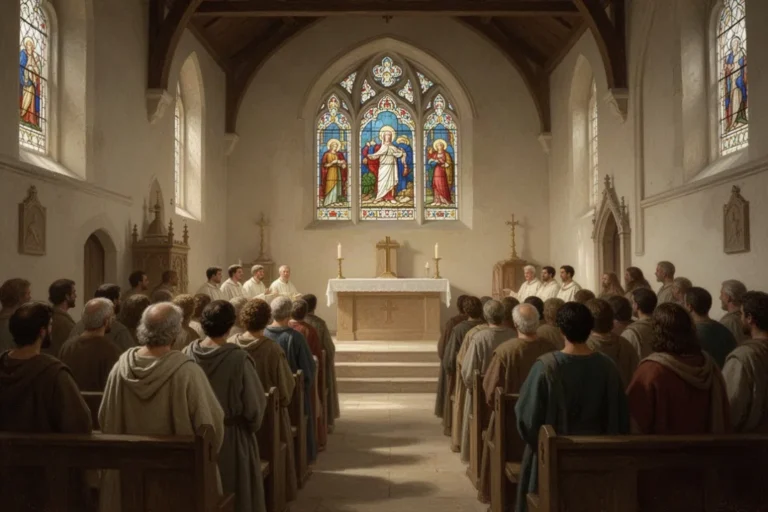
The Mass is the central form of Catholic worship. It normally has two major parts: the Liturgy of the Word, which includes readings from the Bible and a homily, and the Liturgy of the Eucharist, in which bread and wine are offered and consecrated.
People usually stand, sit, and kneel at different points, although local customs and the design of the church can affect this. The congregation joins in prayers, listens to Scripture, sings hymns or responses, and exchanges a sign of peace. The exact style may range from a quiet weekday Mass to a large Sunday celebration with music, incense, children, or several languages.
Sunday Mass is especially important because Catholics observe Sunday as the Lord’s Day. Many parishes also celebrate weekday Masses, feast days, school Masses, and services for particular communities. Mass times are usually listed on the parish website, noticeboard, or diocesan directory.
Visitors are welcome at Mass, but Holy Communion is normally reserved for Catholics who are properly prepared and able to receive according to Catholic practice. If you are not receiving Communion, you can remain seated or approach the minister with your arms crossed over your chest to request a blessing, depending on local custom. You are never required to participate in a way that conflicts with your own beliefs.
If you are attending for the first time: Arrive a few minutes early, sit where you feel comfortable, and follow the congregation’s posture if you wish. You do not need to know every response or prayer before joining a Mass.
How Catholic parishes are organized
A parish is the local Catholic community where people worship, prepare for sacraments, receive pastoral care, and build relationships. It is usually led by a parish priest, although one priest may serve several churches because of changes in population, priestly numbers, or parish restructuring.
Parishes belong to dioceses, which are larger areas governed by a bishop. England and Wales have Catholic dioceses and archdioceses, as do Scotland and Northern Ireland. A diocese may coordinate schools, safeguarding, clergy appointments, charitable work, marriage preparation, youth programs, and social action.
Religious orders also have an important place in British Catholic life. Benedictines, Dominicans, Franciscans, Jesuits, Carmelites, Sisters of Mercy, and many other communities have contributed to prayer, education, scholarship, missions, healthcare, and social work. Their houses and ministries may serve people beyond a single parish.
Laypeople carry much of the practical responsibility for parish life. They may serve as readers, musicians, catechists, extraordinary ministers of Holy Communion, youth leaders, pastoral visitors, finance volunteers, or members of parish councils. Catholic worship is led by ordained ministers, but parish communities rely heavily on the time and skills of lay members.
How to find a Catholic church and begin attending
If you are looking for a parish, search for the official diocesan website covering your town or postcode. Diocesan directories can help you identify churches, Mass times, contact details, sacramental preparation, and services in languages other than English.
Search by location: Use your town, neighborhood, or postcode rather than relying only on a general internet search.
Check the parish’s own information: Confirm current Mass times because schedules can change for holy days, funerals, clergy availability, or parish mergers.
Choose a suitable service: A Sunday Mass may be busier, while a weekday Mass can offer a quieter first visit.
Contact the parish office: Ask about Baptism, becoming Catholic, confession, marriage, children’s preparation, or support for a particular need.
Attend more than once: One visit may not show the full character of a parish, especially if it is a large or multilingual community.
Adults who want to become Catholic usually take part in a period of formation known in many places as the Order of Christian Initiation of Adults. The process gives people time to learn about Catholic belief, pray, ask questions, and decide freely whether to receive Baptism, Confirmation, and the Eucharist. Someone already baptized as a Christian may follow a different path from someone who has never been baptized.
Why Catholic schools matter in the UK
Catholic education has a substantial presence across the UK. Catholic primary and secondary schools aim to combine the national curriculum with a distinct religious ethos, daily prayer, worship, moral formation, and preparation for participation in the Church. Many also welcome pupils who are not Catholic, subject to their admissions policies.
Schools often work closely with local parishes and dioceses. Children may prepare for First Communion and Confirmation through a combination of school lessons, parish sessions, and family involvement. The exact age and process vary by diocese and school, so parents should ask both the school and parish for current guidance.
Catholic schools are not identical. Some are highly diverse urban schools, while others serve smaller communities with a more concentrated Catholic population. Their religious education programs may introduce pupils to Catholic teaching, the Bible, other Christian traditions, and other religions, alongside broader questions of ethics and citizenship.
Admission rules differ by school and by the relevant education authority. Families may be asked for evidence of Baptism, parish practice, or residence, depending on the school’s published criteria. It is best to read the school’s current admissions policy rather than assume that every Catholic school uses the same requirements.
How Catholic charities serve local communities
Catholic social teaching encourages practical concern for people experiencing poverty, homelessness, isolation, war, migration, illness, or discrimination. In the UK, this work is carried out through parishes, religious communities, schools, diocesan programs, and national organizations such as Caritas Social Action Network, the St Vincent de Paul Society, and other Catholic charities.
Local projects can include food banks, debt advice, community meals, refugee support, prison ministry, visits to older people, hospital chaplaincy, and emergency assistance. Some programs are explicitly Catholic, while others serve anyone who needs help. Volunteers may provide practical support without asking recipients to share their faith.
Catholic chaplains work in hospitals, prisons, universities, the armed forces, and other institutions. They may offer prayer, sacramental ministry, pastoral conversation, bereavement support, or links with a local parish. People do not have to be practicing Catholics to ask a chaplain for a conversation or to inquire about available support.
How immigration has changed Catholic communities
Modern Catholic parishes in the UK often reflect several generations of migration. Irish Catholics played a major role in the growth of Catholic institutions, especially in the nineteenth and twentieth centuries. More recent communities have come from Poland, Lithuania, Portugal, the Philippines, India, Nigeria, Ghana, the Caribbean, Eastern Europe, and many other places.
This diversity can be seen in multilingual Masses, cultural associations, food, music, processions, and devotional traditions. A parish may celebrate a Polish Mass, offer Filipino pastoral ministry, or host a community from an African country while remaining part of the same diocese. Some Catholics attend both a local English-language Mass and a cultural or national chaplaincy.
Immigrant Catholics also bring different expectations about parish life. In one tradition, a priest may be expected to organize extensive social support; in another, family associations or lay movements may take the lead. Good pastoral practice makes room for these differences while ensuring that worship and parish administration remain accessible to everyone.
Catholics contribute to public life as teachers, doctors, artists, civil servants, business owners, elected representatives, researchers, activists, and volunteers. Catholic social thought has influenced debates about poverty, labor, healthcare, education, migration, war, the environment, and the responsibilities of government and business.
The UK is religiously diverse and increasingly includes people who describe themselves as having no religion. Catholics therefore share public space with Anglicans, other Christians, Muslims, Jews, Hindus, Sikhs, Buddhists, humanists, and many people whose beliefs do not fit a formal category. Catholic institutions commonly take part in interfaith and community partnerships.
Public discussion can be challenging when Catholic teaching differs from prevailing views, especially on abortion, assisted dying, marriage, sexuality, education, and freedom of religion. Catholics may seek to express their beliefs in public while respecting democratic institutions and the rights of people who disagree. Individual Catholics do not always reach the same political conclusions, even when they share the Church’s principles.
Common Catholic practices at home and in the community
Catholic practice is not limited to church attendance. Many people pray at home, keep a crucifix or religious image, read the Bible, say the Rosary, observe Lent, mark saints’ feast days, or participate in charitable work. Families may gather for prayer before meals or attend Mass for major occasions such as Christmas, Easter, funerals, and baptisms.
The Catholic year includes seasons that shape worship and personal practice. Advent prepares for Christmas, while Lent is a period of prayer, fasting, and reflection before Easter. Holy Week recalls the final events of Jesus’ earthly life, and Easter celebrates the resurrection. Pentecost focuses on the coming of the Holy Spirit, while the remainder of the year develops themes from Jesus’ teaching and the life of the Church.
Many Catholics also have a devotion to Mary, the mother of Jesus, and to particular saints. These devotions may include pilgrimages, novenas, statues, medals, prayer groups, or visits to shrines. Catholics do not worship Mary or the saints; they honor them and ask for their prayers, while worship belongs to God.
Questions to ask when exploring Catholicism
If you are considering Catholicism, you do not need to resolve every theological question before visiting a parish. A useful starting point is to identify what you are seeking: Christian belief, a sacramental community, guidance in prayer, preparation for marriage, a school connection, or support during grief or illness.
What do Catholics believe about Jesus? Ask a priest, catechist, or trusted Catholic to explain the Church’s central beliefs in ordinary language.
What is the purpose of the sacraments? Learn how Baptism, the Eucharist, Reconciliation, and the other sacraments relate to daily Christian life.
How does a parish welcome newcomers? Attend a service or contact the parish office to find out about inquiry groups and community events.
What does Catholic teaching require in practice? Ask about prayer, Sunday worship, moral life, fasting, service, and participation in parish life.
Where can you read reliable information? Use official diocesan resources, Catholic schools or charities, and recognized Catholic publications rather than relying only on social media claims.
Exploring a faith takes time. Catholic parishes in the UK include people at many stages: lifelong believers, people returning after a break, adults preparing for initiation, and visitors who are simply curious. A respectful conversation, a visit to Mass, and a local introduction course can give you a clearer picture than a label alone.
Frequently asked questions
Is Catholicism common in the UK?
Yes. Catholics form a significant Christian community across the UK, although the proportion varies by region. Catholic populations are especially visible in many large cities, parts of Scotland, Northern Ireland, and areas shaped by Irish and later international migration. Census affiliation and regular worship are different measures, so statistics should not be treated as a count of weekly churchgoers.
Can anyone attend a Catholic Mass in the UK?
Yes. Visitors of any faith or no faith can attend and observe respectfully. You do not need to register or introduce yourself. The main restriction concerns Holy Communion, which is ordinarily received by Catholics who are prepared according to Church practice. Visitors may remain seated during Communion or ask about local customs before the service.
How can an adult become Catholic in the UK?
Begin by contacting a nearby Catholic parish or diocesan office and asking about adult formation. You may be invited to join an inquiry group or the Order of Christian Initiation of Adults. The process includes learning, prayer, conversation, and discernment. Baptized Christians and people who have never been baptized may follow different preparation routes.
Do you have to be Catholic to attend a Catholic school?
Not always. Catholic schools often admit pupils from other Christian traditions or other backgrounds, but each school has its own admissions policy and published criteria. Catholic families may receive priority in some circumstances, and evidence of parish practice or Baptism may be requested. Check the current policy for the specific school and local education authority.

Leave a Reply