Catholic beliefs center on faith in one God revealed as Father, Son, and Holy Spirit; Jesus Christ as Savior; the Bible and apostolic tradition; the Church; the sacraments; and the hope of eternal life. Catholics believe that God offers every person grace and calls people to respond through faith, love, worship, and moral living.
The Catholic Church is both a worldwide Christian community and a tradition with defined teachings. Some teachings are considered essential doctrines, while others concern worship practices, spiritual customs, or rules of church discipline. Catholics may express their faith in different cultures and spiritual traditions, but they share a common creed and sacramental life.
Catholics believe there is one God, the creator of everything visible and invisible. God is not one being among many gods or a distant force without concern for human life. God is personal, loving, just, and continually involved with creation.
The central Christian belief about God is the Trinity: one divine nature in three distinct Persons—God the Father, God the Son, and God the Holy Spirit. Catholics do not believe in three separate gods. The Trinity is a mystery of faith, meaning a truth that can be known because God reveals it but cannot be fully contained by human reason.
God the Father is understood as the source and creator of all things. God the Son is Jesus Christ, eternally divine and truly human. The Holy Spirit is the divine Person who gives life, sanctifies believers, and remains active in the Church and in the world.
Catholics see creation as fundamentally good because it comes from God. Human beings possess special dignity because they are made in the image of God, a belief drawn from Genesis 1. This dignity applies to every person, regardless of age, ability, nationality, social position, or religious background.
What Catholics believe about Jesus Christ
Catholics believe that Jesus Christ is fully God and fully human. He is not merely a moral teacher, prophet, or unusually holy person. The Church teaches that the eternal Son of God took human nature through his birth from Mary while remaining divine.
Jesus’ life, teachings, death, and resurrection are at the heart of Catholic faith. The Gospels present him announcing the kingdom of God, healing the sick, forgiving sins, welcoming outsiders, and calling people to conversion. His actions reveal God’s mercy and show what faithful love looks like.
Catholics believe Jesus willingly suffered and died on the cross for the salvation of humanity. The cross is understood as both a real historical death and a profound act of self-giving love. Through his sacrifice, Jesus confronts sin and opens the way to reconciliation with God.
The Resurrection is not treated as a metaphor for the survival of Jesus’ influence. Catholics believe God truly raised Jesus from the dead. The resurrection confirms Jesus’ identity, marks his victory over sin and death, and gives Christians hope that death does not have the final word.
After his resurrection, Jesus sent his disciples to proclaim the Gospel. Catholics believe he remains present to the Church through the Holy Spirit, the Scriptures, the sacraments, Christian worship, and acts of charity. His ascension does not mean that he abandoned the world.
How Catholics understand the Bible and apostolic tradition
Catholics believe the Bible is inspired by God and is essential for knowing God’s plan of salvation. The Church reads Scripture as a unified story that leads to Christ, rather than treating every passage as an isolated statement. Catholics use the Old and New Testaments in public worship and personal prayer.
The Bible contains different kinds of writing, including history, poetry, wisdom literature, prophecy, letters, and symbolic visions. Because of this variety, Catholics believe passages should be interpreted according to their literary form, historical setting, and place within the whole of Scripture.
Catholic belief also gives an important role to Sacred Tradition. In this context, tradition does not simply mean old customs. It refers to the living transmission of the Gospel received from the apostles and handed on through the Church’s worship, teaching, and communal life.
Scripture and Tradition are not considered competing sources of revelation. Catholic teaching holds that both come from the same divine source and work together. The Church’s teaching office, called the Magisterium, serves the Word of God by interpreting it rather than placing itself above it.
The Catholic Bible includes several books that are not found in many Protestant Bibles. These writings are commonly called the deuterocanonical books. Their inclusion reflects the biblical canon received in the Catholic tradition.
Helpful distinction: Catholics do not believe that every church custom has the same authority as a central doctrine. The Trinity, the Resurrection, and the sacraments belong to the core of Catholic faith, while practices such as particular devotions or fasting customs can vary by time, place, and tradition.
Catholics believe that salvation is God’s gift, made possible through the grace of Jesus Christ. People cannot earn salvation as though they were collecting points through good behavior. God takes the initiative, offers mercy, and gives the help needed to respond.
At the same time, Catholic teaching does not treat human choices as irrelevant. People are called to cooperate with grace through faith, repentance, love of neighbor, prayer, and actions that reflect Christ’s teaching. This is why Catholic theology speaks about both faith and works. Good works do not purchase God’s love; they express a living response to it.
Sin is understood as a deliberate failure to love God and neighbor. It damages the person who commits it, harms relationships, and weakens the wider community. Catholic teaching distinguishes between mortal sin, which involves grave matter, sufficient understanding, and deliberate consent, and venial sin, which damages but does not destroy the relationship with God.
Repentance is more than feeling guilty. It involves turning away from sin and turning back toward God. Catholics believe God offers forgiveness through prayer, acts of mercy, and especially the Sacrament of Reconciliation, in which a person confesses sins to a priest and receives absolution.
Grace does not remove human freedom. Catholics believe people are responsible moral agents who can accept or resist God’s help. The Church therefore emphasizes the formation of conscience, careful moral reasoning, and the need to seek forgiveness after serious wrongdoing.
Why the Catholic Church matters in Catholic belief
Catholics believe the Church was established by Christ and entrusted with continuing his mission. The Church is not understood only as a building or an organization. It is the People of God, the Body of Christ, and a community gathered by the Holy Spirit.
The Church teaches, worships, serves, and proclaims the Gospel. Catholics believe it has a visible structure that includes bishops, priests, and deacons, along with laypeople who share in the Church’s mission. The bishop of Rome, the pope, has a particular role in serving the unity of the worldwide Catholic Church.
Catholic belief includes the Church’s four traditional marks: one, holy, catholic, and apostolic. “One” points to unity in faith and sacramental life. “Holy” refers to God’s presence and the call to holiness, even though individual members are sinners. “Catholic” means universal or whole, and “apostolic” refers to continuity with the apostles.
The Church teaches that it contains the fullness of the means of salvation, while also recognizing that God’s grace can be active outside its visible boundaries. Catholics are encouraged to respect other Christians and people of other religions while remaining committed to the truth they have received.
What Catholics believe about the seven sacraments
The sacraments are visible signs instituted by Christ and entrusted to the Church. Catholics believe God gives grace through them. They are not merely symbolic ceremonies or membership rituals; they are sacred actions in which Christ continues to act through the Holy Spirit.
The seven sacraments are grouped into three categories:
Sacraments of initiation: Baptism, Confirmation, and the Eucharist.
Sacraments of healing: Reconciliation and Anointing of the Sick.
Sacraments at the service of communion: Matrimony and Holy Orders.
Baptism begins a person’s sacramental life. Catholics believe it washes away sin, gives new life in Christ, and makes the baptized person a member of the Church. Infants may be baptized because salvation is God’s gift and because parents and the Church promise to help raise the child in faith.
Confirmation strengthens baptismal grace and deepens a person’s connection to the Holy Spirit and the Church. It is associated with a more mature commitment to Christian discipleship, although preparation and age requirements differ by region.
The Eucharist is the central act of Catholic worship. Catholics believe that, through the prayer of the Church and the work of the Holy Spirit, bread and wine become the Body and Blood of Christ. The appearances of bread and wine remain, but their deepest reality is changed. This teaching is called the Real Presence.
Reconciliation brings sacramental forgiveness to those who confess their sins with genuine repentance. The priest acts in the name of Christ and the Church. Catholics believe this sacrament restores and strengthens communion with God and the Christian community.
Anointing of the Sick offers prayer, comfort, strength, and healing to people facing serious illness, advanced age, or significant physical weakness. It is not reserved only for someone who is moments from death, and it is not a guarantee of physical recovery.
Matrimony is the covenant between a baptized man and woman that establishes a lifelong partnership ordered toward the good of the spouses and the upbringing of children. Catholic teaching emphasizes fidelity, permanence, mutual self-giving, and openness to life.
Holy Orders is the sacrament through which the Church’s ordained ministry is conferred in the forms of bishop, priest, and deacon. Ordained ministers serve the Church through preaching, worship, pastoral care, and leadership.
Why Catholics honor Mary and the saints
Catholics honor Mary, the mother of Jesus, because of her unique role in salvation history. The Church teaches that she is the Mother of God because the person she bore is truly God the Son. Catholics also believe in her perpetual virginity, her Immaculate Conception, and her Assumption into heaven.
The Immaculate Conception refers to Mary’s conception without original sin; it does not refer to Jesus’ conception. The Assumption teaches that, at the end of her earthly life, Mary was taken body and soul into heavenly glory. These beliefs point attention toward God’s grace rather than presenting Mary as a rival to God.
Catholics do not worship Mary. They honor her and ask for her prayers, just as a Christian might ask another believer to pray. Catholic devotion to Mary is meant to lead people closer to Jesus, whom she identifies as her Son and Savior.
Saints are people recognized by the Church as having lived in remarkable fidelity to God and now sharing in heavenly life. Catholics honor saints as examples and ask them to intercede. This practice is based on the belief that death does not destroy the unity of Christ’s Church.
Images of Jesus, Mary, and the saints may be used in Catholic churches and homes. Catholics distinguish between veneration, which honors a holy person, and worship, which belongs to God alone. The image itself is not treated as a god or as a magical object.
How Catholic beliefs shape moral life
Catholic morality begins with the command to love God and love one’s neighbor. Jesus’ teaching in Matthew 22 presents these as the central commandments. Moral rules are therefore not intended as arbitrary restrictions; they are meant to protect human dignity, guide freedom, and help people live in communion with God and others.
Catholics believe that every person has a conscience, but conscience must be formed rather than treated as a private impulse. Scripture, prayer, Church teaching, sound reasoning, experience, and the advice of trustworthy people can help a person judge a difficult decision.
The Church teaches that moral choices should consider the action itself, the person’s intention, and the circumstances. A good intention cannot make an intrinsically wrong action right, while difficult circumstances can affect a person’s responsibility. This framework is applied to questions involving family life, sexuality, medical care, economic justice, violence, and social responsibility.
Catholic social teaching emphasizes the dignity of work, care for the poor, solidarity with vulnerable people, responsibility for the common good, and the proper role of families and communities. It also teaches stewardship of creation, meaning that human beings should use the world responsibly rather than treating it as disposable.
The Church strongly rejects racism, human trafficking, torture, unjust discrimination, and attacks on innocent human life. Catholic teaching on life issues includes concern for unborn children, people with disabilities, the elderly, migrants, prisoners, people facing poverty, and those near death.
What Catholics believe about prayer and worship
Prayer is a relationship with God, not a technique for forcing a desired result. Catholics pray through praise, thanksgiving, repentance, petition, and intercession. They may pray alone, with family, in small groups, or in the public worship of the Church.
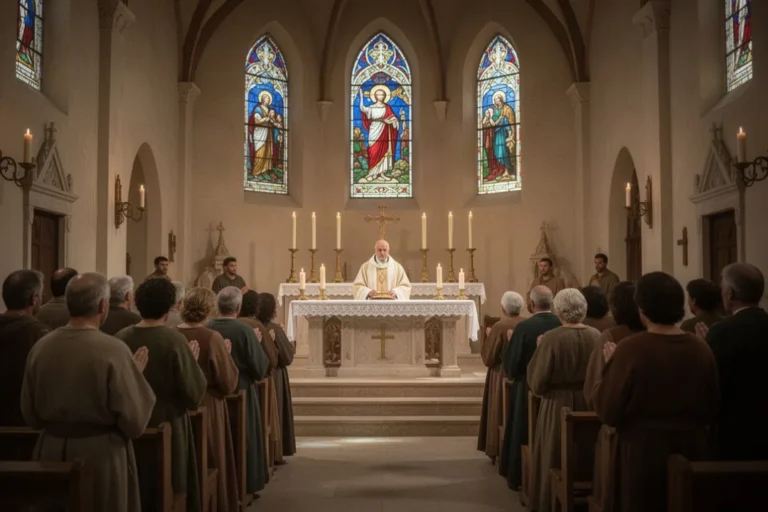
The Mass is the principal form of Catholic worship. It includes readings from Scripture, a homily, prayers, the profession of faith, and the Eucharistic liturgy. Catholics gather not simply to hear a lesson but to worship God and participate sacramentally in Christ’s offering.
The liturgical year helps Catholics remember the major events of Christ’s life. Seasons such as Advent, Christmas, Lent, the Easter Triduum, and Easter shape the Church’s calendar. Different cultural and religious communities may also have distinctive devotions, music, fasting practices, or celebrations.
Common Catholic prayers include the Lord’s Prayer, the Hail Mary, the Glory Be, the Apostles’ Creed, and prayers associated with the Rosary. Catholics may also practice silent prayer, meditation on Scripture, Eucharistic adoration, spiritual reading, and examination of conscience.
What Catholics believe about death, judgment, heaven, and hell
Catholics believe that human life continues beyond bodily death. Each person will face particular judgment, understood as God’s judgment of that person’s life and response to grace. The Church also teaches a final judgment when Christ returns and the full meaning of human choices is revealed.
Heaven is complete union with God, in which the person experiences perfect fulfillment and joy. It is more than a pleasant location; it is the direct presence of God and the completion of human purpose.
Hell is the definitive separation from God. Catholic teaching connects it with the free and deliberate rejection of God’s love. The Church affirms the reality of hell while also teaching that God desires the salvation of all and that human beings should not presume to know the final judgment of another person.
Purgatory refers to the purification of those who die in God’s friendship but still need healing from the effects of sin. It is not a second chance after death or an alternative to heaven. Catholics pray for the dead because they believe the living and the dead remain united in Christ.
Catholics also believe in the resurrection of the body. Christian hope is not merely the survival of an immaterial soul. At the end of time, God will raise the dead and bring creation to its fulfillment.
Practical ways to understand Catholic beliefs accurately
People often encounter Catholic teaching through isolated customs, online arguments, or assumptions drawn from a single parish. A more accurate understanding comes from looking at how beliefs fit together: God’s grace leads to faith, faith shapes worship, worship forms moral life, and all of it points toward communion with God.
Separate worship from devotion. The Mass is the Church’s central worship; practices such as the Rosary, novenas, and pilgrimages are devotional aids.
Distinguish doctrine from discipline. Core teachings are not the same as rules about fasting, clerical customs, or parish administration.
Read Scripture in context. Consider the passage’s literary form and its place within the whole biblical story.
Ask what a term means in Catholic usage. Words such as “tradition,” “grace,” “saint,” and “sacrifice” may carry meanings that differ from everyday speech.
Look for the connection to Christ. Catholic teaching about Mary, the saints, the sacraments, and the Church is intended to serve the mission of Jesus.
Allow for cultural variation. Catholic communities may use different music, languages, foods, gestures, and devotional styles while sharing the same essential faith.
Several common mistakes can make Catholic beliefs seem more confusing than they are. One mistake is assuming Catholics worship Mary or the saints; Catholic teaching reserves worship for God. Another is thinking that Catholics believe people can buy salvation through good deeds; the Church teaches that salvation begins with divine grace.
A third mistake is treating every Catholic as equally knowledgeable or equally observant. Catholics differ in practice, theological emphasis, prayer life, and cultural background. The official teaching of the Church and the everyday behavior of individual Catholics are related, but they are not identical.
When comparing traditions: Start with each tradition’s own definitions instead of judging a practice by its appearance alone. Asking what Catholics believe a practice accomplishes—worship, remembrance, repentance, intercession, or service—usually produces a clearer comparison.
How Catholic beliefs are expressed in everyday life
Catholic faith is practiced through ordinary habits as well as formal ceremonies. A Catholic might attend Mass on Sunday, pray before meals, observe a fast, give to someone in need, confess a serious sin, care for a family member, or make a difficult decision according to conscience.
Many Catholics use physical signs to express belief. Making the Sign of the Cross recalls the Trinity and baptism. Kneeling can express reverence, while standing may signify prayer or readiness. These gestures are meaningful, but the Church also teaches that external actions should be joined to sincere faith.
Parishes provide a local setting for worship, religious education, marriage preparation, service projects, youth programs, and care for people in crisis. Catholic schools, hospitals, charities, monasteries, and religious orders extend the Church’s mission in different ways.
The practical goal is not simply to memorize a list of propositions. Catholics are called to become more fully united with Christ and to let that relationship shape how they treat other people. The central pattern is clear: receive God’s mercy, respond in faith, participate in the life of the Church, and practice love through concrete choices.
Frequently asked questions
Do Catholics believe in one God or three gods?
Catholics believe in one God who exists as three distinct Persons: the Father, the Son, and the Holy Spirit. This belief is called the Trinity. The Persons are not three separate deities, but they are genuinely distinct in their relationships and roles. Catholic teaching presents the Trinity as a revealed mystery that human beings can affirm without completely explaining.
Do Catholics worship Mary and the saints?
No. Catholics worship God alone. They honor Mary and the saints because of their relationship with God and ask them to pray for the Church, much as someone might ask another Christian for prayer. Catholic theology distinguishes worship, which belongs to God, from honor given to holy people and respect shown to sacred images.
Can someone be Catholic without attending Mass?
A person may identify culturally or historically as Catholic without regular attendance, but active Catholic practice considers Sunday Mass a serious obligation, except when illness, caregiving, or another significant reason prevents attendance. The Eucharist is central to Catholic life, so deliberately and habitually avoiding Mass conflicts with the Church’s expectations for committed Catholics.
What is the difference between Catholics and other Christians?
Catholics share core Christian beliefs with many other churches, including faith in the Trinity, Jesus’ death and resurrection, and the authority of Scripture. Distinctive Catholic beliefs include the authority of Scripture and Sacred Tradition together, the seven sacraments, the pope’s role, the Real Presence in the Eucharist, and particular teachings about Mary and the saints.

Leave a Reply